

Caselets CAT PYQs , 171 Questions with Solutions
Master Caselets for CAT 2026 with practice questions and detailed explanations
Caselets in DI
“Caselets” in Data Interpretation (DI) are sets presented in paragraph form—no explicit table or chart, just a word description. CAT often uses caselets that require interpreting a scenario and extracting data.
- CAT 2017: Multiple caselets in both slots – all 8 sets could be considered caselets, including topics like “Happiness Index” and “Flight Operations” descriptions.
- CAT 2018: Featured caselets such as “ATM Machine” and “B-School Grading” – wordy DI sets requiring reasoning without straightforward tables.
- CAT 2019–2024: Hybrid DI-LR caselets have increased, blending logical reasoning with data interpretation.
- CAT 2023: Included a caselet about missing sales data in a table – a multi-step inference caselet.
Key Insights:
- Every year’s DILR includes several caselets; any puzzle set without a simple chart qualifies as a caselet.
- Count-wise, most sets each year (4–8 sets) are caselet-type, with some leaning more DI-oriented and others more LR-oriented.
- Candidates should be ready to parse textual scenarios, as caselets are a core component of CAT DILR.
Weightage Over Past Years
| Year | Q.NONumber of questions | Difficulty Level |
|---|---|---|
| 2025 | 9 | Hard |
| 2024 | 12 | Hard |
| 2023 | 25 | Hard |
| 2022 | 25 | Hard |
| 2021 | 10 | Hard |
| 2020 | 30 | Hard |
| 2019 | 12 | Hard |
| 2018 | 28 | Hard |
| 2017 | 20 | Medium |
CAT 2025 Caselets questions
Question 1
Slot-2
The Sustainability Index (SI) of a country at a point in time is an *integer*****between 1 and 100. This question is related to SI of six countries – A, B, C, D, E, and F – at three different points in time – 2016, 2020, and 2024. The plot represents the exact changes in their SI, with X-coordinate representing % increase in 2020 from 2016, i.e., (SI in 2020 minus SI in 2016) / (SI in 2016), and Y-coordinate representing % increase in 2024 from 2020. At any point in time, the country with highest SI is ranked 1, while the country with the lowest SI is ranked 6. The following additional facts are known.
- In 2016, B, C, E, and A had ranks 1, 2, 3, and 4 respectively.
- F had lower SI than any other country in 2016, 2020, and 2024.
- In 2024, E was the only country with SI of 90.
- The range of SI of the six countries was 60 in 2016 as well as in 2024.

Question 2
Slot-3
Aurevia, Brelosia, Cyrenia and Zerathania are four countries with their currencies being Aurels, Brins, Crowns, and Zentars, respectively. The currencies have different exchange values. Crown's currency exchange rate with Zentars = 0.5, i.e., 1 Crown is worth 0.5 Zentars.
Three travelers, Jano, Kira, and Lian set out from Zerathania visiting exactly two of the countries. Each country is visited by exactly two travelers. Each traveler has a unique Flight Cost, which represents the total cost of airfare in traveling to both the countries and back to Zerathania. The Flight Cost of Jano was 4000 Zentars, while that of the other two travelers were 5000 and 6000 Zentars, not necessarily in that order. When visiting a country, a traveler spent either 1000, 2000 or 3000 in the country's local currency. Each traveler had different spends (in the country's local currency) in the two countries he/she visited. Across all the visits, there were exactly two spends of 1000 and exactly one spend of 3000 (in the country's local currency).
The total "Travel Cost" for a traveler is the sum of his/her Flight Cost and the money spent in the countries visited.
The citizens of the four countries with knowledge of these travels made a few observations, with spends measured in their respective local currencies: i. Aurevia citizen: Jano and Kira visited our country, and their Travel Costs were 3500 and 8000, respectively. ii. Brelosia citizen: Kira and Lian visited our country, spending 2000 and 3000, respectively. Kira's Travel Cost was 4000. iii. Cyrenia citizen: Lian visited our country and her Travel Cost was 36000.
Which of the following statements is NOT true about money spent in the local currency?
Which of the following statements is NOT true about money spent in the local currency?
Kira spent 1000 in Aurevia
Jano spent 2000 in Aurevia
Jano spent 2000 in Cyrenia
Lian spent 2000 in Cyrenia
CAT 2024 Caselets questions
Question 1
Slot-1
The chart below shows the price data for seven shares - A, B, C, D, E, F, and G as a candlestick plot for a particular day. The vertical axis shows the price of the share in rupees. A share whose closing price (price at the end of the day) is more than its opening price (price at the start of the day) is called a bullish share; otherwise, it is called a bearish share. All bullish and bearish shares are shown in green and red colour respectively.

Daily Share Price Variability (SPV) is defined as (Day's high price - Day's low price) / (Average of the opening and closing prices during the day). Which among the shares and F had the highest SPV on that day?
Daily Share Price Variability (SPV) is defined as (Day's high price - Day's low price) / (Average of the opening and closing prices during the day). Which among the shares and F had the highest SPV on that day?
F
A
D
C
Daily Share Price Variability (SPV) is defined as (Day's high price - Day's low price) / (Average of the opening and closing prices during the day). How many shares had an SPV greater than 0.5 on that day?
Daily Share Price Variability (SPV) is defined as (Day's high price - Day's low price) / (Average of the opening and closing prices during the day). How many shares had an SPV greater than 0.5 on that day?
Daily loss for a share is defined as (Opening price - Closing price) / (Opening price). Which among the shares and had the highest daily loss on that day?
Daily loss for a share is defined as (Opening price - Closing price) / (Opening price). Which among the shares and had the highest daily loss on that day?
G
B
A
F
What would have been the percentage wealth gain for a trader, who bought equal numbers of all bullish shares at opening price and sold them at their day's high?
What would have been the percentage wealth gain for a trader, who bought equal numbers of all bullish shares at opening price and sold them at their day's high?
72%
Question 2
Slot-2
The two plots below give the following information about six firms A, B, C, D, E, and F for 2019 and 2023. PAT: The firm's profits after taxes in Rs. crores,
ES: The firm's employee strength, that is the number of employees in the firm, and
PRD: The percentage of the firm's PAT that they spend on Research and Development (R&D).
In the plots, the horizontal and vertical coordinates of point representing each firm gives their ES and PAT values respectively. The PRD values of each firm are proportional to the areas around the points representing each firm. The areas are comparable between the two plots, i.e., equal areas in the two plots represent the same PRD values for the two years.

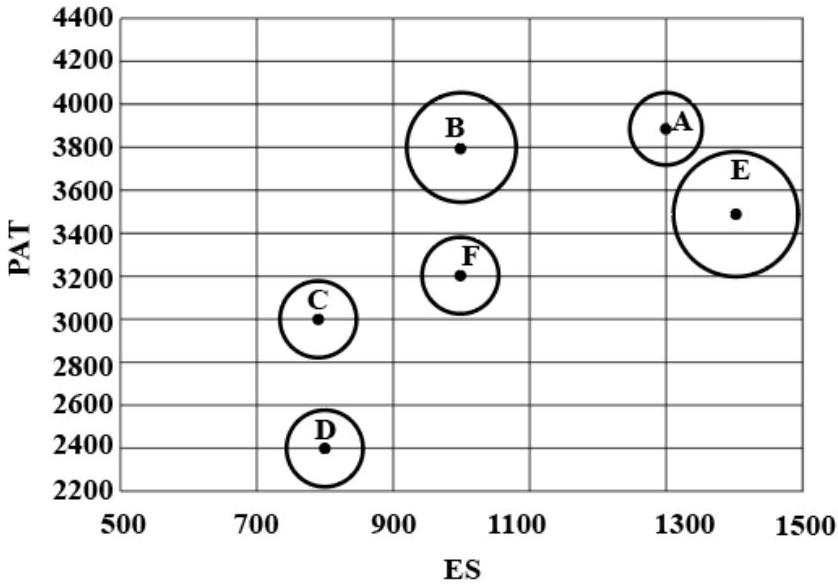
Assume that the annual rate of growth in PAT over the previous year (ARG) remained constant over the years for each of the six firms. Which among the firms , and had the highest ?
Assume that the annual rate of growth in PAT over the previous year (ARG) remained constant over the years for each of the six firms. Which among the firms , and had the highest ?
Firm A
Firm C
Firm E
Firm B
The ratio of the amount of money spent by Firm C on R&D in 2019 to that in 2023 is closest to
The ratio of the amount of money spent by Firm C on R&D in 2019 to that in 2023 is closest to
Which among the firms , and had the maximum PAT per employee in 2023 ?
Which among the firms , and had the maximum PAT per employee in 2023 ?
Firm E
Firm A
Firm F
Firm C
Which among the firms , and had the least amount of R&D spending per employee in 2023 ?
Which among the firms , and had the least amount of R&D spending per employee in 2023 ?
Firm F
Firm D
Firm C
Firm E
Question 3
Slot-3
Over the top (OTT) subscribers of a platform are segregated into three categories: i) Kid, ii)Elder, and iii) Others. Some of the subscribers used one app and the others used multiple apps to access the platform. The figure below shows the percentage of the total number of subscribers in 2023 and 2024 who belong to the 'Kid' and 'Elder' categories.

The following additional facts are known about the numbers of subscribers.
- The total number of subscribers increased by from 2023 to 2024.
- In of the subscribers from the 'Kid' category and of the subscribers from the 'Elder' category subscribers use one app.
- In 2023, the number of subscribers from the 'Kid' category who used multiple apps was the same as the number of subscribers from the 'Elder' category who used one app.
- 10,000 subscribers from the 'Kid' category used one app and 15,000 subscribers from the 'Elder' category used multiple apps in 2023.
How many subscribers belonged to the 'Others' category in 2024?
How many subscribers belonged to the 'Others' category in 2024?
Cannot be determined
65000
55000
45000
What was the percentage increase in the number of subscribers in the 'Elder' categoryfrom 2023 to 2024?
What was the percentage increase in the number of subscribers in the 'Elder' categoryfrom 2023 to 2024?
50%
CAT 2023 Caselets questions
Question 1
Slot-1
The schematic diagram below shows 12 rectangular houses in a housing complex. House numbers are mentioned in the rectangles representing the houses. The houses are located in six columns - Column-A through Column-F, and two rows - Row-1 and Row-2. The houses are divided into two blocks - Block XX and Block YY. The diagram also shows two roads, one passing in front of the houses in Row-2 and another between the two blocks.

Some of the houses are occupied. The remaining ones are vacant and are the only ones available for sale.
The road adjacency value of a house is the number of its sides adjacent to a road. For example, the road adjacency values of , and are 2,1 , and 0 , respectively. The neighbour count of a house is the number of sides of that house adjacent to occupied houses in the same block. For example, E1 and C1 can have the maximum possible neighbour counts of 3 and 2 , respectively.
The base price of a vacant house is Rs. 10 lakhs if the house does not have a parking space, and Rs. 12 lakhs if it does. The quoted price (in lakhs of Rs.) of a vacant house is calculated as (base price) (road adjacency value) (neighbour count).
The following information is also known.
- The maximum quoted price of a house in Block is Rs. 24 lakhs. The minimum quoted price of a house in block YY is Rs. 15 lakhs, and one such house is in Column-E.
- Row-1 has two occupied houses, one in each block.
- Both houses in Column-E are vacant. Each of Column-D and Column-F has at least one occupied house.
- There is only one house with parking space in Block YY.
Which of the following houses is definitely occupied?
Which of the following houses is definitely occupied?
F2 and A2
D2 and B2
D2 and B1
A1 and D2
Which of the following options best describes the number of vacant houses in Row-2?
Which of the following options best describes the number of vacant houses in Row-2?
Exactly 3
Either 3 or 4
Exactly 2
Either 2 or 3
What is the maximum possible quoted price (in lakhs of Rs.) for a vacant house in Column-E?
What is the maximum possible quoted price (in lakhs of Rs.) for a vacant house in Column-E?
Question 2
Slot-1
A visa processing office (VPO) accepts visa applications in four categories - US, UK, Schengen, and Others. The applications are scheduled for processing in twenty 15- minute slots starting at 9:00 am and ending at 2:00 pm. Ten applications are scheduled in each slot.
There are ten counters in the office, four dedicated to US applications, and two each for UK applications, Schengen applications and Others applications. Applicants are called in for processing sequentially on a first-come-first-served basis whenever a counter gets freed for their category. The processing time for an application is the same within each category. But it may vary across the categories. Each US and UK application requires 10 minutes of processing time. Depending on the number of applications in a category and time required to process an application for that category, it is possible that an applicant for a slot may be processed later.
On a particular day, Ira, Vijay and Nandini were scheduled for Schengen visa processing in that order. They had a 9:15 am slot but entered the VPO at 9:20 am. When they entered the office, exactly six out of the ten counters were either processing applications, or had finished processing one and ready to start processing the next.
Mahira and Osman were scheduled in the 9:30 am slot on that day for visa processing in the Others category.
The following additional information is known about that day.
- All slots were full.
- The number of US applications was the same in all the slots. The same was true for the other three categories.
- of the applications were US applications.
- All applicants except Ira, Vijay and Nandini arrived on time.
- Vijay was called to a counter at am.
What is the maximum possible value of the total time (in minutes, nearest to its integer value) required to process all applications in the Others category on that day?
What is the maximum possible value of the total time (in minutes, nearest to its integer value) required to process all applications in the Others category on that day?
Which of the following is the closest to the time when Nandini's application process got over?
Which of the following is the closest to the time when Nandini's application process got over?
9:50 am
9:37 am
9:35 am
9:45 am
Which of the following statements is false?
Which of the following statements is false?
The application process of Osman was completed before 9:45 am.
The application process of Mahira started after Nandini's.
The application process of Osman was completed before Vijay's.
The application process of Mahira was completed before Nandini's.
Question 3
Slot-2
Anjali, Bipasha, and Chitra visited an entertainment park that has four rides. Each ride lasts one hour and can accommodate one visitor at one point. All rides begin at 9 am and must be completed by 5 pm except for Ride-3, for which the last ride has to be completed by 1 pm. Ride gates open every 30 minutes, e.g. 10 am, 10:30 am, and so on. Whenever a ride gate opens, and there is no visitor inside, the first visitor waiting in the queue buys the ticket just before taking the ride. The ticket prices are Rs. 20, Rs. 50, Rs. 30 and Rs. 40 for Rides 1 to 4, respectively. Each of the three visitors took at least one ride and did not necessarily take all rides. None of them took the same ride more than once. The movement time from one ride to another is negligible, and a visitor leaves the ride immediately after the completion of the ride. No one takes a break inside the park unless mentioned explicitly.
The following information is also known.
-
Chitra never waited in the queue and completed her visit by 11 am after spending Rs. 50 to pay for the ticket(s).
-
Anjali took Ride-1 at 11 am after waiting for 30 mins for Chitra to complete it. It was the only ride where Anjali waited.
-
Bipasha began her first of three rides at 11:30 am. All three visitors incurred the same amount of ticket expense by 12:15 pm.
-
The last ride taken by Anjali and Bipasha was the same, where Bipasha waited 30 mins for Anjali to complete her ride. Before standing in the queue for that ride, Bipasha took a 1-hour coffee break after completing her previous ride.
Which were all the rides that Anjali completed by 2:00 pm?
Which were all the rides that Anjali completed by 2:00 pm?
Ride-1 and Ride-4
Ride-1, Ride-2, and Ride-3
Ride-1 and Ride-3
Ride-1, Ride-2, and Ride-4
Question 4
Slot-3
There are only three female students - Amala, Koli and Rini - and only three male students - Biman, Mathew and Shyamal - in a course. The course has two evaluation components, a project and a test. The aggregate score in the course is a weighted average of the two components, with the weights being positive and adding to 1.
The projects are done in groups of two, with each group consisting of a female and a male student. Both the group members obtain the same score in the project.
The following additional facts are known about the scores in the project and the test.
- The minimum, maximum and the average of both project and test scores were identical - 40,80 and 60 , respectively.
- The test scores of the students were all multiples of 10; four of them were distinct and the remaining two were equal to the average test scores.
- Amala's score in the project was double that of Koli in the same, but Koli scored 20 more than Amala in the test. Yet Amala had the highest aggregate score.
- Shyamal scored the second highest in the test. He scored two more than Koli, but two less than Amala in the aggregate.
- Biman scored the second lowest in the test and the lowest in the aggregate.
- Mathew scored more than Rini in the project, but less than her in the test.
Which of the following pairs of students were part of the same project team?
i) Amala and Biman
ii) Koli and Mathew
Which of the following pairs of students were part of the same project team?
i) Amala and Biman
ii) Koli and Mathew
Only ii)
Only i)
Neither i) nor ii)
Both i) and ii)
Question 5
Slot-3
An air conditioner (AC) company has four dealers - D1, D2, D3 and D4 in a city. It is evaluating sales performances of these dealers. The company sells two variants of ACs - Window and Split. Both these variants can be either Inverter type or Non-inverter type. It is known that of the total number of ACs sold in the city, were of Window variant, while the rest were of Split variant. Among the Inverter ACs sold, 20% were of Window variant.
The following information is also known:
-
Every dealer sold at least two window ACs.
-
D1 sold 13 inverter ACs, while D3 sold 5 Non-inverter ACs.
-
A total of six Window Non-inverter ACs and 36 Split Inverter ACs were sold in the city.
-
The number of Split ACs sold by D1 was twice the number of Window ACs sold by it.
-
D3 and D4 sold an equal number of Window ACs and this number was one-third of the number of similar ACs sold by D2.
-
D2 and D3 were the only ones who sold Window Non-inverter ACs. The number of these ACs sold by D2 was twice the number of these ACs sold by D3.
-
D3 and D4 sold an equal number of Split Inverter ACs. This number was half the number of similar ACs sold by D2.
Which of the following statements is necessarily false?
Which of the following statements is necessarily false?
D2 sold the highest number of ACs.
D4 sold more Split ACs as compared to D3.
D1 and D3 sold an equal number of Split ACs.
D1 and D3 together sold more ACs as compared to D2 and D4 together.
If D3 and D4 sold an equal number of ACs, then what was the number of Non-inverter ACs sold by D2?
If D3 and D4 sold an equal number of ACs, then what was the number of Non-inverter ACs sold by D2?
4
5
7
6
CAT 2022 Caselets questions
Question 1
Slot-1
There are 15 girls and some boys among the graduating students in a class. They are planning a get-together, which can be either a 1 -day event, or a 2 -day event, or a 3 -day event. There are 6 singers in the class, 4 of them are boys. There are 10 dancers in the class, 4 of them are girls. No dancer in the class is a singer.
Some students are not interested in attending the get-together. Those students who are interested in attending a 3-day event are also interested in attending a 2-day event; those who are interested in attending a 2-day event are also interested in attending a 1-day event.
The following facts are also known:
- All the girls and of the boys are interested in attending a 1 -day event. of the boys are interested in attending a 2-day event.
- Some of the girls are interested in attending a 1-day event, but not a 2-day event; some of the other girls are interested in attending both.
- 70% of the boys who are interested in attending a 2-day event are neither singers nor dancers. 60% of the girls who are interested in attending a 2-day event are neither singers nor dancers.
- No girl is interested in attending a 3 -day event. All male singers and 2 of the dancers are interested in attending a 3-day event.
- The number of singers interested in attending a 2 -day event is one more than the number of dancers interested in attending a 2-day event.
Which of the following can be determined from the given information?
I. The number of boys who are interested in attending a 1 -day event and are neither dancers nor singers.
II. The number of female dancers who are interested in attending a 1-day event.
Which of the following can be determined from the given information?
I. The number of boys who are interested in attending a 1 -day event and are neither dancers nor singers.
II. The number of female dancers who are interested in attending a 1-day event.
Only II
Neither I nor II c Only II
Both I and II
What BEST can be concluded about the number of male dancers who are interested in attending a 1-day event?
What BEST can be concluded about the number of male dancers who are interested in attending a 1-day event?
5 or 6
6
5
4 or 6
How many female dancers are interested in attending a 2-day event?
How many female dancers are interested in attending a 2-day event?
2
1
0
Cannot be determined
Question 2
Slot-1
Adhara, Bithi, Chhaya, Dhanavi, Esther, and Fathima are the interviewers in a process that awards funding for new initiatives. Every interviewer individually interviews each of the candidates individually and awards a token only if she recommends funding. A token has a face value of , or 13 . Each interviewer awards tokens of a single face value only. Once all six interviews are over for a candidate, the candidate receives a funding that is Rs. 1000 times the product of the face values of all the tokens. For example, if a candidate has tokens with face values 2,5 , and 7 , then they get a funding of Rs. Rs. 70,000 .
Pragnyaa, Qahira, Rasheeda, Smera, and Tantra were five candidates who received funding. The funds they received, in descending order, were Rs.390,000, Rs.210,000, Rs.165,000, Rs.77,000, and Rs.66,000.
The following additional facts are known:
- Fathima awarded tokens to everyone except Qahira, while Adhara awarded tokens to no one except Pragnyaa.
- Rashida received the highest number of tokens that anyone received, but she did not receive one from Esther.
- Bithi awarded a token to Smera but not to Qahira, while Dhanavi awarded a token to Qahira but not to Smera.
Who among the following definitely received a token from Bithi but not from Dhanavi?
Who among the following definitely received a token from Bithi but not from Dhanavi?
Pragnyaa
Rasheeda
Qahira
Tantra
Which of the following could be the amount of funding that Tantra received?
(a) Rs. 66,000
(b) Rs. 165,000
Which of the following could be the amount of funding that Tantra received?
(a) Rs. 66,000
(b) Rs. 165,000
Neither (a) nor (b)
Only (b)
Only (a)
Both (a) and (b)
Question 3
Slot-2
A speciality supermarket sells 320 products. Each of these products was either a cosmetic product or a nutrition product. Each of these products was also either a foreign product or a domestic product. Each of these products had at least one of the two approvals - FDA or EU.
The following facts are also known:
- There were equal numbers of domestic and foreign products.
- Half of the domestic products were FDA approved cosmetic products.
- None of the foreign products had both the approvals, while 60 domestic products had both the approvals.
- There were 140 nutrition products, half of them were foreign products.
- There were 200 FDA approved products. 70 of them were foreign products and 120 of them were cosmetic products.
Which among the following options best represents the number of domestic cosmetic products that had both the approvals?
Which among the following options best represents the number of domestic cosmetic products that had both the approvals?
At least 10 and at most 60
At least 10 and at most 80
At least 20 and at most 70
At least 20 and at most 50
If 70 cosmetic products did not have EU approval, then how many nutrition products had both the approvals?
If 70 cosmetic products did not have EU approval, then how many nutrition products had both the approvals?
50
30
10
20
If 50 nutrition products did not have EU approval, then how many domestic cosmetic products did not have EU approval?
If 50 nutrition products did not have EU approval, then how many domestic cosmetic products did not have EU approval?
Question 4
Slot-3
There are only four neighbourhoods in a city - Levmisto, Tyhrmisto, Pesmisto and Kitmisto.During the onset of a pandemic, the number of new cases of a disease in each of these neighbourhoods was recorded over a period of five days. On each day, the number of newcases recorded in any of the neighbourhoods was either or 3.
The following facts are also known:
- There was at least one new case in every neighbourhood on Day 1.
- On each of the five days, there were more new cases in Kitmisto than in Pesmisto.
- The number of new cases in the city in a day kept increasing during the five-day period. The number of new cases on Day 3 was exactly one more than that on Day 2.
- The maximum number of new cases in a day in Pesmisto was 2, and this happened only once during the fiveday period.
- Kitmisto is the only place to have 3 new cases on Day 2.
- The total numbers of new cases in Levmisto, Tyhrmisto, Pesmisto and Kitmisto over the five-day period were and 14 respectively.
What BEST can be concluded about the total number of new cases in the city on Day2?
What BEST can be concluded about the total number of new cases in the city on Day2?
Either 7 or 8
Exactly 7
Either 6 or 7
Exactly 8
What BEST can be concluded about the number of new cases in Levmisto on Day 3?
What BEST can be concluded about the number of new cases in Levmisto on Day 3?
Either 2 or 3
Exactly 2
Exactly 3
Either 0 or 1
On which day(s) did Pesmisto not have any new case?
On which day(s) did Pesmisto not have any new case?
Only Day 3
Only Day 2
Both Day 2 and Day 3
Both Day 2 and Day 4
Which of the two statements below is/are necessarily false?
Statement A: There were 2 new cases in Tyhrmisto on Day 3.
Statement B: There were no new cases in Pesmisto on Day 2.
Which of the two statements below is/are necessarily false?
Statement A: There were 2 new cases in Tyhrmisto on Day 3.
Statement B: There were no new cases in Pesmisto on Day 2.
Statement A only
Neither Statement A nor Statement B
Statement B only
Both Statement A and Statement B
Question 5
Slot-3
In the following, a year corresponds to 1st of January of that year.
A study to determine the mortality rate for a disease began in 1980 . The study chose 1000 males and 1000 females and followed them for forty years or until they died, whichever came first. The 1000 males chosen in 1980 consisted of 250 each of ages 10 to less than 20,20 to less than 30,30 to less than 40 , and 40 to less than 50 . The 1000 females chosen in 1980 also consisted of 250 each of ages 10 to less than 20,20 to less than 30,30 to less than 40 , and 40 to less than 50 .
The four figures below depict the age profile of those among the 2000 individuals who were still alive in 1990, 2000, 2010, and 2020. The blue bars in each figure represent the number of males in each age group at that point in time, while the pink bars represent the number of females in each age group at that point in time. The numbers next to the bars give the exact numbers being represented by the bars. For example, we know that 230 males among those tracked and who were alive in 1990 were aged between 20 and 30.

In 2000 , what was the ratio of the number of dead males to dead females among those being tracked?
In 2000 , what was the ratio of the number of dead males to dead females among those being tracked?
41 : 43
129:131
109:107
How many people who were being tracked and who were between 30 and 40 years of age in 1980 survived until 2010?
How many people who were being tracked and who were between 30 and 40 years of age in 1980 survived until 2010?
110
90
190
310
How many individuals who were being tracked and who were less than 30 years of age in 1980 survived until 2020?
How many individuals who were being tracked and who were less than 30 years of age in 1980 survived until 2020?
240
580
470
230
How many of the males who were being tracked and who were between 20 and 30 years of age in 1980 died in the period 2000 to 2010?
How many of the males who were being tracked and who were between 20 and 30 years of age in 1980 died in the period 2000 to 2010?
How many of the females who were being tracked and who were between 20 and 30 years of age in 1980 died between the ages of 50 and 60?
How many of the females who were being tracked and who were between 20 and 30 years of age in 1980 died between the ages of 50 and 60?
CAT 2021 Caselets questions
Question 1
Slot-1
Ganga, Kaveri, and Narmada are three women who buy four raw materials (Mango, Apple, Banana and Milk) and sell five finished products (Mango smoothie, Apple smoothie, Banana smoothie, Mixed fruit smoothie and Fruit salad). Table-1 gives information about the raw materials required to produce the five finished products. One unit of a finished product requires one unit of each of the raw materials mentioned in the second column of the table.
| Finished product | Raw materials required |
|---|---|
| Mango smoothie | Mango, Milk |
| Apple smoothie | Apple, Milk |
| Banana smoothie | Banana, Milk |
| Mixed fruit smoothie | Mango, Apple, Banana, Milk |
| Fruit salad | Mango, Apple, Banana |
One unit of milk, mango, apple, and banana cost ₹5, ₹3, ₹2, and ₹1 respectively. Each unit of a finished product is sold for a profit equal to two times the number of raw materials used to make that product. For example, apple smoothie is made with two raw materials (apple and milk) and will be sold for a profit of ₹4 per unit. Leftover raw materials are sold during the last business hour of the day for a loss of ₹1 per unit.
The amount, in rupees, received from sales (revenue) for each woman in each of the four business hours of the day is given in Table-2.
| Business Hour | Ganga | Kaveri | Narmada |
|---|---|---|---|
| Hour 1 | 23 | 19 | 31 |
| Hour 2 | 21 | 22 | 21 |
| Hour 3 | 29 | 30 | 23 |
| Hour 4 (last hour) | 30 | 27 | 22 |
The following additional facts are known.
-
No one except possibly Ganga sold any Mango smoothie.
-
Each woman sold either zero or one unit of any single finished product in any hour.
-
Each woman had exactly one unit each of two different raw materials as leftovers.
-
No one had any banana leftover.
What BEST can be concluded about the number of units of fruit salad sold in the first hour?
What BEST can be concluded about the number of units of fruit salad sold in the first hour?
Either 0 or 1 or 2.
Exactly 1.
Exactly 2.
Either 1 or 2.
Which of the following is NECESSARILY true?
Which of the following is NECESSARILY true?
Narmada sold one unit of leftover milk.
Kaveri sold one unit of leftover mangoes.
Ganga did not sell any leftover apples.
Ganga did not sell any leftover mangoes.
What BEST can be concluded about the total number of units of milk the three women had in the beginning?
What BEST can be concluded about the total number of units of milk the three women had in the beginning?
Either 18 or 19 or 20 units.
Either 17 or 18 or 19 units.
Either 19 or 20 units.
Either 18 or 19 units.
If it is known that three leftover units of mangoes were sold during the last business hour of the day, how many apple smoothies were sold during the day?
If it is known that three leftover units of mangoes were sold during the last business hour of the day, how many apple smoothies were sold during the day?
Question 2
Slot-2
Ravi works in an online food-delivery company. After each delivery, customers rate Ravi on each of four parameters - Behaviour, Packaging, Hygiene, and Timeliness, on a scale from 1 to 9. If the total of the four rating points is 25 or more, then Ravi gets a bonus of ₹20 for that delivery. Additionally, a customer may or may not give Ravi a tip. If the customer gives a tip, it is either ₹30 or ₹50.
One day, Ravi made four deliveries - one to each of Atal, Bihari, Chirag, and Deepak, and received a total of ₹120 in bonus and tips. He did not get both a bonus and a tip from the same customer.
The following additional facts are also known.
- In Timeliness, Ravi received a total of 21 points, and three of the customers gave him the same rating points in this parameter. Atal gave higher rating points than Bihari and Chirag in this parameter.
- Ravi received distinct rating points in Packaging from the four customers adding up to 29 points. Similarly, Ravi received distinct rating points in Hygiene from the four customers adding up to 26 points.
- Chirag gave the same rating points for Packaging and Hygiene.
- Among the four customers, Bihari gave the highest rating points in Packaging, and Chirag gave the highest rating points in Hygiene.
- Everyone rated Ravi between 5 and 7 in Behaviour. Unique maximum and minimum ratings in this parameter were given by Atal and Deepak respectively.
- If the customers are ranked based on ratings given by them in individual parameters, then Atal's rank based on Packaging is the same as that based on Hygiene. This is also true for Deepak.
The COMPLETE list of customers who gave the maximum total rating points to Ravi is
The COMPLETE list of customers who gave the maximum total rating points to Ravi is
Atal
Bihari
Bihari and Chirag
Atal and Bihari
What BEST can be concluded about the tip amount given by Deepak?
What BEST can be concluded about the tip amount given by Deepak?
Either ₹0 or ₹30 or ₹50
Either ₹30 or ₹50
₹50
₹30
In which parameter did Atal give the maximum rating points to Ravi?
In which parameter did Atal give the maximum rating points to Ravi?
Hygiene
Behaviour
Timeliness
Packaging
CAT 2020 Caselets questions
Question 1
Slot-1
The local office of the APP-CAB company evaluates the performance of five cab drivers, Arun, Barun, Chandan, Damodaran, and Eman for their monthly payment based on ratings in five different parameters (P1 to P5) as given below:
P1: timely arrival
P2: behaviour
P3: comfortable ride
P4: driver's familiarity with the route
P5: value for money
Based on feedback from the customers, the office assigns a rating from 1 to 5 in each of these parameters. Each rating is an integer from a low value of 1 to a high value of 5. The final rating of a driver is the average of his ratings in these five parameters. The monthly payment of the drivers has two parts – a fixed payment and final rating-based bonus. If a driver gets a rating of 1 in any of the parameters, he is not eligible to get bonus. To be eligible for bonus a driver also needs to get a rating of five in at least one of the parameters.
The partial information related to the ratings of the drivers in different parameters and the monthly payment structure (in rupees) is given in the table below:

The following additional facts are known.
-
Arun and Barun have got a rating of 5 in exactly one of the parameters. Chandan has got a rating of 5 in exactly two parameters.
-
None of drivers has got the same rating in three parameters
If Damodaran does not get a bonus, what is the maximum possible value of his final rating?
If Damodaran does not get a bonus, what is the maximum possible value of his final rating?
3.4
3.6
3.8
3.2
If Eman gets a bonus, what is the minimum possible value of his final rating?
If Eman gets a bonus, what is the minimum possible value of his final rating?
3.4
3.2
3.0
2.8
If all five drivers get bonus, what is the minimum possible value of the monthly payment (in rupees) that a driver gets?
If all five drivers get bonus, what is the minimum possible value of the monthly payment (in rupees) that a driver gets?
1600
1700
1740
1750
If all five drivers get bonus, what is the maximum possible value of the monthly payment (in rupees) that a driver gets?
If all five drivers get bonus, what is the maximum possible value of the monthly payment (in rupees) that a driver gets?
1960
1950
1900
2050
Question 2
Slot-1
Four institutes, , and D , had contracts with four vendors , and Z during the ten calendar years from 2010 to 2019. The contracts were either multi-year contracts running for several consecutive years or singleyear contracts. No institute had more than one contract with the same vendor. However, in a calendar year, an institute may have had contracts with multiple vendors, and a vendor may have had contracts with multiple institutes. It is known that over the decade, the institutes each got into two contracts with two of these vendors, and each vendor got into two contracts with two of these institutes.
The following facts are also known about these contracts.
I. Vendor Z had at least one contract in every year.
II. Vendor had one or more contracts in every year up to 2015 , but no contract in any year after that.
III. Vendor Y had contracts in 2010 and 2019. Vendor W had contracts only in 2012.
IV. There were five contracts in 2012.
V. There were exactly four multi-year contracts. Institute B had a 7-year contract, D had a 4-year contract, and A and C had one 3 -year contract each. The other four contracts were single-year contracts.
VI. Institute C had one or more contracts in 2012 but did not have any contract in 2011.
VII. Institutes B and D each had exactly one contract in 2012. Institute D did not have any contract in 2010.
Which of the following is true?
Which of the following is true?
B had a contract with Z in 2017
B had a contract with Y in 2019
D had a contract with X in 2011
D had a contract with Y in 2019
What BEST can be concluded about the number of contracts in 2010?
What BEST can be concluded about the number of contracts in 2010?
exactly 4
exactly 3
at least 3
at least 4
Which institutes had multiple contracts during the same year?
Which institutes had multiple contracts during the same year?
A only
B and C only
A and B only
B only
Which institutes and vendors had more than one contracts in any year?
Which institutes and vendors had more than one contracts in any year?
B, W, X, and Z
A, B, W, and X
A, D, W, and Z
B, D, W, and X
Question 3
Slot-1
1000 patients currently suffering from a disease were selected to study the effectiveness of treatment of four types of medicines - A, B, C and D. These patients were first randomly assigned into two groups of equal size, called treatment group and control group. The patients in the control group were not treated with any of these medicines; instead they were given a dummy medicine, called placebo, containing only sugar and starch. The following information is known about the patients in the treatment group.
-
A total of 250 patients were treated with type A medicine and a total of 210 patients were treated with type C medicine.
-
25 patients were treated with type A medicine only. 20 patients were treated with type C medicine only. 10 patients were treated with type D medicine only.
-
35 patients were treated with type A and type D medicines only. 20 patients were treated with type A and type B medicines only. 30 patients were treated with type A and type C medicines only. 20 patients were treated with type C and type D medicines only.
-
100 patients were treated with exactly three types of medicines.
-
40 patients were treated with medicines of types A, B and C, but not with medicines of type D. 20 patients were treated with medicines of types A, C and D, but not with medicines of type B.
-
50 patients were given all the four types of medicines. 75 patients were treated with exactly one type of medicine.
Question 4
Slot-2
In an election several candidates contested for a constituency. In any constituency, the winning candidate was the one who polled the highest number of votes, the first runner up was the one who polled the second highest number of votes, the second runner up was the one who polled the third highest number of votes, and so on. There were no ties (in terms of number of votes polled by the candidates) in any of the constituencies in this election.
In an electoral system, a security deposit is the sum of money that a candidate is required to pay to the election commission before he or she is permitted to contest. Only the defeated candidates (i.e., one who is not the winning candidate) who fail to secure more than one sixth of the valid votes polled in the constituency, lose their security deposits.
The following table provides some incomplete information about votes polled in four constituencies: and , in this election .
| Constituency | ||||
|---|---|---|---|---|
| A | B | C | D | |
| No. of candidates contesting | 10 | 12 | 5 | 8 |
| Total No. of valid votes polled | 5,00,000 | 3,25,000 | 6,00,030 | |
| No. of votes polled by the winning candidate | 2,75,000 | 48,750 | ||
| No. of votes polled by the first runner up | 95,000 | 37,500 | ||
| No. of votes polled by the second runner up | 30,000 | |||
| % of valid votes polled by the third runner up | 10% |
The following additional facts are known:
-
The first runner up polled 10,000 more votes than the second runner up in constituency .
-
None of the candidates who contested in constituency C lost their security deposit. The difference in votes polled by any pair of candidates in this constituency was at least 10,000.
-
The winning candidate in constituency polled of valid votes more than that of the first runner up. All the candidates who lost their security deposits while contesting for this constituency, put together, polled of the valid votes.
What is the percentage of votes polled in total by all the candidates who lost their security deposits while contesting for constituency A ?
What is the percentage of votes polled in total by all the candidates who lost their security deposits while contesting for constituency A ?
What BEST can be concluded about the number of votes polled by the winning candidate in constituency C ?
What BEST can be concluded about the number of votes polled by the winning candidate in constituency C ?
between 1,40,005 and 1,40,010
less than
The winning margin of a constituency is defined as the difference of votes polled by the winner and that of the first runner up. Which of the following CANNOT be the list of constituencies, in increasing order of winning margin?
The winning margin of a constituency is defined as the difference of votes polled by the winner and that of the first runner up. Which of the following CANNOT be the list of constituencies, in increasing order of winning margin?
D, B, C, A
B, D, C, A
B, C, D, A
D, C, B, A
For all the four constituencies taken together, what was the approximate number of votes polled by all the candidates who lost their security deposit expressed as a percentage of the total valid votes from these four constituencies?
For all the four constituencies taken together, what was the approximate number of votes polled by all the candidates who lost their security deposit expressed as a percentage of the total valid votes from these four constituencies?
32.00%
Question 5
Slot-3
A farmer had a rectangular land containing 205 trees. He distributed that land among his four daughters – Abha, Bina, Chitra and Dipti by dividing the land into twelve plots along three rows (X,Y,Z) and four Columns (1,2,3,4) as shown in the figure below:
The plots in rows X, Y, Z contained mango, teak and pine trees respectively. Each plot had trees in non-zero multiples of 3 or 4 and none of the plots had the same number of trees. Each daughter got an even number of plots. In the figure, the number mentioned in top left corner of a plot is the number of trees in that plot, while the letter in the bottom right corner is the first letter of the name of the daughter who got that plot (For example, Abha got the plot in row Y and column 1 containing 21 trees). Some information in the figure got erased, but the following is known:
-
Abha got 20 trees more than Chitra but 6 trees less than Dipti.
-
The largest number of trees in a plot was 32, but it was not with Abha.
-
The number of teak trees in Column 3 was double of that in Column 2 but was half of that in Column 4.
-
Both Abha and Bina got a higher number of plots than Dipti.
-
Only Bina, Chitra and Dipti got corner plots.
-
Dipti got two adjoining plots in the same row.
-
Bina was the only one who got a plot in each row and each column.
-
Chitra and Dipti did not get plots which were adjacent to each other (either in row / column / diagonal).
-
The number of mango trees was double the number of teak trees.

Which of the following is the correct sequence of trees received by Abha, Bina, Chitra and Dipti in that order?
Which of the following is the correct sequence of trees received by Abha, Bina, Chitra and Dipti in that order?
50, 69, 30, 56
60, 39, 40, 66
44, 87, 24, 50
54, 57, 34, 60
Who got the plot with the smallest number of trees and how many trees did that plot have?
Who got the plot with the smallest number of trees and how many trees did that plot have?
Abha, 4 trees
Dipti, 6 trees
Bina, 3 trees
Bina, 4 trees
Which of the following statements is NOT true?
Which of the following statements is NOT true?
Bina got 32 pine trees.
Chitra got 12 mango trees.
Abha got 41 teak trees.
Dipti got 56 mango trees
Question 6
Slot-3
Sixteen patients in a hospital must undergo a blood test for a disease. It is known that exactly one of them has the disease. The hospital has only eight testing kits and has decided to pool blood samples of patients into eight vials for the tests. The patients are numbered 1 through 16, and the vials are labelled A, B, C, D, E, F, G, and H. The following table shows the vials into which each patient’s blood sample is distributed.
If a patient has the disease, then each vial containing his/her blood sample will test positive. If a vial tests positive, one of the patients whose blood samples were mixed in the vial has the disease. If a vial tests negative, then none of the patients whose blood samples were mixed in the vial has the disease.

Suppose vial C tests positive and vials A, E and H test negative. Which patient has the disease?
Suppose vial C tests positive and vials A, E and H test negative. Which patient has the disease?
Patient 8
Patient 14
Patient 6
Patient 2
Suppose vial A tests positive and vials D and G test negative. Which of the following vials should we test next to identify the patient with the disease?
Suppose vial A tests positive and vials D and G test negative. Which of the following vials should we test next to identify the patient with the disease?
Vial H
Vial E
Vial B
Vial C
Which of the following combinations of test results is NOT possible?
Which of the following combinations of test results is NOT possible?
Vial B positive, vials C, F and H negative
Vials A and G positive, vials D and E negative
Vials B and D positive, vials F and H negative
Vials A and E positive, vials C and D negative
Suppose one of the lab assistants accidentally mixed two patients' blood samples before they were distributed to the vials. Which of the following correctly represents the set of all possible numbers of positive test results out of the eight vials?
Suppose one of the lab assistants accidentally mixed two patients' blood samples before they were distributed to the vials. Which of the following correctly represents the set of all possible numbers of positive test results out of the eight vials?
{4,5,6,7}
{4,5,6,7,8}
{4,5}
{5,6,7,8}
CAT 2019 Caselets questions
Question 1
Slot-1
The figure below shows the street map for a certain region with the street intersections marked from a through I. A person standing at an intersection can see along straight lines to other intersections that are in her line of sight and all other people standing at these intersections. For example, a person standing at intersection g can see all people standing at intersections , and k . In particular, the person standing at intersection g can see the person standing at intersection e irrespective of whether there is a person standing at intersection .

Six people U, V, W, X, Y, and Z, are standing at different intersections. No two people are standing at the same intersection. The following additional facts are known.
-
, and Z are standing at the three corners of a triangle formed by three street segments.
-
can see only and .
-
can see only and .
-
U sees V standing in the next intersection behind Z .
-
W cannot see V or Z.
-
No one among the six is standing at intersection .
Should a new person stand at intersection , who among the six would she see?
Should a new person stand at intersection , who among the six would she see?
W and X only
U and W only
U and Z only
V and X only
Question 2
Slot-2
To compare the rainfall data, India Meteorological Department (IMD) calculated the Long Period Average (LPA) of rainfall during period June-August for each of the 16 states. The figure given below shows the actual rainfall (measured in mm) during June-August, 2019 and the percentage deviations from LPA of respective states in 2018. Each state along with its actual rainfall is presented in the figure.

If a 'Heavy Monsoon State' is defined as a state with actual rainfall from June-August, 2019 of 900 mm or more, then approximately what percentage of 'Heavy Monsoon States' have a negative deviation from respective LPAs in 2019?
If a 'Heavy Monsoon State' is defined as a state with actual rainfall from June-August, 2019 of 900 mm or more, then approximately what percentage of 'Heavy Monsoon States' have a negative deviation from respective LPAs in 2019?
42.86
75.00
57.14
14.29
If a 'Low Monsoon State' is defined as a state with actual rainfall from June-August, 2019 of 750 mm or less, then what is the median 'deviation from LPA' (as defined in the Y-axis of the figure) of 'Low Monsoon States'?
If a 'Low Monsoon State' is defined as a state with actual rainfall from June-August, 2019 of 750 mm or less, then what is the median 'deviation from LPA' (as defined in the Y-axis of the figure) of 'Low Monsoon States'?
10%
-30%
What is the average rainfall of all states that have actual rainfall of 600 mm or less in 2019 and have a negative deviation from LPA?
What is the average rainfall of all states that have actual rainfall of 600 mm or less in 2019 and have a negative deviation from LPA?
367 mm
500 mm
450 mm
460 mm
The LPA of a state for a year is defined as the average rainfall in the preceding 10 years considering the period of June-August. For example, LPA in 2018 is the average rainfall during 2009-2018 and LPA in 2019 is the average rainfall during 2010-2019. It is also observed that the actual rainfall in Gujarat in 2019 is more than the rainfall in 2009. The LPA of Gujarat in 2019 is closest to
The LPA of a state for a year is defined as the average rainfall in the preceding 10 years considering the period of June-August. For example, LPA in 2018 is the average rainfall during 2009-2018 and LPA in 2019 is the average rainfall during 2010-2019. It is also observed that the actual rainfall in Gujarat in 2019 is more than the rainfall in 2009. The LPA of Gujarat in 2019 is closest to
475 mm
505 mm
490 mm
525 mm
Question 3
Slot-2
In the table below the check marks indicate all languages spoken by five people: Paula, Quentin, Robert, Sally and Terence. For example, Paula speaks only Chinese and English.

These five people form three teams, Team 1, Team 2 and Team 3. Each team has either 2 or 3 members. A team is said to speak a particular language if at least one of its members speak that language.
The following facts are known.
-
Each team speaks exactly four languages and has the same number of members.
-
English and Chinese are spoken by all three teams, Basque and French by exactly two teams and the other languages by exactly one team.
-
None of the teams include both Quentin and Robert.
-
Paula and Sally are together in exactly two teams.
-
Robert is in Team 1 and Quentin is in Team 3.
Who among the following four people is a part of exactly two teams?
Who among the following four people is a part of exactly two teams?
Paula
Quentin
Sally
Robert
Apart from Chinese and English, which languages are spoken by Team 1?
Apart from Chinese and English, which languages are spoken by Team 1?
Arabic and French
Basque and French
Arabic and Basque
Basque and Dutch
CAT 2018 Caselets questions
Question 1
Slot-1
Fuel contamination levels at each of 20 petrol pumps were recorded as either high, medium, or low.
-
Contamination levels at three pumps among were recorded as high.
-
P6 was the only pump among P1-P10 where the contamination level was recorded as low.
-
P7 and P8 were the only two consecutively numbered pumps where the same levels of contamination were recorded.
-
High contamination levels were not recorded at any of the pumps P16-P20.
-
The number of pumps where high contamination levels were recorded was twice the number of pumps where low contamination levels were recorded.
Which of the following MUST be true?
Which of the following MUST be true?
The contamination level at P 20 was recorded as medium.
The contamination level at P 13 was recorded as low.
The contamination level at P 12 was recorded as high.
The contamination level at P 10 was recorded as high.
What best can be said about the number of pumps at which the contamination levels were recorded as medium?
What best can be said about the number of pumps at which the contamination levels were recorded as medium?
At least 8
More than 4
Exactly 8
At most 9
If the contamination level at P 11 was recorded as low, then which of the following MUST be true?
If the contamination level at P 11 was recorded as low, then which of the following MUST be true?
The contamination level at P 12 was recorded as high.
The contamination level at P 15 was recorded as medium.
The contamination level at P18 was recorded as low.
The contamination level at P 14 was recorded as medium.
If contamination level at P 15 was recorded as medium, then which of the following MUST be FALSE?
If contamination level at P 15 was recorded as medium, then which of the following MUST be FALSE?
Contamination levels at P 13 and P 17 were recorded as the same.
Contamination levels at P 11 and P 16 were recorded as the same.
Contamination level at P14 was recorded to be higher than that at P15.
Contamination levels at P10 and P14 were recorded as the same. ## Instructions [51-54] The multi-layered pie-chart below shows the sales of LED television sets for a big retail electronics outlet during 2016 and 2017. The outer layer shows the monthly sales during this period, with each label showing the month followed by sales figure of that month. For some months, the sales figures are not given in the chart. The middle-layer shows quarterwise aggregate sales figures (in some cases, aggregate quarter-wise sales numbers are not given next to the quarter). The innermost layer shows annual sales. It is known that the sales figures during the three months of the second quarter (April, May, June) of 2016 form an arithmetic progression, as do the three monthly sales figures in the fourth quarter (October, November, December) of that year. 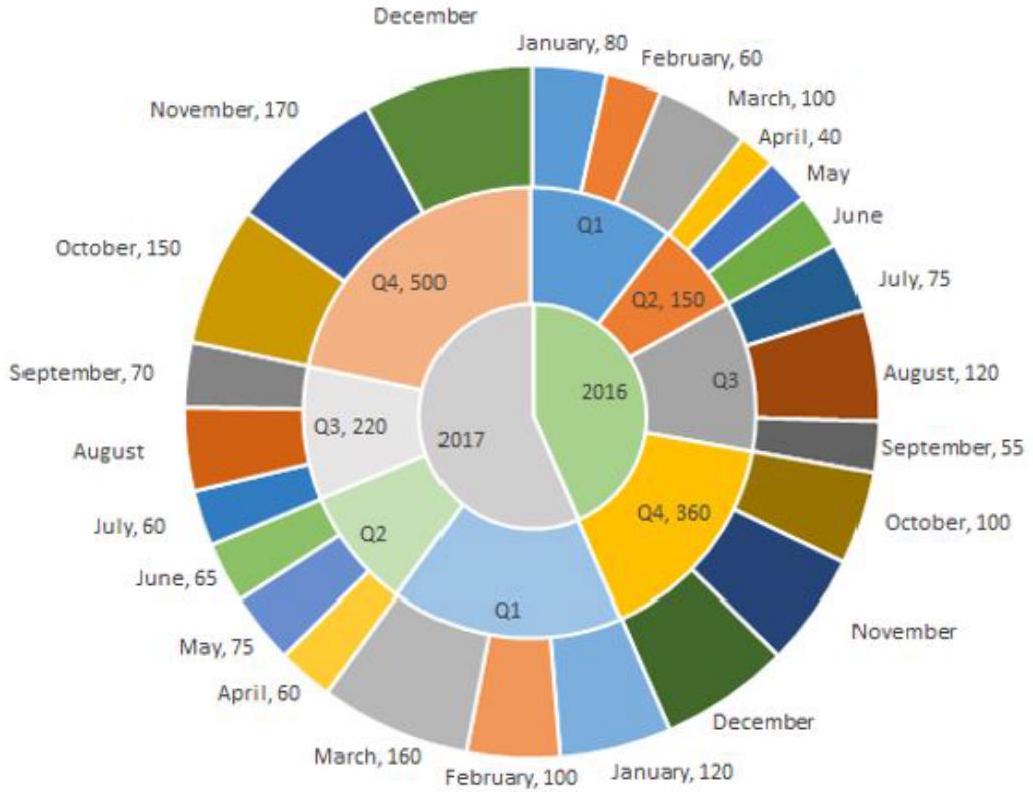
Question 2
Slot-1
Twenty four people are part of three committees which are to look at research, teaching, and administration respectively. No two committees have any member in common. No two committees are of the same size. Each committee has three types of people: bureaucrats, educationalists, and politicians, with at least one from each of the three types in each committee. The following facts are also known about the committees:
- The numbers of bureaucrats in the research and teaching committees are equal, while the number of bureaucrats in the research committee is 75% of the number of bureaucrats in the administration committee.
- The number of educationalists in the teaching committee is less than the number of educationalists in the research committee. The number of educationalists in the research committee is the average of the numbers of educationalists in the other two committees.
- 60% of the politicians are in the administration committee, and 20% are in the teaching committee.
Based on the given information, which of the following statements MUST be FALSE?
Based on the given information, which of the following statements MUST be FALSE?
In the administration committee the number of bureaucrats is equal to the number of educationalists
The size of the research committee is less than the size of the teaching committee
The size of the research committee is less than the size of the administration committee
In the teaching committee the number of educationalists is equal to the number of politicians
Which of the following CANNOT be determined uniquely based on the given information?
Which of the following CANNOT be determined uniquely based on the given information?
The total number of educationalists in the three committees
The total number of bureaucrats in the three committees
The size of the teaching committee
The size of the research committee
Question 3
Slot-2
There are only four brands of entry level smartphones called Azra, Bysi, Cxqi, and Dipq in a country. Details about their market share, unit selling price, and profitability (defined as the profit as a percentage of the revenue) for the year 2016 are given in the table below:
| Brand | Market Share (%) | Unit Selling Price (Rs.) | Profitability (%) |
|---|---|---|---|
| Azra | 40 | 15,000 | 10 |
| Bysi | 25 | 20,000 | 30 |
| Cxqi | 15 | 30,000 | 40 |
| Dipq | 20 | 25,000 | 30 |
In 2017, sales volume of entry level smartphones grew by as compared to that in 2016 . Cxqi offered a discount on its unit selling price in 2017, which resulted in a increase in its market share. Each of the other three brands lost market share. However, the profitability of Cxqi came down to half of its value in 2016. The unit selling prices of the other three brands and their profitability values remained the same in 2017 as they were in 2016.
The complete list of brands whose profits went up in 2017 from 2016 is:
The complete list of brands whose profits went up in 2017 from 2016 is:
Azra, Bysi, Dipq
Cxqi, Azra, Dipq
Azra, Bysi, Cxqi
Bysi, Cxqi, Dipq
Question 4
Slot-2
Each visitor to an amusement park needs to buy a ticket. Tickets can be Platinum, Gold, or Economy. Visitors are classified as Old, Middle-aged, or Young. The following facts are known about visitors and ticket sales on a particular day:
-
140 tickets were sold.
-
The number of Middle-aged visitors was twice the number of Old visitors, while the number of Young visitors was twice the number of Middle-aged visitors.
-
Young visitors bought 38 of the 55 Economy tickets that were sold, and they bought half the total number of Platinum tickets that were sold.
-
The number of Gold tickets bought by Old visitors was equal to the number of Economy tickets bought by Old visitors.
If the number of Old visitors buying Platinum tickets was equal to the number of Middle-aged visitors buying Platinum tickets, then which among the following could be the total number of Platinum tickets sold?
If the number of Old visitors buying Platinum tickets was equal to the number of Middle-aged visitors buying Platinum tickets, then which among the following could be the total number of Platinum tickets sold?
34
36
38
32
If the number of Old visitors buying Platinum tickets was equal to the number of Middle-aged visitors buying Economy tickets, then the number of Old visitors buying Gold tickets was
If the number of Old visitors buying Platinum tickets was equal to the number of Middle-aged visitors buying Economy tickets, then the number of Old visitors buying Gold tickets was
If the number of Old visitors buying Gold tickets was strictly greater than the number of Young visitors buying Gold tickets, then the number of Middle-aged visitors buying Gold tickets was
If the number of Old visitors buying Gold tickets was strictly greater than the number of Young visitors buying Gold tickets, then the number of Middle-aged visitors buying Gold tickets was
Which of the following statements MUST be FALSE?
Which of the following statements MUST be FALSE?
The numbers of Gold and Platinum tickets bought by Young visitors were equal
The numbers of Middle-aged and Young visitors buying Gold tickets were equal
The numbers of Old and Middle-aged visitors buying Platinum tickets were equal
The numbers of Old and Middle-aged visitors buying Economy tickets were equal
Question 5
Slot-2
Instructions [59-62]
Seven candidates, Akil, Balaram, Chitra, Divya, Erina, Fatima, and Ganeshan, were invited to interview for a position. Candidates were required to reach the venue before 8 am . Immediately upon arrival, they were sent to one of three interview rooms: 101, 102, and 103. The following venue log shows the arrival times for these candidates. Some of the names have not been recorded in the log and have been marked as '?'.
| Time | 7:10 AM | 7:15 AM | 7:25 AM | 7:30 AM | 7:40 AM | 7:45 AM |
|---|---|---|---|---|---|---|
| Person | Akil, ? | Chitra | Fatima |
Additionally here are some statements from the candidates: Balaram: I was the third person to enter Room 101. Chitra: I was the last person to enter the room I was allotted to. Erina: I was the only person in the room I was allotted to. Fatima: Three people including Akhil were already in the room that I was allotted to when I entered it. Ganeshan : I was one among the two candidates allotted to Room 102.
What best can be said about the room to which Divya was allotted?
What best can be said about the room to which Divya was allotted?
Definitely Room 101
Definitely Room 103
Definitely Room 102
Either Room 101 or Room 102
If Ganeshan entered the venue before Divya, when did Balaram enter the venue?
If Ganeshan entered the venue before Divya, when did Balaram enter the venue?
am
7:10 am
7:15 am
7:45 am ## Instructions [63-66] There are only four brands of entry level smartphones called Azra, Bysi, Cxqi, and Dipq in a country. Details about their market share, unit selling price, and profitability (defined as the profit as a percentage of the revenue) for the year 2016 are given in the table below: | Brand | Market Share
(%) | Unit Selling
Price (Rs.) | Profitability (%) | | :---: | :---: | :---: | :---: | | Azra | 40 | 15,000 | 10 | | Bysi | 25 | 20,000 | 30 | | Cxqi | 15 | 30,000 | 40 | | Dipq | 20 | 25,000 | 30 | In 2017, sales volume of entry level smartphones grew by as compared to that in 2016 . Cxqi offered a discount on its unit selling price in 2017, which resulted in a increase in its market share. Each of the other three brands lost market share. However, the profitability of Cxqi came down to half of its value in 2016. The unit selling prices of the other three brands and their profitability values remained the same in 2017 as they were in 2016.
Question 6
Slot-2
An agency entrusted to accredit colleges looks at four parameters: faculty quality , reputation , placement quality , and infrastructure . The four parameters are used to arrive at an overall score, which the agency uses to give an accreditation to the colleges. In each parameter, there are five possible letter grades given, each carrying certain points: points points points points , and points . The overall score for a college is the weighted sum of the points scored in the four parameters. The weights of the parameters are and 0.4 in some order, but the order is not disclosed. Accreditation is awarded based on the following scheme:
| Range | Accreditation |
|---|---|
| Overall score | AAA |
| Overall score | BAA |
| Overall score | BBA |
| Overall score | BBB |
| Overall score | Junk |
Eight colleges apply for accreditation, and receive the following grades in the four parameters ( , and I ):
| F | R | P | I | |
|---|---|---|---|---|
| A-one | A | A | A | B |
| Best Ed | B | C | D | D |
| Cosmopolitan | B | D | D | C |
| Dominance | D | D | B | C |
| Education Aid | A | A | B | A |
| Fancy | A | A | B | B |
| Global | C | F | D | D |
| High Q | C | D | D | B |
It is further known that in terms of overall scores:
-
High Q is better than Best Ed;
-
Best Ed is better than Cosmopolitan; and
-
Education Aid is better than A-one.
Question 7
Slot-2
Instructions [35-38]
The base exchange rate of a currency with respect to a currency is the number of units of currency which is equivalent in value to one unit of currency . Currency exchange outlets buy currency at buying exchange rates that are lower than base exchange rates, and sell currency at selling exchange rates that are higher than base exchange rates.
A currency exchange outlet uses the local currency L to buy and sell three international currencies , and C , but does not exchange one international currency directly with another. The base exchange rates of and with respect to are in the ratio 100:120:1. The buying exchange rates of each of , and with respect to are 5% below the corresponding base exchange rates, and their selling exchange rates are 10% above their corresponding base exchange rates. The following facts are known about the outlet on a particular day:
- The amount of used by the outlet to buy equals the amount of it received by selling .
- The amounts of used by the outlet to buy and are in the ratio .
- The amounts of the outlet received from the sales of and are in the ratio .
- The outlet received 88000 units of by selling during the day.
- The outlet started the day with some amount of units of units of B , and 48000 units of C .
- The outlet ended the day with some amount of units of units of B , and 51000 units of C .
What was the buying exchange rate of currency with respect to currency on that day?
What was the buying exchange rate of currency with respect to currency on that day?
1.10
0.95
2.20
1.90 ## Instructions [39-42] Each visitor to an amusement park needs to buy a ticket. Tickets can be Platinum, Gold, or Economy. Visitors are classified as Old, Middle-aged, or Young. The following facts are known about visitors and ticket sales on a particular day:
CAT 2017 Caselets questions
Question 1
Slot-1
Healthy Bites is a fast food joint serving three items: burgers, fries and ice cream. It has two employees Anish and Bani who prepare the items ordered by the clients. Preparation time is 10 minutes for a burger and 2 minutes for an order of ice cream. An employee can prepare only one of these items at a time. The fries are prepared in an automatic fryer which can prepare up to 3 portions of fries at a time, and take 5 minutes irrespective of the number of portions. The fryer does not need an employee to constantly attend to it, and we can ignore time taken by an employee to start and stop the fryer; thus, an employee can be engaged in preparing other items while the frying is on. However, fries cannot be prepared in anticipation of future orders.
Healthy Bites wishes to serve the orders as early as possible. The individual items in any orders are served as and when ready; however, the order is considered to be completely served only when all the items of that order are served.
The table below gives the orders of three clients and the times at which they placed their orders:

Assume that only one client’s order can be processed at any given point of time. So, Anish or Bani cannot start preparing a new order while previous order is being prepared.
At what time is the order placed by client 1 completely served?
Assume that only one client’s order can be processed at any given point of time. So, Anish or Bani cannot start preparing a new order while previous order is being prepared. At what time is the order placed by client 1 completely served?
10:17
10:10
10:15
10:20
Assume that only one client’s order can be processed at any given point of time. So, Anish or Bani cannot start preparing a new order while previous order is being prepared.
At what time is the order placed by client 3 completely served?
Assume that only one client’s order can be processed at any given point of time. So, Anish or Bani cannot start preparing a new order while previous order is being prepared. At what time is the order placed by client 3 completely served?
10:35
10:22
10:25
10:17
Suppose the employees are allowed to process multiple orders at a time, but the preference would be to finish orders of clients who placed their orders earlier.
At what time is the order placed by client 2 completely served?
Suppose the employees are allowed to process multiple orders at a time, but the preference would be to finish orders of clients who placed their orders earlier. At what time is the order placed by client 2 completely served?
10:10
10:12
10:15
10:17
Suppose the employees are allowed to process multiple orders at a time, but the preference would be to finish orders of clients who placed their orders earlier.
Also assume that the fourth client came in only at 10:35. Between 10:00 and 10:30, for how many minutes is exactly one of the employees idle?
Suppose the employees are allowed to process multiple orders at a time, but the preference would be to finish orders of clients who placed their orders earlier. Also assume that the fourth client came in only at 10:35. Between 10:00 and 10:30, for how many minutes is exactly one of the employees idle?
7
10
15
23
Question 2
Slot-1
There are 21 employees working in a division, out of whom 10 are special-skilled employees (SE) and the remaining are regular skilled employees (RE). During the next five months, the division has to complete five projects every month. Out of the 25 projects, 5 projects are "challenging", while the remaining ones are "standard". Each of the challenging projects has to be completed in different months. Every month, five teams - T1, T2, T3, T4 and T5, work on one project each. T1, T2, T3, T4 and T5 are allotted the challenging project in the first, second, third, fourth and fifth month, respectively. The team assigned the challenging project has one more employee than the rest.
In the first month, T1 has one more SE than T2, T2 has one more SE than T3, T3 has one more SE than T4, and T4 has one more SE than T5. Between two successive months, the composition of the teams changes as follows:
a. The team allotted the challenging project, gets two SE from the team which was allotted the challenging project in the previous month. In exchange, one RE is shifted from the former team to the latter team.
b. After the above exchange, if T1 has any SE and T5 has any RE, then one SE is shifted from T1 to T5, and one RE is shifted from T 5 to T1. Also, if T2 has any SE and T4 has any RE, then one SE is shifted from T2 to T4, and one RE is shifted from T4 to T2.
Each standard project has a total of 100 credit points, while each challenging project has 200 credit points. The credit points are equally shared between the employees included in that team.
The number of times in which the composition of team T2 and the number of times in which composition of team T4 remained unchanged in two successive months are:
The number of times in which the composition of team T2 and the number of times in which composition of team T4 remained unchanged in two successive months are:
(2,1)
(1,0)
(0,0)
(1,1)
The number of SE in T1 and T5 for the projects in the third month are, respectively:
The number of SE in T1 and T5 for the projects in the third month are, respectively:
(0,2)
(0,3)
(1,2)
(1,3)
Which of the following CANNOT be the total credit points earned by any employee from the projects?
Which of the following CANNOT be the total credit points earned by any employee from the projects?
140
150
170
200
One of the employees named Aneek scored 185 points. Which of the following CANNOT be true?
One of the employees named Aneek scored 185 points. Which of the following CANNOT be true?
Aneek worked only in teams T1, T2, T3, and T4
Aneek worked only in teams T1, T2, T4, and T5
Aneek worked only in teams T2, T3, T4, and T5
Aneek worked only in teams T1, T3, T4, and T5
Question 3
Slot-1
A study to look at the early learning of rural kids was carried out in a number of village spanning three states, chosen from the North East (NE), the West (W) and the South (S). 50 four-year old kids each were sampled from each of the 150 villages from NE, 250 villages from W and 200 villages from S. It was found that of the 30000 surveyed kids 55% studied in primary schools run by government (G), 37% in private schools (P) while the remaining 8% did not go to school (O).
The kids surveyed were further divided into two groups based on whether their mothers dropped out of school before completing primary education or not. The table below gives the number of kids in different type of schools for mothers who dropped out of school before completing primary education:
It is also known that: 1.In S, 60% of the surveyed kids were in G. Moreover, in S, all surveyed kids whose mothers had completed primary education were in school. 2.In NE, among the O kids, 50% had mothers who had dropped out before completing primary education. 3.The number of kids in G in NE was the same as the number of kids in G in W.

Among the kids in W whose mothers had completed primary education, how many were not in school?
Among the kids in W whose mothers had completed primary education, how many were not in school?
300
1200
1050
1500
In a follow up survey of the same kids two years later, it was found that all the kids were now in school. Of the kids who were not in school earlier, in one region, 25% were in G now, whereas the rest were enrolled in P; in the second region, all such kids were in G now; while in the third region, 50% of such kids had now joined G while the rest had joined P. As a result, in all three regions put together, 50% of the kids who were earlier out of school had joined G. It was also seen that no surveyed kid had changed schools.
What number of the surveyed kids now were in G in W?
In a follow up survey of the same kids two years later, it was found that all the kids were now in school. Of the kids who were not in school earlier, in one region, 25% were in G now, whereas the rest were enrolled in P; in the second region, all such kids were in G now; while in the third region, 50% of such kids had now joined G while the rest had joined P. As a result, in all three regions put together, 50% of the kids who were earlier out of school had joined G. It was also seen that no surveyed kid had changed schools. What number of the surveyed kids now were in G in W?
6000
5250
6750
6300
In a follow up survey of the same kids two years later, it was found that all the kids were now in school. Of the kids who were not in school earlier, in one region, 25% were in G now, whereas the rest were enrolled in P; in the second region, all such kids were in G now; while in the third region, 50% of such kids had now joined G while the rest had joined P. As a result, in all three regions put together, 50% of the kids who were earlier out of school had joined G. It was also seen that no surveyed kid had changed schools.
What percentage of the surveyed kids in S, whose mothers had dropped out before completing primary education, were in G now?
In a follow up survey of the same kids two years later, it was found that all the kids were now in school. Of the kids who were not in school earlier, in one region, 25% were in G now, whereas the rest were enrolled in P; in the second region, all such kids were in G now; while in the third region, 50% of such kids had now joined G while the rest had joined P. As a result, in all three regions put together, 50% of the kids who were earlier out of school had joined G. It was also seen that no surveyed kid had changed schools. What percentage of the surveyed kids in S, whose mothers had dropped out before completing primary education, were in G now?
94.7%
89.5%
93.4%
Cannot be determined
Question 4
Slot-1
Simple Happiness index (SHI) of a country is computed on the basis of three parameters: social support (S), freedom to life choices (F) and corruption perception (C). Each of these three parameters is measured on a scale of 0 to 8 (integers only). A country is then categorized based on the total score obtained by summing the scores of ail the three parameters, as shown in the following table:

Following diagram depicts the frequency distribution of the scores in S, F and C of 10 countries - Amda, Benga, Calla, Delma, Eppa, Varsa, Wanna, Xanda, Yanga and Zooma:

Further, the following are known: 1.Amda and Calla jointly have the lowest total score, 7, with identical scores in all the three parameters. 2.Zooma has a total score of 17. 3.All the 3 countries, which categorised as happy, have the highest score in exactly one parameter.
Benga and Delma, two countries categorized as happy, are tied with the same total score. What is the maximum score they can have?
Benga and Delma, two countries categorized as happy, are tied with the same total score. What is the maximum score they can have?
14
15
16
17
If Benga scores 16 and Delma scores 15, then what is the maximum number of countries with a score of 13?
If Benga scores 16 and Delma scores 15, then what is the maximum number of countries with a score of 13?
0
1
2
3
Question 5
Slot-2
There were seven elective courses - E1 to E7 - running in a specific term in a college. Each of the 300 students enrolled had chosen just one elective from among these seven. However, before the start of the term, E 7 was withdrawn as the instructor concerned had left the college. The students who had opted for E7 were allowed to join any of the remaining electives. Also, the students who had chosen other electives were given one chance to change their choice. The table below captures the movement of the students from one elective to another during this process. Movement from one elective to the same elective simply means no movement. Some numbers in the table got accidentally erased; however, it is known that these were either 0 or 1.
Further, the following are known:
-
Before the change process there were 6 more students in E1 than in E4, but after the reshuffle, the number of students in E4 was 3 more than that in E1.
-
The number of students in E2 increased by 30 after the change process.
-
Before the change process, E4 had 2 more students than E6, while E2 had 10 more students than E3.
The table is given below -

How many elective courses among E 1 to E 6 had a decrease in their enrollments after the change process?
How many elective courses among E 1 to E 6 had a decrease in their enrollments after the change process?
4
1
2
3
After the change process, which of the following is the correct sequence of number of students in the six electives E 1 to E6?
After the change process, which of the following is the correct sequence of number of students in the six electives E 1 to E6?
19, 76, 78, 22, 45, 60
18, 76, 79, 21, 45, 61
After the change process, which course among E 1 to E 6 had the largest change in its enrollment as a percentage of its original enrollment?
After the change process, which course among E 1 to E 6 had the largest change in its enrollment as a percentage of its original enrollment?
E1
E2
E3
E6
Later, the college imposed a condition that if after the change of electives, the enrollment in any elective (other than E7) dropped to less than 20 students, all the students who had left that course will be required to re-enroll for that elective. Which of the following is a correct sequence of electives in decreasing order of their final enrollments?
Later, the college imposed a condition that if after the change of electives, the enrollment in any elective (other than E7) dropped to less than 20 students, all the students who had left that course will be required to re-enroll for that elective. Which of the following is a correct sequence of electives in decreasing order of their final enrollments?
E2, E3, E6, E5, E1, E4
E3, E2, E6, E5, E4, E1
E2, E5, E3, E1, E4, E6
E2, E3, E5, E6, E1, E3
Loading...