

Network Flow Diagrams CAT PYQs , 57 Questions with Solutions
Master Network Flow Diagrams for CAT 2026 with practice questions and detailed explanations
Network / Flow Puzzles
Network or flow puzzles involve nodes connected by paths, sometimes requiring finding shortest routes or flows through a network.
- CAT 2019 Slot 1:
- “Intersection and Network” (moderate) – likely a road network or intersections puzzle
- “Spider Web” puzzle (easy) – actually a radar chart DI, not a true network flow
- CAT 2020 Slot 3: “Bidding” puzzle (very difficult) – might have involved a network of bids or connections
Key Insights:
- Network/flow puzzles are rare; perhaps 1 set from 2017–2024 can be classified as a network flow problem (the 2019 set).
- If they appear, it’s usually one set of 4 questions.
- More likely to appear as part of a mixed set rather than a pure map/flow optimization puzzle.
- Still, candidates should be aware of the concept, as network reasoning may come embedded in other puzzle types.
Weightage Over Past Years
| Year | Q.NONumber of questions | Difficulty Level |
|---|---|---|
| 2025 | 10 | Hard |
| 2024 | 19 | Hard |
| 2023 | 10 | Hard |
| 2022 | 10 | Hard |
| 2017 | 8 | Medium |
CAT 2025 Network Flow Diagrams questions
Question 1
Slot-1
A train travels from Station A to Station E, passing through stations B, C, and D, in that order. The train has a seating capacity of 200. A ticket may be booked from any station to any other station ahead on the route, but not to any earlier station.
A ticket from one station to another reserves one seat on every intermediate segment of the route. For example, a ticket from B to E reserves a seat in the intermediate segments B – C, C – D, and D – E.
The occupancy factor for a segment is the total number of seats reserved in the segment as a percentage of the seating capacity. The total number of seats reserved for any segment cannot exceed 200.
The following information is known.
- Segment C – D had an occupancy factor of 95%. Only segment B – C had a higher occupancy factor.
- Exactly 40 tickets were booked from B to C and 30 tickets were booked from B to E.
- Among the seats reserved on segment D – E, exactly four-sevenths were from stations before C.
- The number of tickets booked from A to C was equal to that booked from A to E, and it was higher than that from B to E.
- No tickets were booked from A to B, from B to D and from D to E.
- The number of tickets booked for any segment was a multiple of 10.
What is the difference between the number of tickets booked to Station C and the number of tickets booked to Station D?
What is the difference between the number of tickets booked to Station C and the number of tickets booked to Station D?
Question 2
Slot-3
Three countries — Pumpland (P), Xiland (X) and Cheeseland (C) — trade among themselves and with the (other countries in) Rest of World (ROW). All trade volumes are given in IC (international currency). The following terminology is used: • Trade balance = Exports – Imports • Total trade = Exports + Imports • Normalized trade balance = Trade balance / Total trade, expressed in percentage terms
The following information is known.
- The normalized trade balances of P, X and C are 0%, 10%, and –20%, respectively.
- 40% of exports of X are to P. 22% of imports of P are from X.
- 90% of exports of C are to P; 4% are to ROW.
- 12% of exports of ROW are to X, 40% are to P.
- The export volumes of P, in IC, to X and C are 600 and 1200, respectively. P is the only country that exports to C.
Which among the countries P, X, and C has/have the least total trade?
Which among the countries P, X, and C has/have the least total trade?
Both X and C
Only X
Only C
Only P
CAT 2024 Network Flow Diagrams questions
Question 1
Slot-2
The numbers 1, 2, 3, 4, 5, 6, 7, 8, 9, and 10 are placed in ten slots of the following grid based on the conditions below.

-
Numbers in any row appear in an increasing order from left to right.
-
Numbers in any column appear in a decreasing order from top to bottom.
-
1 is placed either in the same row or in the same column as 10.
-
Neither 2 nor 3 is placed in the same row or in the same column as 10.
-
Neither 7 nor 8 is placed in the same row or in the same column as 9.
-
4 and 6 are placed in the same row.
Which of the following statements MUST be true?
I. 10 is placed in a slot in Row 1.
II. 1 is placed in a slot in Row 4.
Which of the following statements MUST be true?
I. 10 is placed in a slot in Row 1.
II. 1 is placed in a slot in Row 4.
Both I and II
Neither I nor II
Only II
Only I
Which of the following statements MUST be true? I. 2 is placed in a slot in Column 2. II. 3 is placed in a slot in Column 3.
Which of the following statements MUST be true? I. 2 is placed in a slot in Column 2. II. 3 is placed in a slot in Column 3.
Only I
Both I and II
Neither I nor II
Only II
For how many slots in the grid, placement of numbers CANNOT be determined with certainty?
For how many slots in the grid, placement of numbers CANNOT be determined with certainty?
Question 2
Slot-2

The above is a schematic diagram of walkways (indicated by all the straight-lines) and lakes (3 of them, each in the shape of rectangles – shaded in the diagram) of a gated area. Different points on the walkway are indicated by letters (A through P) with distances being OP = 150 m, ON = MN = 300 m, ML = 400 m, EL = 200 m, DE = 400 m.
The following additional information about the facilities in the area is known.
- The only entry/exit point is at C.
- There are many residences within the gated area; all of them are located on the path AH and ML with four of them being at A, H, M, and L.
- The post office is located at P and the bank is located at B.
One resident whose house is located at L, needs to visit the post office as well as the bank. What is the minimum distance (in m) he has to walk starting from his residence and returning to his residence after visiting both the post office and the bank?
One resident whose house is located at L, needs to visit the post office as well as the bank. What is the minimum distance (in m) he has to walk starting from his residence and returning to his residence after visiting both the post office and the bank?
3200
2700
3000
3400
One person enters the gated area and decides to walk as much as possible before leaving the area without walking along any path more than once and always walking next to one of the lakes. Note that he may cross a point multiple times. How much distance (in m) will he walk within the gated area?
One person enters the gated area and decides to walk as much as possible before leaving the area without walking along any path more than once and always walking next to one of the lakes. Note that he may cross a point multiple times. How much distance (in m) will he walk within the gated area?
3800
2800
3000
3200
One resident takes a walk within the gated area starting from A and returning to A without going through any point (other than A) more than once. What is the maximum distance (in m) she can walk in this way?
One resident takes a walk within the gated area starting from A and returning to A without going through any point (other than A) more than once. What is the maximum distance (in m) she can walk in this way?
Visitors coming for morning walks are allowed to enter as long as they do not pass by any of the residences and do not cross any point (except C) more than once. What is the maximum distance (in m) that such a visitor can walk within the gated area?
Visitors coming for morning walks are allowed to enter as long as they do not pass by any of the residences and do not cross any point (except C) more than once. What is the maximum distance (in m) that such a visitor can walk within the gated area?
Question 3
Slot-3
The air-conditioner (AC) in a large room can be operated either in REGULAR mode or in POWER mode to reduce the temperature.
If the AC operates in REGULAR mode, then it brings down the temperature inside the room(called inside temperature) at a constant rate to the set temperature in 1 hour. If it operates in POWER mode, then this is achieved in 30 minutes.
If the AC is switched off, then the inside temperature rises at a constant rate so as to reach the temperature outside at the time of switching off in 1 hour.
The temperature outside has been falling at a constant rate from 7 pm onward until 3 am on a particular night. The following graph shows the inside temperature between and that night.

The following facts are known about the AC operation that night.
• The AC was turned on for the first time that night at .
• The AC setting was changed (including turning it on/off, and/or setting different temperatures) only at the beginning of the hour or at 30 minutes after the hour.
• The AC was used in POWER mode for longer duration than in REGULAR mode during this 3-hour period.
How many times the AC must have been turned off between 11:01 pm and 1:59 am?
How many times the AC must have been turned off between 11:01 pm and 1:59 am?
cannot be determined
2
0
1
What best can be concluded about the number of times the AC must have either been turned on or the AC temperature setting been altered between 11:01 pm and 1:59 am?
What best can be concluded about the number of times the AC must have either been turned on or the AC temperature setting been altered between 11:01 pm and 1:59 am?
More than 3
Either 2 or 3
Exactly 2
Exactly 3
What was the maximum difference between temperature outside and inside temperature, in degree Celsius, between 11:01 pm and 1:59 am?
What was the maximum difference between temperature outside and inside temperature, in degree Celsius, between 11:01 pm and 1:59 am?
Question 4
Slot-3
The figure below shows a network with three parallel roads represented by horizontal lines R-A, R-B, and R-C and another three parallel roads represented by vertical lines , and V 3 . The figure also shows the distance (in km ) between two adjacent intersections.
Six ATMs are placed at six of the nine road intersections. Each ATM has a distinct integer cash requirement (in Rs. Lakhs), and the numbers at the end of each line in the figure indicate the total cash requirements of all ATMs placed on the corresponding road. For example, the total cash requirement of the ATM(s) placed on road R-A is Rs. 22 Lakhs.
The following additional information is known.
-
The ATMs with the minimum and maximum cash requirements of Rs. 7 Lakhs and Rs. 15 Lakhs are placed on the same road.
-
The road distance between the ATM with the second highest cash requirement and the ATM located at the intersection of and V 3 is 12 km .
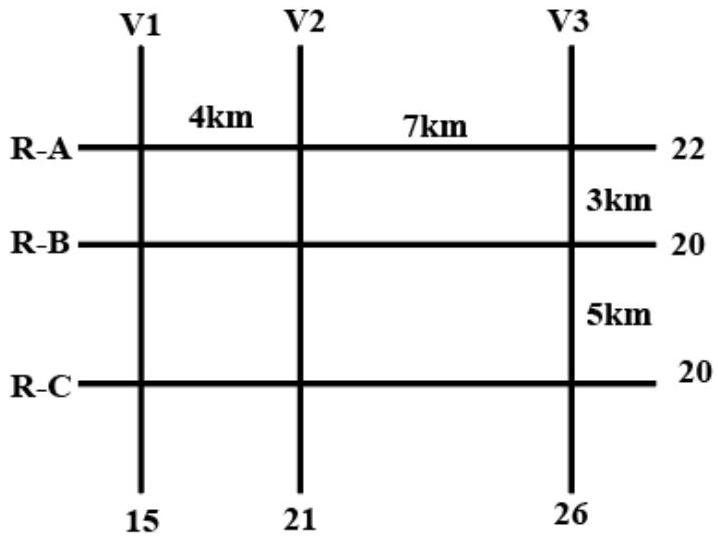
Which of the following statements is correct?
Which of the following statements is correct?
There is no ATM placed at the (R-C, V2) intersection.
The ATM placed at the (R-C, V2) intersection has a cash requirement of Rs. 9 Lakhs.
The ATM placed at the (R-C, V2) intersection has a cash requirement of Rs. 8 Lakhs.
The cash requirement of the ATM placed at the (R-C, V2) intersection cannot be uniquely determined.
Which of the following two statements is/are DEFINITELY true? Statement A: Each of R-A, R-B, and R-C has two ATMs. Statement B: Each of V1, V2, and V3 has two ATMs.
Which of the following two statements is/are DEFINITELY true? Statement A: Each of R-A, R-B, and R-C has two ATMs. Statement B: Each of V1, V2, and V3 has two ATMs.
Only Statement A
Neither Statement A nor Statement B
Only Statement B
Both Statement A and Statement B
What best can be said about the road distance (in km) between the ATMs having the second highest and the second lowest cash requirements?
What best can be said about the road distance (in km) between the ATMs having the second highest and the second lowest cash requirements?
4 km
7 km
5 km
Either 4 km or 7 km
What is the number of ATMs whose locations and cash requirements can both be uniquely determined?
What is the number of ATMs whose locations and cash requirements can both be uniquely determined?
CAT 2023 Network Flow Diagrams questions
Question 1
Slot-2
There are nine boxes arranged in a 3×3 array as shown in Tables 1 and 2. Each box contains three sacks. Each sack has a certain number of coins, between 1 and 9, both inclusive.
The average number of coins per sack in the boxes are all distinct integers. The total number of coins in each row is the same. The total number of coins in each column is also the same.

Table 1 gives information regarding the median of the numbers of coins in the three sacks in a box for some of the boxes. In Table 2 each box has a number which represents the number of sacks in that box having more than 5 coins. That number is followed by a * if the sacks in that box satisfy exactly one among the following three conditions, and it is followed by ** if two or more of these conditions are satisfied.
-
The minimum among the numbers of coins in the three sacks in the box is 1.
-
The median of the numbers of coins in the three sacks is 1.
-
The maximum among the numbers of coins in the three sacks in the box is 9.
For how many boxes are the average and median of the numbers of coins contained in the three sacks in that box the same?
For how many boxes are the average and median of the numbers of coins contained in the three sacks in that box the same?
Question 2
Slot-3
Comprehension:
and F are the six police stations in an area, which are connected by streets as shown below. Four teams - Team 1, Team 2, Team 3 and Team 4 - patrol these streets continuously between 09:00 hrs. and 12:00 hrs. each day.

The teams need 30 minutes to cross a street connecting one police station to another. All four teams start from Station A at 09:00 hrs. and must return to Station A by 12:00 hrs. They can also pass via Station A at any point on their journeys.
The following facts are known.
- None of the streets has more than one team traveling along it in any direction at any point in time.
- Teams 2 and 3 are the only ones in stations and respectively at 10:00 hrs.
- Teams 1 and 3 are the only ones in station at 10:30 hrs.
- Teams 1 and 4 are the only ones in stations B and E respectively at 11:30 hrs.
- Team 1 and Team 4 are the only teams that patrol the street connecting stations and .
- Team 4 never passes through Stations B, D or F.
Which one among the following stations is visited the largest number of times?
Which one among the following stations is visited the largest number of times?
Station C
Station E
Station D
Station F
CAT 2022 Network Flow Diagrams questions
Question 1
Slot-1
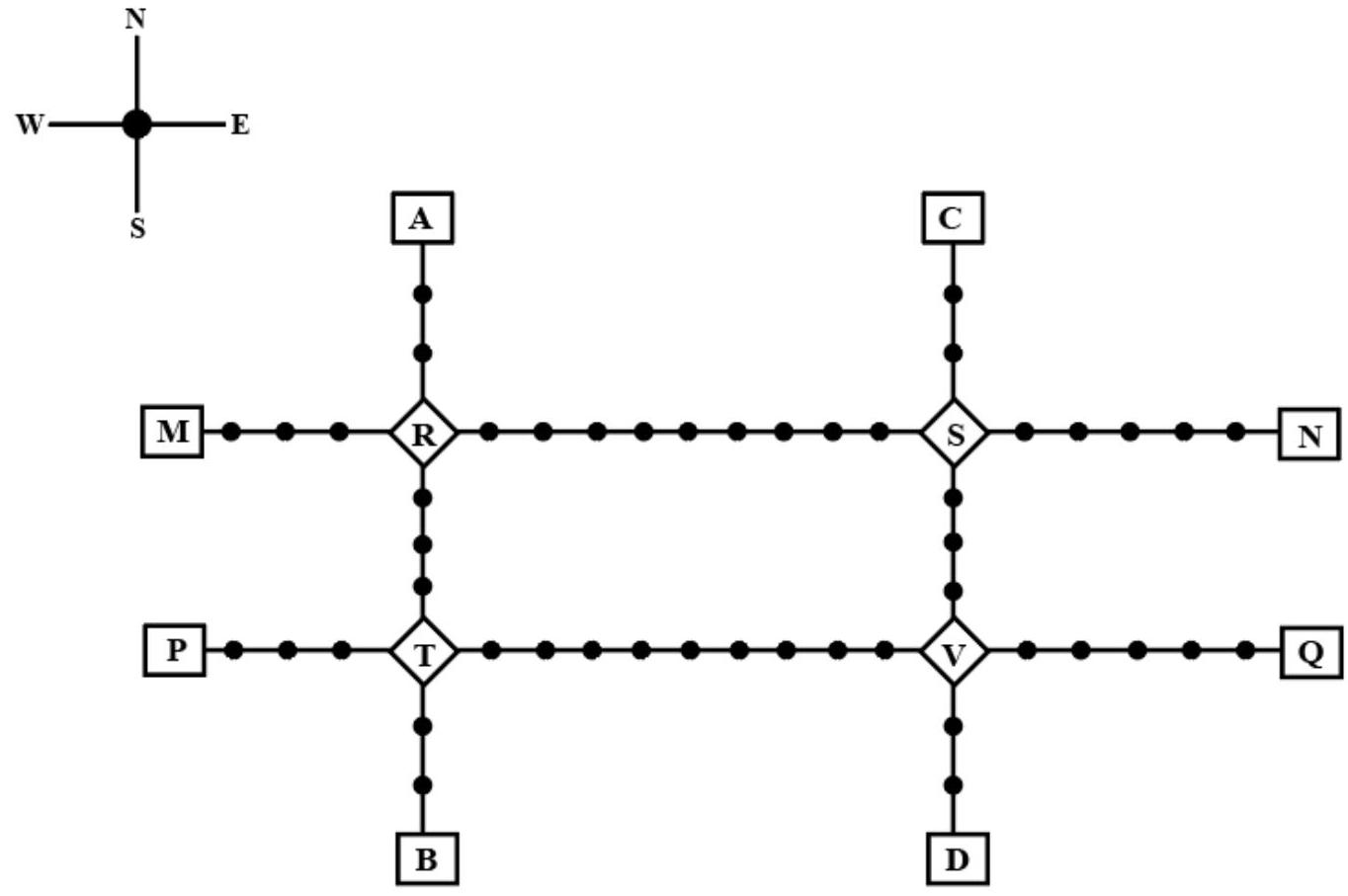
Given above is the schematic map of the metro lines in a city with rectangles denoting terminal stations (e.g. A), diamonds denoting junction stations (e.g. R) and small filled-up circles denoting other stations. Each train runs either in east-west or north-south direction, but not both. All trains stop for 2 minutes at each of the junction stations on the way and for 1 minute at each of the other stations. It takes 2 minutes to reach the next station for trains going in east-west direction and 3 minutes to reach the next station for trains going in northsouth direction. From each terminal station, the first train starts at 6 am; the last trains leave the terminal stations at midnight. Otherwise, during the service hours, there are metro service every 15 minutes in the northsouth lines and every 10 minutes in the east-west lines. A train must rest for at least 15 minutes after completing a trip at the terminal station, before it can undertake the next trip in the reverse direction. (All questions are related to this metro service only. Assume that if someone reaches a station exactly at the time a train is supposed to leave, (s)he can catch that train.)
If Hari is ready to board a train at am from station , then when is the earliest that he can reach station N ?
If Hari is ready to board a train at am from station , then when is the earliest that he can reach station N ?
9:11 am
9:06 am
9:01 am
9:13 am
If Priya is ready to board a train at am from station , then when is the earliest that she can reach station ?
If Priya is ready to board a train at am from station , then when is the earliest that she can reach station ?
11:12 am
11:22 am
11:07 am
11:28 am
Haripriya is expected to reach station late. What is the latest time by which she must be ready to board at station if she must reach station before 1 am via station ?
Haripriya is expected to reach station late. What is the latest time by which she must be ready to board at station if she must reach station before 1 am via station ?
11:49 am
11:43 pm
What is the minimum number of trains that are required to provide the service on the line (considering both north and south directions)?
What is the minimum number of trains that are required to provide the service on the line (considering both north and south directions)?
What is the minimum number of trains that are required to provide the service in this city?
What is the minimum number of trains that are required to provide the service in this city?
Question 2
Slot-2
Every day a widget supplier supplies widgets from the warehouse ( W ) to four locations - Ahmednagar (A), Bikrampore (B), Chitrachak (C), and Deccan Park (D). The daily demand for widgets in each location is uncertain and independent of each other. Demands and corresponding probability values (in parenthesis) are given against each location ( , and ) in the figure below. For example, there is a chance that the demand in Ahmednagar will be 50 units and a chance that the demand will be 70 units. The lines in the figure connecting the locations and warehouse represent two-way roads connecting those places with the distances (in km ) shown beside the line. The distances in both the directions along a road are equal. For example, the road from Ahmednagar to Bikrampore and the road from Bikrampore to Ahmednagar are both 6 km long.
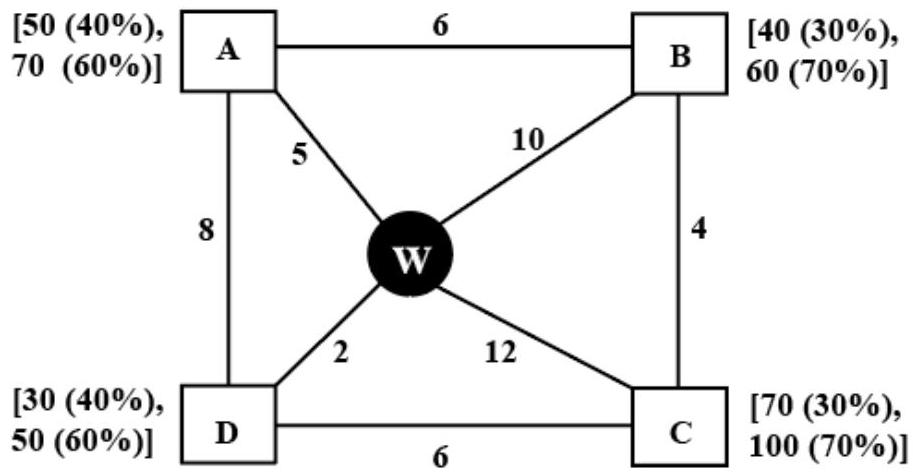
Every day the supplier gets the information about the demand values of the four locations and creates the travel route that starts from the warehouse and ends at a location after visiting all the locations exactly once. While making the route plan, the supplier goes to the locations in decreasing order of demand. If there is a tie for the choice of the next location, the supplier will go to the location closest to the current location. Also, while creating the route, the supplier can either follow the direct path (if available) from one location to another or can take the path via the warehouse. If both paths are available (direct and via warehouse), the supplier will choose the path with minimum distance.
If the last location visited is Ahmednagar, then what is the total distance covered in the route (in km )?
If the last location visited is Ahmednagar, then what is the total distance covered in the route (in km )?
If the total number of widgets delivered in a day is 250 units, then what is the total distance covered in the route (in km )?
If the total number of widgets delivered in a day is 250 units, then what is the total distance covered in the route (in km )?
What is the chance that the total number of widgets delivered in a day is 260 units and the route ends at Bikrampore?
What is the chance that the total number of widgets delivered in a day is 260 units and the route ends at Bikrampore?
10.80%
If the first location visited from the warehouse is Ahmednagar, then what is the chance that the total distance covered in the route is 40 km ?
If the first location visited from the warehouse is Ahmednagar, then what is the chance that the total distance covered in the route is 40 km ?
If Ahmednagar is not the first location to be visited in a route and the total route distance is 29 km , then which of the following is a possible number of widgets delivered on that day?
If Ahmednagar is not the first location to be visited in a route and the total route distance is 29 km , then which of the following is a possible number of widgets delivered on that day?
210
220
200
250
CAT 2017 Network Flow Diagrams questions
Question 1
Slot-1
Four cars need to travel from Akala (A) to Bakala (B). Two routes are available, one via Mamur (M) and the other via Nanur (N). The roads from A to M, and from N to B, are both short and narrow. In each case, one car takes 6 minutes to cover the distance, and each additional car increases the travel time per car by 3 minutes because of congestion. (For example, if only two cars drive from A to M, each car takes 9 minutes.) On the road from A to N, one car takes 20 minutes, and each additional car increases the travel time per car by 1 minute. On the road from M to B, one car takes 20 minutes, and each additional car increases the travel time per car by 0.9 minute.
The police department orders each car to take a particular route in such a manner that it is not possible for any car to reduce its travel time by not following the order, while the other cars are following the order.
How many cars would be asked to take the route A-N-B, that is Akala-Nanur-Bakala route, by the police department? (TITA)
How many cars would be asked to take the route A-N-B, that is Akala-Nanur-Bakala route, by the police department? (TITA)
If all the cars follow the police order, what is the difference in travel time (in minutes) between a car which takes the route A-N-B and a car that takes the route A-M-B?
If all the cars follow the police order, what is the difference in travel time (in minutes) between a car which takes the route A-N-B and a car that takes the route A-M-B?
1
0.1
0.2
0.9
A new one-way road is built from M to N. Each car now has three possible routes to travel from A to B: A-M-B, A-N-B and A-M-N-B. On the road from M to N, one car takes 7 minutes and each additional car increases the travel time per car by 1 minute. Assume that any car taking the A-M-N-B route travels the A-M portion at the same time as other cars taking the A-M-B route, and the N-B portion at the same time as other cars taking the A-N-B route.
How many cars would the police department order to take the A-M-N-B route so that it is not possible for any car to reduce its travel time by not following the order while the other cars follow the order? (Assume that the police department would never order all the cars to take the same route.) (TITA)
A new one-way road is built from M to N. Each car now has three possible routes to travel from A to B: A-M-B, A-N-B and A-M-N-B. On the road from M to N, one car takes 7 minutes and each additional car increases the travel time per car by 1 minute. Assume that any car taking the A-M-N-B route travels the A-M portion at the same time as other cars taking the A-M-B route, and the N-B portion at the same time as other cars taking the A-N-B route. How many cars would the police department order to take the A-M-N-B route so that it is not possible for any car to reduce its travel time by not following the order while the other cars follow the order? (Assume that the police department would never order all the cars to take the same route.) (TITA)
A new one-way road is built from M to N. Each car now has three possible routes to travel from A to B: A-M-B, A-N-B and A-M-N-B. On the road from M to N, one car takes 7 minutes and each additional car increases the travel time per car by 1 minute. Assume that any car taking the A-M-N-B route travels the A-M portion at the same time as other cars taking the A-M-B route, and the N-B portion at the same time as other cars taking the A-N-B route.
If all the cars follow the police order, what is the minimum travel time (in minutes) from A to B? (Assume that the police department would never order all the cars to take the same route.)
A new one-way road is built from M to N. Each car now has three possible routes to travel from A to B: A-M-B, A-N-B and A-M-N-B. On the road from M to N, one car takes 7 minutes and each additional car increases the travel time per car by 1 minute. Assume that any car taking the A-M-N-B route travels the A-M portion at the same time as other cars taking the A-M-B route, and the N-B portion at the same time as other cars taking the A-N-B route. If all the cars follow the police order, what is the minimum travel time (in minutes) from A to B? (Assume that the police department would never order all the cars to take the same route.)
26
32
29.9
30
Question 2
Slot-1
A new airlines company is planning to start operations in a country. The company has identified ten different cities which they plan to connect through their network to start with. The flight duration between any pair of cities will be less than one hour. To start operations, the company has to decide on a daily schedule.
The underlying principle that they are working on is the following:
Any person staying in any of these 10 cities should be able to make a trip to any other city in the morning and should be able to return by the evening of the same day.
If the underlying principle is to be satisfied in such a way that the journey between any two cities can be performed using only direct (non-stop) flights, then the minimum number of direct flights to be scheduled is:
If the underlying principle is to be satisfied in such a way that the journey between any two cities can be performed using only direct (non-stop) flights, then the minimum number of direct flights to be scheduled is:
45
90
180
135
Suppose three of the ten cities are to be developed as hubs. A hub is a city which is connected with every other city by direct flights each way, both in the morning as well as in the evening. The only direct flights which will be scheduled are originating and/or terminating in one of the hubs. Then the minimum number of direct flights that need to be scheduled so that the underlying principle of the airline to serve all the ten cities is met without visiting more than one hub during one trip is:

Suppose three of the ten cities are to be developed as hubs. A hub is a city which is connected with every other city by direct flights each way, both in the morning as well as in the evening. The only direct flights which will be scheduled are originating and/or terminating in one of the hubs. Then the minimum number of direct flights that need to be scheduled so that the underlying principle of the airline to serve all the ten cities is met without visiting more than one hub during one trip is:
54
120
96
60
Suppose the 10 cities are divided into 4 distinct groups G1, G2, G3, G4 having 3, 3, 2 and 2 cities respectively and that G1 consists of cities named A, B and C. Further, suppose that direct flights are allowed only between two cities satisfying one of the following:
-
Both cities are in G1
-
Between A and any city in G2
-
Between B and any city in G3
-
Between C and any city in G4
Then the minimum number of direct flights that satisfies the underlying principle of the airline is: (TITA)
Suppose the 10 cities are divided into 4 distinct groups G1, G2, G3, G4 having 3, 3, 2 and 2 cities respectively and that G1 consists of cities named A, B and C. Further, suppose that direct flights are allowed only between two cities satisfying one of the following:
-
Both cities are in G1
-
Between A and any city in G2
-
Between B and any city in G3
-
Between C and any city in G4
Then the minimum number of direct flights that satisfies the underlying principle of the airline is: (TITA)
Suppose the 10 cities are divided into 4 distinct groups G1, G2, G3, G4 having 3, 3, 2 and 2 cities respectively and that G1 consists of cities named A, B and C. Further, suppose that direct flights are allowed only between two cities satisfying one of the following:
-
Both cities are in G1
-
Between A and any city in G2
-
Between B and any city in G3
-
Between C and any city in G4
However, due to operational difficulties at A, it was later decided that the only flights that would operate at A would be those to and from B. Cities in G2 would have to be assigned to G3 or to G4.
What would be the maximum reduction in the number of direct flights as compared to the situation before the operational difficulties arose? (TITA)
Suppose the 10 cities are divided into 4 distinct groups G1, G2, G3, G4 having 3, 3, 2 and 2 cities respectively and that G1 consists of cities named A, B and C. Further, suppose that direct flights are allowed only between two cities satisfying one of the following:
-
Both cities are in G1
-
Between A and any city in G2
-
Between B and any city in G3
-
Between C and any city in G4
However, due to operational difficulties at A, it was later decided that the only flights that would operate at A would be those to and from B. Cities in G2 would have to be assigned to G3 or to G4. What would be the maximum reduction in the number of direct flights as compared to the situation before the operational difficulties arose? (TITA)
Loading...