
The Thinking Gap: Why Knowing the Concept Doesn't Guarantee Solving the Question
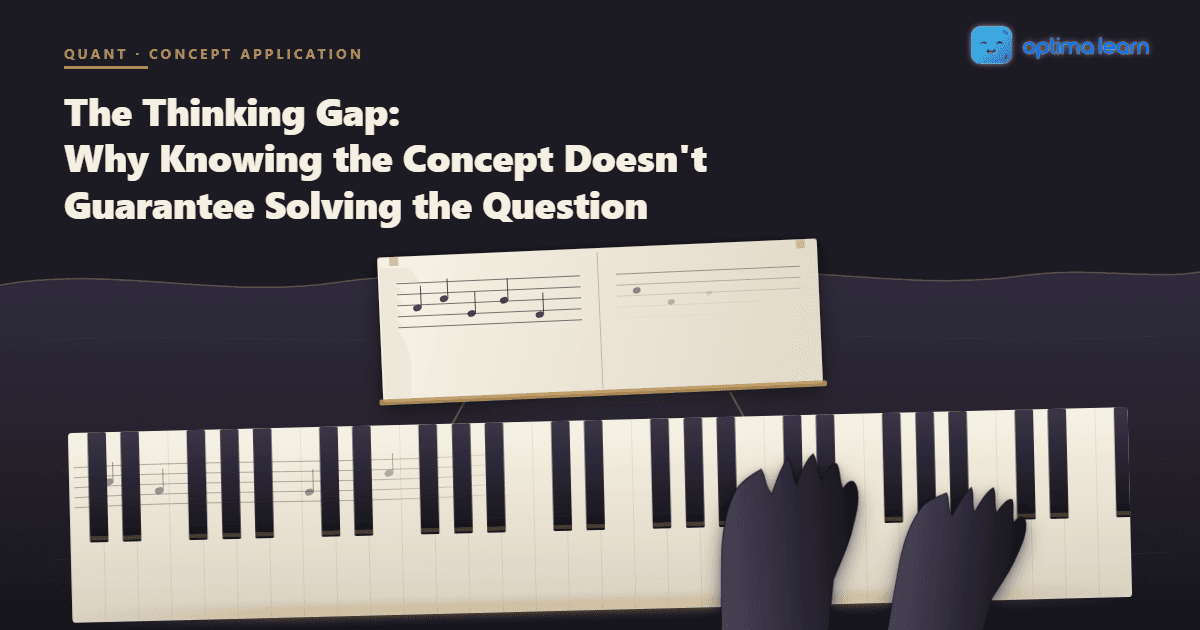
Knowing a concept and applying it under exam pressure draw on two different mental skills, declarative knowledge and procedural execution. The Thinking Gap is the space between them, the reason a concept you can explain perfectly still fails you mid-question. Closing it takes one specific kind of practice, not more revision.
Picture the scene. You explained relative motion to a study partner last night, sketching the diagram, walking through why the formula works. Twenty minutes into today's mock, a relative motion question shows up wearing a costume you don't recognize. You knew the concept cold. You just didn't know this question was that concept.
Have you noticed how that moment never feels like ignorance? It feels like betrayal, as if the syllabus changed the rules on you specifically. It didn't. What changed was the format the concept arrived in, and nothing in your prep had trained you to notice the change.
Closing that gap needs a specific kind of guided, live practice, not another round of reading solved examples. That's the exact space our AI voice tutor for CAT, Prof Opto, was built for: cold problems, out loud, with feedback in real time.
- The Thinking Gap sits between declarative knowledge, explaining a concept, and procedural execution, solving it live under a clock.
- Recognition memory, nodding along to a worked solution, feels like mastery but rarely survives contact with a disguised question.
- CAT Quant recycles a small set of concepts inside unfamiliar wording far more often than it invents new math.
- The fix is the Missing Rehearsal: solving mixed, unlabeled questions where you identify the concept yourself before you apply it.
- Two companion pieces already cover the symptom of this gap; this one covers the mechanism and the specific practice that closes it.
This piece is for the aspirant who reads a solution and thinks, obviously, I know this, then blanks on a similar question three days later. If you've read why your CAT Quant accuracy drops even when you know the concepts or why your correct Quant method is still costing you marks, you've already met the symptom. Those two pieces describe what the gap looks like on a scoresheet. This one explains why it exists, and the single habit that actually closes it.
Why Can You Explain a CAT Quant Concept Perfectly and Still Get the Question Wrong?
The honest answer is that explaining and solving use different memory systems entirely. Explaining draws on declarative knowledge, the ability to describe what a concept is and why it works. Solving live draws on procedural execution, the ability to notice that a concept applies and run it correctly under time pressure.
Psychologists have studied this split for decades, usually calling it the difference between knowing that and knowing how. You can know that a two-step percentage change compounds multiplicatively without being able to spot the compounding hidden inside an unfamiliar word problem in real time.
Mentor's Insight
Aspirants rarely fail a Quant question because they misunderstood the concept behind it. They fail because the exam's version of that concept never announced itself, and nobody taught them to go looking for the disguise.
Most revision only trains one side of this distinction. Rereading notes, watching solved videos, and nodding through a worked example all strengthen declarative knowledge. None of them force you to notice a disguised concept cold, which is the actual skill CAT is testing.
Quant carries the heaviest version of this problem, more than VARC or DILR, because Quant problems can be rephrased almost infinitely while the underlying method stays fixed. A time-speed-distance question can wear a train costume, a boat costume, a runner costume, or an escalator costume, and the calculation underneath barely changes.
What Is the Score and the Keys, and Why Does the Gap Sit Between Them?
The Score and the Keys names the two modes at play and the bridge most aspirants never build between them. Reading the Score is explaining a concept correctly, untimed, in its clean textbook form. Playing at Tempo is executing that same concept live, inside a disguised question, against a clock.
Musicians make the same distinction without needing a name for it. A pianist can explain a piece's key changes fluently, note by note, and still stumble the first time fingers actually meet the keys at performance speed. CAT Quant works the same way, reading fluency and playing fluency are not the same skill.
CAT keeps the Quant section tightly timed, tight enough that Reading the Score alone can't carry you through it. The exam is, in effect, auditioning for Playing at Tempo, and most preparation plans still rehearse only for the easier half of that audition.
The Score and the Keys
Reading the score is not the same as playing it at tempo.
- Reading the Score: being able to explain a concept correctly, out loud, untimed, when the problem is presented in its clean textbook form.
- Playing at Tempo: recognizing and executing that same concept live, inside a differently worded, differently disguised question, under a ticking clock.
- The Missing Rehearsal: the specific bridge most aspirants skip: attempting problems cold, without knowing in advance which concept they test, which is the only practice that actually trains tempo.
Notice where the gap actually lives. It isn't in Reading the Score, most aspirants get there eventually; it's in the jump to Playing at Tempo, and almost nobody plans to train that jump specifically.
Why Does Recognition Feel Like Mastery in CAT Quant?
Recognition memory is what fires when you see a worked solution and think, right, of course. It feels identical to understanding because the brain doesn't distinguish "I could have found this" from "I did find this." CAT Quant tests the second one, and only cold, unlabeled practice builds it.
Take a concept most aspirants would call easy: successive percentage change. A price marked up by 25% and then discounted by 20% doesn't net to a 5% increase. The formula is a + b + (ab divided by 100), so 25 + (-20) + (25 x -20 / 100) = 25 - 20 - 5 = 0%. The price ends up exactly where it started.
Now disguise it. A mock score improves by 25% in one focused month, then drops 20% from that new high during a rough week. Panic reads that as a net loss. It's the identical successive-change concept: 1.25 x 0.8 = 1.00, the score is back to exactly where it began, not below it.
None of this is a trick played on you specifically. It's simply what happens when the same underlying method gets dressed in a new context, a discount becomes a dip in a mock score, a distance becomes a data table. The math didn't move. Only your ability to see past the noun did.
Common Mistake
Calling a worked example "revision" when you only followed the logic and agreed with it. Following someone else's reasoning strengthens recognition memory. It does almost nothing for the recall-under-disguise skill that a live, unlabeled question actually demands.
The difference between the two usually shows up in the first ten seconds of a question, well before any calculation begins.
| Panic Move | Pro Move |
|---|---|
| Re-reading the concept explanation again, hoping it clicks faster next time. | Asking what specific clue in this question signals which concept applies, before recalling any formula. |
| Assuming a familiar-sounding setup, trains, pipes, percentages, means the standard version of that concept. | Checking the actual relationship being described, not the surface noun, before choosing a method. |
| Treating a blank moment as "I don't know this topic" and skipping the question. | Treating a blank moment as "I haven't identified the concept yet" and hunting for the disguise. |
| Practicing only in topic-labeled worksheets where the concept is already named for you. | Practicing in mixed, unlabeled sets where identifying the concept is part of the task. |
How Do You Actually Train the Skill of Playing at Tempo?
You train it with the one exercise most study plans skip entirely: solving problems cold, in a mixed and unlabeled set, where you don't know in advance which concept a question is testing. That single constraint, not knowing, is what forces the recognition skill CAT actually rewards.
Chapter-wise worksheets already hand you the answer to the hardest part of a question, which concept applies, before you've read a single line. Practicing with mixed CAT Quant previous year questions instead removes that crutch, so identifying the concept becomes part of what you're actually being tested on.
Watching someone else solve the same disguised question doesn't rebuild the gap either, because they already named the concept for you the moment they picked a method. You need the harder, less comfortable version: get it wrong first, then work backward to find what clue you missed.
A Habit Worth Building
Before you check which chapter a practice question came from, cover the label and give yourself thirty seconds to name the concept yourself. That thirty-second pause is the closest thing to exam-day recognition you can train outside the exam.
A simple version takes ten minutes to set up. Pull fifteen previous year questions from at least four different chapters, shuffle them into one random order, and remove any chapter labels before you start. Solve them cold, under a light clock, and only check which concept each one tested after you've committed to an answer.
Rehearse Cold, Not Just Correct
Prof Opto walks through unlabeled, disguised Quant problems with you out loud, the same way a coach would sit beside you at a piano bench.
Talk to Prof OptoTwenty minutes of this, three times a week, does more for the Thinking Gap than an entire weekend of re-reading formula sheets, because it trains the one skill re-reading cannot touch, noticing.
The Bottom Line: Closing the Thinking Gap Before It Costs You the Exam
The Thinking Gap doesn't close through more revision, because revision was never the part that was missing. It closes through rehearsal: noticing a familiar concept inside unfamiliar wording, under time pressure, without anyone telling you in advance which concept to look for.
Reading the Score will always matter; you cannot execute a concept you never understood. But Reading the Score was never the missing piece for aspirants stuck at a plateau. The missing piece was always Playing at Tempo, and the only rehearsal for tempo is cold, unlabeled, timed practice.
The Score and the Keys, in one line each
- Reading the Score: explaining the concept correctly, untimed.
- Playing at Tempo: executing it live, disguised, under a clock.
- The Missing Rehearsal: cold, unlabeled practice, the only bridge between the two.
As the exam gets closer, the temptation is to retreat into comfortable, labeled revision because it feels safe and productive. Resist it. Protect at least two sessions a week for cold, mixed, unlabeled practice all the way to your last mock.
Close the Gap Before Exam Day
If you already know the concepts and still lose marks live, the missing ingredient is rehearsal, not another chapter. Start with Prof Opto.
Start a Session with Prof OptoThe concept was never really the problem. The rehearsal was missing. Fix that one habit deliberately, and the gap between what you know and what you can actually do on exam day gets smaller every week.
Frequently Asked Questions
Why can I explain a Quant concept perfectly but still get the question wrong?
Explaining a concept uses recognition memory, you already know what to look for because the concept was just named. Solving a live question uses recall under disguise, you first have to notice which concept even applies before you can use it, and that noticing skill is not built by re-reading explanations.
How do I practice the 'playing at tempo' skill specifically?
Solve mixed, unlabeled question sets rather than topic-wise practice sets. A chapter-wise worksheet already tells you which concept to apply before you start; a mixed set forces you to identify the concept yourself first, which is the actual skill CAT tests.
Is this gap the same as being slow at Quant?
Not quite. Slowness is often a symptom of the gap rather than the cause. An aspirant who has not practiced identifying disguised concepts will hesitate mid-question while figuring out what is even being asked, and that hesitation looks like slowness but is really a recognition gap.
Does watching more solved examples close the Thinking Gap?
Rarely on its own. Watching a solved example is still Reading the Score, since the concept has already been named for you by the person solving it. Closing the gap needs unlabeled, cold attempts where you do the identifying yourself, even if you get several wrong at first.
Practice these Quant concepts, chapter by chapter
Thousands of CAT Quant practice questions by chapter and difficulty, each with a worked solution.
More from Quant
Continue reading
Why Word Problems Feel Harder in CAT Quant Than School

Why High Scorers Skip an Entire CAT RC Passage Fully

Why DILR Sets Take Longer to Understand Than Solve

Do Mocks in a Noisy Environment Help or Hurt CAT Prep?
Put it into practice