
Why Your CAT Quant Accuracy Drops Even When You Know the Concepts
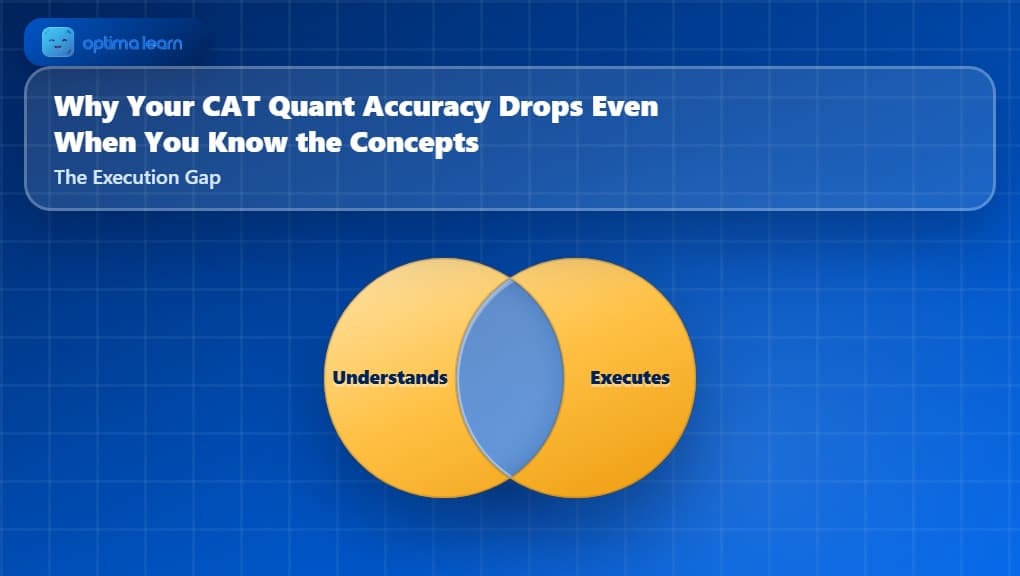
You solve every quadratic equation in your topic-wise practice sheet correctly the night before a mock. You feel almost bored, because the concept stopped surprising you weeks ago. Then the mock arrives, and your CAT quant accuracy takes the hit anyway: three of the five questions from that exact topic come back wrong, not because you don't know the method, but because you read one condition backward, drop a sign, or change a right answer at the last second. This gap between understanding a concept and actually scoring it under a live clock rarely gets fixed by revising the concept one more time, because the concept was never the problem.
That kind of wrong answer stings differently. It feels like proof that you don't actually know the topic, even though every step in your rough work says otherwise. That sting is worth paying attention to, because it usually points you toward the wrong fix.
- CAT quant accuracy often drops even when the concept is fully understood, because concept mastery and scored execution are two different skills.
- This gap, The Execution Gap, looks small in calm, untimed practice but widens the moment a timer and competing questions enter the picture.
- It splits into four independent causes: misreading the question, arithmetic slips, wrong-condition formulas, and second-guessing a correct instinct.
- Each cause needs its own fix. Treating all four as generic carelessness, or simply revising the concept again, rarely closes the gap.
- An error log that records the specific reason behind each mock mistake, not just the topic, is the fastest way to see which of the four is actually costing you marks.
Why Does Concept Mastery Not Guarantee CAT Quant Accuracy?
Concept mastery and scored accuracy are measured by two different processes, even though your CAT scorecard reports them as a single number. Understanding a formula with unlimited time and no distractions tests recall and logic. Applying that same formula correctly inside a two-minute window, with twenty other questions competing for your attention, tests something else: execution under load.
Think about how you practice a topic at home. You isolate ratio and proportion for an hour, solve fifteen questions back to back, and settle into a rhythm built for that one topic alone. A mock never gives you that luxury. Ratio and proportion shows up as question fourteen, sandwiched between a geometry question you skipped and a number system question that rattled your confidence three minutes earlier.
Have you ever noticed that your accuracy on a topic drops the moment it stops being the only thing you're thinking about? That drop has nothing to do with knowledge. We call it The Execution Gap: the space between knowing a method and reliably producing the right answer once time, pressure, and competing questions all enter the picture at once. Checking your own numbers against a target percentile calculator is often the fastest way to see how wide that gap actually runs for you.
Picture two circles instead of one confidence score. One circle is everything you understand: formulas, shortcuts, the logic behind each method. The other circle is everything you actually execute correctly. In calm, untimed practice the two circles overlap almost entirely, which is exactly why this gap is so easy to miss until a real mock exposes it.
the Concept
Accurately
The crescent on the left is the part of your knowledge that never converts into a scored mark. It isn't small because you know less. It only looks small in calm, untimed practice, when nothing is timed, nothing is graded, and nothing else is competing for your attention. Put a clock and twenty other questions back into the picture, the actual conditions of a CAT mock, and that same crescent widens into the gap the opening story described.
The Execution Gap: Four Independent Diagnoses of Accuracy Loss
The Execution Gap splits into four distinct causes, and each shows up differently in a mock review: misreading the question, arithmetic slips, wrong-condition formulas, and second-guessing a correct instinct. Treating all four as generic carelessness is exactly why most fixes for this problem never stick.
The Execution Gap
Understanding the concept and executing it under time pressure are two different skills, scored the same way. Each diagnosis below is independent. None of them causes the others, and none has to happen before the next one can.
| Diagnosis | What It Looks Like in a Mock Review | What It Is Not |
|---|---|---|
| Misreading the Question | A technically correct calculation answers a value the question never asked for. | Not a vocabulary problem. Every word was understood; the wrong target was solved for. |
| Arithmetic Slips | A sign flips, a digit is carried wrong, or a step drops out of an otherwise correct method. | Not a concept gap. The method chosen was completely correct from start to finish. |
| Wrong-Condition Formulas | A formula that is valid in general gets applied where this question's specific condition doesn't allow it. | Not ignorance of the formula. It was known and used; it just didn't apply here. |
| Second-Guessing a Correct Instinct | The first calculated answer was right, but it got changed during a final review pass. | Not indecision from weak preparation. It is a trust problem, not a knowledge problem. |
Notice that none of these four sits inside another, and none of them happens in a fixed sequence. You don't misread a question, then make an arithmetic slip, then apply the wrong formula, then second-guess yourself, all in a single attempt. Each is its own independent failure mode, which is why a single generic fix, like being more careful, never works for all four at once.
See Your Own Execution Gap in Numbers
Reading about four diagnoses is useful only once you know which ones are actually costing you marks. Run your last mock's response sheet through our score calculator and compare concept-level accuracy against timed accuracy on the same topics.
estimate your CAT scoreWhy Do You Misread a Question You Already Understand?
Misreading happens because your mind locks onto the first familiar pattern in a question and stops reading for exceptions after that. A percentage question asking how much more A earns than B often gets solved as how much less B earns than A. Same two numbers, wrong base of comparison, and a calculation that is technically flawless but answers nothing the question actually asked.
Ever finished a calculation, felt genuinely confident about it, and only later realized you'd solved for the wrong variable entirely? That single mismatch, between what you solved for and what the question was asking for, is responsible for more wrong quant answers than any missing formula. It rarely feels like a mistake while you're making it.
The two phrasings share every number in the question, which is exactly why the error hides so well. Reading comprehension traps get plenty of attention in CAT preparation, but quant carries an almost identical trap disguised as a calculation problem. Working through CAT quant previous year questions with a visible timer running is one of the fastest ways to notice how often you solve confidently for the wrong target, since untimed practice rarely reproduces the pressure that causes it.
Arithmetic Slips and Wrong-Condition Formulas: The Two Quietest Mark Killers
Arithmetic slips and wrong-condition formulas both get dismissed as silly mistakes, but they come from different places entirely. A slip is a small computational error sitting inside an otherwise correct method. A wrong-condition formula is a correct formula applied where its underlying assumption doesn't actually hold.
Take a classic case. A train covers the first half of a journey at 60 km/h and the second half at 40 km/h. The instinct is to average the two speeds and land on 50 km/h. That shortcut only works when time, not distance, is equal across both halves. Here it isn't, and the correct average speed comes out to exactly 48 km/h using the harmonic mean instead.
Arithmetic slips are harder to predict in advance but easier to catch during review, since the method column in your rough work usually stays correct even when the final number doesn't. What separates a slip from a knowledge gap is simple: does the same error repeat across similar questions, or does it show up once and disappear? A repeating error points at the concept. A one-off points at the clock.
Wrong-condition formulas are trickier, because the formula itself was never wrong anywhere else you've used it. The fix has nothing to do with memorizing more formulas. It comes down to a two-second habit: checking the condition a formula assumes, distance, time, direction, or rate, before plugging in numbers.
Why Do You Talk Yourself Out of a Correct Instinct?
Second-guessing happens because a correct answer rarely feels dramatically more confident than an incorrect one, especially under time pressure. Your first calculated response is usually right more often than your gut believes, but the discomfort of uncertainty pushes you toward a nearby option that feels safer, not more correct.
Picture solving a TITA question and arriving at 42 within ninety seconds. With three minutes still left on the clock, doubt creeps in anyway. You recompute quickly, make a small error the second time around, and land on 41 instead. You submit 41. The original 42 was correct the whole time, and the recheck is what actually cost you the mark, not the first attempt.
How many of your mock corrections actually caught a real mistake, versus how many replaced a right answer with a wrong one purely out of discomfort? The moment of doubt feels identical either way, which makes this pattern hard to see on your own. Talking through a handful of these reversals with a personal CAT mentor often surfaces it faster, since someone else can see your working without your own doubt attached to it.
None of these four diagnoses (misreading, arithmetic slips, wrong-condition formulas, or second-guessing) responds to the same fix. That is the entire point of treating The Execution Gap as four separate diagnoses instead of one vague label like carelessness.
The Bottom Line
Concept mastery and execution are two different skills, and CAT grades only one of them: the one you execute under a clock. The Execution Gap has a clear anatomy: four separate, diagnosable habits (misreading the question, arithmetic slips, wrong-condition formulas, and second-guessing a correct instinct), each needing its own fix instead of another round of concept revision.
The next time a mock hands back a wrong answer on a topic you know well, resist the urge to re-learn the topic itself. Open your working instead, and ask which of these four actually happened. That single habit, done consistently, closes more of the gap than another week of solving questions you already know how to solve.
Turn This Diagnosis Into a Number
You don't have to guess how wide your own Execution Gap runs. Feed your recent mock responses into our score calculator and see exactly where concept accuracy and scored accuracy start to separate.
get your CAT score estimateFrequently Asked Questions
Why does my CAT quant accuracy drop in mocks even though I understand the concepts?
Because understanding a concept in isolation, with unlimited time and no pressure, tests a different skill than applying it correctly inside a two-minute window while your attention is split across a whole section. The gap between the two is real and needs its own practice, not just more concept revision.
What are the most common causes of the CAT quant execution gap?
The main causes are misreading exactly what the question asks after correctly identifying the concept, small arithmetic slips under time pressure, applying a formula meant for a slightly different condition, and second-guessing a correct first instinct. Each of these has almost nothing to do with concept knowledge.
How do I close the execution gap instead of just revising more concepts?
Keep an error log that records the specific reason each mock mistake happened, not just the topic. If most entries say misread the question or arithmetic slip rather than didn't know the formula, more concept revision will not fix the problem, and timed, distraction-present practice will.
Can a score predictor tool actually help identify this gap?
Yes. Comparing your concept-test accuracy against your full-mock, timed accuracy on the same topics is one of the clearest ways to see the execution gap in numbers rather than guess at it, which is exactly the kind of comparison a response-sheet-based score estimate can surface.
Practice these Quant concepts, chapter by chapter
Thousands of CAT Quant practice questions by chapter and difficulty, each with a worked solution.
More from Quant
Continue reading

Why CAT RC Answer Options Often Feel Equally Correct

How To Study For CAT When You Are Mentally Exhausted

How To Stop Procrastinating On Your Weakest Section

How To Recover From A Wrong Start On A DILR Set Explained
Put it into practice