
The Irreversible Move in Every DILR Set
Most of what you do in a DILR set is reversible. You try a value, it fails, you back out, and the set is exactly where it was. Cheap, and it is why exploring feels safe.
Then there is the irreversible kind. You commit to a case and start building on it. You fill the grid in pen instead of in your head. You throw away a branch because it looked wrong. These do not back out cleanly. If they were wrong, you do not return to where you were; you return to something worse, with four minutes gone and a table you can no longer trust.
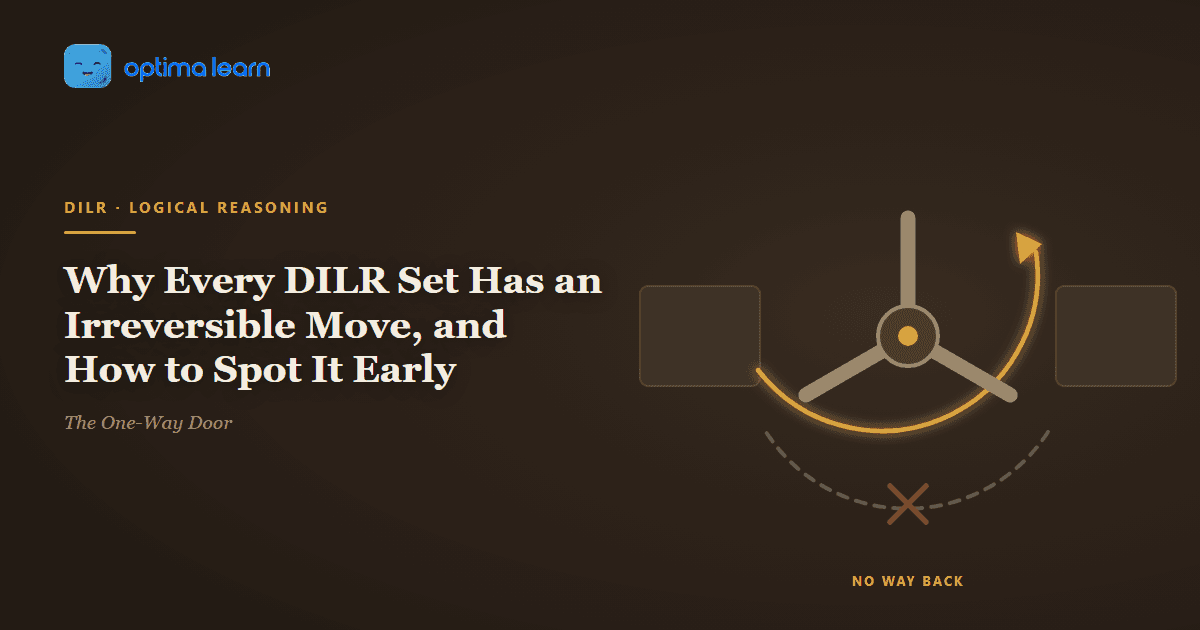
A turnstile is the honest picture. It lets you through, and then it does not let you back. Every DILR set has one, and the difference between a set you finish and a set you abandon is usually whether you noticed which move it was.
- DILR moves split into two kinds: cheap to reverse, and effectively permanent. Only the second kind loses sets.
- The One-Way Door tests a move before you make it: can you unwind it quickly, does it overwrite information, and are you choosing rather than deducing?
- Deductions are always safe. Choices are always doors, however obvious the choice looks.
- You do not need to avoid one-way moves. You need to make them recoverable, which costs about fifteen seconds.
- The expensive failure is not choosing wrongly. It is choosing without being able to get back.
Why Some DILR Moves Cannot Be Undone
Reversibility in a caselet is not about the logic, it is about the paper. A deduction is reversible because it was never optional: it followed from the clues, so it stays true whatever else happens. A choice is different. Everything you build on it inherits it, and unwinding means identifying every downstream entry and removing exactly those.
The cost of unwinding grows in a particular way:
- One step down, you simply rub out the last entry.
- Three steps down, you have to reason about which entries were independent.
- Six steps down, you cannot reliably tell, so the safe move is to redo the whole branch.
- Past that, redoing costs more than the set is worth, which is the point at which aspirants abandon.
That is straightforward for two steps and impossible for eight, because by then you cannot remember which entries came from the assumption and which were independent.
The moves that turn out to be doors are consistent across sets:
- Committing to a case without recording where the branch started.
- Erasing eliminations to tidy the grid, destroying the reasoning that produced them.
- Discarding a branch on a feeling rather than a contradiction.
- Merging two grids into one when a case split should have kept them separate.
The One-Way Door: Three Tests Before You Commit
Each test takes a couple of seconds and they run in order. The first one that answers badly means you are at a door.
The One-Way Door
- Can I unwind this in under thirty seconds? If undoing it means finding and removing downstream entries you have not marked, it is a door.
- Does this overwrite information, or add to it? Adding is always safe. Overwriting destroys a state you may need.
- Am I choosing, or deducing? A deduction is forced by the clues. A choice is not, however likely it looks.
The thirty-second test is the most practical, because it is about your notation rather than the logic:
- If every entry from this point carries a branch marker, unwinding is trivial and this is not a door.
- If entries will be indistinguishable from earlier ones, it is a door regardless of how confident you are.
- If you would have to redraw the grid to undo it, it is a door and an expensive one.
Overwriting versus adding catches the doors that do not feel like decisions at all:
- Erasing is always overwriting. Striking through is adding.
- Replacing an option list with a single value overwrites the alternatives you eliminated.
- Tidying a messy grid destroys state, which is why the tidy-up so often precedes the collapse.
Choosing versus deducing is the test aspirants fail most often, because a strong likelihood feels like a conclusion:
- Ask which clue forces it. If you cannot name one, you are choosing.
- "It has to be this, otherwise nothing works" is a choice until you have actually shown nothing works.
- The most dangerous choices are the ones that turn out to be right, because they teach you the habit is safe.
Put the One-Way Door to Work
Doors are only visible when the clock is running and the grid is half full. Optima Learn's DILR sets mirror real CAT caselets, so the commitment points arrive where the exam puts them.
Practise CAT DILR SetsHow to Walk Through a Door Safely
The answer is not to avoid case splits. Many CAT sets cannot be solved without one. The answer is to make the door two-way before you step through it.
| The move | What makes it a door | What makes it recoverable |
|---|---|---|
| Case split | Building on it without marking where it began | Draw a line, label the branch, keep entries below it marked |
| Filling a slot | Same notation as proved entries | Box assumptions, circle deductions |
| Eliminating an option | Erasing it | Strike through, never rub out |
| Dropping a branch | Dropping on intuition | Record the contradiction that killed it |
| Redrawing the grid | Copying only what looks settled | Do not redraw; annotate the one you have |
Every entry in the right-hand column costs a few seconds and converts a permanent decision into a temporary one. That conversion is the whole skill, and it is entirely mechanical.
When to Open the Door Early
There is a timing question underneath all of this. Splitting into cases too early multiplies work; too late and you stall. A few reliable guides:
- Split when the two-option slots stop producing. If no further deduction follows from the constraints, a case split is the only way forward.
- Split on the most constrained slot, not the first one you notice. Fewer branches, and each one resolves faster.
- Split on two options, never three. If your candidate has three, look for a different slot; three-way splits rarely finish inside the time.
- Split early rather than late once you have decided to. A split at minute four with six minutes to test is worth far more than one at minute eight.
- Do not split while the untouched list is non-empty. Unused information is cheaper than assumed information, every time.
Recognising when a set has genuinely stopped yielding, rather than when you have stopped looking, is covered in why every impossible DILR set is actually waiting for one observation.
Common Mistakes Around Irreversible Moves
The habit shows up in several forms:
- Erasing rather than striking through. Destroying eliminations you will have to redo.
- Unmarked case splits. Assuming without recording where the assumption began.
- Three-way splits. Opening more branches than the clock can test.
- Abandoning a branch on feel. Dropping a case without a contradiction, then being unable to justify returning to it.
- Redrawing on a fresh page. Copying the conclusions and leaving the reasoning behind.
A Practice Drill for Spotting Doors
The drill trains recognition of the commitment point, which is the part that happens too fast to notice in real time.
- Take eight DILR sets and solve them normally, but draw a line every time you make a move that is not forced by a clue.
- Afterwards, count the lines. Most aspirants are surprised by how many there are.
- For each line, check whether you could have unwound it in thirty seconds. Mark the ones you could not.
- On the next eight sets, convert every marked case into a recoverable one before proceeding.
What usually emerges:
- Aspirants make two to four unforced moves per set and consciously notice about one.
- Most doors are opened in the first four minutes, when confidence is highest and the grid still looks manageable.
- Sets that ran out of time almost always contain an unmarked branch made before minute five.
- Once branches are marked, the number of sets abandoned drops before accuracy on individual questions moves.
The Bottom Line
DILR punishes commitment without a record, not commitment itself. Every set asks you to choose something eventually. The only question that matters is whether the choice you made is one you can still walk back from at minute nine, and that is decided entirely by how you wrote it down.
The One-Way Door, Recap
- Thirty-second test: if unwinding takes longer, it is a door.
- Overwrite versus add: adding is safe, overwriting destroys state.
- Choosing versus deducing: name the clue that forces it, or you are choosing.
Build the Habit on Timed CAT DILR
Marking branches is the first discipline to go when the clock is running, so it has to be built against one. Work through CAT previous year questions in timed blocks, or sit full CAT mock tests and past papers so the habit survives real fatigue. More DILR method sits in the CAT DILR blog archive, and if sets keep becoming unrecoverable it is worth having your approach reviewed honestly.
Keep Your Options Open in CAT 2026
Every DILR set asks for a commitment eventually. Making those commitments recoverable is a fifteen-second habit that decides whether a hard set finishes or collapses.
Start Practising CAT DILRFrequently Asked Questions
What is an irreversible move in a DILR set?
Any move you cannot cheaply undo, usually because later entries depend on it and are not marked as doing so. Case commitments, erased eliminations and grid redraws are the common ones. Deductions forced by clues are never irreversible, because they stay true regardless of what follows.
How do I know if I am assuming or deducing?
Name the clue that forces it. If you can point to a specific constraint that makes the entry the only possibility, you are deducing. If your justification is that it seems likely or that nothing else appears to work, you are choosing, and the entry needs to be marked as an assumption.
Should I avoid case splitting in DILR?
No. Many CAT caselets are built so that a split is required, and avoiding it just stalls the set. Split on the most constrained slot, prefer two branches to three, and mark where the branch begins so abandoning it costs seconds rather than the whole set.
When should I split into cases?
Once no further deduction follows from the clues and your list of untouched entities is empty. Splitting while unused information remains is more expensive than using it, because assumed information always costs more to maintain than deduced information does.
Practice DILR sets, chapter by chapter
CAT DILR practice across LR puzzles and DI sets, each with a worked solution.
More from DILR
Continue reading

XLRI Admission Process: The Exam Nobody Ever Checks

Why Do Some CAT DILR Sets Feel Totally Unsolvable?
Why School Level Quant Feels Hard in the CAT Paper

Why Do Non Engineers Struggle in CAT VARC As Well?
Put it into practice