
The Calibration Mindset in CAT Prep
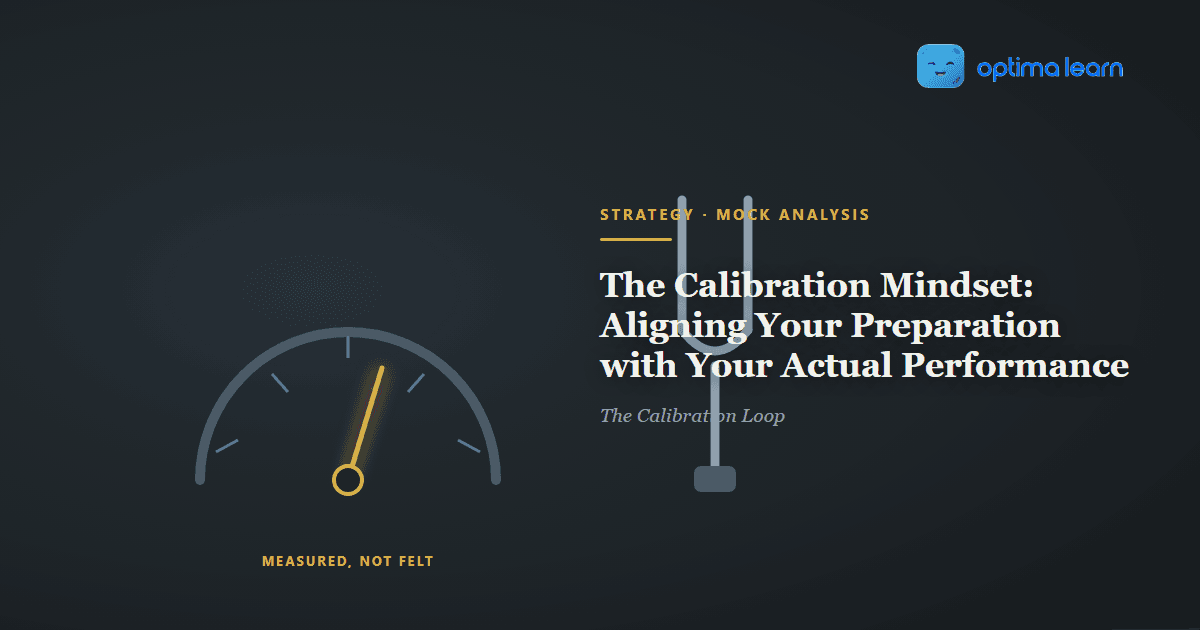
Here is a small piece of CAT mock analysis worth running on your next attempt. Before you look at the score, write down what you think it will be. One number, committed, no hedging.
Most aspirants have never done this, and the first few attempts are uncomfortable, because the gap between the predicted number and the real one is usually large and usually in the same direction. That direction is the most useful diagnostic available in CAT preparation, and it is invisible to anyone who checks their score before forming an expectation.
A tuning fork is worth having because it does not care how in-tune you feel. It gives you a reference you cannot argue with, and calibration is the process of bringing your sense of things into line with one.
- Most aspirants cannot predict their own mock score, and the error runs consistently in one direction.
- The Calibration Loop has three checks: predict before scoring, compare felt difficulty with actual accuracy, and track the gap over time.
- Over-confidence produces poor question selection; under-confidence produces avoidable skipping. Both cost marks.
- Calibration is trainable and improves faster than accuracy does, because it is a measurement habit rather than a skill.
- An uncalibrated aspirant cannot make good in-exam decisions, because every decision rests on an estimate of their own state.
Why Mock Analysis Should Start Before You See the Score
Nearly every decision in a CAT section is a judgement about yourself rather than about the paper. Can I do this one? Am I close? Is this taking longer than it should? Should I leave it?
Each of those is an estimate, and an estimate made by someone systematically wrong about their own state will be systematically wrong. That is why calibration is not a soft skill sitting alongside the technical ones. It is the input every technical decision depends on.
The two failure directions produce different damage:
- Over-confidence keeps you on questions past the point of value, because "nearly there" feels true.
- Under-confidence makes you leave questions you would have solved, and skip passages you could have handled.
- Over-confidence about a section leads to under-preparing it, which is the more expensive version.
- Under-confidence about a section leads to over-preparing it, which is merely wasteful.
The Calibration Loop: Three Checks
All three cost seconds and all three require committing to a number before seeing the answer, which is the only part that is genuinely hard.
The Calibration Loop
- Predict before you score. Write your expected score, per section, before opening the result. The gap is your calibration error.
- Compare felt difficulty with actual accuracy. Rate each section easy, normal or hard as you finish it, then check against what you actually scored.
- Track the gap over time. Direction and size are both stable, which means both are fixable.
Predicting before scoring is the core of it and the step most easily skipped:
- Write three numbers, one per section, immediately after finishing and before checking anything.
- Commit properly. A range is a way of not answering, and it destroys the measurement.
- Record both numbers, predicted and actual, in the same place every time.
Comparing felt difficulty with accuracy catches a subtler error than score prediction does:
- Sections that felt hard and scored well mean you are leaving questions unnecessarily.
- Sections that felt easy and scored badly mean you are not noticing your own errors, which is the more dangerous direction.
- The mismatch is usually concentrated in one section rather than spread across all three.
Tracking the gap converts an anecdote into something you can act on:
- Five data points are enough to see the direction. Ten are enough to see the size.
- A consistent over-estimate of ten marks is a correction you can apply during the exam.
- The gap usually narrows faster than the score rises, which is the earliest sign the habit is working.
Put the Calibration Loop to Work
Calibration needs a series of mocks with predictions attached. Optima Learn's mocks give you the reference the loop measures against.
Take CAT Mock TestsWhat the Direction of Your Error Tells You
The two directions call for opposite corrections, which is why measuring the direction matters more than measuring the size.
| Pattern | What it means | The correction |
|---|---|---|
| Predict high, score low | You do not notice your own errors | Verify more; leave questions earlier |
| Predict low, score high | You leave winnable questions | Attempt more; trust the first read |
| Accurate on two sections, wrong on one | Section-specific blind spot | Review that section's errors specifically |
| Felt easy, scored badly | Errors are invisible to you in the moment | Slow the final check; re-read targets |
| Felt hard, scored well | Difficulty perception is miscalibrated | Raise attempt counts deliberately |
The fourth row is the most dangerous and the least likely to be noticed. A section that felt comfortable and scored poorly means your error-detection failed silently, and no amount of additional practice fixes something you cannot see happening.
Calibrating Difficulty, Not Just Score
Score prediction is the headline check. Difficulty perception is the one that changes behaviour inside a section:
- Rate every question you leave. One word: too long, unfamiliar, or unclear. Check later whether you were right.
- Rate the paper before the discussion. Once you have heard other people's views, your own perception is contaminated.
- Compare your difficulty rating with your accuracy, not with anyone else's opinion of the paper.
- Check the questions you skipped. If a third of them were solvable in ninety seconds, your difficulty read is running high.
- Do this per section. Perception is usually well calibrated in your strongest section and badly calibrated elsewhere.
That last point catches people out. Comfort in a section produces good difficulty judgement there and gives you false confidence that your judgement is good generally, when it may be poor everywhere else.
Common Mistakes in Self-Assessment
Related errors:
- Predicting a range. A range is a refusal to commit and cannot be scored against.
- Rating difficulty after the discussion. By then your perception is somebody else's.
- Measuring size, not direction. The direction determines the correction; the size only scales it.
- Averaging across sections. Which hides a blind spot in one section behind good judgement in another.
- Stopping once the gap narrows. Calibration drifts, particularly as difficulty and fatigue change.
A Drill for Calibration
Runs alongside your existing mocks and adds about a minute each.
- Immediately after each mock, write predicted scores for all three sections and rate each easy, normal or hard.
- Only then check the result. Record both numbers side by side.
- After five mocks, compute the average gap per section, keeping the sign.
- Apply the correction in the next mock: if you over-predict Quant by ten, treat your in-exam sense of "doing fine" as ten marks optimistic.
What usually emerges within five or six mocks:
- The direction is consistent, and it is usually the same one every time.
- One section is far worse calibrated than the other two.
- The gap narrows once it is being measured, without any deliberate effort.
- In-exam decisions get better before the score does, which is the expected order.
The Bottom Line
Every decision you make during a CAT section is a judgement about your own state. If that judgement is systematically off, every decision built on it is off with it, however good your technique is. Ten seconds of prediction after each mock is the entire cost of finding out, and almost nobody pays it.
The Calibration Loop, Recap
- Predict before you score: three numbers, committed, before opening the result.
- Compare felt difficulty with accuracy: felt easy and scored badly is the dangerous combination.
- Track the gap: direction determines the correction, size scales it.
Build the Habit on Real Mock Data
Calibration needs a series, not a single reading. Sit full CAT mock tests and past papers at a steady cadence with a prediction attached to each, and work through CAT previous year questions between them. More on measurement sits in the CAT strategy blog archive, and if your mock scores keep surprising you it is worth having your approach reviewed honestly.
Calibrate Before CAT 2026
Every in-exam decision rests on an estimate of your own state. Find out how wrong yours is while there is still time to correct it.
Take CAT Mock TestsFrequently Asked Questions
What is calibration in CAT preparation?
It is how closely your sense of your own performance matches the actual result. Since every in-exam decision is a judgement about your own state, an aspirant who is systematically wrong about that state will make systematically wrong decisions regardless of technique.
How do I measure my calibration?
Write predicted scores for all three sections immediately after a mock and before checking the result, then record both numbers side by side. After five mocks the average gap, keeping its sign, tells you the direction and size of your error.
What does it mean if a section felt easy but scored badly?
That your error detection failed silently, which is the most dangerous calibration pattern. You were not aware of making mistakes at the time, so no amount of additional practice addresses it directly. The correction is a slower final check and deliberate re-reading of what each question asked.
How quickly does calibration improve?
Faster than accuracy, usually within five or six mocks, because it is a measurement habit rather than a skill. Most of the improvement comes simply from writing a number down before seeing the result, and in-exam decisions tend to improve before the score does.
Build your CAT 2026 study plan
Personalised daily plan that adapts to your section-wise mock scores.
More from Strategy
Continue reading
XLRI Admission Process: The Exam Nobody Ever Checks
Why Do Some CAT DILR Sets Feel Totally Unsolvable?
Why School Level Quant Feels Hard in the CAT Paper

Why Do Non Engineers Struggle in CAT VARC As Well?
Put it into practice