
Stop Chasing 99 Percentile: Build a Strategy That Matches Your Brain, Not Someone Else's
Every CAT prep circle has one document that gets passed around like scripture: a 99th-percentile topper's exact strategy, screenshotted from an interview and forwarded until nobody remembers who annotated it first. Two friends studying together downloaded the same one last year. One followed it for eight weeks, question by question, and her mock score dropped nine points. She had done everything right, by someone else's definition of right.
A CAT strategy built for another person's pace, risk tolerance, and working memory is not a neutral checklist. It is calibrated to a nervous system that is not yours, and running someone else's calibration against your own often produces the opposite of what it promised, slower decisions, not faster ones.
- Copying a 99th-percentile topper's exact strategy can lower your score if their pace and risk tolerance are not yours.
- The Cognitive Fit Framework names four strategy archetypes: The Sprinter, The Verifier, The Anchor, and The Opportunist.
- Your last three mocks, not your intentions, reveal which archetype you actually are.
- No single archetype has a monopoly on 99th percentile; fit matters more than which type you happen to be.
- Fighting your own wiring under real exam pressure usually costs more marks than working with it.
This is for aspirants who have tried copying a senior's routine, a topper's timetable, or a friend's exact section order, and watched their scores stall instead of climb. If your mock scores have plateaued despite following someone else's playbook to the letter, our guide on what to do when mock scores stop improving is worth reading alongside this one.
Why Copying a Topper's Exact Strategy Can Actively Hurt You
Copying a topper's exact strategy backfires because a strategy is a set of trade-offs tuned to one specific mind, not a checklist that transfers cleanly to another. Hand a Sprinter's fast, instinct-first approach to someone who needs to verify before committing, and the discomfort is only the visible part. Underneath it, that approach quietly produces the exact errors it was designed to avoid in someone else.
Every strategy carries assumptions about working memory, error tolerance, and how much ambiguity a person can hold while solving. A topper's routine assumes their specific levels of each. Borrow the routine without those same levels underneath it, and you are running someone else's operating system on different hardware.
The same logic explains why two aspirants who cover the identical syllabus, solve the same mock sets, and put in the same hours can land on different percentiles on result day. Preparation volume is only half the equation; our piece on why two equally prepared aspirants score differently unpacks the other half, the fit between strategy and mind.
Consider two aspirants sitting the same 22-question Quant section. One skips a stuck geometry question after 40 seconds, trusting she will pick up marks elsewhere. The other, wired to verify, spends 90 seconds confirming an answer she already knew was right. Copy the first aspirant's 40-second rule onto the second, and she stops verifying the very answers she was actually getting wrong.
The frustrating part is rarely the dropped score itself. It's the self-doubt that follows: if the exact routine that worked for someone at the 99.7th percentile did not work for you, the easy conclusion is that something is wrong with you, not with the fit. That conclusion is almost always wrong, and it's the more expensive mistake of the two.
The Cognitive Fit Framework: Four Strategy Archetypes
The Cognitive Fit Framework sorts CAT strategy into four archetypes built around how a person naturally moves through pressure: The Sprinter, The Verifier, The Anchor, and The Opportunist. Each archetype trades speed for accuracy, or order for opportunism, differently, and no archetype is inherently stronger than another at the top of the percentile table.
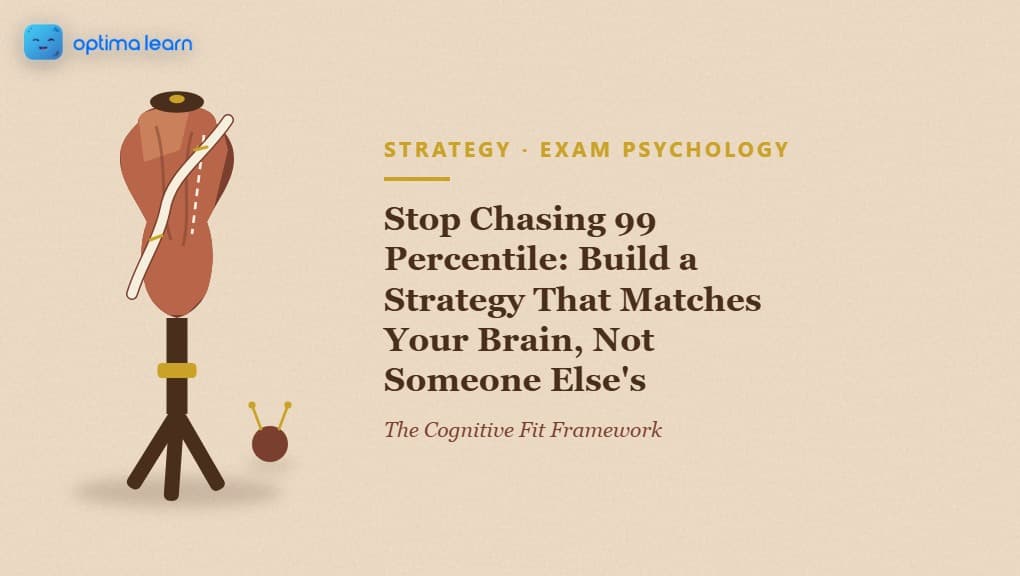
Think of the four archetypes the way a tailor thinks about a body before cutting cloth: the same jacket pattern, chalked and re-pinned four different ways, one for each build it actually needs to fit. A pattern that flatters one build will hang wrong on another, however well it was cut.
The Four Archetypes, at a Glance
- The Sprinter: Fast pace, high risk tolerance. Moves on quickly and trusts first instincts.
- The Verifier: Slower pace, low risk tolerance. Rechecks before committing, accuracy first.
- The Anchor: Steady, consistent pace regardless of question difficulty. Resists rushing even under pressure.
- The Opportunist: Variable pace that hunts for easy wins first and returns to harder questions later. Comfortable with a non-linear order.
| Archetype | Natural Strength | Where It Can Go Wrong |
|---|---|---|
| The Sprinter | Covers more questions in less time | Careless errors when accuracy is never double-checked |
| The Verifier | High accuracy on every attempted question | Runs out of time before finishing reachable marks |
| The Anchor | Consistent output, resistant to panic | Under-attempts when a faster pace was actually available |
| The Opportunist | Maximizes easy marks early, protects morale | Loses track of time across scattered questions |
An Opportunist facing four DILR sets scans all four in the first two minutes, picks the two that look most tractable, and only returns to the harder pair once marks are banked. Force that same aspirant to solve sets strictly in printed order, an Anchor's natural approach, and she loses her single biggest strength: the ability to secure easy marks before pressure builds later in the section.
Know Your Archetype, Then Know Your Number
A strategy that fits your archetype only matters if it's aimed at the right target. See exactly which percentile gets you into the IIMs and B-schools on your list.
Find the Percentile You NeedFinding Your Own Archetype From Your Last Three Mocks
Your last three mocks, not your self-image, reveal your real archetype. Track how you actually moved through each section: did you skip fast and trust instinct, recheck before committing, hold one pace throughout, or jump around chasing easy marks first. The pattern that repeats across all three mocks, not the one you admire, is the one worth building around.
So which one are you, really, not on your best day of untimed practice, but under the pressure of an actual timed mock?
- Pull up your last three mock analyses side by side, not just the final scores.
- Mark every question you left unattempted: a time-out, a genuine guess, or a deliberate skip.
- Compare your average time on questions you got right against questions you got wrong.
- Look at the order you actually solved in, not the order printed on the paper.
In our experience reviewing mock data across many aspirants, self-image and mock data disagree more often than not. An aspirant convinced she is a careful Verifier can discover, once she actually reviews the timing log, that she guesses on any question past 100 seconds rather than genuinely rechecking it. Her self-image says Verifier. Her data says Opportunist, with panic mixed in.
Common Mistakes That Come From Fighting Your Own Wiring
Most damage from a mismatched strategy comes from three repeatable mistakes: adopting someone else's pace wholesale, treating your own natural tendency as a flaw to override, and switching archetypes mid-exam under panic. Each mistake is fixable once named, but each one quietly compounds if it goes unnoticed through several mocks in a row.
| Panic Move | Pro Move |
|---|---|
| Adopting a Sprinter's 40-second skip rule because it worked for a topper | Testing your own skip threshold against your last three mocks first |
| Treating your natural need to verify as slowness to be trained away | Building extra verification time into your section plan instead of fighting it |
| Switching from Anchor to Sprinter mid-section once the clock starts running out | Deciding your pace strategy before the exam, not while you're inside it |
| Copying an Opportunist's non-linear order without ever practicing it under time | Rehearsing your own archetype's approach in full mocks, not just untimed sets |
An Anchor who has held a steady pace through two mocks suddenly panics during a slow VARC section and starts rushing like a Sprinter. The rush doesn't feel unnatural in the moment, panic rarely does, but it produces a Sprinter's risk profile without any of the instinct-trust that normally makes that risk pay off.
What would change if you stopped treating your own instinct as something to fix, and started treating it as data about how you actually think under pressure?
A Practice Drill for Building a Strategy Around Your Archetype
Building a strategy around your archetype starts with one drill: run your next three mocks using rules matched to your diagnosed type, then review whether marks improved or merely felt more comfortable. Comfort alone is not proof of fit. What confirms it is the mock data itself, sectional accuracy and completion rate, read together.
| Drill | What It Builds | Frequency |
|---|---|---|
| Archetype-matched pacing: set your skip and verify rules to your diagnosed type before starting | Confidence that your natural pace is a strategy, not a weakness | Every mock |
| Cross-archetype trial: deliberately run one section using a different archetype's rules | Proof, by direct contrast, of why your own archetype fits better | Once, early on |
| Post-mock archetype log: note exactly where you drifted from your type under pressure | Awareness of your specific panic pattern before exam day | After every mock |
If you've run this drill for a few mocks and still can't tell whether the mismatch is archetype or something else entirely, take one step back before troubleshooting further. Confirm you're even chasing the right number in the first place: our target percentile calculator shows exactly what score gets you into the specific IIMs and B-schools on your list, so you're not mistaking a targeting problem for an archetype problem.
None of this is an excuse for a weak habit dressed up as a personality trait. It's about spending your limited prep time on drills your mind will actually keep on exam day, instead of chasing a stranger's plan you'll quietly abandon the moment real pressure builds. The Cognitive Fit Framework, one more time, at a glance:
The Cognitive Fit Framework, Recap
- The Sprinter: fast pace, high risk tolerance, trusts first instincts.
- The Verifier: slower pace, low risk tolerance, rechecks before committing.
- The Anchor: steady pace regardless of difficulty, resists rushing under pressure.
- The Opportunist: variable pace, hunts easy wins first, comfortable with a non-linear order.
A 99th-percentile score has been built by Sprinters, Verifiers, Anchors, and Opportunists alike, four different routes to the same number. Find yours, rehearse it until it holds under real pressure, and stop auditioning for someone else's.
Ready to Aim at the Right Number?
Your archetype tells you how to move through the exam. Your target percentile tells you where you're actually moving toward. Get both dialed in before your next mock.
Check Your Target PercentileFrequently Asked Questions
Why would copying a 99th-percentile strategy backfire?
A topper's strategy is optimized for their own working memory, risk tolerance, and pace, not for yours. A Verifier forced into a Sprinter's fast, high-risk approach often makes careless errors, while a Sprinter forced into a Verifier's slow, cautious approach often runs out of time.
How do I find out which Cognitive Fit archetype I am?
Look at your last three mocks for a pattern: do you consistently move fast and accept some risk, recheck before committing, keep a steady pace regardless of difficulty, or jump around chasing easy questions first. Whichever pattern shows up consistently, not what you think you should be doing, is your real archetype.
Can I change my archetype with practice?
It can shift somewhat, but working with your natural tendency is usually faster than trying to override it completely. A Verifier can learn to trust verified instincts faster over time, without forcing themselves into a Sprinter's risk profile that doesn't fit how they process pressure.
Is one archetype better than the others for reaching 99th percentile?
No single archetype has a monopoly on top scores. Aspirants from all four profiles reach 99th percentile, because the score comes from a strategy that fits how that specific person thinks under pressure, not from which archetype label they carry.
Build your CAT 2026 study plan
Personalised daily plan that adapts to your section-wise mock scores.
More from Strategy
Continue reading
Why CAT RC Answer Options Often Feel Equally Correct

How To Study For CAT When You Are Mentally Exhausted
How To Stop Procrastinating On Your Weakest Section
How To Recover From A Wrong Start On A DILR Set Explained
Put it into practice