
Why Every CAT Quant Question Has a Point of No Return
The clock reads 39:12 in the CAT Quant section when you finally look up. You have been on question 14 for what felt like ninety seconds. The timer disagrees. It has been seven minutes, and you still do not have an answer.
What makes that moment sting is not the question you lost. It is the three questions at the end of the section you never even read, two of which you would have solved in under a minute each. The damage was done long before you gave up. It was done several minutes earlier, at the point of no return: the moment walking away stopped being cheap, and you kept going anyway.
- Every CAT Quant question has a point of no return: a moment after which abandoning it costs you more than finishing it, because you have already paid the expensive part.
- The mistake is almost never staying too long. It is failing to notice the moment you crossed from "I can still walk away" to "I am committed."
- The V1 Check catches it with three signals: the second restart, the growing page, and the lost target.
- Any one signal means you are at the line. Two together mean you are already past it, and the only cheap exit was thirty seconds ago.
- The skill is not solving faster. It is deciding earlier, while the decision is still free.
The Six Minutes You Can Never Get Back
The CAT Quant section gives you 40 minutes for 22 questions. That is roughly 1 minute 50 seconds per question if you attempt every one, and nobody does. Most strong scorers attempt 14 to 17 and get almost all of them right.
Run the arithmetic on a single overrun and the picture changes shape. A question that takes seven minutes has not cost you one question. It has cost you close to four.
| Time on one question | Share of the section | Questions displaced at 1:50 each |
|---|---|---|
| 3:00 | 7.5% | about 1.6 |
| 5:00 | 12.5% | about 2.7 |
| 7:00 | 17.5% | about 3.8 |
| 9:00 | 22.5% | about 4.9 |
Here is the part that gets missed in review. Those displaced questions are not random, and that is what makes them expensive:
- They sit at the end of the section, so they are the ones you never got to read at all.
- Because you never read them, you have no idea whether they were easy, and statistically some of them were.
- They cost you zero seconds to lose, which is exactly why they leave no trace in your memory of the mock.
A seven-minute question does not trade one mark for one mark. It trades one uncertain mark for two or three likely ones, and it does so invisibly.
And yet "spend less time per question" is advice nobody can actually execute, because you never feel the minutes passing. You feel close. That feeling of being close is the whole problem, and it is worth understanding where it comes from.
The V1 Check: Three Signals You Have Passed the Point of No Return
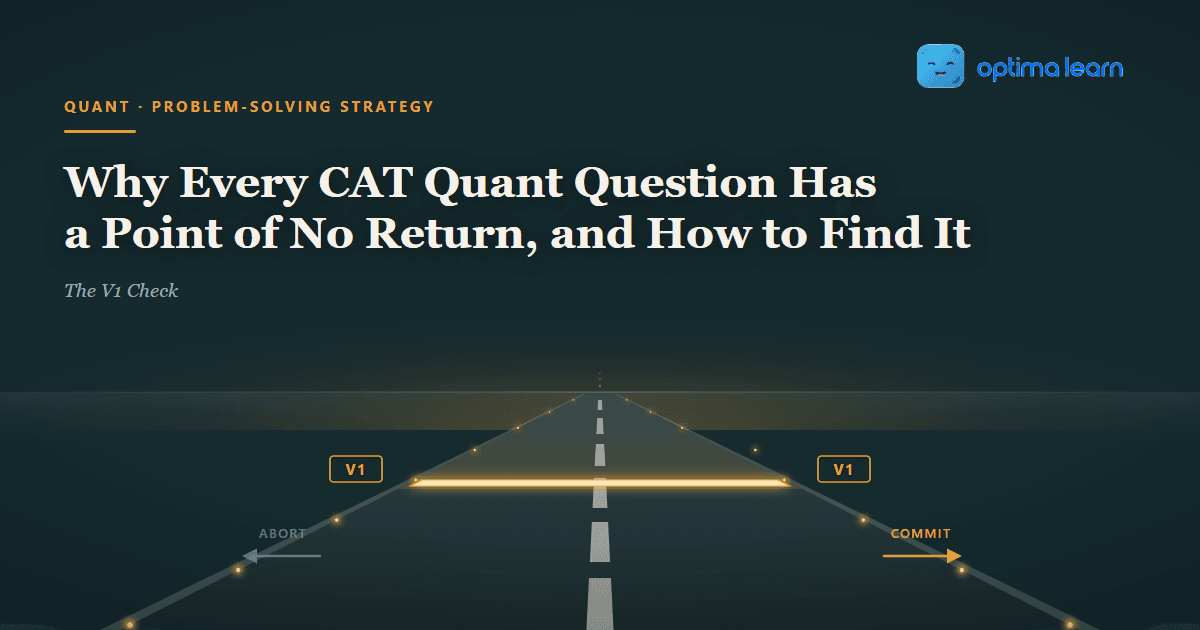
Pilots have a number for this. On every takeoff roll there is a speed called V1, the decision speed. Below V1, an engine failure means you brake and stop on the remaining runway. Above V1, you no longer have enough runway to stop, so you fly, even with a failed engine. The aircraft has not changed. The runway has not changed. What has changed is that one option quietly disappeared.
V1 is not marked on the tarmac. The pilot calls it out loud, every single takeoff, because a threshold you do not name is a threshold you will cross without noticing.
Quant questions work the same way. There is a point past which the cheap exit is gone, and it never announces itself. So you have to call it.
The V1 Check
- The Second Restart: you have begun the same question a second time from a different angle. The first restart is diagnosis. The second is denial.
- The Growing Page: your rough work is expanding instead of contracting. Real progress shrinks a problem. If each new line adds an unknown rather than removing one, you are past V1.
- The Lost Target: you can no longer say in one sentence what you are solving for. Once the target goes, every further second produces work rather than answers.
The Second Restart is the earliest and the most reliable. Starting over once is healthy: you tried the obvious route, it stalled, you back out and try the structural one. That is what good solvers do. But the second restart is different in kind. By then you are not choosing a better method, you are hoping a different method will rescue the time you have already spent. Watch for these:
- You have written the same given quantity in three different notations.
- You catch yourself thinking "let me just try assuming a value" after already trying algebra.
- You have flipped the page or scrubbed the rough sheet clean and started fresh.
The Growing Page is the one people argue with, so it is worth being precise. A question that is going well produces rough work that gets smaller: five unknowns become two, a messy ratio resolves to a clean integer, a system collapses into one equation. A question that has gone wrong produces work that sprawls. You introduce a variable to handle a case, then another to handle a sub-case, and the page fills sideways. Signs:
- You are on your third or fourth variable in a question that gave you two quantities.
- Your numbers are getting uglier, not cleaner. CAT answers are usually tidy.
- You have started a case list and the cases keep branching.
The Lost Target is the last one to fire and the most decisive. Under time pressure the working memory that holds the goal gets crowded out by the arithmetic. You are still computing, competently, but you have drifted into solving something rather than the thing that was asked. Check yourself:
- You have to re-read the question stem to remember what it wants.
- You solved for x and then paused, because the question asked for something else.
- If someone tapped your shoulder and asked "what are you finding?", you would need a moment.
Put the V1 Check to Work
Reading about the three signals is different from catching one at minute four with the clock running. Optima Learn's Quant sets mirror real CAT-style patterns, so you can practise calling V1 out loud before it costs you a section.
Practise CAT Quant QuestionsWhy Every Quant Question Has a V1 in the First Place
The point of no return is not an accident of your temperament. It is built into how CAT questions are constructed.
Most Quant questions have two solution paths. One runs through a piece of structure: a symmetry, a substitution, a reframing that makes the numbers cooperate. The other runs through raw computation, and it usually works, eventually. The setter knows both exist. The question is calibrated so that the structural path takes about ninety seconds and the computational path takes six or seven minutes.
| Recognition path | Brute-force path | |
|---|---|---|
| How you enter it | You spot the structure in the first 30 seconds | You miss it and start computing |
| Typical time | 60 to 100 seconds | 5 to 8 minutes |
| Rough work | Shrinks with each line | Grows with each line |
| How it usually ends | A clean answer | Abandoned, or a guess |
This is why the point of no return exists. Once you are two minutes into the brute-force branch, you have sunk the expensive part of that path without collecting any of its payoff. Quitting now wastes everything. Continuing costs another four minutes. Neither option is good, which is precisely what "past V1" means: you are choosing between two bad outcomes because the good one expired.
What V1 Looks Like Across the Quant Families
The signals are constant, but where the line sits shifts by topic. Knowing roughly where to expect it makes it far easier to catch.
- Arithmetic (ratios, percentages, time-speed-distance, mixtures): V1 arrives early, often around ninety seconds. These questions reward picking a convenient base value. If you have set up equations rather than assuming a number like 100 and are two minutes in, you are already committed to the long path.
- Algebra (equations, functions, inequalities, logarithms): V1 arrives at the second unknown you introduce. Algebra questions are designed to be reduced. Every extra variable is runway spent, and the moment you have more variables than independent equations, the cheap exit has closed.
- Geometry and Mensuration: V1 arrives when you start computing lengths before the diagram is complete. If you are applying a formula to a figure you have not fully constructed, you are in the brute-force branch and the numbers will get ugly fast.
- Number Systems: V1 arrives at your third enumerated case. These questions almost always turn on a divisibility or remainder property. Listing cases is a sign you have not found it, and case lists grow faster than the clock allows.
If you want to see how few underlying ideas these families actually rest on, our piece on the hidden architecture of CAT Quant takes the same set of questions apart from the structural side.
How Your Point of No Return Moves During the Section
V1 is not a fixed number, and treating it as one is why rigid time rules break down in a real exam. Pilots recalculate it before every takeoff for weight, runway length and wind. Yours shifts too, and in fairly predictable ways.
- It gets earlier as the section runs down. With 30 minutes left you can afford a three-minute investigation. With 8 minutes left you cannot, because there is no runway behind you to spend.
- It gets earlier when you are tired. Quant is often the third section on the clock. Fatigue does not slow your arithmetic much, but it badly degrades your ability to notice you have restarted.
- It gets later on topics you have genuinely drilled. Not topics you like: topics where you have solved enough questions that the structural path shows up reliably. That earned patience is the only kind worth having.
- It gets earlier after an early win streak. Three quick correct answers create a confidence that reads as competence, and confidence is what talks you into the fourth minute.
- It resets between sections, but your sense of it does not. A brutal DILR section leaves you inclined to over-invest in Quant to make up ground, which is the exact opposite of what the arithmetic supports.
Common Mistakes That Come From Ignoring V1
The sunk-cost reflex is the root of it, but it shows up in several recognisable shapes:
- The pride attempt. Refusing to leave a topic you consider a strength. Strength areas produce the longest overruns precisely because leaving one feels like an admission.
- The nearly-there loop. Believing you are one step away for four consecutive minutes. If you have felt one step away twice, you are not.
- The revisit that never happens. Marking a question for review, then returning with six minutes left and re-solving it from scratch, paying the same cost twice.
- The unexamined overrun. Reviewing only the questions you got wrong. Overruns on questions you eventually got right are just as expensive and far more invisible.
- Guessing at the wrong moment. Guessing after six minutes, when the same guess at ninety seconds would have cost nothing and saved four questions.
A Practice Drill for Finding Your Own V1
Your point of no return is not the same as anyone else's. It moves with topic, with fatigue, and with how the section has gone so far. So rather than memorising a number, measure your own.
- Take ten timed Quant questions. Keep a stopwatch running and write the elapsed time in the margin every time you start a new line of attack, not just at the end.
- Solve them normally. Do not try to be fast. The point is to observe yourself, not to perform.
- Afterwards, for every question that ran over three minutes, find the first of the three signals in your rough work and note its timestamp.
- Average those timestamps. That number, usually somewhere between 100 and 160 seconds, is your personal V1.
Then do the only thing that makes the number useful: for the next two weeks, when a question crosses your V1 without a clear path, leave it. Not reluctantly, not with a mental promise to return. Leave it, and note the question number. Here is what usually shows up in that fortnight:
- Attempts go up before accuracy does. You will read four or five more questions per section almost immediately, because the minutes are simply there now.
- Your accuracy on attempted questions rises. The questions you abandon are disproportionately the ones you were going to get wrong anyway.
- A few abandonments will hurt. You will leave a question and later see it was two lines from done. Expect this, and do not let it reverse the habit; the arithmetic still favours leaving.
- The call gets faster. By the end of week two the three signals fire in about two seconds rather than needing a deliberate check.
The Bottom Line
You do not lose Quant marks by being slow. You lose them by making a decision late that was free to make early. The clock is not really measuring how fast you compute. It is measuring how quickly you are willing to admit which branch you are on.
The V1 Check, Recap
- Second restart: you have changed approach twice. You are at the line.
- Growing page: your rough work is adding unknowns instead of removing them. You are at the line.
- Lost target: you cannot state what you are solving for. You are past it.
One signal means call it out and give yourself thirty more seconds, no more. Two signals together mean the cheap exit closed a while ago, and the best remaining move is to mark, guess if there is no negative-marking risk you object to, and move on.
Build the Habit on Timed CAT Quant
The check only works if it is automatic, and automatic takes repetition under a clock. Work through CAT previous year questions in timed blocks, or take full CAT mock tests and past papers so the decision gets practised alongside real section fatigue. If your wider plan is the thing that keeps slipping, put your strategy up for an honest review and see whether time management is the actual bottleneck or just the visible one.
For a related failure mode, our piece on why solving more questions can slow your improvement covers what happens when volume replaces decision-making, and there is more in the CAT Quant blog archive.
Frequently Asked Questions
What is the point of no return in a CAT Quant question?
It is the moment after which abandoning the question costs you more than finishing it, because you have already spent the expensive part of the long solution path without collecting any of its payoff. Before that point, walking away is nearly free. After it, both remaining options are bad.
How many minutes should I spend on one CAT Quant question?
There is no single correct number, which is why fixed rules like "two minutes maximum" fail in the exam. Most aspirants find their own point of no return sits between 100 and 160 seconds, and the drill in this article measures yours directly rather than guessing it.
Is it better to guess early or keep trying in CAT Quant?
Guessing early is almost always better than guessing late, because the guess itself is identical while the time cost is not. A guess at ninety seconds preserves the three or four questions at the end of the section that a guess at six minutes destroys.
Why do I only notice I spent too long after the mock ends?
Because the feeling of being close suppresses your sense of elapsed time. You are not tracking minutes while solving, you are tracking progress, and a question that keeps almost yielding registers as progress. The V1 Check works around this by watching your rough work rather than the clock.
Know Where Your Line Sits Before CAT 2026
The aspirants who protect their section score are the ones who measured their own point of no return months before the exam. Build the habit now, on real CAT-style Quant questions, under a real clock.
Start Practising CAT QuantPractice these Quant concepts, chapter by chapter
Thousands of CAT Quant practice questions by chapter and difficulty, each with a worked solution.
More from Quant
Continue reading

Using a Study Journal for CAT Without Overdoing It

How to Stop Comparing Your CAT Prep With Everyone Else

SPJIMR Admission Process: Why the Profile Leads It
How to Solve CAT Quant Faster Without Skipping Steps
Put it into practice