
Strategic Checkpoints Before CAT 2026
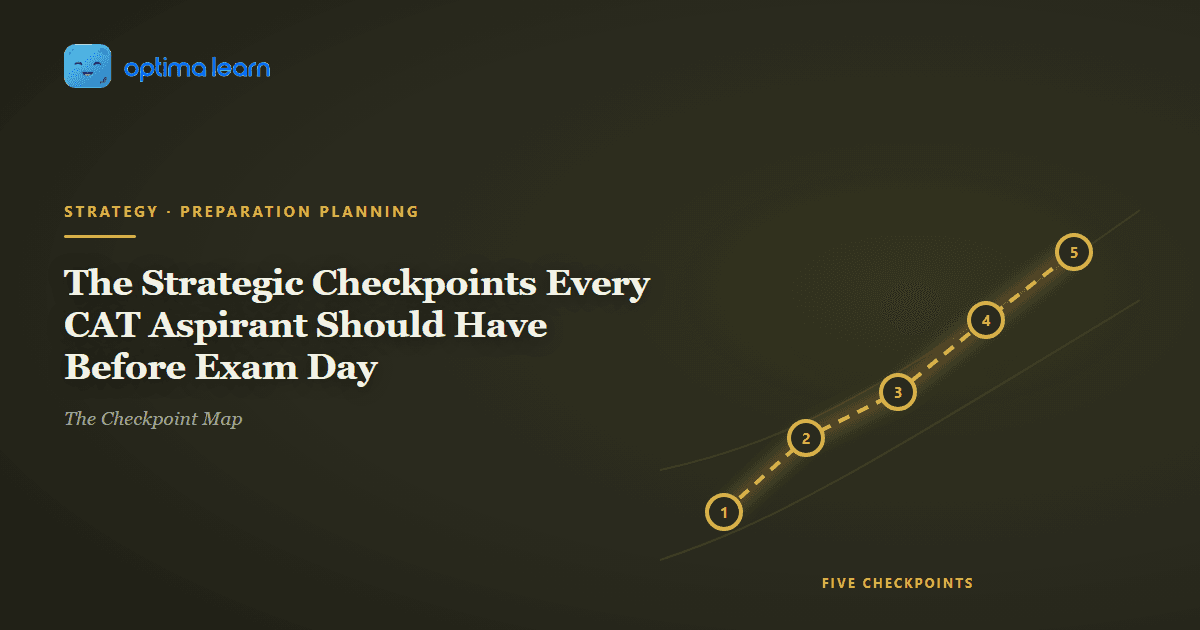
CAT preparation checkpoints barely exist for most aspirants. Ask one in August whether they are on track for CAT 2026 and you get a feeling, not an answer. It is nearly always the same feeling: broadly yes, a bit behind on one section, should probably do more mocks.
That answer is unfalsifiable, which is the problem. There is no date on which it could be shown to be wrong, no number that would contradict it, and no consequence attached to it being wrong. So it survives from August all the way to the week before the exam, at which point it turns out to have been optimistic.
A trail with numbered markers works differently. You are at marker three or you are not, and if you are not, you know it on the day rather than at the end.
- "On track" is unfalsifiable, which is why it survives all the way to November.
- The Checkpoint Map demands three things of every checkpoint: a date, a number, and a pre-committed response to missing it.
- Without a pre-committed response, a missed checkpoint gets explained away rather than acted on.
- Five checkpoints between now and 29 November 2026 is enough. More becomes bureaucracy.
- The point of a checkpoint is not motivation, it is early detection of a plan that has stopped working.
Why "On Track" Is Not a Status
Progress in CAT preparation is genuinely hard to feel. Hours accumulate, questions get solved, topics get covered, and all of that produces a strong sense of movement regardless of whether the score is moving.
Worse, the feeling is systematically biased. Comfortable work feels productive and uncomfortable work feels slow, so the areas you are strongest in contribute most to the sense of being on track while contributing least to the marks that are missing.
The result is a specific failure that repeats every year:
- Nothing looks wrong in August, September or October, because nothing is being tested against a threshold.
- The first genuine reality check is a mock in November, by which point options are limited.
- Every earlier warning sign was available and unmeasured.
- The response, when it comes, is to work harder rather than differently, because there was never a diagnosis.
The Checkpoint Map: What Makes a Checkpoint Real
Most self-imposed milestones fail one of these three, and failing any one makes the checkpoint decorative.
The Checkpoint Map
- Dated, not phased. "By mid-preparation" is not a checkpoint. 15 October is.
- Measurable. A number from a mock or a log, not a judgement about how you feel about a section.
- Pre-committed response. Decide in advance what changes if you miss it, because deciding afterwards means not deciding.
Dated matters more than it sounds, because an undated goal cannot be missed:
- A phase-based target slides forward with you and is therefore never failed.
- A date creates a moment at which the plan is compared with reality, which is the entire mechanism.
- Working backwards from 29 November 2026 gives you the dates for free.
Measurable is what makes the comparison possible at all:
- Percentile from a full mock, attempts per section, accuracy on attempted questions, questions never opened.
- "Comfortable with arithmetic" is not measurable and will always be reported as true.
- One number per checkpoint. Several numbers turn a checkpoint into a review.
Pre-committed response is the requirement almost nobody meets:
- Written before the checkpoint arrives, when you are not defending anything.
- Specific: "if VARC is below X on 15 October, the daily hour moves from Quant to RC for four weeks".
- Without it, a missed checkpoint produces an explanation rather than a change, and explanations are always available.
Put the Checkpoint Map to Work
Checkpoints need mocks to measure against, at a cadence that produces data rather than anecdotes.
Take CAT Mock TestsFive Checkpoints Before 29 November 2026
Five is enough. The dates below follow from the exam date rather than from anything published.
| When | What it tests | If you miss it |
|---|---|---|
| Mid-September | Syllabus coverage: nothing entirely unseen | Coverage becomes the only priority for three weeks |
| Mid-October | Weakest section above your floor in a full mock | Reallocate hours; stop starting new topics |
| End October | Attempts per section at target, accuracy holding | Switch from content work to selection practice |
| Mid-November | Three full mocks completed under timed conditions | Cancel remaining topic work; mocks only |
| Week of 22 November | Mocks at your allotted slot time, score stable | Consolidate only. Nothing new enters. |
The second row is the most important and the most commonly failed. Mid-October is the last point at which a weak section can genuinely be rebuilt rather than merely protected, and passing that date without checking is how a section ends up hedged by accident rather than by choice.
How to Set the Numbers
The thresholds have to be yours, because a generic target produces either false alarms or false comfort:
- Set them from your own baseline. A realistic step up from where you are now, not from where you would like to be.
- Use percentile rather than raw score, since raw scores are not comparable across mocks.
- Set a floor, not a target. The question is whether you have fallen below the level at which the plan still works.
- One number per checkpoint. Multiple thresholds turn a pass-or-fail into a discussion.
- Write the response next to the number, in the same sentence, so they cannot be separated later.
Common Mistakes With Checkpoints
Related errors:
- Phase-based milestones. "By the middle of preparation", which slides forward indefinitely.
- Unmeasurable criteria. Confidence, comfort, feeling ready. All will report positive.
- Too many checkpoints. Weekly reviews become administration and stop being read.
- Moving the threshold. Lowering the number after seeing the result, which deletes the information.
- No checkpoint before October. Which leaves the first real signal until there is little time to act on it.
A Drill for Setting Your Checkpoints
Twenty minutes, once, and it produces the only early-warning system you will have.
- Write the five dates above in your calendar, adjusted to your own schedule.
- Beside each, write one measurable number, taken from your current mock baseline rather than from an ambition.
- Beside each number, write the specific change you will make if you fall below it.
- On each date, spend five minutes comparing and acting. No extension, no renegotiation.
What aspirants typically find:
- The first checkpoint is usually failed, and that is the point.
- Writing the response in advance changes what actually happens on the day, far more than the number does.
- Two checkpoints in a row missed on the same metric means the plan is wrong rather than the effort.
- Five minutes on a date beats an hour of unstructured worry in the same week.
The Bottom Line
Preparation without checkpoints does not feel unstructured. It feels fine right up until November, because nothing in it can generate bad news. The point of a dated, measured, pre-committed checkpoint is not discipline; it is to make bad news arrive early enough to be useful.
The Checkpoint Map, Recap
- Dated: a real date derived from 29 November, not a phase.
- Measurable: one number from a mock, not a feeling.
- Pre-committed: the response written before the checkpoint arrives.
Build the Habit on Real Mock Data
Checkpoints need a mock series to measure against. Sit full CAT mock tests and past papers at a steady cadence and work through CAT previous year questions between them. More on planning sits in the CAT strategy blog archive, and if the checkpoints keep getting renegotiated it is worth having your plan reviewed honestly.
Set Your Checkpoints for CAT 2026
Bad news in September is cheap and bad news in November is not. Build the dates that make the difference visible.
Build Your CAT 2026 PlanFrequently Asked Questions
What checkpoints should I set before CAT 2026?
Five is enough between now and 29 November: syllabus coverage in mid-September, weakest section above its floor in mid-October, attempt counts at target by end-October, three full mocks completed by mid-November, and stable scores at your allotted slot time in the final week.
How do I know if I am on track for CAT?
You cannot know it from a feeling, because the feeling is biased by comfortable work. It requires a date, a number from a full mock, and a threshold set in advance. Without all three, "on track" is unfalsifiable and will report positive until November.
What should I do if I miss a checkpoint?
Whatever you wrote down before the checkpoint arrived. That is the whole point of pre-committing: a response decided in advance is made by someone with no result to defend, while a response decided afterwards is almost always an explanation of why no change is needed.
Can you have too many checkpoints?
Yes. Weekly reviews become administration, stop being read and produce no decisions. Five well-spaced checkpoints with one measurable number each are enough to catch a failing plan early, which is the only thing checkpoints are for.
Build your CAT 2026 study plan
Personalised daily plan that adapts to your section-wise mock scores.
More from Strategy
Continue reading

XLRI Admission Process: The Exam Nobody Ever Checks

Why Do Some CAT DILR Sets Feel Totally Unsolvable?
Why School Level Quant Feels Hard in the CAT Paper

Why Do Non Engineers Struggle in CAT VARC As Well?
Put it into practice