
Why Solving More Questions Can Actually Slow Your Quant Improvement
Open a serious CAT aspirant's practice tracker in September and you'll usually notice something strange. The question count keeps climbing steadily, week after week, while the accuracy line sitting right below it barely moves at all. Past the eight-hundred-question mark, most people stop asking why that line refuses to rise and simply solve faster instead. That instinct, that more Quant questions automatically means more improvement, is wrong more often than it's right.
Solving more Quant questions without reviewing why each wrong answer went wrong doesn't build new skill. It repeats the same mistake at a larger scale, which is a strange kind of practice to call progress.
- Solving more Quant questions without reviewing errors just repeats the same mistake at a larger scale.
- The Traction Gap names three traps that create motion without real score movement: the Volume Trap, the Fatigue Trap, and the Comfort Trap.
- Effort without feedback tends to calcify bad habits instead of correcting them, which is the core problem with unreviewed volume.
- Real traction comes from review time, not question count, since review is where the actual correction happens.
- A smaller number of questions followed by genuine error analysis usually beats a larger number solved and forgotten.
This is for aspirants whose practice count keeps climbing while their mock score refuses to move, especially anyone who already recognizes the same few root patterns behind hundreds of questions and is still stuck despite knowing them cold.
The Volume Illusion: Why More Questions Can Feel Like Progress and Not Be
Why does a bigger number on a practice tracker feel so reassuring, even when the score sitting right next to it hasn't moved at all?
A rising question count feels like progress because it's easy to measure and hard to argue with. Forty questions solved today beats twenty solved yesterday, at least on the tracker. But question count measures effort, not correction, and CAT Quant only rewards the second one. A wrong answer solved wrong twice in two different weeks was never practiced at all, just repeated.
Picture two aspirants working the same two-hour block. One solves forty questions back to back, three minutes each, and reviews nothing once the timer stops. The other solves twenty-four questions in seventy-two minutes, then spends the remaining forty-eight minutes reviewing the eight questions gotten wrong, six minutes on each. Both logged a two-hour session. Only one of them knows why eight specific mistakes happened.
This isn't a new idea, it applies to how any skill gets built, or fails to. A batsman who nets for two hours grooving the same flawed technique doesn't get better by hour three, only more confident in a flawed technique. Quant behaves the same way: repetition without a corrective loop grooves an error deeper instead of erasing it.
That doesn't mean the fix is simply solving fewer questions. Question count was never the number worth watching in the first place. Three specific traps turn a full practice log into flat momentum, and naming them is the first step toward escaping them.
The Traction Gap: Three Traps That Spin the Wheels
The Traction Gap describes the space between questions solved and score actually earned, and three traps create it: the Volume Trap, the Fatigue Trap, and the Comfort Trap. Each one produces visible activity, a rising count, a full session, a comfortable topic, while blocking the kind of correction a score improvement needs.
The Traction Gap, in Three Traps
- The Volume Trap: solving many questions without reviewing why each wrong answer went wrong, so the same error repeats at a higher count.
- The Fatigue Trap: pushing past real mental fatigue, where accuracy drops but every question attempted still gets counted as progress.
- The Comfort Trap: defaulting to topics already strong at because they feel productive, while the genuinely weak topics stay avoided.
The Volume Trap is the one aspirants fall into first, because it looks like the safest kind of effort. Forty questions solved is forty questions solved, whether or not any of the sixteen wrong ones get a second look. Without review, a wrong assumption about, say, when to apply the shortcut for successive percentage change just gets carried into the next fifty questions unchanged.
The Fatigue Trap hides inside a study log that only tracks question count by session, never accuracy by time within the session. A log built that way could show eighty percent accuracy in the first forty minutes and something closer to fifty percent in the last forty, and never once flag it, because both hours still count as "two hours of Quant practice" on paper.
The Comfort Trap is the quietest of the three because it feels like discipline instead of avoidance. Solving another set of Time-Speed-Distance questions when that topic is already a strength produces a satisfying stream of right answers, and satisfying is not the same as useful. Geometry, sitting at the bottom of the same aspirant's topic-wise accuracy sheet, stays untouched for another week.
Naming the trap is diagnostic, not corrective. What actually closes the Traction Gap is what a session looks like when none of the three traps get to operate unchecked.
Build a Practice Log Worth Reviewing
Random sets make review hard to structure. Solve topic-tagged CAT Quant previous year questions so every wrong answer points straight back to a specific pattern worth fixing.
Practice CAT Quant PYQsWhat Real Traction Actually Looks Like in a Study Session
Real traction shows up as a smaller number with a paper trail attached to it, not a bigger number with none. A session that produces twenty solved questions, six errors logged with a specific reason for each, and one topic re-tested after the fix moves a score more than solving double that many questions cold ever would.
What does a session that actually earns its two hours look like in practice?
- Solve in a focused block: twenty to twenty-five questions, timed, no pausing to check answers mid-set.
- Log every wrong answer immediately: not just that it was wrong, but which of three reasons it was wrong for, concept gap, calculation slip, or misread question.
- Re-derive, don't just re-read: solve the missed question again from scratch a day later, without looking at the original working.
- Re-test the pattern: find two or three fresh questions from the same root idea before moving to a new topic.
The second step, naming the reason a question went wrong, is the one aspirants skip most often, and it's the one that closes the gap. "Concept gap" needs a different fix than "calculation slip," and both need something completely different from "misread the question under time pressure." Lumping all three under "got it wrong" is what keeps the same error reappearing three mocks later.
Concept gap, concretely, looks like consistently missing successive-percentage-change questions because the shortcut, multiplying net factors instead of adding percentages, never fully replaced the slower method under time pressure. That's a different fix than a calculation slip, where the method was right and a decimal point moved somewhere in the arithmetic.
Closing the gap doesn't demand more hours in the day either. A twenty-question reviewed session and a forty-question unreviewed one both cost roughly the same two hours. The difference is entirely in where those two hours go, not how many of them there are.
Common Mistakes That Masquerade as Discipline
Which of the three traps has been steering your last few weeks of practice? The three traps rarely look like laziness, which is exactly why they survive so long. A six-hour Sunday practice marathon looks like commitment on the surface, even when four of those hours ran on fatigue and produced more wrong-answer rehearsal than actual correction.
| Panic Move | Pro Move |
|---|---|
| Measuring a session by questions attempted | Measuring a session by errors reviewed and reclassified |
| Solving past genuine mental fatigue to hit a daily target | Ending the session once accuracy visibly drops, and resuming fresh later |
| Repeating sets from a strong topic because they feel productive | Spending the same block on the topic sitting lowest on the accuracy sheet |
| Filing a wrong answer away without naming why it went wrong | Tagging every miss as a concept gap, calculation slip, or misread |
| Treating a long practice log as proof of progress | Treating a shrinking repeat-error list as proof of progress |
If your last few study plans have built in one of these traps without you noticing, it's worth having someone else look at the pattern; you can get your CAT prep plan reviewed free before locking in another month of the same routine.
Discipline that isn't pointed at review is just motion dressed up as effort. The fix isn't more willpower or a longer Sunday session, it's a five-minute structural change to how every practice block ends, tagging and re-testing instead of just tallying, and that's exactly what the drill below is built around.
A Practice Drill for Converting Volume Into Actual Improvement
The fastest way to close the Traction Gap is a fixed error-log ritual added to the end of every practice session, not a longer session. Five minutes of structured review after twenty-five questions catches more repeat mistakes than an extra hour of unreviewed solving ever will.
| Drill | What It Fixes | Frequency |
|---|---|---|
| Twenty-five question timed sets, error tagged concept, calculation, or misread immediately after | The Volume Trap, since every wrong answer gets a reason before the next set starts | Daily |
| A hard stop the moment accuracy visibly drops within a session, tracked by half-hour block | The Fatigue Trap, since fatigue-driven errors stop getting counted as real practice | Every session |
| One weak-topic block scheduled before any strong-topic revision, using the accuracy sheet as the guide | The Comfort Trap, since the lowest-accuracy topic gets first claim on fresh energy | 3 to 4 times a week |
| A same-pattern re-test: two fresh questions from each tagged error, attempted two days later | Confirms whether the fix actually held, not just whether the explanation made sense at the time | Weekly |
Track one number that question count can't fake: the repeat-error rate, the share of this week's mistakes that are the same tagged category as last week's. A falling repeat-error rate is real traction. A rising question count next to a flat repeat-error rate is just the Volume Trap wearing a longer log.
None of this argues for solving less Quant. It argues for making sure every question solved actually earns its place in the score, instead of adding to a count that stopped meaning much somewhere around the eight-hundred mark.
The Traction Gap, Recap
- The Volume Trap: questions solved without review repeat the same error at a bigger scale.
- The Fatigue Trap: accuracy drops past real mental fatigue while question count keeps climbing regardless.
- The Comfort Trap: strong topics get repeated because they feel productive, while weak topics stay avoided.
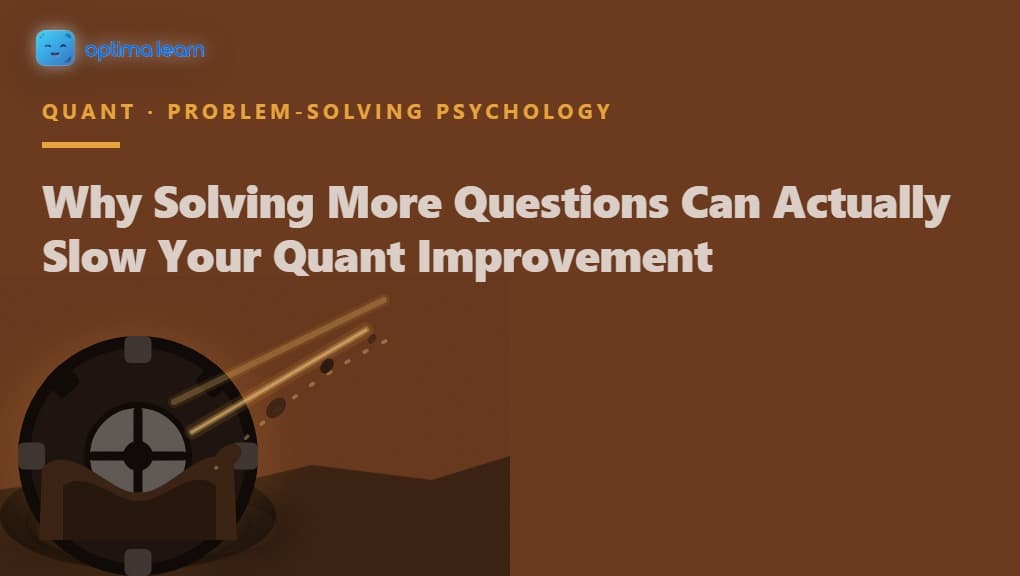
A wheel spinning in mud doesn't need a stronger engine, it needs traction, and traction comes from what grips the surface, not from how fast the wheel turns. The next time your practice tracker shows a big number for the week, ask what changed in your error log instead of asking how high the count went.
That single question, not a longer session, is usually the real unlock. It's the same shift behind a quant revision system built on error logs, not volume.
Test Whether Your Review Habit Actually Holds
The fastest way to know if a trap is still active is to solve a fresh set and tag every miss before checking the explanation.
Solve CAT Quant Previous Year QuestionsFrequently Asked Questions
How can solving more Quant questions actually hurt my improvement?
It doesn't hurt the questions themselves, it hurts your time allocation. Hours spent solving without reviewing why each error happened repeats the same mistakes at a larger scale, while the review time that would have actually fixed the pattern never happens.
What is the Fatigue Trap in Quant practice?
It's continuing to solve past the point of genuine mental freshness while still counting every attempted question as productive practice. Accuracy quietly drops during fatigue, and a study log that only tracks question count won't show this, only a log that tracks accuracy by time-of-session will.
How do I know if I've fallen into the Comfort Trap?
Check whether your recent practice sessions are dominated by topics you already score well on. It feels productive because you solve quickly and correctly, but it isn't closing the gap that's actually capping your score, which usually sits in the topics you've been quietly avoiding.
So should I solve fewer questions?
Not necessarily fewer, but fewer without review. A smaller number of questions followed by genuine error analysis usually beats a larger number solved and immediately forgotten, since the review step is where the actual learning happens, not the solving step.
Practice these Quant concepts, chapter by chapter
Thousands of CAT Quant practice questions by chapter and difficulty, each with a worked solution.
More from Quant
Continue reading
Why CAT RC Answer Options Often Feel Equally Correct

How To Study For CAT When You Are Mentally Exhausted

How To Stop Procrastinating On Your Weakest Section
How To Recover From A Wrong Start On A DILR Set Explained
Put it into practice