
How Many CAT Mocks Should You Take Before CAT 2026
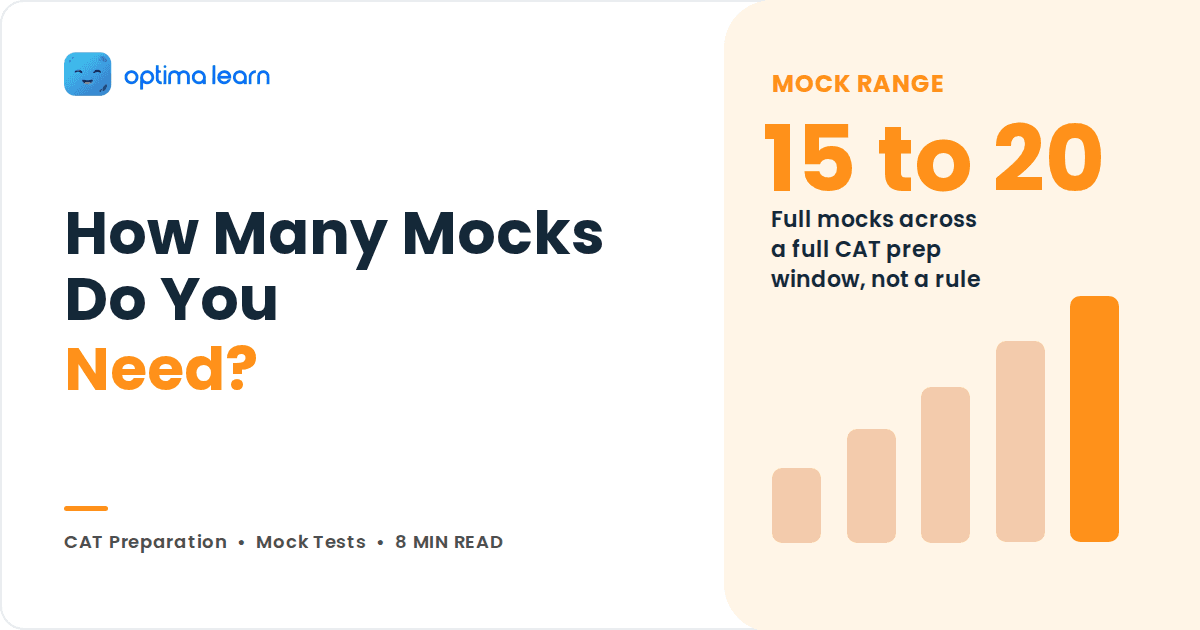
Why the number of mocks you take matters far less than what you do with each one afterward.
The aspirant with 30 mocks logged is not automatically ahead of the aspirant with 15. That sounds wrong the first time you hear it, since more practice should mean more improvement, but mock count and mock value are two different things, and CAT preparation is full of aspirants who confuse the two.
How many mock tests before CAT 2026 is actually enough is the wrong question on its own. The better question is how many mocks you can genuinely review, because a mock that never gets analysed teaches almost nothing beyond a number that makes you anxious for a day. Here is a realistic cadence, and why the review matters more than the count.
- How many mock tests before CAT 2026 depends more on review capacity than on a target number.
- A mock without a structured review afterward teaches close to nothing.
- Most aspirants preparing over 3 to 4 months land around 15 to 20 full length mocks, plus more sectional tests.
- There is no fixed relationship between mock count and percentile. Accuracy and question selection decide the score, not volume.
- A mock taken before real syllabus coverage mostly measures gaps you already knew existed.
Why More Mocks Do Not Automatically Mean a Better Score
A full length mock is a diagnostic instrument before it is anything else. It tells you where your accuracy breaks down, which set types cost you time, and which section drags your overall attempt count down. None of that information does anything on its own. It only helps once you act on it.
Taking a new mock every single day without time to review the last one produces the same mistake on repeat, just at a new venue each time. Practice volume stops helping once it outpaces your capacity to learn from it, and mocks are the clearest example of that pattern in CAT preparation.
There is also a marking mechanics reason the count matters less than aspirants assume. CAT rewards correct answers at plus 3, penalises a wrong MCQ at minus 1, and charges nothing for a question left blank. TITA questions carry no negative marking at all. A mock's real value is in showing you where your selection and accuracy break down under that specific marking scheme, not in adding another number to a running total.
The Mock Cadence Matrix: 4 Stages
The Mock Cadence Matrix maps mock type and frequency against your preparation stage, so the question shifts from "how many total" to "what kind, and how often, right now."
The Mock Cadence Matrix
- Foundation Stage: 1 diagnostic full mock to find your starting point, plus light sectional tests as chapters get covered.
- Coverage Stage: 1 sectional test a week per section as that section's syllabus gets built.
- Immersion Stage: 2 to 3 full length mocks a week, each followed by a same day or next day review.
- Taper Stage: mock frequency drops sharply in the final 2 weeks, replaced by review of past mistakes.
Total mock count falls out of this matrix rather than being chosen upfront. An aspirant with a longer runway naturally accumulates more mocks across the Coverage and Immersion stages, while a compressed timeline compresses the same four stages without skipping the review step inside each one.
Put the Mock Cadence Matrix to Work
Reading four stages is easy. Timing your specific mocks against your actual coverage is the part most study plans skip entirely.
Practice With Real CAT Previous Year PapersWhat a Healthy Mock Range Actually Looks Like
There is no fixed magic number, but a useful range exists for most aspirants preparing over a typical 3 to 4 month window. Treat the figures below as a planning reference, not a target to hit exactly.
| Preparation Window | Rough Full Mock Range | Sectional Tests |
|---|---|---|
| 8 or more months | 25 to 35 | Weekly from month 2 onward |
| 4 to 6 months | 18 to 25 | Weekly from the coverage stage |
| 3 to 3.5 months | 12 to 18 | Twice weekly once syllabus coverage begins |
Notice these are ranges, not targets. An aspirant who takes 14 well reviewed mocks in a 3 month window is very likely better prepared than one who rushed through 22 without reviewing most of them.
The ranges also are not evenly spread across your timeline. Most aspirants take relatively few mocks early, since coverage is still incomplete, and the frequency climbs as the exam approaches and more of the syllabus is genuinely ready to be tested. A schedule that is flat across the whole window, the same one mock a week from day one to exam day, usually front loads mocks before they are useful and under uses the final stretch when they matter most.
If you are unsure whether your current pace fits your remaining weeks, dated checkpoints against your CAT 2026 timeline make that visible instead of leaving it as a guess.
Common Mistakes in How Aspirants Count Their Mocks
The mock count conversation goes wrong in a few predictable ways, almost all of them rooted in treating the number itself as the goal.
- Starting mocks before real coverage exists. An early mock on an uncovered syllabus mostly confirms what you already suspected.
- Treating the percentile shown as fixed truth. Mock percentiles come from a small, self selected cohort and do not map directly onto a CAT percentile.
- Skipping sectional tests entirely. Sectional tests and full length mocks serve different purposes, and relying only on one leaves a real gap.
- Never revisiting old mocks. A mistake pattern from week 3 that resurfaces in week 10 is worth catching before exam day, not after.
- Ignoring set selection in DILR. Two aspirants who can solve the same set types can post very different scores if one consistently picks the harder set first under pressure. Mock review should cover which sets you chose, not only whether you solved them correctly.
A related trap worth naming directly: no fixed number of questions attempted guarantees a target percentile, in a mock or in the real exam. An aspirant who attempts fewer questions with higher accuracy routinely outscores one who attempts nearly the full paper with weak accuracy, because every wrong MCQ actively subtracts from a score that correct answers built. Chasing a specific attempt count is a common mock era mistake, and it is worth catching in review rather than repeating for months.
How Mock Frequency Should Interact With Your Broader Timeline
A mock count in isolation does not tell you whether your preparation is on schedule. The more useful question is whether your mock frequency is actually matched to where you are in the calendar between now and CAT 2026, since a pace that makes sense in September can be far too slow by late October.
Early on, mocks are diagnostic tools more than performance measures, so a lighter weekly cadence with heavier review is the right shape. As the exam gets closer, the balance should shift toward more frequent, full length, timed attempts that simulate the actual pressure of exam day, even if that means slightly less time available for fresh topic coverage in those final weeks.
A Practice Drill for Reviewing a Mock Properly
This is the step most mock schedules skip, and it is the one that actually converts a test into progress.
- Separate wrong answers by cause. Split them into concept gaps, careless errors, and time pressure decisions, since each needs a different fix.
- Flag your slowest correct answers too. A right answer that took four minutes is still a speed problem worth noting.
- Write one sentence per section. Name the single biggest lesson from that section in this specific mock.
- Check it against your last 2 mocks. A repeating pattern across three mocks is more urgent than a one time slip.
- Set one adjustment for the next mock. Not five. One specific, testable change.
Once a mistake pattern is identified, close it with targeted chapter practice rather than another full mock. Optima Learn's chapter wise practice questions let you drill exactly the gap a mock exposed, which is a faster fix than waiting for the same topic to reappear in your next test.
The Bottom Line
How many mock tests before CAT 2026 stops being the right question once you see what mocks are actually for. They are not a volume target, they are a diagnostic loop, and the loop only works if review keeps pace with testing.
The Mock Cadence Matrix, Recap
- Foundation Stage: one diagnostic mock, light sectionals.
- Coverage Stage: weekly sectionals as each section gets built.
- Immersion Stage: 2 to 3 full mocks weekly, reviewed within a day.
- Taper Stage: mock frequency drops, review of old mistakes rises.
The aspirant who takes fewer, well reviewed mocks almost always outpaces the one chasing a bigger number on a spreadsheet. The count was never the real variable.
Build the Habit of Reviewing Every Mock
A mock without a review plan is a wasted testing slot. Optima Learn's practice and previous year question sets help you drill the specific gaps your mocks expose.
See What Your Mock Score PredictsFrequently Asked Questions About CAT Mock Counts
How many mock tests should I take before CAT 2026?
Most aspirants preparing over 3 to 4 months land in a range of roughly 15 to 20 full length mocks, alongside a larger number of sectional tests. The exact count matters less than whether each mock gets a real review, since an unreviewed mock teaches almost nothing.
Is it possible to take too many CAT mocks?
Yes. Taking a new full length mock every single day, without time to review the previous one, usually just repeats the same mistakes at a new venue. Review time is what converts a mock into an improvement, and that time has to be protected.
Should I start CAT mocks early or wait until the syllabus is covered?
Wait until your fundamentals are stable enough that a mock measures your actual preparation rather than basic gaps. An early diagnostic mock is useful, but a heavy mock schedule works best once real syllabus coverage exists underneath it.
Do more CAT mocks guarantee a higher percentile?
No. There is no fixed relationship between mock count and percentile, since percentile depends on accuracy, question selection, and the specific paper's difficulty, not on a raw number of tests attempted. A reviewed mock moves the needle more than an unreviewed one.
Build your CAT 2026 study plan
Personalised daily plan that adapts to your section-wise mock scores.
More from Strategy
Continue reading

Why CAT RC Answer Options Often Feel Equally Correct

How To Study For CAT When You Are Mentally Exhausted

How To Stop Procrastinating On Your Weakest Section

How To Recover From A Wrong Start On A DILR Set Explained
Put it into practice