
When More CAT Practice Stops Helping
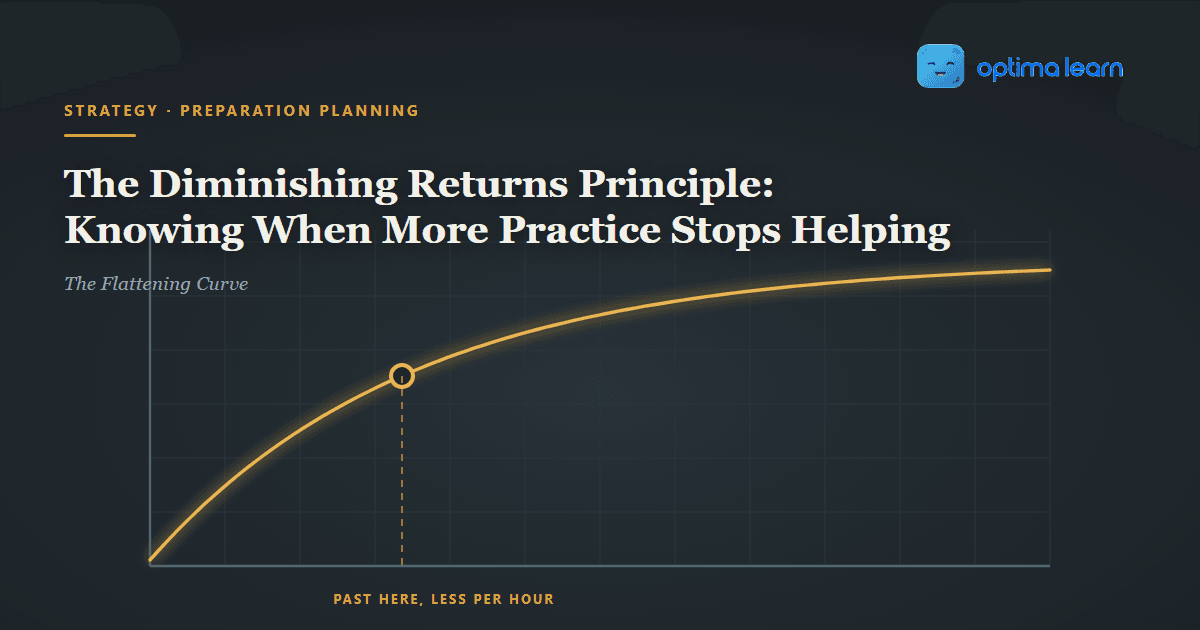
Diminishing returns arrive quietly, and knowing when more CAT practice stops helping is the whole problem. The first two hundred Quant questions you solve change you considerably. The next two hundred change you noticeably. Somewhere past that, two hundred more produce a difference you cannot detect in a mock score, and the hours are identical.
Almost every aspirant hits this and reads it as a personal ceiling. The honest reading is different: the input has stopped being the constraint. More of something that has stopped working does not start working because you do more of it.
A learning curve rises steeply and then flattens. Not because effort stopped mattering, but because the thing that effort was fixing has largely been fixed, and what remains is limited by something else entirely.
- Practice volume has a steep phase and a flat phase, and most aspirants keep applying steep-phase inputs long into the flat one.
- The Flattening Curve is detectable with three signals: gain inside the noise, errors changing type rather than rate, and time-per-question refusing to fall.
- Hitting the flat part is not a ceiling. It means the constraint has moved and the input needs to change with it.
- The fix is a different input, not a larger one: review depth, method work, full-section practice or simulation.
- Every topic has its own curve, so you can be flat in one area and steep in another at the same time.
Why More Practice Stops Working: Diminishing Returns in Preparation
Practice fixes a specific thing: the gap between not being able to do something and being able to do it. Once that gap closes, additional repetitions have very little left to act on.
What remains is a different kind of limit. You now know the methods and can execute them, and your score is held back by which questions you choose, how quickly you recognise a structure, or how you perform under exam conditions. None of those respond to solving another hundred questions of the kind you can already solve.
The trap is that volume remains the easiest input to increase:
- It is measurable, so it feels like progress even when nothing moves.
- It is comfortable, because you are practising what you can already do.
- It requires no diagnosis, which is the part most people would rather skip.
- It is what everyone else appears to be doing, which makes stopping feel risky.
The Flattening Curve: Three Signals You Are on the Flat Part
All three are visible in mock data you already have, which makes this diagnosable rather than a matter of feel.
The Flattening Curve
- Gain is inside the noise. Your month-on-month improvement is smaller than the variation between consecutive mocks. Real gains have to exceed your own scatter.
- Errors change type, not rate. You fix one class of mistake and a different class appears at the same frequency. Total errors stay flat.
- Time per question stops falling. Speed is the most responsive thing to practice, so when it stalls, practice has stopped being the constraint.
Gain inside the noise is the most rigorous of the three and the one aspirants never compute:
- Take the spread of your last six mock scores. That range is your noise.
- Compare your improvement over the same period against that range.
- If improvement is smaller than the spread, you cannot yet claim to have improved at all.
Errors changing type is the clearest sign that volume has stopped acting on anything:
- Calculation slips fall, setup errors rise, and the total stays where it was.
- You solve the topics you drilled and lose marks on selection instead.
- Each individual fix works, and none of them shows up in the score.
Time per question stalling is the earliest signal of the three:
- Speed responds to practice faster than accuracy does, so it flattens first.
- If your average time on a familiar topic has not moved in a month, that topic is flat.
- Speed that has stalled while accuracy is still rising means you are near the flat part but not on it.
Put the Flattening Curve to Work
Diagnosing which curve you are on needs mock data at a steady cadence. Optima Learn's mocks and past papers give you the series to measure against.
Take CAT Mock TestsWhat to Change When the Curve Flattens
The answer is never "stop practising". It is to change what the practice is for.
| What has flattened | The old input | The input that still works |
|---|---|---|
| Accuracy on a drilled topic | More questions of that topic | Harder variants, or a different topic entirely |
| Speed on familiar questions | Repetition | Method work: fewer lines, not faster lines |
| Section score with good accuracy | More questions | Full-section practice and selection drills |
| Mock score with strong untimed work | More content | Simulation at exam time, under exam conditions |
| Everything at once | More hours | Review depth: fewer questions, analysed properly |
The last row is the one most aspirants need and least want. Solving twenty questions and analysing each one properly beats solving eighty and checking answers, and it is considerably less enjoyable, which is why it is under-used.
Why Every Topic Has Its Own Curve
The curve is not one thing. You can be on the flat part in arithmetic and the steep part in geometry in the same week, which means blanket judgements about practice are usually wrong.
- Check curves per topic, not per section. A flat section score can hide one flat topic and one steep one.
- Steep areas deserve volume. Where the gap is still knowledge, practice is exactly the right input.
- Flat areas deserve maintenance only. Enough to hold the level, not enough to chase gains that are not there.
- Reallocating from flat to steep is usually the single largest available gain, and it costs no extra hours.
- Re-check monthly. A steep topic becomes flat once it has been worked, and the allocation should follow.
That reallocation is the practical link to reviewing a plan on a cycle rather than following it to the end.
Common Mistakes When Progress Stalls
Related errors:
- Reading the plateau as a ceiling. Concluding you have reached your limit when you have reached your input's limit.
- Ignoring noise. Treating a good mock as improvement and a bad one as regression, when both sit inside normal scatter.
- Judging by section, not topic. Missing that one topic is still steep while another is flat.
- Skipping review. Choosing volume over analysis because volume is more comfortable and more countable.
- Changing everything. Overreacting to a plateau by rebuilding the whole plan, so nothing runs long enough to evaluate.
A Drill for Finding Where You Are on the Curve
The drill produces a per-topic picture, which is what a section-level score hides.
- List your six most-practised topics. For each, pull accuracy and average time from the last month and from two months before.
- Mark each topic steep if both improved, flat if neither did, and mixed otherwise.
- For every flat topic, cut its allocation by half.
- Move those hours to steep topics, or to review depth if nothing is steep.
What aspirants usually find:
- Two or three topics are flat and are receiving a disproportionate share of the hours.
- The topics that are still steep are usually the ones being avoided.
- Section scores move within a month of reallocation, without any increase in total hours.
- Where nothing is steep, the constraint is almost always selection or composure rather than content.
The Bottom Line
Effort has a shape. It works enormously well at first, then less, and eventually the thing it was fixing is fixed and something else is holding the score down. Recognising that is not an argument for working less. It is an argument for working on the thing that is currently binding, which requires a diagnosis that more hours will never produce.
The Flattening Curve, Recap
- Gain inside the noise: improvement smaller than your own mock-to-mock scatter.
- Errors change type, not rate: each fix works and the total stays put.
- Time per question stalls: speed flattens first, so it is the earliest signal.
Build the Habit on Real Mock Data
You cannot see a curve without a series, so this needs mocks at a steady cadence. Sit full CAT mock tests and past papers regularly and work through CAT previous year questions between them, analysed rather than merely completed. More on preparation planning sits in the CAT strategy blog archive, and if a plateau has lasted more than two months it is worth rebuilding the plan around your current constraint.
Find Your Constraint Before CAT 2026
A plateau is information about your input, not a verdict on your ceiling. Diagnose which curve you are on before adding another hour.
Get Your Strategy ReviewedFrequently Asked Questions
Why has my CAT score stopped improving despite more practice?
Because volume has stopped being the constraint. Practice closes the gap between not being able to do something and being able to do it, and once that gap is closed, extra repetitions have little left to act on. What holds the score down next is usually selection, speed of recognition, or composure.
How do I know I have hit diminishing returns?
Three signals in your own mock data: improvement smaller than the spread between your recent mocks, errors changing type while the total stays flat, and average time per question refusing to fall on familiar topics. Speed flattens first, so it is the earliest warning.
Should I practise less when I plateau?
Practise differently rather than less. Cut allocation on topics where accuracy and speed have both been flat for a month, and move those hours to topics still improving, or to deeper review if nothing is. Solving twenty questions analysed properly beats eighty merely completed.
Is a plateau a sign I have reached my limit?
Almost never. In most cases you are still improving at the thing you are practising, and that thing has stopped being what your score depends on. Finding the new constraint requires diagnosis, which is the part adding hours conveniently avoids.
Build your CAT 2026 study plan
Personalised daily plan that adapts to your section-wise mock scores.
More from Strategy
Continue reading

XLRI Admission Process: The Exam Nobody Ever Checks

Why Do Some CAT DILR Sets Feel Totally Unsolvable?

Why School Level Quant Feels Hard in the CAT Paper

Why Do Non Engineers Struggle in CAT VARC As Well?
Put it into practice