
CAT Score vs Percentile: Why Attempts Alone Mislead
What score gets you 99 percentile? The honest answer is that the question itself is the mistake. There is no fixed CAT score vs percentile conversion. The question assumes a number sits waiting on the other side of the exam. It does not. Two aspirants can submit the same raw score in the same slot and walk away with different percentiles, because percentile is never a property of your paper alone.
The more common version of the same question, the one that actually drives bad exam day decisions, is "how many questions should I attempt." That number does not exist either. What decides your outcome is not how many questions you touch, but what you do with the ones you touch, multiplied by how many you touch, and this piece walks through that arithmetic properly so you stop guessing at a borrowed target.
Before anything else, see where your own numbers actually sit. Run a completed mock through the CAT Score Predictor and look at your net score next to your attempt count, not just the final total.
- There is no fixed attempt count that guarantees a percentile. Net score depends on attempts and accuracy together, and percentile depends on the whole test taking population that day.
- CAT's marking is +3 for a correct answer, minus 1 for a wrong MCQ, 0 for unattempted, and TITA questions carry no negative marking at all.
- Attempting more questions at low accuracy can produce a lower net score than attempting fewer questions at high accuracy, on the exact same paper.
- Your real lever is knowing your own accuracy at different confidence levels, then attempting to the edge of where that accuracy holds, not to a headline number someone else set.
- Percentile adds a second layer of uncertainty on top of your raw score, because it is set by normalization across every slot, not by your score in isolation.
Why Attempt Count Is the Wrong Question to Ask
Every CAT season, the same forum thread resurfaces. Someone posts a mock score, and the replies fill up with a single question: how many did you attempt. Attempt count is easy to compare, easy to brag about, and easy to turn into a target. None of that makes it the right variable to chase.
A CAT paper punishes a wrong MCQ by taking a full mark away, on top of the mark you never earned. That single rule breaks the assumption most aspirants carry from school exams, where more attempts almost always meant more marks. On CAT, more attempts only help if the accuracy behind them holds up. Push past the point where your accuracy is reliable, and you are not adding to your score. You are quietly taking from it.
This is not a reason to attempt cautiously out of fear. It is a reason to attempt deliberately, based on what you actually know in the moment, section by section and question by question. Deliberate attempting is a discipline you can rehearse for months before results day, not an instinct you either happen to have or do not.
Mentors who review scripts after every mock season notice the same pattern. The aspirant chasing a round attempt number almost always has a lower net score than the one who simply answered what they were sure of and left the rest blank. The second aspirant is not less ambitious. They just stopped treating attempts as the scoreboard.
How CAT Marking Actually Turns Attempts Into a Score
Before the strategy makes sense, the arithmetic behind it has to be clear. CAT scores every question on the same simple rule, and that rule is the entire reason attempt count cannot be optimized on its own, no matter how confident an aspirant feels that morning.
The Marking Rule in One Line
A correct MCQ earns three marks. A wrong MCQ costs one mark. An unattempted question earns and costs nothing. That third option, the blank, is the one most attempt count advice quietly ignores, and it is the one doing most of the protective work in a strong net score.
Why TITA Changes the Calculus
Type In The Answer questions work differently. A correct TITA still earns three marks, but a wrong TITA costs nothing, the same as leaving it blank. The downside math above applies only to multiple choice questions. A TITA question you are unsure of is a safer attempt than an equally unsure MCQ, because a TITA guess cannot cost a mark, only fail to earn one.
| Outcome | MCQ | TITA |
|---|---|---|
| Correct | +3 | +3 |
| Incorrect | -1 | 0 |
| Unattempted | 0 | 0 |
One Mock, 66 Questions: What Overattempting Actually Cost
Numbers explain this faster than adjectives do, so here is a real worked example. Take a mock, sat deliberately to study how CAT's marking behaves under pressure rather than to chase a score. The paper ran 66 questions across 198 marks, in line with recent CAT papers, which have generally run 66 to 68 questions rather than a fixed count.
The Arithmetic, Step by Step
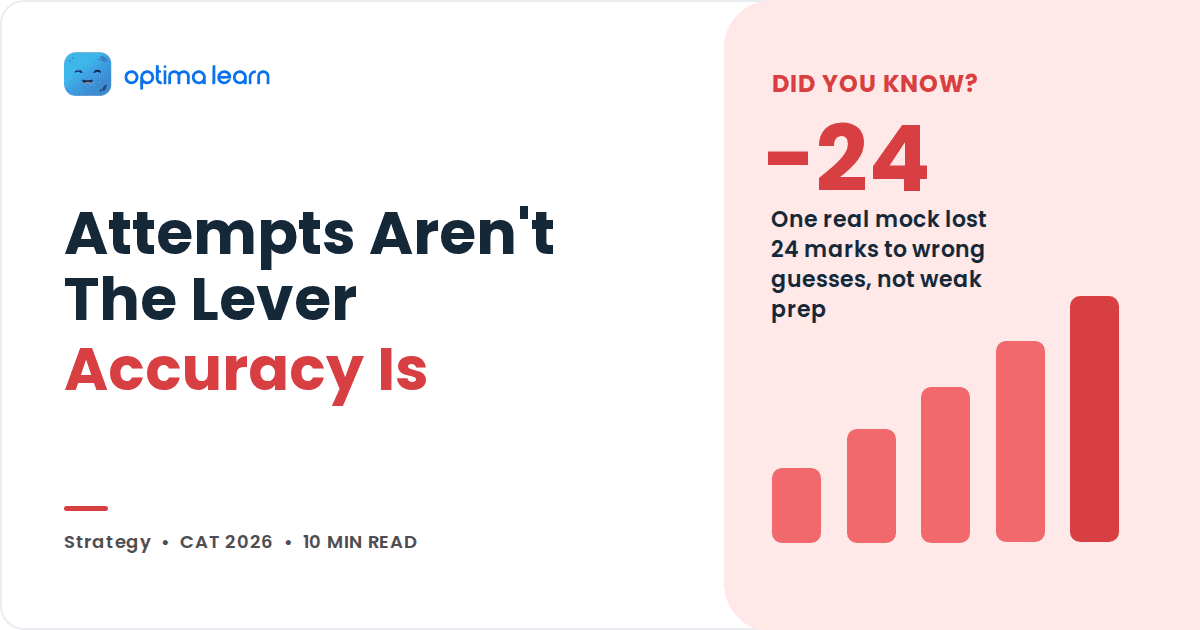
63 of the 66 questions were attempted, at roughly 41 percent accuracy, which works out to about 26 correct answers. The gross value of those 26 correct answers is 26 times 3, or 78 marks. The actual net score on the paper was 54 marks. The gap between those two numbers, 24 marks, is exactly what the 37 wrong attempts cost.
Run the counterfactual and the point becomes impossible to miss. Had only the 26 answers that were actually known been attempted, with the remaining 40 questions left blank, the same paper returns 78 marks instead of 54. Attempting nearly the entire paper made the score worse than attempting under two thirds of it would have. The extra attempts were not neutral. They were actively expensive.
Treating a blank answer as a wasted opportunity. A blank costs nothing. A wrong MCQ costs a full mark on top of the mark never earned. On a section where your accuracy is genuinely low, the blank is not the timid choice. It is the mathematically correct one.
The Attempt Accuracy Matrix: Net Score Across 9 Outcomes
The worked example above shows what happened on one paper. The Attempt Accuracy Matrix shows why, by holding the paper constant and changing only two things: how many questions get attempted, and how accurate those attempts are. Every cell is a net marks calculation on the same paper, using the plus three, minus one arithmetic above. No cell is a percentile, which is a separate step covered further down.
Reading the Grid
Three attempt levels run down the side. Conservative means 50 of the 66 questions. Moderate means 58. Aggressive means all 66. Three accuracy levels run across the top: 50 percent, 70 percent, and 90 percent. Multiply attempts by accuracy for correct answers, apply plus three and minus one, and the net marks land where they land.
| Attempts | 50% accuracy | 70% accuracy | 90% accuracy |
|---|---|---|---|
| Conservative (50) | 50 | 90 | 130 |
| Moderate (58) | 58 | 104 | 151 |
| Aggressive (66, full paper) | 66 | 119 | 172 |
What the Grid Actually Proves
Look along the top row first, the 50 percent accuracy column. Going from Conservative to Aggressive, attempting 16 more questions at that accuracy adds only 16 net marks, the smallest gain on the whole grid. That is what an aspirant guessing their way to a bigger attempt count actually buys: almost nothing, because every extra correct answer is nearly cancelled out by an extra wrong one.
Now compare Moderate at 90 percent accuracy, 151 marks, against Aggressive at 50 percent accuracy, 66 marks. Fewer attempts, dramatically higher score, because the lever that moved the number was never the attempt count. It was accuracy. Aggressive attempt counts only pay off once accuracy is already high, and by then the attempt count was never the thing worth optimizing in the first place.
Finding Your Own Accuracy Tiers Before Exam Day
The matrix only helps if you know which row and column describe you, and most aspirants genuinely do not, because they track overall accuracy instead of accuracy by confidence level. Overall accuracy hides the exact information you need on exam day.
Tag Every Practice Question by Confidence, Not Just Correctness
While solving mocks and sectional sets, mark each question as sure, likely, or guess, before checking the answer. Then score your accuracy separately within each tag. Most aspirants discover their sure tier sits close to 90 percent while their guess tier sits closer to 40, and those two numbers, not the overall average, are what should decide an attempt on exam day.
Convert Section Practice Into a Real Accuracy Number
Build this by section, because your confidence tiers rarely match across Quant, DILR and VARC. Work through CAT Quant practice questions and track accuracy by chapter and by confidence tag, not just a single running score. Do the same with CAT VARC practice questions, where sure tier accuracy often runs higher on inference than on tone, and with CAT DILR practice questions, where set selection matters more than raw speed.
Once you can name your sure tier accuracy for each section, you already know more about your realistic attempt ceiling than any generic target ever told you. That number is yours, it moves as your preparation improves, and it is the only version of "how many to attempt" worth trusting on exam day.
Why Percentile Adds a Second Layer of Uncertainty
Net score is only half the picture. CAT converts every candidate's score to a percentile through normalization, a process that accounts for the fact that slots differ slightly in difficulty. Your percentile is your position relative to everyone who sat the exam that day, not a fixed conversion from your raw score.
That is precisely why no honest source can hand you a table saying a given score always equals a given percentile. The same net score can land in a different percentile band depending on how the rest of that day's test takers performed, and that population changes every year.
A worked example on one mock cannot tell you your CAT percentile either, because a mock cohort is small and self selected, nothing like the scale of a real national exam.
None of this makes net score meaningless. It is still the only number you control. It just means the honest goal is maximizing your own net score, then letting normalization run, rather than reverse engineering a target percentile into an attempt count that does not exist. Our piece on why the same CAT score gives a different percentile walks through the normalization mechanics in more depth than fits here.
Stop Guessing. Run Your Own Numbers.
You have seen the Attempt Accuracy Matrix. Now see what it looks like on your own response sheet, section by section, and get a real net score instead of a borrowed target.
Calculate My Net ScoreBuilding an Attempt Strategy You Can Actually Trust
Turning this into an exam day habit takes less machinery than it sounds like. It comes down to setting a ceiling instead of a target, and rehearsing the moment you decide to skip a question rather than leaving that decision to whatever mood you happen to be in that morning.
Set an Attempt Ceiling, Not an Attempt Target
A target says attempt this many questions no matter what. A ceiling says stop attempting once your confidence drops below your known sure tier accuracy for that section, whatever the count ends up being. The ceiling moves with the paper. The target never does, which is exactly why it fails on a harder than expected set.
- Solve the question fully before deciding whether to answer it, not the other way around.
- Tag your confidence as sure, likely, or guess the moment you finish solving.
- Answer every sure and likely question in the section without hesitation.
- On a guess tagged MCQ, attempt it only if you can eliminate at least two options.
- On a guess tagged TITA, attempt it anyway. A wrong TITA costs nothing.
Rehearsing the Ceiling Until It's Automatic
Rehearsing this under real time pressure matters more than understanding it in theory. Work through previous year CAT exam papers under strict timing and apply the same ceiling rule question by question, so the decision is already automatic before results day arrives.
- Do you know your sure tier accuracy for each section, not just your overall accuracy?
- Are you still attempting MCQs you cannot eliminate a single option on?
- Do you leave guess tagged MCQs blank on purpose, or only by accident when time runs out?
- Would your last mock's net score have gone up or down if you had attempted 10 fewer questions?
A ceiling built from real numbers is also easier to plan around outside exam day. If tracking confidence tiers by hand across three sections feels like a lot to hold in your head every week, a personalised CAT preparation plan can carry that tracking for you and flag exactly which chapters are dragging your sure tier down before the next mock.
Turn the Arithmetic Into Your Exam Day Plan
Knowing the mechanism is the first step. Turning it into a section wise attempt ceiling you actually follow on results day is the next one.
Build My CAT Preparation PlanFrequently Asked Questions About CAT Score vs Percentile
Is there a fixed number of questions to attempt for a given percentile?
No. Net score depends on attempts and accuracy together, and percentile depends on normalization across every candidate who sat that slot. Run your own numbers through the Attempt Accuracy Matrix above rather than trusting any table claiming a fixed attempt count equals a fixed percentile, since that presents a variable relationship as if it were constant.
How is CAT percentile actually calculated from a raw score?
Your raw score goes through normalization, which adjusts for small difficulty differences between slots, then your position relative to every other test taker that year sets your percentile. It is a relative measure, not a direct conversion, which is why the same score can land differently across years.
What accuracy should I aim for in CAT?
There is no single target accuracy that fits every aspirant. What matters is knowing your own accuracy at each confidence tier by section, then attempting up to the edge of where that accuracy holds, rather than borrowing a number that was never measured on your own preparation.
Does a wrong TITA answer carry negative marking in CAT?
No. TITA questions carry no negative marking. A correct TITA earns three marks, and a wrong or blank TITA earns zero. Negative marking in CAT applies only to incorrect MCQ answers, which is the detail that makes TITA guesses meaningfully safer than MCQ guesses.
Build your CAT 2026 study plan
Personalised daily plan that adapts to your section-wise mock scores.
More from Strategy
Continue reading

Why CAT RC Answer Options Often Feel Equally Correct

How To Study For CAT When You Are Mentally Exhausted

How To Stop Procrastinating On Your Weakest Section

How To Recover From A Wrong Start On A DILR Set Explained
Put it into practice