
The Momentum Shift: Recognising the Exact Moment to Abandon One Quant Approach for Another
There is a particular kind of CAT Quant failure that does not feel like failure while it is happening. You picked a sensible method. You are executing it correctly. Every line follows from the one above it. And you are four minutes in with nothing to show, because the method was wrong for this question and nothing about doing it well was ever going to fix that.
This is not the same as staying too long on a question you should have left. That decision is about the question. This one is about the approach, and it comes earlier. Most aspirants who lose a Quant section lose it here, in the gap between "my method is not working yet" and "my method is not going to work."
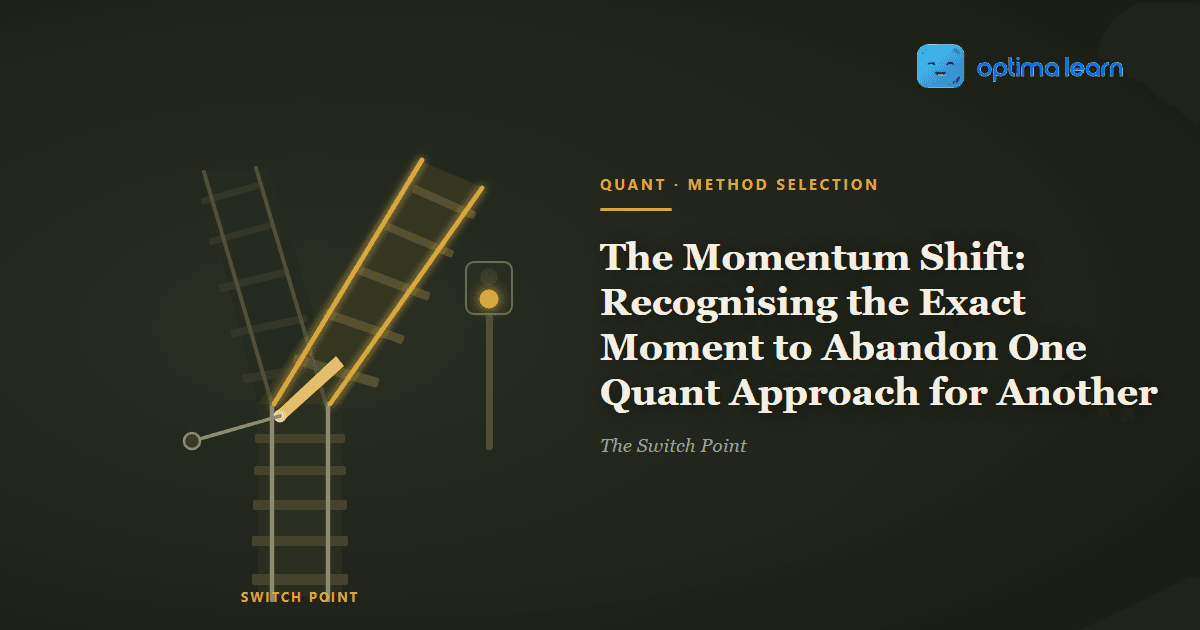
Railways have a name for the place where that decision gets made. It is the switch point, and the defining feature of a switch is that it only exists for a short stretch of track.
- Abandoning a method is a different decision from abandoning a question, and it comes considerably earlier.
- A method that is going to work shows progress inside about ninety seconds. One that is not will keep producing correct lines that go nowhere.
- The Switch Point has three signals: the repeating line, the rising cost per step, and the method fighting the data.
- Switching is cheap when you have a menu to switch to. Most aspirants stay with a failing method because they cannot think of a second one under pressure.
- Correct execution is not evidence of a correct approach, and mistaking one for the other is what makes the loss invisible.
Why a Correct Method Can Still Be the Wrong One
Almost every CAT Quant question can be solved more than one way. Setting up simultaneous equations, substituting convenient values, working backwards from the options, testing a boundary case, drawing the figure rather than computing it: these are all legitimate, and on any given question one of them is dramatically faster than the rest.
On a single question those routes diverge enormously in cost:
- Simultaneous equations: reliable, and usually the most expensive per unknown.
- Assigning convenient values: near-instant when roles are interchangeable, useless when they are not.
- Working backwards from the options: bounded by the number of options, so it can never run away from you.
- Testing a boundary case: often answers a maximum or minimum question outright without touching the general case.
The trouble is that the slow ones are not wrong. They terminate. If you had unlimited time, brute-force algebra would answer most CAT questions. So there is no error to catch, no contradiction, no moment where the page tells you to stop. You just keep going, correctly, into a wall you cannot see.
That is why this decision has to be made on evidence about rate of progress rather than evidence about correctness. Correctness will not save you.
The Switch Point: Three Signals Your Method Has Stopped Paying
Each of these is visible on your rough sheet, which matters, because the clock is exactly the thing you will not be watching.
The Switch Point
- The Repeating Line: you have written structurally the same line three times with different numbers. The method is looping rather than converging.
- The Rising Cost Per Step: each step is taking longer than the one before. A method that fits a question gets easier as it goes, not harder.
- The Method Fighting the Data: you keep converting between forms to keep the approach alive. Conversion work is not progress, it is maintenance.
The Repeating Line is the earliest signal and the easiest to verify, because it is a property of the page rather than of your memory. Look for:
- Three lines with the same shape and different constants.
- An expression you have expanded, factorised, and then expanded again.
- The same substitution made twice because the first one did not simplify anything.
The Rising Cost Per Step is the most reliable and the most counter-intuitive. Aspirants expect hard questions to get harder. In practice, a well-matched method narrows the problem, so the later steps are the cheap ones. When the reverse happens, the method is generating complexity rather than removing it:
- Your first line took ten seconds and your fourth is taking ninety.
- You have moved from integers to fractions to decimals without being asked to.
- You are now solving a sub-problem you invented, not one the question posed.
The Method Fighting the Data shows up when the shape of the given and the shape of the method disagree. The classic case is forcing algebra onto a question whose numbers are begging to be tested directly:
- You are rationalising, clearing denominators, or converting units repeatedly.
- The question gave you options that are clean integers and you have not looked at them once.
- You are carrying a general variable through a question that named a specific quantity.
Put the Switch Point to Work
Switching methods mid-question feels expensive until you have done it enough times to trust it. Optima Learn's Quant sets follow real CAT patterns, so the questions that punish a single fixed approach show up the way they will in the exam.
Practise CAT Quant QuestionsWhat to Switch To: The Menu That Makes Switching Cheap
Recognising the switch point is useless if you have nowhere to go. Most aspirants stay with a failing method because under pressure they cannot generate an alternative, and inventing one at minute three costs more than continuing. So the menu has to be memorised in advance.
| If you started with | Switch to | Works best when |
|---|---|---|
| Simultaneous equations | Assigning convenient values | Roles are interchangeable or only a ratio is asked |
| Forward algebra | Working backwards from the options | Options are clean integers and few in number |
| General case | A specific boundary case | The question asks for a maximum, minimum or range |
| Formula application | Drawing and reading the figure | Geometry, or anything with a spatial relationship |
| Case enumeration | Finding the constraint that kills most cases | The list is branching faster than you can write |
Two things make this menu usable rather than decorative. First, each switch is a genuine change of kind, not a variation of the same idea. Second, each one is cheap to start, so a switch that also fails costs you thirty seconds rather than three minutes.
Why Switching Feels Worse Than It Is
There is a real psychological cost here and it is worth naming, because the arithmetic and the feeling point in opposite directions.
- The work looks wasted. It is not. Two minutes of failed algebra usually clarified the structure, which makes the second method faster than it would have been cold.
- Switching feels like admitting error. It is not an error. Choosing a method before you know the question well is unavoidable, and revising it is the system working.
- The new method might also fail. Sometimes it will. But a second method that fails in forty seconds is far cheaper than a first method that fails in four minutes.
- You lose your place. Only if you scrub the page. Leave the old work visible; you will often need one line of it.
Once you have switched and the second method also stalls, you are no longer making a method decision. You are making a question decision, which is covered in why every CAT Quant question has a point of no return. Two failed methods is a strong signal that the question itself should go.
How Long to Give a CAT Quant Approach Before Switching
Ninety seconds is the working number, but it is a ceiling rather than a rule, and several things pull it earlier.
- Earlier when the clock is short. With eight minutes left there is no room for a second method, so the first one gets sixty seconds, not ninety.
- Earlier on an unfamiliar topic. Your choice was a weaker guess to begin with, so evidence against it should carry more weight.
- Later when the options are ugly. If working backwards is off the menu your alternatives are fewer, and switching is worth less.
- Immediately on the second repeating line. This overrides the clock entirely; a loop does not become a spiral with more time.
- Never past three minutes. Beyond that you are no longer choosing a method, you are choosing whether to keep the question at all.
Common Mistakes That Come From Staying Too Long with One Method
The same reflex takes a few recognisable forms:
- The favourite method. Using the approach you are best at rather than the one this question invites, especially in a topic you consider a strength.
- Switching too late. Changing approach at minute four, when the second method needed to start at minute one to be worth anything.
- Switching to a cousin. Replacing one algebraic route with another algebraic route. That is a variation, not a switch, and it usually fails the same way.
- Erasing the old work. Wiping the page and losing the setup, then paying to rebuild it.
- Never looking at the options. Treating a multiple-choice question as an open-response one, which removes the cheapest alternative method from the menu entirely.
A Practice Drill for Finding Your Switch Points
This one requires solving the same question twice, which feels wasteful and is the entire point.
- Take ten Quant questions and solve each one normally, timing yourself per question.
- Now solve the same ten again using a deliberately different method from the menu, even for the ones you got quickly.
- Compare the times. Note every question where the second method was faster, and write down what in the stem should have pointed you there first.
- Collect those pointers. After thirty or forty questions you will have a short personal list of tells, and it is usually four or five items long.
What the second pass reliably exposes:
- At least two questions where a thirty-second method existed and you took four minutes.
- A default method you reach for regardless of the question, usually the one you were taught first.
- A topic where that default is systematically the wrong choice.
- The specific phrasing in a stem that should have pointed you at the faster route.
The output of this drill is not speed. It is that the menu becomes real to you. Aspirants who have never solved a question two ways do not genuinely believe alternatives exist, and belief is what makes a switch possible at minute two.
The Bottom Line
Momentum in a Quant section is not about moving fast. It is about not spending minutes on a road that was never going to arrive. The method you chose in the first ten seconds was a guess made with almost no information, and treating it as a commitment is what turns a two-minute question into a six-minute one.
The Switch Point, Recap
- The repeating line: the same shape three times means looping, not converging.
- The rising cost per step: a fitting method gets cheaper as it goes. Rising cost means switch.
- The method fighting the data: conversion work is maintenance, not progress.
Build the Habit on Timed CAT Quant
A switch you have not rehearsed will not happen under pressure. Work through CAT previous year questions in timed blocks, or sit full CAT mock tests and past papers so method choice gets tested alongside real fatigue. More on how CAT questions are built sits in the CAT Quant blog archive, and if the same method keeps failing you across whole sections it is worth having your strategy reviewed honestly.
Frequently Asked Questions
How do I know when to change my approach in CAT Quant?
Watch the rough sheet rather than the clock. Three lines of the same shape, steps that take longer than the ones before them, or repeated conversion between forms all indicate the method is not fitting the question. Any one of those signals means switch, and they usually appear inside the first two minutes.
Is changing method the same as skipping the question?
No, and confusing the two is expensive. Changing method is a cheap decision made early, while the question is still worth having. Skipping is a later decision about the question itself. Two methods failing in succession is usually the point at which the second decision becomes the right one.
What methods should I have ready to switch to?
Keep a short rehearsed menu: assigning convenient values, working backwards from the options, testing a boundary or extreme case, drawing the figure instead of computing, and hunting the constraint that eliminates most cases. Four or five you can reach for instantly beat a dozen you have to think about.
Doesn't switching waste the work I already did?
Rarely. The first attempt almost always clarifies the structure of the question, which makes the second method faster than starting cold. Leave the old working visible rather than scrubbing it, because one line of it is frequently reusable. The genuine waste is continuing with a method that has already stopped paying.
Rehearse the Switch Before CAT 2026
The menu only works if choosing from it is automatic, and automatic comes from repetition against real questions under a real clock. Start building it now.
Start Practising CAT QuantPractice these Quant concepts, chapter by chapter
Thousands of CAT Quant practice questions by chapter and difficulty, each with a worked solution.
More from Quant
Continue reading

Using a Study Journal for CAT Without Overdoing It
How to Stop Comparing Your CAT Prep With Everyone Else

SPJIMR Admission Process: Why the Profile Leads It
How to Solve CAT Quant Faster Without Skipping Steps
Put it into practice