
The Moment a DILR Set Stops Being a Puzzle and Starts Becoming Data
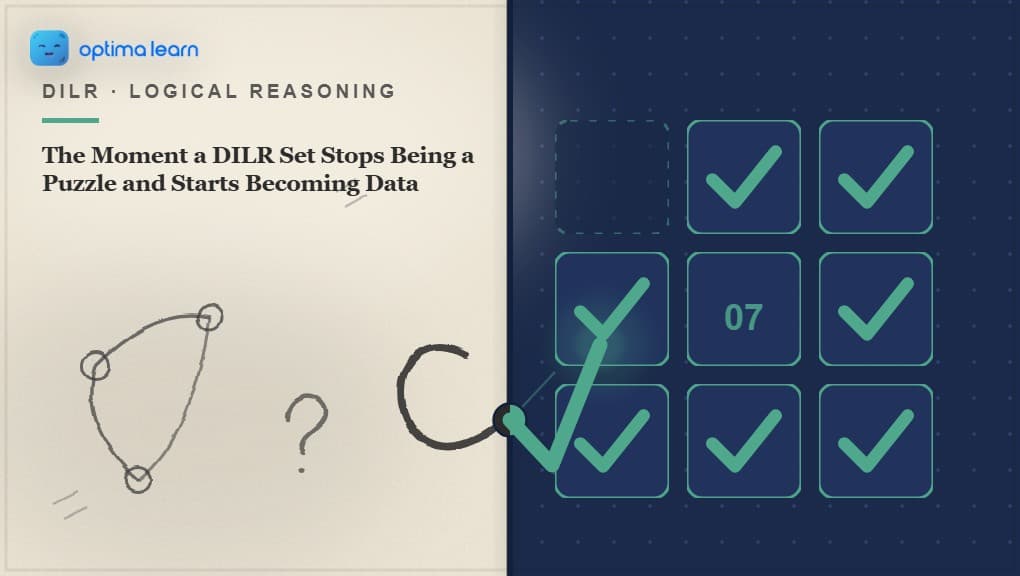
Twelve minutes into a DILR set, something shifts, and most solvers can't say exactly when the puzzle turned into something else. One moment you're testing scenario after scenario, holding two or three possibilities loosely in mind, genuinely unsure which one survives. The next, you're not guessing anymore, you're filling in a table. That shift has a name: the Data Threshold, the specific point where a value you've just placed stops merely fitting the given clues and starts forcing every other value around it into place, whether you asked it to or not. Every solvable DILR set crosses this threshold somewhere. The sets that feel impossible under exam pressure are almost always the ones where a solver never finds where.
- The Data Threshold is the exact moment a DILR set stops feeling like guesswork and starts behaving like a table you're filling in.
- Puzzle Mode is normal at the start of any set; the mistake is staying there past the point where a value should start forcing others.
- The Threshold Signal is a placed value that forces other values, not one that merely permits them, and that difference is the whole framework.
- You can engineer the threshold early by testing the most constrained entity first, instead of waiting for it to arrive on its own.
- Once a set reaches Data Mode, most remaining questions become close to mechanical lookups rather than fresh deductions.
This piece is for anyone who reads an entire DILR set start to finish and still can't tell where to make the first mark. It pairs naturally with classifying a set's mechanism before you start solving, since naming the mechanism early is often what decides how fast the Threshold Signal shows up at all.
Why Some DILR Sets Suddenly Click, and Others Never Do
Ask any CAT aspirant to describe a DILR set that finally clicked, and they will usually describe a feeling, not a step. Something loosened. The scattered testing stopped, and every new clue started slotting into a spot that already felt half-decided. Ask the same aspirant about a set that never clicked, and the description flips: the same scenario tested three separate times, and a nagging sense of going in circles.
That gap has very little to do with raw logical ability. Two sets can look equally dense on paper, four entities, five attributes, a wall of clues, and still behave completely differently once you're inside them. One rewards a plan. The other punishes every plan you try, and the frustration that creates is real: a quiet self-doubt that builds as your own reasoning keeps failing to move forward.
What actually separates the two has nothing to do with the amount of information printed in the set. It comes down to whether you've crossed a specific point inside it, the moment a placed value stops merely being consistent with everything else and starts actively deciding the rest of the table for you. Cross that point, and a set that felt unsolvable at minute five turns almost mechanical by minute twelve. Miss it, and you can spend an entire section testing scenarios that were never going to converge.
Have you noticed that the sets you remember as impossible are rarely the ones with the most clues? They're usually the ones where you never found the one clue doing the real work. That point has a name, and once you can recognize it while you're still inside a set, not just afterward while reviewing, it changes how the set feels in the moment, not only how it looks once it's already solved.
The Data Threshold: Puzzle Mode, the Signal, and Data Mode
The Data Threshold names three stages every solvable DILR set moves through, though most solvers only ever notice two of them. There's the stage where you're testing. There's the stage where you're filling in. And there's the single moment in between that decides how long the first stage actually lasts.
The Data Threshold, in Three Parts
- Puzzle Mode: the early stage where you're still testing possibilities and holding multiple scenarios loosely in mind, genuinely uncertain which one is correct.
- The Threshold Signal: the specific moment a placed value or eliminated case starts forcing other values, not just permitting them.
- Data Mode: the stage after the threshold where the set behaves like a table to fill in rather than a mystery to guess at, and most remaining moves become close to mechanical.
Puzzle Mode is not a mistake. Every set starts there, and it should. Picture a set that ranks five participants, one from each of five cities, Mumbai, Delhi, Pune, Chennai, and Bangalore, by their finishing position in a race, first through fifth. In the first minute or two, real uncertainty is normal: a clue like "Delhi finished immediately after Pune" tells you nothing about where either one actually lands, only how they sit relative to each other.
Add the next two clues. One states directly that the participant from Mumbai finished third. Another states that the participant from Chennai did not finish first or fifth. Neither of these collapses anything on its own, they just narrow the field slightly, which is still Puzzle Mode: useful information, but nothing yet is forced.
The picture gets sharper before it resolves. With Mumbai fixed at third, the Pune-Delhi pair, immediately after each other, can only sit at one-two or four-five, since third is already taken. Two live scenarios remain, and until a new clue tests both, either could still be true. This is still Puzzle Mode, just narrower.
Now add a fourth clue: the participant from Bangalore finished before the one from Chennai. Test it against both surviving scenarios. If Pune and Delhi take one and two, Chennai is pushed to four and Bangalore to five, but that puts Bangalore behind Chennai, which the new clue forbids outright. One clue just eliminated an entire scenario, not merely adjusted it. That's the Threshold Signal: a clue that forces a value rather than only permitting one.
Once that clue lands, Pune and Delhi must be four and five, which pushes Chennai to two and Bangalore to one. Every position is now settled: Bangalore first, Chennai second, Mumbai third, Pune fourth, Delhi fifth. Any question the set asks from here, who finished ahead of Mumbai, who finished immediately after Chennai, is answered by reading the table, not by reasoning through it again. That is Data Mode.
Practice Until the Threshold Becomes a Reflex
Reading about the Data Threshold is one thing. Feeling it happen under a real clock, on a genuinely new set, is what actually builds the reflex. Optima Learn's timed DILR sets mirror the exact structure CAT uses, so you can practice spotting the signal instead of only recognizing it in hindsight.
Practice Timed CAT DILR SetsHow to Actually Engineer the Threshold Instead of Waiting for It
Most solvers treat the Threshold Signal as something that happens to them, a stroke of luck partway through a set. It does not have to work that way. You can deliberately pull a set toward the threshold instead of testing clues in whatever order they happen to be printed, and the technique is simpler than it sounds: place the most constrained entity first.
Every entity in a DILR set carries a different number of valid positions before you have placed anything. An entity given directly, Mumbai finishing third in the earlier example, effectively has one valid position, whatever the clue states outright. An entity constrained only by a vague relative clue might still fit four or five different slots. Starting with the entity that has the fewest options costs nothing and removes the most uncertainty per second spent.
In practice, this means ranking clues before you write anything down, not reading them top to bottom and reacting as you go.
- Absolute clues first: any clue that states a position or value directly gets used before anything else.
- Double eliminations next: a clue that rules out two positions at once outranks one that only rules out one.
- Relative clues last: clues that only describe a relationship between two entities get tested against whatever the first two steps already fixed.
Skip this ranking and the failure mode is specific: you spend the first several minutes testing an entity that was only ever going to narrow one branch among several, while the clue that would have collapsed the whole set sits unread further down the page. The set has not gotten harder. Your path through it has simply gotten longer, and under a strict clock that amounts to the same thing.
Before you start a set, are you scanning for the most absolute clue, or just starting at the top because that happens to be where the page begins?
This is also where reading with real intent matters more than reading quickly. Reading a set like a detective instead of a student is largely the same skill described in different language: treating each clue as evidence to be ranked, not a sentence to be understood in the order it was printed.
Common Mistakes That Keep a Set Stuck in Puzzle Mode
A set does not stay in Puzzle Mode because it is genuinely harder than the others in the section. It usually stays there because of a specific, repeatable habit, and most of these habits feel productive while they are happening, which is exactly what makes them difficult to notice in the middle of a set.
| Panic Move | Pro Move |
|---|---|
| Testing entities in the order the clues happen to be printed | Ranking clues by how absolute they are before testing anything |
| Committing to one scenario and writing over your own earlier notes | Holding two scenarios open and testing both against the next new clue |
| Declaring a set "impossible" after five unproductive minutes | Re-reading the single most restrictive-sounding line for a missed constraint |
| Treating every clue as equally useful | Actively hunting for the clue that forces a value, not just permits one |
| Re-solving the same branch twice without realizing it | Marking eliminated scenarios clearly the moment they're ruled out |
This pattern, staying in Puzzle Mode out of habit rather than actual difficulty, is also most of the answer to how top percentilers actually start a DILR set. They are rarely faster at the underlying logic. They just make fewer of these five mistakes inside the first ninety seconds.
A Practice Drill for Recognizing the Threshold Faster
Recognizing the Threshold Signal faster is not something you can read your way into. It is a pattern-matching skill, and pattern-matching skills sharpen only through repetition with feedback, specifically feedback on the exact moment things shifted, not just whether the final answer came out right.
Here is a drill that builds exactly that kind of feedback, using sets you have already solved rather than new ones.
- Pull five solved sets, ideally ones that took longer than they should have.
- Mark the exact clue where Puzzle Mode ended and Data Mode began in each one.
- Count what came before it, and ask how many of those earlier clues were actually necessary to reach that moment.
Most solvers find the same pattern across their own sets: one or two clues did the real work, and the rest were confirmation, or noise. Once that pattern is visible across five sets, new ones start reading differently, since you are scanning for the clue likely to do the real work instead of processing every line with equal weight.
What would change about your first ninety seconds on a set if you assumed, going in, that only one or two of the clues actually mattered?
None of this replaces knowing your logic cold. It changes what you look for while you apply it. The next time a set feels stuck, resist the pull to test another scenario at random. Ask instead whether you have found a clue that forces something, not one that merely permits it. That single question, asked early and often, is most of what separates a set that clicks by minute eight from one that never does.
The practical move is small: rank your clues before you write anything down. The mindset shift is larger: stop treating every clue as equally important, and start hunting for the one that is not.
Puzzle Mode, the Signal, Data Mode
- Puzzle Mode: testing possibilities, holding more than one scenario loosely in mind.
- The Threshold Signal: a placed value or eliminated case that forces other values, not just permits them.
- Data Mode: the set behaves like a table to fill in, and most remaining moves are close to mechanical.
Put the Data Threshold to Work on a Real Set
The fastest way to internalize this framework is to notice it happening, live, on a set built to CAT's actual pattern. Optima Learn's DILR previous year questions give you exactly that, with the pressure of a real clock attached.
Explore CAT DILR Previous Year QuestionsFrequently Asked Questions
What is 'the Data Threshold' in a DILR set?
It's the specific moment a set stops feeling like guesswork and starts behaving like a table you're filling in, marked by one placed value or eliminated case suddenly forcing other values rather than just narrowing possibilities.
How do I know if I'm still in Puzzle Mode or already in Data Mode?
If you're holding two or three scenarios loosely and testing which one survives, you're in Puzzle Mode, if placing one value is now mechanically forcing the next one without new testing, you've crossed into Data Mode.
Can I make the threshold happen faster instead of waiting for it?
Yes, by deliberately placing the most constrained entity first, the one with the fewest valid positions, since that single placement is the most likely one to trigger a chain of forced values and pull the set across the threshold early.
What if a set never seems to cross the threshold at all?
That usually means the set is being tested with the wrong starting entity or a missed constraint, not that it's unsolvable, going back to re-read the most restrictive-sounding line in the set is the fastest way to find what was missed.
Practice DILR sets, chapter by chapter
CAT DILR practice across LR puzzles and DI sets, each with a worked solution.
More from DILR
Continue reading
XLRI Admission Process: The Exam Nobody Ever Checks

Why Do Some CAT DILR Sets Feel Totally Unsolvable?
Why School Level Quant Feels Hard in the CAT Paper

Why Do Non Engineers Struggle in CAT VARC As Well?
Put it into practice