
The CAT 2026 Preparation Calendar
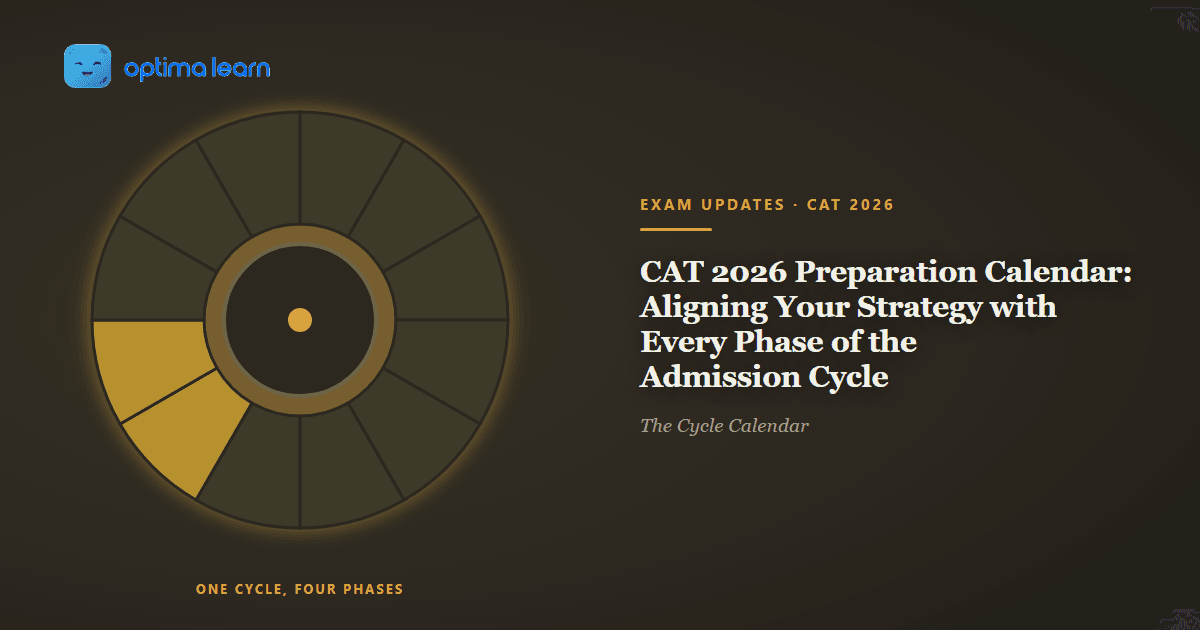
Most CAT preparation calendars stop on 29 November. Everything before it is planned in some detail and everything after it is a blank, on the assumption that the exam is the end of the process.
It is roughly the halfway point. The result arrives in late December or early January. IIM shortlists follow through January and February. Interview rounds run from February into April, and final offers land around May 2027. That is five more months of a cycle that most aspirants enter with no plan at all, having spent four months planning the part that ends on a Sunday in November.
A year-wheel makes the shape obvious in a way a linear to-do list does not. The admission cycle is not a run-up to one date. It has four phases, each rewarding a completely different kind of work.
- The CAT 2026 cycle runs from August 2026 to roughly May 2027, and the exam sits near its middle rather than at its end.
- The Cycle Calendar has four phases: Build, Sharpen, Simulate and Convert.
- Each phase rewards a different input, and running the wrong input for a phase is the most common planning error.
- The Convert phase, from December to May, is the one nobody plans and the one that turns a score into an admission.
- Phase boundaries are derived from 29 November, not published anywhere.
The Shape of the CAT 2026 Cycle
Laid out end to end, the cycle is considerably longer than the preparation window most people imagine.
| Period | What is happening | What it demands |
|---|---|---|
| Aug – mid Oct 2026 | Registration (3 Aug – 15 Sep); the long preparation stretch | Concepts, coverage, method |
| Mid Oct – mid Nov 2026 | Content work winding down | Method refinement, selection practice |
| Mid Nov – 29 Nov 2026 | Admit card on 4 Nov; the exam on 29 Nov | Full simulation, consolidation, nothing new |
| Dec 2026 – May 2027 | Other exams, result, shortlists, interviews, offers | A different skill set entirely |
The fourth row is the one that surprises people. December alone contains the SNAP dates, the NMAT window closing and the CAT result. XAT follows on 3 January 2027. Then shortlists, then interviews, and none of that is a continuation of the work that got you through November.
The Cycle Calendar: Four Phases, Four Inputs
Naming the phase you are in decides what this week should contain, which is a more useful question than how many hours it should contain.
The Cycle Calendar
- Build (now to mid-October). Coverage and concepts. The only phase where starting something new pays back before the exam.
- Sharpen (mid-October to mid-November). Method and selection. Fewer new things, faster execution of familiar ones.
- Simulate (mid-November to 29 November). Full-length practice at your allotted slot time. No acquisition at all.
- Convert (December to May 2027). Other exams, interviews, profile presentation. A different skill set with its own preparation.
Build is the longest phase and the only one where breadth is the right instinct:
- New topics are worth starting because there is time for them to become reliable under a clock.
- Mock cadence can be fortnightly; the purpose is diagnosis rather than rehearsal.
- This is where a weak section can genuinely be rebuilt rather than merely hedged.
Sharpen is where most aspirants keep running Build inputs for too long:
- The return on new concepts falls sharply once the exam is inside six weeks.
- Selection practice becomes more valuable than topic practice, because attempt counts move faster than accuracy.
- Mock cadence tightens to weekly, and review starts taking longer than the mock itself.
Simulate is short, specific and easy to waste:
- The admit card on 4 November tells you your slot: 08:30, 12:30 or 16:30. Practise at that hour from then on.
- There are roughly four weekends in this window, which is exactly enough for four full simulations.
- Nothing new enters. The last fortnight is consolidation, and anything learned now will not be reliable.
Convert is the phase with no plan, and the one that decides what the score becomes:
- Other exams are still running: SNAP dates fall in December 2026 and XAT is on 3 January 2027.
- The CAT result is expected in late December or early January, and shortlists follow through January and February.
- Interview rounds run February to April 2027, with final offers around May.
Put the Cycle Calendar to Work
Knowing which phase you are in decides what the week should contain. Optima Learn's planner sets the phase boundaries from your own profile and the 29 November date.
Build Your CAT 2026 PlanWhere the Phase Boundaries Actually Fall
None of these are published. All of them follow from 29 November and from how long different kinds of change take to become reliable.
- Build ends around mid-October, because a topic started later than that will not be dependable under time by exam day.
- Sharpen ends around 15 November, leaving a clean fortnight for simulation.
- Simulate begins in earnest after 4 November, once the admit card has told you which slot to rehearse.
- Convert begins on 30 November, not in January when the result appears. XAT is thirty-five days after CAT.
- The whole cycle closes around May 2027, when final admission offers are made.
The fourth point catches people every year. Treating 30 November to 3 January as a rest period means arriving at XAT undercooked, having had five weeks in which nothing else was scheduled.
What December and January Actually Contain
The post-exam window is busier than most aspirants expect, and it arrives immediately:
- SNAP runs across three dates in December 2026.
- The NMAT window spans October to December 2026, with up to three attempts permitted.
- XAT 2027 is on 3 January 2027, five weeks after CAT.
- The CAT result is expected in late December 2026 or early January 2027.
- IIFT no longer runs a separate entrance test and admits on the CAT score, which changes what that score is worth.
Every one of those has a preparation requirement, and none of them is served by the assumption that the season ends on 29 November.
Common Mistakes in Planning the Cycle
Related errors:
- Running Build inputs in November. Starting topics that cannot become reliable in time.
- Fortnightly mocks into the final month. Too few simulations in the window where they matter most.
- Ignoring the slot. Practising at 22:00 for an 08:30 exam, because the admit card was filed and forgotten.
- Treating December as recovery. Losing five weeks before XAT on 3 January.
- No interview preparation until a shortlist arrives. Which leaves days rather than weeks.
A Drill for Building Your Cycle Calendar
Fifteen minutes, and it produces the half of the calendar that usually does not exist.
- Draw a line from today to May 2027 and mark 29 November on it. Note how much of the line sits to the right of that mark.
- Place the four phase boundaries: mid-October, 15 November, 29 November.
- On the Convert section, mark the SNAP window, XAT on 3 January, the expected result, and the February-to-April interview period.
- For each phase, write one sentence describing what a typical week contains. Different sentences, or the phases are not doing any work.
What the exercise usually reveals:
- Roughly half the cycle sits after the exam, and none of it was planned.
- The Build phase is shorter than it feels, and it closes in October.
- December is not empty; it contains other exams and a result.
- Interview preparation has no natural slot unless one is created before the shortlists arrive.
The Bottom Line
CAT 2026 on 29 November is a checkpoint in a cycle that runs to May 2027. Planning only the run-up means preparing thoroughly for the middle of the process and improvising the end of it, which is an odd allocation for something this consequential.
The Cycle Calendar, Recap
- Build to mid-October: coverage and concepts.
- Sharpen to mid-November: method and selection.
- Simulate to 29 November: full mocks at your allotted slot time.
- Convert to May 2027: other exams, result, shortlists, interviews.
Build the Habit on Timed Practice
Phases only mean something if mocks are landing on the calendar to mark them. Sit full CAT mock tests and past papers at a cadence that tightens as November approaches, and work through CAT previous year questions between them. More on the cycle sits in the CAT exam updates archive and the CAT strategy archive, and if the phases keep blurring it is worth having your plan reviewed honestly.
Plan the Whole Cycle, Not the Run-Up
Half of this cycle sits after 29 November. Build a calendar that runs to May 2027 rather than stopping at the exam.
Build Your CAT 2026 PlanFrequently Asked Questions
How should I plan my CAT 2026 preparation calendar?
In four phases working backwards from 29 November: Build to mid-October for coverage and concepts, Sharpen to mid-November for method and selection, Simulate for the final fortnight with full mocks at your allotted slot, and Convert from December to May 2027 for other exams and interviews.
When should I stop starting new topics for CAT 2026?
Around mid-October. A topic generally needs about six weeks to become reliable under timed conditions, so anything started later will not be dependable by 29 November, and the same hours produce more as method work and simulation.
What happens after the CAT 2026 exam?
SNAP runs across three dates in December 2026 and XAT 2027 is on 3 January. The CAT result is expected in late December or early January, IIM shortlists follow through January and February, interview rounds run February to April, and final offers land around May 2027.
How many full mocks should I take before CAT 2026?
Cadence matters more than the total. Fortnightly during Build is enough for diagnosis, weekly through Sharpen, and roughly one per weekend in the final fortnight, taken at the slot time your admit card assigns on 4 November.
Track CAT 2026: never miss a date
Slot booking, admit cards, results, and IIM cutoffs, one timeline.
More from Exam Updates
Continue reading

XLRI Admission Process: The Exam Nobody Ever Checks

Why Do Some CAT DILR Sets Feel Totally Unsolvable?

Why School Level Quant Feels Hard in the CAT Paper

Why Do Non Engineers Struggle in CAT VARC As Well?
Put it into practice