
The CAT 2026 Ecosystem Update
The CAT 2026 ecosystem is larger than the exam, and most aspirants build a mental model of this year with one item in it: CAT on 29 November. Everything else — the other exams, the twenty-one IIMs, the much larger field of institutes that accept the score, the interview rounds — sits somewhere off to the side as detail to be dealt with later.
That model is not wrong so much as incomplete, and the incompleteness costs specific things. It is why aspirants skip a December exam that would have suited them, or discover in January that an institute they wanted was never on their form, or optimise a score for a weighting that the institute they care about does not use.
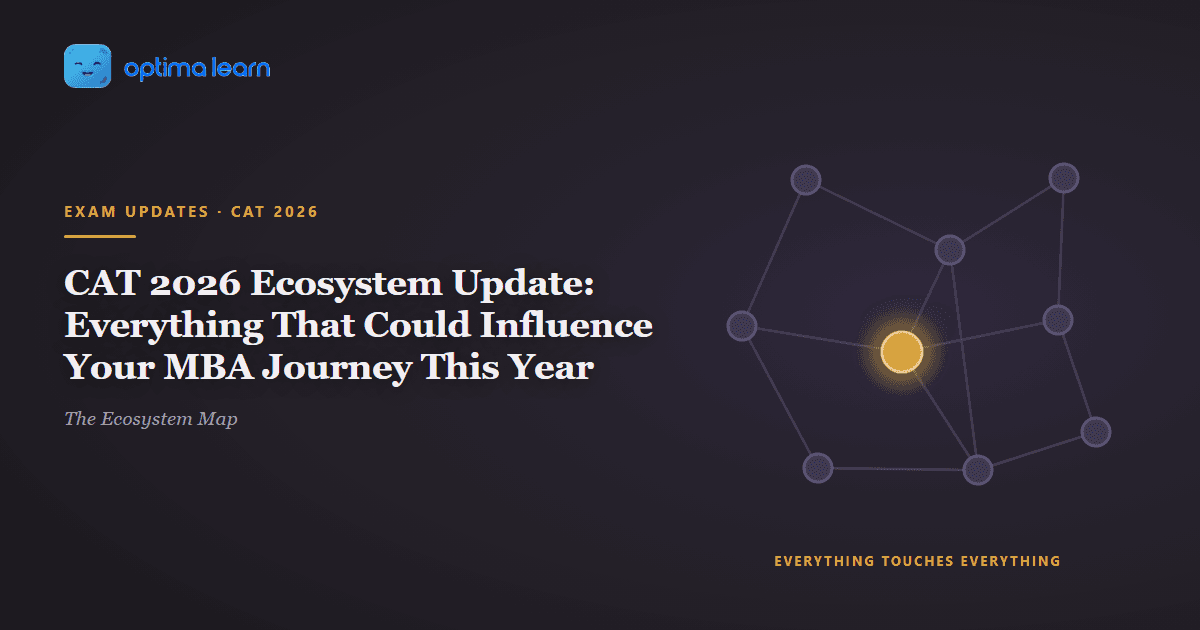
A network of connected nodes is a better picture than a single point. Everything touches everything, and a decision made in August about one node changes what is available at another in March.
- CAT 2026 sits inside an ecosystem of exams, institutes and selection criteria that interact with each other.
- The Ecosystem Map has three layers: the exam layer, the institution layer and the profile layer.
- Twenty-one IIMs use the CAT score, alongside a much larger field of non-IIM institutes.
- IIFT discontinued its own entrance test and now admits on CAT, which raises what a single score is worth.
- Decisions in one layer constrain the others, and most are made without noticing the connection.
The Exam Layer: What Else Is Running
CAT is the largest of these and it is not the only one, and their windows overlap the CAT run-up rather than politely following it.
| Exam | When | What it means for your CAT plan |
|---|---|---|
| CAT 2026 | 29 November 2026 | The anchor. IIM Indore conducting. |
| NMAT | October – December 2026 window | Overlaps CAT prep; up to three attempts permitted |
| SNAP | Three dates in December 2026 | Immediately after CAT; requires its own decision |
| XAT 2027 | 3 January 2027 | Five weeks after CAT; distinct structure |
| IIFT | No separate exam since 2024 | Admits on CAT score |
The NMAT row is the one that changes plans, because its window opens in October while CAT preparation is still in its sharpening phase. Multiple attempts are permitted, which is a genuinely different structure from a single-date exam and needs deciding on rather than drifting into.
The Ecosystem Map: Three Layers
Thinking in layers rather than in a list is what makes the connections visible.
The Ecosystem Map
- The exam layer. CAT plus the exams around it, each with its own window, format and demands.
- The institution layer. Twenty-one IIMs and a much larger non-IIM field, each with its own weighting of what you bring.
- The profile layer. Academics, work experience and background, which institutions weight differently and which you can no longer change.
The exam layer mostly asks how many exams to attempt and which:
- Each additional exam costs preparation time that would otherwise be CAT time, and buys a separate set of options.
- Exams with multiple attempts, such as NMAT, behave differently from single-date exams and are worth planning rather than defaulting into.
- An exam whose format suits you can be worth more than a marginal increase in CAT percentile.
The institution layer is where the CAT score turns into outcomes:
- Twenty-one IIMs use the score, and each publishes its own criteria for shortlisting and final selection.
- The non-IIM field accepting CAT is considerably larger than most aspirants have in mind when they set a target.
- IIFT admitting on CAT rather than its own test means one score now reaches further than it did a few cycles ago.
- Which institutes you selected in the application form determines who considers you at all.
The profile layer is fixed input and variable presentation:
- Academic record, work experience and background are what they are by August, and they are weighted differently by different institutes.
- The same profile is stronger at some institutions than others, purely because of how their criteria are built.
- What remains in your control is whether you can explain your record clearly when asked between February and April.
Put the Ecosystem Map to Work
A plan built around one exam and one date leaves most of the ecosystem unhandled. Build one that accounts for the exams and institutes around it.
Build Your CAT 2026 PlanHow the Layers Interact
The connections are what make this a map rather than three lists, and they run in both directions:
- Profile shapes institution choice. A strong academic record and a strong work record are rewarded differently, and by different places.
- Institution choice shapes exam choice. If the places that suit your profile accept XAT or SNAP, those exams stop being optional extras.
- Exam choice shapes your calendar. Every added exam takes preparation time from the CAT window and adds dates in December and January.
- Score validity shapes the whole thing. A CAT score lasting roughly a year affects whether this cycle is your only shot.
- The form shapes all of it. Programme selections made in August decide which parts of the institution layer are reachable at all.
That last connection is the one most often missed. A decision taken in fifteen rushed minutes during registration sets the boundary of what the rest of the cycle can produce, and it is essentially never revisited.
What Has Actually Changed in This Ecosystem
Not much moves year to year, which makes the things that do worth noting:
- IIFT stopped running its own entrance test from the 2024 cycle and admits on CAT, removing one exam from the calendar and adding weight to the CAT score.
- The CAT structure has been stable since 2021, so preparation transfers cleanly from past papers.
- Multiple-attempt formats such as NMAT continue to offer a different risk profile from single-date exams.
- The non-IIM field accepting CAT keeps growing, which widens what a given score can reach.
- The overall cycle shape is unchanged: exam in late November, results around the turn of the year, interviews through spring.
Common Mistakes in Reading the Ecosystem
Related errors:
- Treating CAT as the only exam. Skipping formats that might have suited you better.
- Ignoring institute criteria. Optimising for a weighting your target institutes do not use.
- Under-selecting on the form. Closing institutions in August that you would have wanted in January.
- Assuming the non-IIM field is small. It is considerably larger than most aspirants realise.
- Planning exams in isolation. Each one changes the calendar for all the others.
A Drill for Mapping Your Own Ecosystem
Half an hour, and it replaces a percentile target with an actual plan.
- List the institutes you would genuinely accept. Not aspirational names, places you would attend.
- For each, look up the published shortlisting and selection criteria and note how the CAT score is weighted against everything else.
- Work out which exams those institutes accept, and whether any of them are ones you are not currently taking.
- Check your submitted CAT form against that list, and note anything you cannot now reach.
What this usually surfaces:
- One or two institutes accept an exam you had not planned to take.
- Your profile is weighted more favourably somewhere you had not seriously considered.
- The score you actually need is often lower than the target you had set.
- At least one selection on the application form deserved more thought than it received.
The Bottom Line
CAT 2026 is one node in a network, and it is the one everyone stares at. The exams around it, the institutes that accept it and the profile you bring to it all interact, and choices made in one place quietly limit what is possible in another. Half an hour spent mapping it is worth more than another week of practice.
The Ecosystem Map, Recap
- The exam layer: CAT, plus NMAT, SNAP and XAT, with overlapping windows and different formats.
- The institution layer: twenty-one IIMs and a much larger non-IIM field, each weighting differently.
- The profile layer: fixed by now, weighted differently everywhere, and yours to present.
Build the Score the Whole Ecosystem Runs On
Whatever the map looks like, the CAT score sits at the centre of most of it. Work through CAT previous year questions in timed blocks and sit full CAT mock tests and past papers on a fixed cadence. More on the cycle sits in the CAT exam updates archive and the CAT strategy archive, and if your target still has no institute attached to it, it is worth having your strategy reviewed honestly.
Map the Ecosystem Before CAT 2026
The score matters because of what surrounds it. Spend half an hour on the network before spending another month on the node.
Build Your CAT 2026 PlanFrequently Asked Questions
Which institutes accept the CAT 2026 score?
Twenty-one IIMs use it, alongside a much larger field of non-IIM institutes. IIFT also admits on CAT, having discontinued its own entrance test from the 2024 cycle, so a single score now reaches further than it did a few admission cycles ago.
Should I take other MBA entrance exams besides CAT 2026?
It depends on which institutes you would actually accept. Work backwards from those to the exams they take. NMAT runs October to December with multiple attempts, SNAP has three December dates, and XAT is on 3 January 2027, so each adds preparation time and calendar dates.
What percentile should I target for CAT 2026?
A percentile is not a goal until an institute is attached to it. Different institutes weight academics, work experience and diversity differently, so the score you need depends on where you are applying and what you bring besides the score. Working backwards from the outcome usually produces a lower and clearer target.
How much does my profile matter alongside the CAT score?
Substantially, and differently at each institute. Academic record, work experience and background are fixed inputs by now, and every IIM publishes its own weighting for shortlisting and final selection. What remains in your control is how clearly you can present that record when asked.
Track CAT 2026: never miss a date
Slot booking, admit cards, results, and IIM cutoffs, one timeline.
More from Exam Updates
Continue reading

XLRI Admission Process: The Exam Nobody Ever Checks
Why Do Some CAT DILR Sets Feel Totally Unsolvable?
Why School Level Quant Feels Hard in the CAT Paper

Why Do Non Engineers Struggle in CAT VARC As Well?
Put it into practice