
The Asymmetry Principle in CAT Prep
How to improve a CAT score quickly is really a question about pricing, because not all preparation is priced the same. Some improvements take three months of work and move a percentile point. Others take a fortnight and move several, and they are usually sitting in plain sight in a mock report nobody has read carefully.
The uncomfortable part is that effort and return are close to uncorrelated in CAT preparation. The hardest thing you could work on is frequently not the most valuable, and the most valuable is frequently something that feels too small to be worth scheduling.
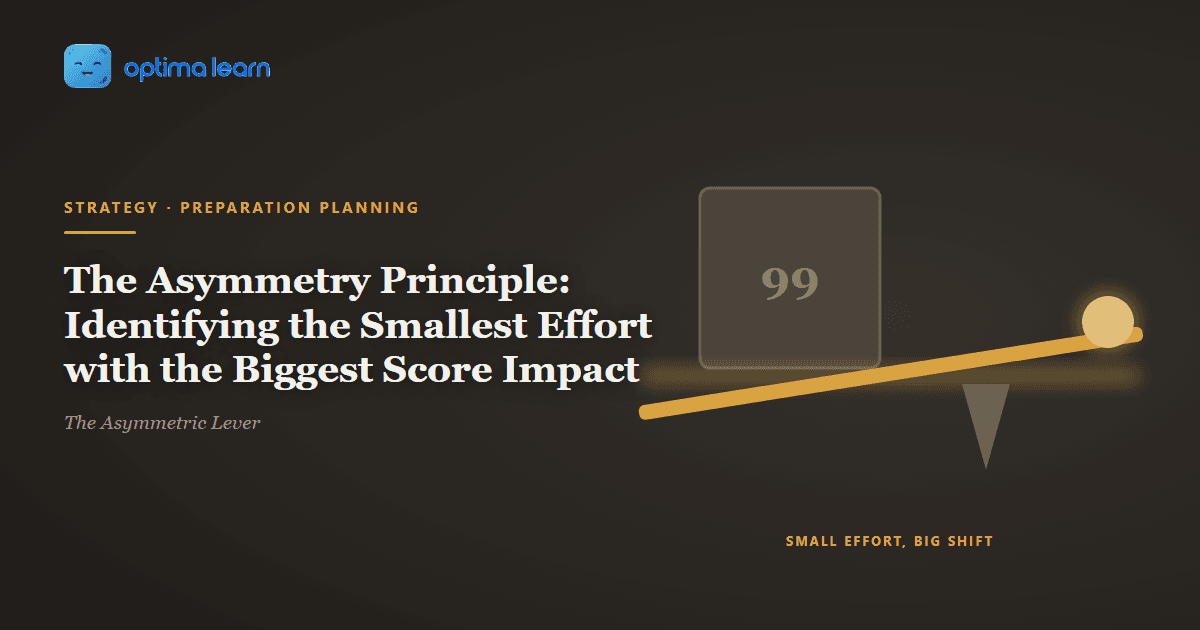
A lever is the honest picture. A small force at the right distance moves something a large force in the wrong place cannot budge, and the whole question is where you are standing.
- Effort and return are close to uncorrelated in CAT preparation, so the hardest work is rarely the most valuable.
- The Asymmetric Lever finds cheap marks in three places: process errors, question selection, and the section nearest a floor.
- Process errors are the cheapest of all, because they need no new knowledge and are visible in any mock report.
- A section sitting near a sectional cutoff is worth more per mark than a strong section, because cutoffs are pass or fail.
- Finding the lever is a thirty-minute analysis, not a strategy question.
Why Effort and Return Come Apart
Aspirants allocate by difficulty because difficulty is easy to perceive and return is not. The hardest topic feels like the most important one, and working on it feels the most virtuous, so it gets the hours.
But return depends on how many marks are actually available at that point and how cheaply they can be recovered. A topic that is genuinely hard for you may carry two marks and take a month; a process error you make in every mock may carry six and take a fortnight to fix.
The mismatch shows up in a consistent shape:
- The area receiving the most hours is often the one with the least available upside.
- The cheapest marks are usually in something that does not feel like studying at all.
- Nothing in a standard mock report ranks losses by how expensive they are to recover.
- So the ranking gets done by feel, and feel tracks difficulty rather than value.
The Asymmetric Lever: Three Places to Look
All three are visible in mock data you already have, and none of them requires learning anything new.
The Asymmetric Lever
- Process errors. Marks lost to misread targets, transcription slips and unchecked setups. No new knowledge required; the fix is a habit.
- Question selection. Marks lost to questions never opened. Also no new knowledge, and it moves attempts immediately.
- The section nearest a floor. Because sectional cutoffs are pass or fail, a mark there is worth more than a mark in a strong section.
Process errors are the highest-return category and the most consistently dismissed:
- Solving for x when the question wanted x plus three. Correct work, wrong answer.
- Misreading a comparative in a word problem, which produces a confident wrong equation.
- Copying a number incorrectly between lines, which nothing downstream will catch.
- Aspirants label these "silly" and therefore do not schedule work on them, which is why they persist for years.
Question selection is the second lever and requires no content work at all:
- Marks lost to unopened questions appear in no standard report, so they are invisible unless counted.
- A ninety-second first pass over a section typically changes which questions you reach.
- The gain arrives within two or three sections of practice, which is faster than any content change.
The section nearest a floor is where the arithmetic of the exam does the work for you:
- Sectional percentile cutoffs are pass or fail, so being just below one is qualitatively different from being just above.
- Five marks in a section near its floor can be worth more than fifteen in a section comfortably clear.
- Most aspirants allocate by total score and therefore never see this asymmetry at all.
Put the Asymmetric Lever to Work
Levers are found in mock data rather than in study plans. Optima Learn's mocks give you the report the analysis needs.
Take CAT Mock TestsHow to Improve Your CAT Score Quickly: Rank Fixes by Cost
Once losses are categorised, the ranking is usually obvious and usually the opposite of the intuitive one.
| What you are losing marks to | Cost to fix | Typical time to show |
|---|---|---|
| Misread targets and transcription slips | Very low: a checking habit | Two weeks |
| Questions never opened | Low: a first-pass habit | Two to three sections |
| A section near its floor | Moderate, but each mark is worth more | Four to six weeks |
| A weak topic within a strong section | Moderate | Four to six weeks |
| A genuinely unfamiliar area | High: months | Two to three months |
Most aspirants start at the bottom of that table, because the bottom row is the one that feels like real preparation. The top two rows are almost always available, almost always ignored, and pay back inside a fortnight.
How to Actually Fix a Process Error
These do not respond to intending to be more careful. They respond to a specific mechanical check:
- Name the category. Not "silly mistakes" but "solved for the wrong quantity" or "reversed a comparative".
- Count it across five mocks. The rate will be stable, which tells you it is systematic rather than random.
- Build one check aimed at it. Underline what the question asks before solving; write the unit beside every variable.
- Apply the check to every question for two weeks, including the ones where it feels unnecessary.
- Recount. If the rate has not fallen, the check is aimed at the wrong category.
The specificity is what makes this work. "Be careful" is not a check and cannot be executed under time pressure; "underline the target" takes two seconds and can.
Common Mistakes in Choosing What to Work On
Related errors:
- Dismissing process errors. Calling them silly and therefore never scheduling work on them.
- Optimising the total. Missing that a section near a floor carries more value per mark.
- Ignoring unopened questions. A loss that appears in no report and therefore never enters the ranking.
- Chasing the last topic. Spending a month on an area worth two marks.
- Never ranking at all. Working on whatever is next in the syllabus rather than on what is available.
A Drill for Finding Your Lever
Thirty minutes with three mock reports, and it usually changes the next month entirely.
- For each mock, sort every lost mark into one of five buckets: process error, never opened, wrong method, unfamiliar topic, or ran out of time.
- Total each bucket across the three mocks.
- Beside each total, write how long you think fixing that bucket would take.
- Divide marks by weeks. Work on the highest number first, whatever it turns out to be.
What this typically produces:
- Process errors and unopened questions together account for more marks than any single topic.
- The topic you were about to spend a month on ranks low once divided by time.
- One section is closer to a floor than you realised, which reprices everything in it.
- The ranking is stable across the three mocks, which means it is real rather than a bad day.
The Bottom Line
Preparation is usually allocated by what feels most deserving of attention, and CAT does not pay by desert. It pays by marks available divided by weeks required, and on that measure the cheapest gains are almost always things aspirants have decided are beneath scheduling. Thirty minutes of ranking is worth more than a month of working on the wrong thing well.
The Asymmetric Lever, Recap
- Process errors: correct working, wrong answer. No new knowledge, fixed in a fortnight.
- Question selection: marks lost to questions never opened, invisible in every report.
- The section near a floor: each mark worth more, because cutoffs are pass or fail.
Build the Habit on Real Mock Data
Levers only show up when losses are categorised rather than totalled. Sit full CAT mock tests and past papers and analyse each one by loss category, then work through CAT previous year questions aimed at the largest bucket. More on allocation sits in the CAT strategy blog archive, and if the ranking keeps coming out flat it is worth having your preparation reviewed honestly.
Find the Cheap Marks Before CAT 2026
Effort and return are not the same thing. Rank your losses by marks per week before allocating another month.
Get Your Strategy ReviewedFrequently Asked Questions
What gives the biggest improvement for the least effort in CAT?
Usually process errors and question selection. Both are visible in mock data, neither requires new knowledge, and both typically pay back within a fortnight. Together they often account for more marks than any single topic you could study.
How do I actually fix silly mistakes?
Name the specific category rather than calling them silly, count the rate across five mocks, and build one mechanical check aimed at that category. "Underline what the question asks" is executable under time pressure; "be more careful" is not.
Should I work on my hardest topic?
Only if it ranks well on marks per week. Difficulty measures how hard something is to fix, not how many marks are waiting there. A month spent on a topic worth two marks in a typical paper is usually beaten by a fortnight spent on an error category worth six.
Why does a section near a sectional cutoff matter more?
Because sectional percentile cutoffs are pass or fail rather than a gradient. Being just below one is qualitatively different from being just above, so a few marks in that section can be worth considerably more than a larger gain in a section already comfortably clear.
Build your CAT 2026 study plan
Personalised daily plan that adapts to your section-wise mock scores.
More from Strategy
Continue reading
XLRI Admission Process: The Exam Nobody Ever Checks

Why Do Some CAT DILR Sets Feel Totally Unsolvable?
Why School Level Quant Feels Hard in the CAT Paper

Why Do Non Engineers Struggle in CAT VARC As Well?
Put it into practice