
Preparing for CAT Under Uncertainty
You do not know what CAT 2026 will look like on 29 November. You do not know which slot you will get until 4 November, what the DILR sets will be, whether the paper will suit you, or what percentile a given score will translate into.
Most aspirants respond to that in one of two ways. Some try to eliminate the uncertainty by predicting harder: forecasts, topic-weight guesses, theories about the conducting IIM. Others let it paralyse the planning, on the reasonable grounds that you cannot optimise for something unknown.
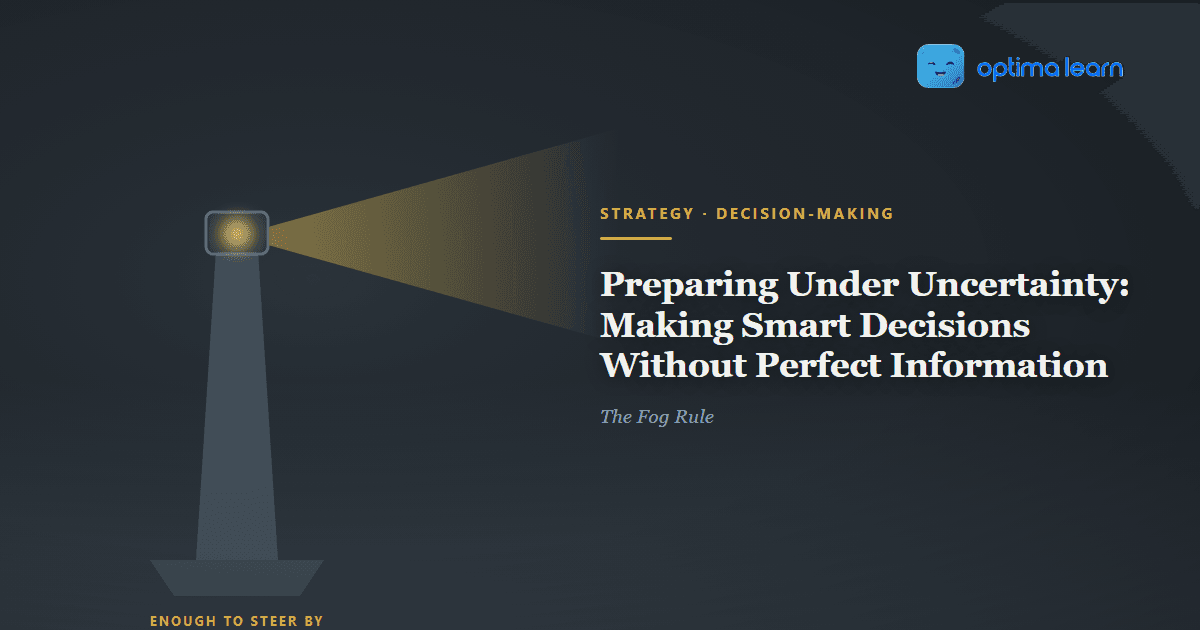
Both miss the same thing. A lighthouse does not clear the fog. It gives you enough to steer by while the fog stays exactly where it is, and steering under limited visibility is a skill in its own right rather than a compromise.
- Substantial uncertainty about CAT 2026 is permanent and cannot be forecast away.
- The Fog Rule has three moves: act on what is invariant, prefer reversible decisions, and buy information cheaply.
- Far more is already known than most aspirants realise, which is where the plan should be built.
- Reversible decisions are worth more than optimal ones when the information is missing.
- A mock is a probe as much as a score, and treating it that way changes how it is used.
What You Cannot Know, and What You Already Do
It helps to separate these explicitly, because the two lists are very different lengths and the useful one is the longer.
Genuinely unknowable: the specific questions, the difficulty of your slot, which topics appear, how the field performs, what percentile your score converts to.
Already known: the structure has been stable since 2021, with three sections of forty minutes each in fixed order, roughly 68 questions, marking at +3 and −1 with no penalty on TITA, and the exam on Sunday 29 November 2026. Your own profile, your weakest section and your error patterns are all measurable today.
- The unknowable list is short and consists almost entirely of things you could not act on anyway.
- The known list contains everything a preparation plan actually needs.
- Trying to forecast the first list produces no usable decisions.
- Building on the second list produces a plan that survives whatever the paper does.
The Fog Rule: Three Moves Under Uncertainty
None of these reduce the uncertainty. All three let you act well despite it.
The Fog Rule
- Act on what is invariant. Build the plan on the parts that will be true whatever the paper looks like, and there are more of those than it feels.
- Prefer reversible decisions. When information is missing, a decision you can undo cheaply beats one that is optimal under a guess.
- Buy information cheaply. A mock is a probe. Take it to learn something specific, not only to record a number.
Acting on the invariant covers most of what a plan needs:
- Forty minutes per section is fixed, so sectional strategy can be built now and will still apply in November.
- Negative marking on MCQs and none on TITA is fixed, so guessing policy is decidable today.
- Your own weakest section is measurable, and it will still be your weakest section next month.
- Fixed section order means the decision problem is identical every time you practise it.
Preferring reversible decisions is the move that changes how plans are written:
- A four-week allocation is reversible. A decision to abandon a section is not.
- Reviewing a plan monthly is reversible; committing to one routine until November is not.
- Keeping a second exam on the calendar preserves an option; dropping it in September closes one.
- When two plans look similar, take the one that is cheaper to abandon.
Buying information cheaply reframes what mocks are for:
- Take a mock to test something specific: a new selection rule, a changed order within a section, a different guessing threshold.
- Write the question before the mock, so the result answers something rather than merely reporting.
- A mock that resolves a question is worth more than one that produces a slightly better score.
Put the Fog Rule to Work
Probing works best on real papers under real conditions. Optima Learn's mocks let you test a rule rather than only record a score.
Take CAT Mock TestsDeciding Without Enough Information
Several common CAT decisions have to be made before the information that would settle them arrives. The right approach differs by how reversible each one is.
| Decision | Information you lack | How to decide anyway |
|---|---|---|
| How many exams to attempt | Your CAT performance | Keep options open; decide finally in October |
| Which section to prioritise | What the paper will favour | Prioritise your own floor, which is measurable |
| Attempt count target | Paper difficulty | Set a rule, not a number: leave at your own threshold |
| Guessing policy | Nothing. Marking is known. | Decide now. This one is not uncertain. |
| Whether to attempt again in 2027 | Result and shortlists | Defer until after interviews; the score is valid a year |
The fourth row is worth noticing. Guessing policy feels like it depends on the paper and it does not: the marking scheme is published and fixed, so the correct policy can be worked out in August and never revisited.
What to Do With the Genuinely Unknowable
Some things will not be known before you sit down on 29 November, and the correct handling is not to think harder about them:
- Prepare across the range. If DILR sets have varied between four and six, practise both rather than betting on one.
- Build rules, not targets. "Leave at ninety seconds without a path" survives any paper; "attempt eighteen questions" does not.
- Hedge the floor. You cannot know which section the paper will punish, so protect the one with the widest variance.
- Rehearse the version you like least. Uncertainty will eventually hand you the variant you skipped.
- Stop consuming predictions. They change no decision, and the attention has a better use.
That second point is the most transferable. A rule adapts to whatever paper arrives; a target has to be guessed in advance and will be wrong in exactly the situations where it matters most.
Common Mistakes Under Uncertainty
Related errors:
- Forecasting the paper. Spending attention on the one variable with no evidence behind it.
- Setting targets instead of rules. Numbers that require a correct guess about difficulty.
- Making irreversible calls early. Dropping a section or an exam before the information arrives.
- Treating mocks as scores only. Missing that each one could have answered a specific question.
- Confusing uncertainty with risk. Sectional floors are a known, quantifiable risk and deserve hedging, not worry.
A Drill for Deciding Under Fog
Fifteen minutes, and it usually removes most of what has been described as uncertainty.
- List everything currently undecided about your CAT 2026 plan.
- Mark each one known, knowable soon, or genuinely unknowable.
- Decide every known item today. Most of them turn out to be known.
- For the knowable ones, name the date the information arrives and defer to it. For the rest, write a rule instead of a decision.
What aspirants generally find:
- Most items marked uncertain are actually known, and had simply never been decided.
- The genuinely unknowable list is very short, usually two or three items.
- Every one of those can be handled with a rule rather than a forecast.
- The anxiety attached to uncertainty was mostly attached to undecided knowns.
The Bottom Line
You will not know what CAT 2026 looks like until you are in it, and that is a stable condition rather than a problem to be solved. Nearly everything a plan needs is already fixed and measurable today. What remains is handled with rules that adapt and decisions cheap enough to reverse, neither of which requires knowing anything more than you already do.
The Fog Rule, Recap
- Act on what is invariant: the fixed structure, the marking, your own measured profile.
- Prefer reversible decisions: cheap to undo beats optimal under a guess.
- Buy information cheaply: take each mock to answer a specific question.
Build the Habit on Real Mock Data
Probing needs papers that behave like the real thing. Sit full CAT mock tests and past papers with a question attached to each, and work through CAT previous year questions across the range rather than betting on one variant. More on planning sits in the CAT strategy blog archive, and if decisions keep getting deferred it is worth having your plan reviewed honestly.
Steer Through the Fog to CAT 2026
Most of what you need is already known. Build on that rather than waiting for the rest.
Build Your CAT 2026 PlanFrequently Asked Questions
How do I plan for CAT when so much is uncertain?
Build on what is already fixed, which is more than it feels: three sections of forty minutes in fixed order, marking at +3 and −1 with no penalty on TITA, and your own measured weakest section. Those support a full plan without any forecast about the paper.
Should I set an attempt target for the exam?
Set a rule rather than a number. A target such as eighteen attempts requires a correct guess about a paper you have not seen, while a rule such as leaving a question at ninety seconds without a clear path adapts to whatever difficulty arrives.
What should I do about the things I genuinely cannot predict?
Prepare across the observed range rather than betting on one value, hedge the section with the widest variance, and deliberately rehearse the variant you have practised least. None of that requires knowing what the paper will do, which is why it works.
How should I use mocks when the outcome is uncertain?
As probes as well as scores. Write one question before each mock that the mock will answer, such as whether a changed leaving threshold raises attempts without hurting accuracy. A mock that settles a question is worth several that only produce a number.
Build your CAT 2026 study plan
Personalised daily plan that adapts to your section-wise mock scores.
More from Strategy
Continue reading
XLRI Admission Process: The Exam Nobody Ever Checks
Why Do Some CAT DILR Sets Feel Totally Unsolvable?
Why School Level Quant Feels Hard in the CAT Paper

Why Do Non Engineers Struggle in CAT VARC As Well?
Put it into practice