
Fix the Leak, Not the Tap
Why repairing one repeated CAT weakness can matter more than learning a new topic
You've probably watched this happen, maybe even to yourself. Three mocks in a row, same percentile, give or take a point. So you open a fresh chapter you'd been avoiding, work through it properly, and walk into the next mock feeling ready.
The score barely moves. There's a specific kind of deflation in that: doing the right thing and watching nothing change. Something else was wrong, and it wasn't the chapter.
- After a weak mock, the instinct is to add a new topic. Often, the smarter move is fixing one repeated mistake instead.
- A leak is a mistake pattern that costs marks across several sections, not a single weak topic.
- Once your syllabus coverage is reasonably broad, patching the leak usually recovers more marks than learning something new.
- This is a different call from a 30-day repair plan or an effort-vs-impact matrix. It's about which of the two you reach for first.
The reflex to reach for the tap
Adding something new after a bad mock feels like progress because it's easy to point to. You read a chapter, solved ten new questions, learned a formula you didn't know before. There's a concrete thing to show for the effort, and that feels better than facing an old mistake you thought you'd already fixed.
This isn't the same question a topic-priority list answers. A companion piece on this blog, the 80/20 rule of CAT preparation, helps you pick which topic deserves your time. This post asks something earlier: whether you should reach for a new topic at all, or fix an old leak still draining marks from everything you already know.
The Leak, Not the Tap
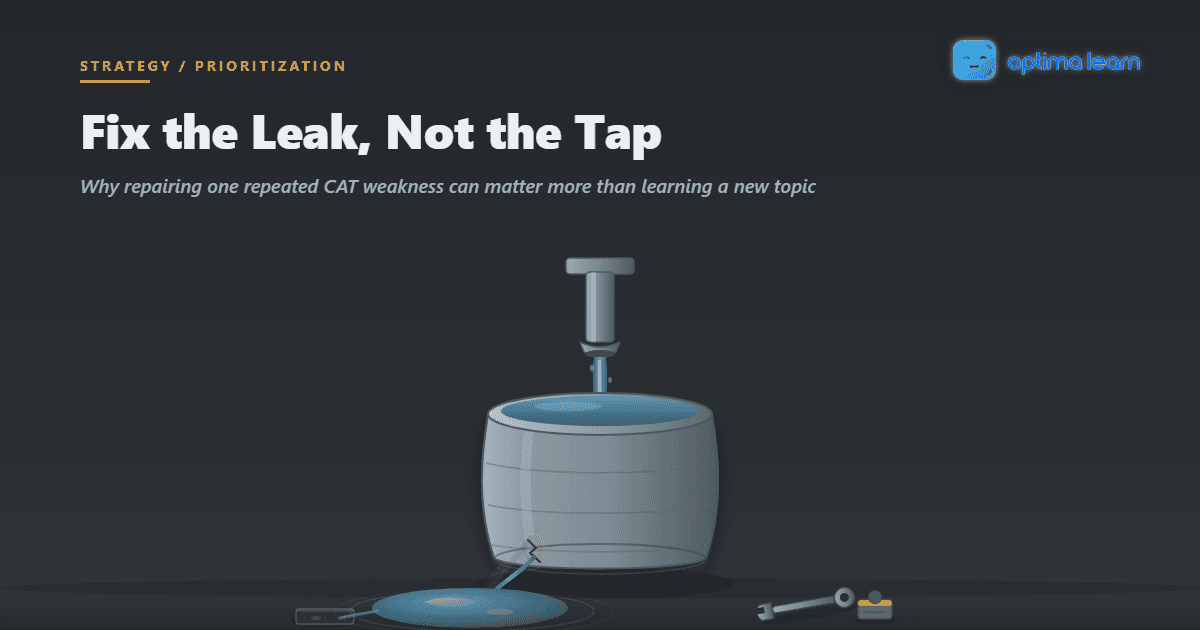
Here's a simple way to tell the two apart. Picture a bucket being filled from a tap above, while it leaks steadily from a small crack near the base. Pour in more water, and the level barely rises, because it's draining out just as fast as it's coming in. Studying is the pouring. The leak is whatever's draining it back out.
The Leak, Not the Tap
Pouring in more won't help if it's still leaking out the same crack.
- The Tap: the instinct to add more whenever a mock feels weak, a new topic, a new shortcut, a new question type.
- The Leak: the one recurring weakness quietly costing marks across many different topics and sections, the same mistake wearing a different disguise each time.
- Patch Before You Pour: fixing the one repeated leak usually recovers more marks than learning one more new topic, since the leak has been draining every topic you already know.
Notice what makes this a genuine leak, not just one weak topic. It shows up more than once, in more than one place, and it rarely looks like itself twice. A single tough chapter is a tap problem. A mistake that costs marks in Quant on Monday and DILR on Wednesday is a leak.
How to tell if you actually have a leak
Pull out your last four or five mocks and look at the wrong answers, not by topic, but by what went wrong. Did you misread the question? Rush the final calculation? Pick an approach that works but takes too long? Sort by mistake type first, topic second.
Look closely, and three wrong answers can turn out to be the same mistake wearing different clothes: solving for the wrong quantity. A total instead of an average. A current age instead of an age two years ago. One was in Quant, one in DILR, one in a VARC question. Three sections, one leak: reading the question's exact ask before solving.
| What you notice | Looks like a leak | Looks like a topic gap |
|---|---|---|
| Where it shows up | Quant, DILR and VARC all lose marks the same way | Only one specific chapter or question type |
| What repeats | The type of error: misread, rushed check, wrong assumption | The same formula or concept, wherever it appears |
| What actually fixes it | One corrective habit, practiced across sections | Properly learning that one chapter |
| Mock-to-mock pattern | Score plateaus even as coverage keeps growing | Score improves once that chapter is covered |
Not sure what your leak actually is?
Prof Opto listens to how you solve, not just what answer you land on, and flags the same slip when it repeats.
Talk to Prof OptoWhen learning something new still wins
None of this means new topics stop mattering. Early in preparation, whole sections can still feel unfamiliar, and that's exactly when learning is the right move. There's no pattern to fix yet, only ground still uncovered.
The Leak, Not the Tap matters most in a specific window: once your syllabus is reasonably covered and your score has stopped climbing anyway. That plateau is the signal. If you've studied broadly and mocks still aren't improving, a leak is a more likely explanation than one more missing chapter.
In Quant, a leak often looks like getting the setup right and the final answer wrong: a sign error, a units slip, an unrounded value carried forward. Practicing more CAT Quant questions won't fix that alone, since the leak isn't in the syllabus. It's in how the last step gets checked.
Once you've named the leak, the next question is how to close it in practice. A companion piece on this blog, how to identify and fix your weakest CAT section in 30 days, lays out a tactical plan for exactly that. This post is about deciding what deserves the repair in the first place. That one is about doing the repair.
Bottom line
A weak mock can look like a gap in your syllabus when it's actually one habit quietly costing you marks everywhere, dressed up as a dozen unrelated mistakes. Fix that first. The new topic will still be there afterward, and it'll be easier to learn without the same leak draining it too.
The Leak, Not the Tap, in Short
- The Tap: adding something new the moment a mock feels weak.
- The Leak: one repeated mistake draining marks across sections.
- Patch Before You Pour: fix the leak before you add anything new.
Ready to find your leak?
Work through your mocks with Prof Opto and catch the one mistake repeating across sections, before you add anything new.
Try Prof OptoFrequently Asked Questions
How do I know if I actually have one recurring leak?
Look across your last several mocks for the same TYPE of mistake, not the same topic, showing up in different sections. A leak often looks like several unrelated wrong answers until you notice they share the same underlying slip.
Isn't learning new topics necessary too?
Yes, eventually, especially early in preparation. The Leak, Not the Tap applies most directly once your syllabus coverage is reasonably broad and mock scores have stopped improving despite that coverage.
What's an example of one leak affecting multiple topics?
Misreading exactly what a question asks, and answering with the wrong quantity, a total instead of an average, say, can quietly cost marks in Quant, DILR, and VARC alike, even though each mistake looks unrelated on the surface.
How much of a percentile gain can fixing one leak realistically produce?
It varies by aspirant, but a leak that touches multiple sections often costs more cumulative marks than a single uncovered topic would, since an uncovered topic caps your loss at that topic alone.
Build your CAT 2026 study plan
Personalised daily plan that adapts to your section-wise mock scores.
More from Strategy
Continue reading

Why Aspirants Misjudge Which DILR Sets Are Really Doable

Should You Reattempt CAT After a Disappointing Score?
How to Stop Second Guessing on Para Summary Questions

SCMHRD Pune and the Deadline That Actually Binds You
Put it into practice