
The 80/20 Rule of CAT Preparation: Which Topics Actually Move Your Percentile
Ask any CAT aspirant which topic they studied hardest this month, and you will usually hear about the one they enjoy solving, not the one that actually shows up on test day. That mismatch is the quiet trap behind most study plans.
Time spent and percentile earned are not the same thing, and the 80/20 rule of CAT preparation makes that gap explicit: a small set of topics, matched against your own current accuracy, accounts for most of the realistic percentile gains still available, while a long tail of rarely tested or poorly matched topics eats your hours for almost nothing in return.
Quick Answer
- Not every CAT topic moves your percentile the same amount: the 80/20 rule says a small set of topics, matched against your own accuracy, accounts for most of the realistic gains left on the table.
- The Percentile Leverage Matrix plots two things: how often a topic appears across recent CAT papers, and how close your own accuracy on it already is to a comfortable threshold.
- The Compounding Zone (frequent, already strong) deserves your next hours first; the Comfort Zone and Low Priority quadrants deserve the least.
- Urgent Investment (frequent, still weak) is second priority, not first, and is the quadrant most aspirants under-fund.
- Revisit the matrix every three to four weeks, since your own accuracy shifts as you study and quadrants move with it.
Why Doesn't Every CAT Topic Deserve the Same Number of Study Hours?
Because CAT does not test topics evenly, and your own accuracy on each one is not evenly distributed either. Some topics appear in almost every recent paper; others show up once and vanish for two years. Treating a rare topic and a frequent one as equally worth an evening of revision is where most study plans lose their edge.
Picture two aspirants three months from CAT. One spends four evenings a week on Time-Speed-Distance because the puzzles feel satisfying to crack. The other spends those same evenings on Reading Comprehension inference questions and DILR arrangement sets, formats that show up in nearly every recent paper. Six weeks later, only one of them has moved their mock percentile.
This is not an argument against depth. It is an argument against depth applied without regard for where it pays back. Checking your own target percentile calculator result against the topics you've been revising is often the fastest way to see this mismatch for yourself.
The same pattern shows up outside Quant. An aspirant who drills obscure grammar rules for VARC, while skipping RC inference practice that CAT has tested consistently across recent papers, is making the identical mistake in a different section. The topic doesn't have to be numerical for this trap to apply.
Have you ever finished a study session feeling productive, only to realize the topic barely moved your mock score? That gap between effort and outcome is exactly what the next section tries to close.
What Is the Percentile Leverage Matrix?
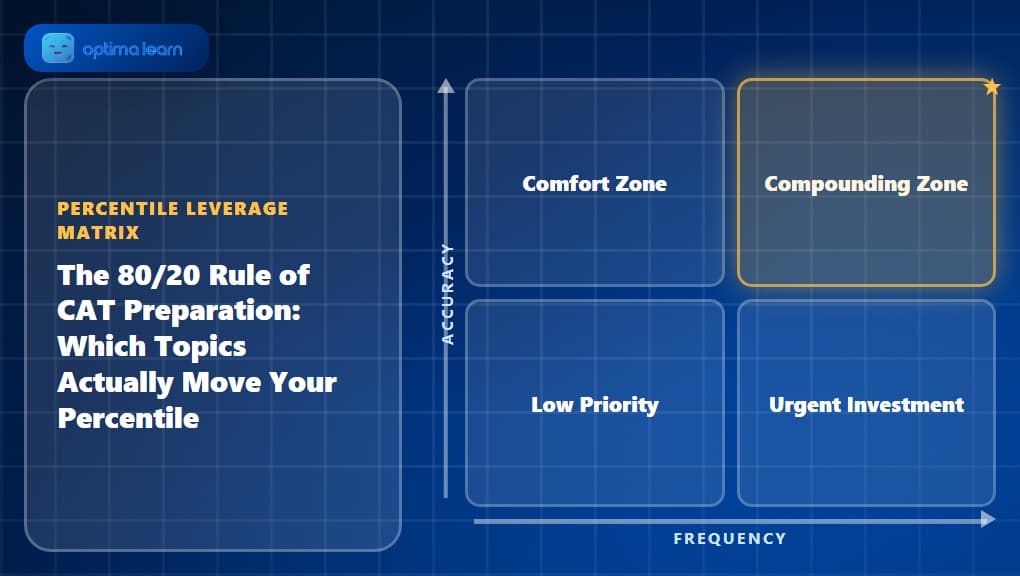
The Percentile Leverage Matrix is a simple 2x2 grid that plots two things against each other: how often a topic has appeared across recent CAT papers, and how close your own accuracy on it already is to a comfortable threshold. Four quadrants. One of them is where your next study hour should almost always go.
Most study plans treat every "important topic" the same way. The matrix forces a split most aspirants never make: exam frequency decides whether a topic earns serious hours at all, while your own accuracy decides what kind of hours it gets. A frequent topic still calls for real time: protect it if you're strong, chase it hard if you're weak. A rare topic gets only a sliver of that time either way, because frequency sets the ceiling, not your confidence.
Comfort Zone
Already accurate here, but it rarely appears. Light revision only, never fresh hours.
Compounding Zone
Frequent and already strong. Extra hours here convert most directly into percentile. Protect and sharpen first.
Low Priority
Rarely tested and currently weak. Basic familiarity only, never your best hours.
Urgent Investment
Frequent but still shaky. Second priority after the leverage zone, and the one most aspirants under-fund.
Vertical axis: your current accuracy. Horizontal axis: how often the topic appears across recent CAT papers.
Notice what the matrix does not ask you to do: rank topics by how much you enjoy them, how impressive they sound, or how much time you have already sunk into them. It asks only two questions, one about the exam and one about you, and plots the answer against both.
Build the frequency axis from the last four or five years of CAT papers, not just one, since a single year's paper can be moderated unusually and skew your sense of what's common. Patterns that hold across several conducting IIMs are far more reliable than one paper's surprises.
Plot topic frequency against your own accuracy, and stop treating every topic as equally worth your time. That's the whole idea in one sentence, and it holds up whether you're three months from CAT or three weeks out.
See Exactly Where Your Hours Are Going
Most aspirants can name their weak topics but can't say how those hours stack up against topic frequency. A structured plan closes that gap in one sitting.
get a personalized CAT study planHow Do You Plot Your Own High-Leverage CAT Topics?
Start with two lists, not one. List every topic by how often it has shown up across the last four or five CAT papers, then separately score your own accuracy on each from your last three mocks. Plotting both together turns a vague sense of "important topics" into an actual leverage map.
Take Quant as a working example. Say Arithmetic-heavy Data Interpretation has been a fixture in recent papers, but your mock accuracy on it still sits closer to 45 percent. That combination lands squarely in Urgent Investment: frequent, but not yet converting into marks. A few more focused hours here close that gap faster than the same hours spent on a topic CAT rarely tests.
Now compare that to Probability with dice-based conditional setups. It appears rarely across recent papers, and your accuracy on it hovers near 40 percent. That combination sits in Low Priority, not because Probability doesn't matter in principle, but because the return on your very next study hour is genuinely small there right now.
A worked example makes the four quadrants concrete faster than any definition. Here's roughly how five common CAT topics might map, based on typical recent-paper frequency and one aspirant's mock accuracy:
| Topic (example) | Frequency in Recent Papers | Aspirant's Accuracy | Quadrant |
|---|---|---|---|
| RC inference questions | High | High | Compounding Zone |
| Arithmetic-heavy DI sets | High | Low | Urgent Investment |
| Seating arrangement DILR | High | High | Compounding Zone |
| Dice-based probability | Low | Low | Low Priority |
| Number series completion | Low | High | Comfort Zone |
Your own table will look different, and that's the point. The matrix is personal by design, built from your accuracy, not a generic difficulty ranking anyone could publish.
This is where the matrix earns its name: a leverage map you keep redrawing as your accuracy shifts, not a worksheet you fill out once and set aside. That redrawing is exactly what the next section deals with.
What Mistakes Quietly Break the 80/20 Rule of CAT Preparation?
The most common mistake is confusing frequent with difficult, and re-routing hours toward whichever topic feels hardest rather than whichever topic the matrix flags. Difficulty and leverage are not the same axis, and treating them as one sends effort toward comfort, not payoff.
A second, subtler mistake is building the matrix once and never touching it again. Accuracy moves as you study, but frequency barely does, so real movement is almost always vertical. A topic that was Urgent Investment two months ago, because your accuracy on a frequent topic was still shaky, can slide into the Compounding Zone once that accuracy climbs. A matrix drawn in July and left untouched stops reflecting reality by September.
The third mistake is abandoning low-frequency topics entirely instead of simply deprioritizing them. CAT's per-question marking means even a topic worth one or two questions a year still deserves basic familiarity. The matrix asks you to spend less time there, never zero time.
There's a fourth trap worth naming: sunk cost. Hours already spent on a topic feel like a reason to keep going, even when the matrix says otherwise. Past effort is not evidence of future leverage, and the matrix only cares about hours still ahead of you, not hours already behind you.
Have you drawn a matrix like this before, even informally, and then brushed aside what it told you because a topic felt more urgent than it actually measured? That instinct is common, and it's usually wrong.
How Often Should You Update Your Percentile Leverage Matrix?
Revisit your matrix every three to four weeks, or immediately after any full-length mock that shifts a topic's accuracy by more than ten percentage points. Waiting longer than that means you're allocating hours based on a version of yourself that no longer exists.
Mock cycles are exactly when accuracy moves fastest, which is also when quadrants shift the most. A topic sitting in Urgent Investment in June can cross into the Compounding Zone by August, purely because you put in deliberate, focused hours there. The matrix should track that movement, not miss it.
Here's the insight worth carrying forward: a topic earns your hours by paying back in percentile, not by being interesting or by feeling unfinished. That's a measurable fact, not a feeling.
The practical action is smaller than it sounds. Spend fifteen minutes this week plotting your own matrix from your last mock, using nothing more than a notebook and your own scoresheet.
The mindset shift is the hardest part of all: your CAT preparation works better as a portfolio you actively rebalance than as a checklist you complete once and never revisit. Some weeks the leverage sits in Quant. Other weeks it sits somewhere in VARC or DILR instead.
If building this matrix alone feels like one more thing on an already full plate, you can get your CAT plan reviewed free and have someone flag which quadrant your current hours are landing in.
Turn the Matrix Into a Weekly Plan
Knowing your high-leverage topics is only half the job. The other half is turning that into a week-by-week schedule that reflects it.
build your CAT planFrequently Asked Questions
What is the 80/20 rule applied to CAT preparation?
It means a small number of topics and question types, usually the ones that appear most consistently across recent CAT papers and match your current accuracy level, account for most of your realistic percentile gains, while a long tail of rarely tested or currently weak-fit topics contributes far less per hour invested.
How do I find my own high-leverage CAT topics?
Plot each topic on two axes: how frequently it has appeared across recent CAT papers, and how close your current accuracy on it already is to a passing bar. Topics that are both frequent and near your reach deserve the most hours; topics that are rare and far from your current ability deserve the least.
Does this mean I should skip low-frequency CAT topics entirely?
No, it means deprioritize them, not ignore them. A topic that appears in only one or two questions most years still deserves basic familiarity, since CAT's per-question marking rewards even single correct answers, but it should never take hours away from a high-leverage topic that's still developing.
How often should I recheck which topics are high leverage for me?
Revisit this every three to four weeks, especially after a full-length mock, since your own accuracy shifts as you study, and a topic that was low leverage two months ago because you were weak in it can become high leverage once your accuracy climbs close to a useful threshold.
Build your CAT 2026 study plan
Personalised daily plan that adapts to your section-wise mock scores.
More from Strategy
Continue reading

Why CAT RC Answer Options Often Feel Equally Correct

How To Study For CAT When You Are Mentally Exhausted

How To Stop Procrastinating On Your Weakest Section
How To Recover From A Wrong Start On A DILR Set Explained
Put it into practice