
CAT Strategy Changes by Percentile
There is no single CAT percentile strategy, because almost all CAT advice is written for a generic aspirant. Attempt more questions. Improve accuracy. Do more mocks. Fix your weakest section. Each of those is genuinely good advice for somebody, and following it while being the wrong somebody is how a year of effort produces very little.
The reason is that what holds you back changes as you climb. At one level the binding constraint is coverage; at another it is accuracy; higher still it is selection, and higher again it is composure. Advice aimed at a constraint you cleared eighteen months ago will not move anything.
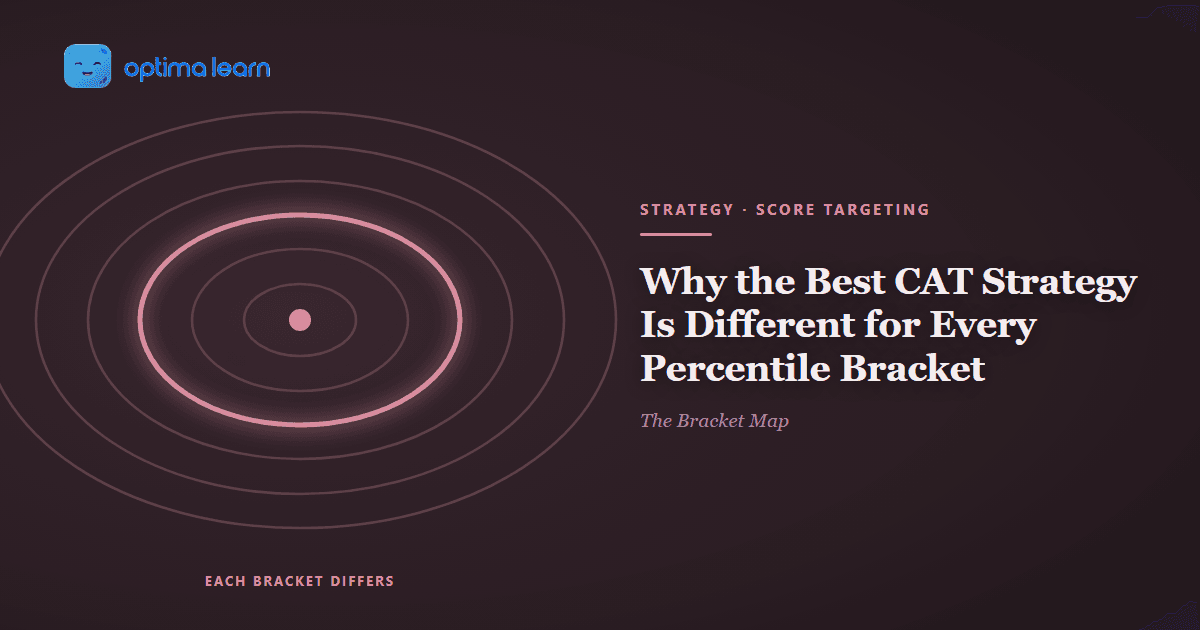
Contour rings make the point better than a ladder does. Each band is a different terrain, and what you need to carry across one is not what you needed for the last.
- What limits your score changes as your percentile rises, so generic advice fits only one band at a time.
- The Bracket Map tracks three things that shift: what limits you, what a marginal hour buys, and what risk profile is correct.
- Below the mid-80s the constraint is usually coverage; in the low 90s it is accuracy; in the high 90s it is selection and composure.
- Applying a higher bracket's strategy early is one of the most common ways aspirants stall.
- Identifying your bracket takes one honest look at a mock report.
Why the Same Advice Cannot Work Everywhere
A score is limited by whichever thing is currently binding. Adding effort anywhere else produces nothing, however well-executed it is.
At lower percentiles the binding constraint is usually that some part of the syllabus is unavailable to you, so the marks are simply not reachable. Once coverage is complete, the constraint becomes how reliably you convert what you attempt. Once accuracy is good, the constraint becomes which questions you choose to spend time on. And once selection is sound, what remains is whether you can execute all of it under pressure on one Sunday morning.
Which produces a predictable mismatch:
- Aspirants with coverage gaps reading advice about question selection, which they cannot use.
- Aspirants with strong accuracy still drilling accuracy, which has stopped being the limit.
- Aspirants near the top adding content when the gap is composure.
- Everybody following advice written by someone in a different band, because the advice does not say which band it is for.
The Bracket Map: Three Things That Shift
Knowing which band you are in decides all three at once, which is why the identification is worth doing carefully.
The Bracket Map
- What limits you. Coverage, then accuracy, then selection, then composure. Only one is binding at a time.
- What a marginal hour buys. The same hour returns very differently depending on which constraint is active.
- What risk profile is correct. Attempt counts and guessing policy are not universal; they follow from the bracket.
Identifying the binding constraint is a short diagnostic on your own mock report:
- If there are questions you could not attempt because you did not know the topic, the constraint is coverage.
- If you attempted plenty and got a meaningful share wrong, the constraint is accuracy.
- If accuracy is high but attempts are low and questions went unread, the constraint is selection.
- If untimed performance is far above mock performance, the constraint is composure.
What a marginal hour buys follows directly, and it is the reason allocation should change with the bracket:
- Under a coverage constraint, an hour of new content is worth a great deal.
- Under an accuracy constraint, an hour of review beats an hour of new questions.
- Under a selection constraint, only full-section practice moves anything.
- Under a composure constraint, simulation under exam conditions is the only input that acts.
Risk profile is the part that is almost never adjusted:
- Lower brackets gain more from raising attempts than from protecting accuracy.
- Middle brackets are usually attempting enough and losing marks to negatives.
- Upper brackets gain most from leaving questions early, because the cost of a long question is highest when the rest of the section is winnable.
Put the Bracket Map to Work
The bracket is visible in your mock data, not in your ambitions. Optima Learn's mocks give you the report the diagnosis needs.
Take CAT Mock TestsWhat Changes Across the Bands
Approximate rather than exact, because the boundaries are blurry and the pattern is not.
| Band | Usually limited by | Highest-return input | Attempt policy |
|---|---|---|---|
| Below mid-80s | Coverage | New content, worked examples | Raise attempts; accuracy follows |
| Mid-80s to low 90s | Accuracy | Deep review of errors | Hold attempts; cut careless losses |
| Low to mid 90s | Selection | Full sections, first-pass practice | Leave earlier; protect the tail |
| Mid to high 90s | Composure and speed of recognition | Simulation at exam conditions | Leave very early; attempt fewer, cleaner |
| Any band | One weak section below a sectional floor | Hedge that section regardless of the rest | Protect the floor first |
The last row overrides the others. Sectional percentile cutoffs are pass or fail, so a section below the floor is the binding constraint no matter how strong the total is or which band the total suggests.
How to Tell When You Have Changed Bracket
The transition is worth catching, because continuing with the old band's inputs is how plateaus start:
- Coverage to accuracy: you stop meeting questions you cannot attempt, and start meeting ones you get wrong.
- Accuracy to selection: your error rate falls but the score does not, because attempts are the limit.
- Selection to composure: untimed performance clearly exceeds mock performance.
- Any direction, on one section only: brackets are per section, not per aspirant, and they are frequently different.
- Check monthly. The bracket usually changes at least once across a preparation cycle.
That fourth point matters more than it looks. It is entirely normal to be coverage-limited in DILR and selection-limited in VARC at the same time, which means one plan cannot serve both.
Common Mistakes in Choosing a Strategy
Related errors:
- Drilling accuracy when selection is the limit. Getting better at questions you never reach.
- Adding content at the top of the range. Where the gap is composure rather than knowledge.
- Using one strategy across three sections. When the brackets differ by section, which is common.
- Ignoring a sectional floor. Optimising the total while one section sits below a cutoff.
- Never re-diagnosing. Keeping a strategy after the constraint it addressed has been cleared.
A Drill for Finding Your Bracket
Ten minutes with a mock report and it settles what the next month should contain.
- For each section, count marks lost to wrong answers and marks lost to questions never opened.
- Note any question you could not attempt because the topic was unfamiliar. That is coverage.
- Compare your mock score with an untimed attempt at the same paper. A large gap is composure.
- Write one constraint word per section, and set that section's next four weeks accordingly.
What usually comes out:
- The three sections are rarely in the same bracket.
- At least one section is being worked on the wrong constraint, often the strongest one.
- Marks lost to unopened questions are larger than expected and appear nowhere in the accuracy figure.
- The diagnosis changes the plan more than any amount of additional effort would.
The Bottom Line
There is no best CAT strategy, only a strategy that matches what is currently binding. The advice that helped somebody at the 85th percentile will do nothing at the 95th, and the advice that works at the 95th is actively unhelpful earlier. Working out which band you are in, per section, is a ten-minute job that decides what the next month is worth.
The Bracket Map, Recap
- What limits you: coverage, then accuracy, then selection, then composure.
- What an hour buys: entirely different depending on which is binding.
- What risk to take: attempt counts and leaving policy follow from the bracket.
Build the Habit on Real Mock Data
Bracket diagnosis needs a mock report rather than an impression. Sit full CAT mock tests and past papers at a steady cadence and work through CAT previous year questions for the constraint you have identified. More on this sits in the CAT strategy blog archive, and if the diagnosis keeps coming out ambiguous it is worth having it reviewed honestly.
Find Your Bracket Before CAT 2026
The right strategy depends entirely on what is currently binding. Diagnose it per section before allocating another month.
Get Your Strategy ReviewedFrequently Asked Questions
Does CAT strategy really change by percentile bracket?
Yes, because what limits your score changes as you climb. Coverage binds first, then accuracy, then question selection, then composure. Advice aimed at a constraint you have already cleared will not move anything, however well you execute it.
How do I find out what is limiting my CAT score?
Compare marks lost to wrong answers against marks lost to questions you never opened, note any question you could not attempt because the topic was unfamiliar, and check the gap between timed and untimed performance. Each points at a different constraint and a different fix.
Should I copy a topper's preparation strategy?
Only if you share their constraint. A routine optimised for composure at the top of the range assumes coverage and accuracy that are already in place. Copying the visible behaviour without the invisible precondition produces a low score reached carefully.
Can my sections be in different brackets?
Usually they are, and that is normal. It is common to be coverage-limited in one section and selection-limited in another, which means a single plan cannot serve all three. Diagnose per section and set each section's next month separately.
Build your CAT 2026 study plan
Personalised daily plan that adapts to your section-wise mock scores.
More from Strategy
Continue reading

XLRI Admission Process: The Exam Nobody Ever Checks
Why Do Some CAT DILR Sets Feel Totally Unsolvable?
Why School Level Quant Feels Hard in the CAT Paper

Why Do Non Engineers Struggle in CAT VARC As Well?
Put it into practice