
Why CAT Questions Age Well: What a 10-Year-Old Question Can Still Teach You Today
A CAT question from ten years ago can still sharpen you today, because the Common Admission Test has spent well over a decade testing the same six to eight reasoning skills, just in different disguises. The topic labels change. The specific reasoning being tested rarely does. That is the whole idea behind what we call the Heartwood Principle.
Open a compiled workbook of old CAT papers and notice what your hand does first. It flips past anything older than three or four years, straight to the newest set, as if the rest has gone stale. We have watched this happen in review sessions more times than we can count. This reflex is not laziness so much as a reasonable-sounding instinct that happens to be wrong.
By the time most aspirants reach their third month of prep, their old-papers folder has become a graveyard, opened once, judged as "too outdated," and never touched again. That folder is not dead weight. It is one of the most under-used resources most CAT aspirants own.
Curious how far back this pattern actually holds? Practice CAT previous year questions from across the last decade and see the pattern show up on your own screen.
- CAT has tested the same six to eight core reasoning skills for over a decade, only the surface details change year to year.
- The Heartwood Principle separates a question into three layers: the Costume, the Core, and the Grain.
- Solving old CAT papers builds the same reasoning skill as new ones, because the skill being tested rarely changes.
- Going back 8 to 10 years in your practice reveals the Core more clearly than only solving the last 2 to 3 years.
- Recent papers are still useful, mainly for pacing and current difficulty calibration, not for learning the underlying skill itself.
This piece is for anyone staring at a stack of old CAT papers, unsure whether a 2016 question is worth solving when this year's mocks are waiting. If a mentor has ever pushed you toward a decade-old DILR set instead of a fresh one, this is the reasoning behind that push, and how to use it yourself.
Why Does an Old CAT Question Still Feel Worth Solving?
An old CAT question still teaches you something because the exam tests reasoning ability, not memorized content that expires with the calendar. Psychologists call the general decay of untouched memory the forgetting curve, but the reasoning skill underneath a solved question does not decay the same way; it strengthens with repetition, regardless of the question's age.
There is a quiet anxiety in this decision, the fear of wasting a limited number of prep hours on something that will not show up "like that" again. This fear is not irrational, just aimed at the wrong target: the Costume, rather than the Core.
Ranking old CAT papers by "relevance" instead of by which skill they test. A 2015 question and a 2025 question testing the same constraint-elimination logic are equally useful, even though only one of them looks current.
Picture a DILR set built around landline telephone billing plans from 2013. Nobody's phone plan looks like that anymore, so the surface reads as irrelevant almost instantly. But strip away the telecom dressing and the set is testing the same constraint-elimination logic as this year's cloud-storage-tier set: given partial information, which combinations are impossible. The subject matter retired years ago. The skill never did.
The graveyard feeling has less to do with the paper's age than with a quieter worry, that time spent on "old" material will not translate into marks on results day. The Heartwood Principle exists to answer that worry directly, not to dismiss it.
Have you ever solved an old question and felt strangely certain you had seen this exact reasoning before, just wearing a different topic? You were noticing the Grain, not deja vu, and the next section gives it a proper name.
What Is the Heartwood Principle?
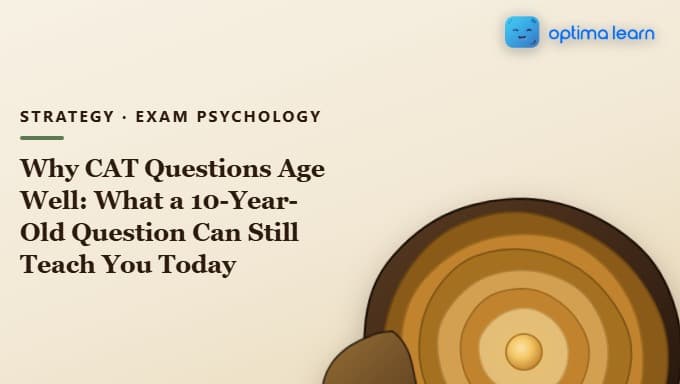
The Heartwood Principle is a mental model with three concentric layers, not a step-by-step sequence: the Costume, the Core, and the Grain. It takes its name from a tree trunk, where the outer bark changes with the seasons but the heartwood at the center has stayed since the tree first began growing.
The Heartwood Principle
The Costume changes every year. The Core never does.
- The Costume - the surface dressing of a question: the topic label, the numbers used, the story wrapped around it, the specific year's context. This is what changes every CAT cycle.
- The Core - the actual reasoning skill being tested underneath the Costume: proportional reasoning, constraint elimination, reading for what a sentence implies rather than states. This is what stays constant year after year.
- The Grain - the pattern that becomes visible only after solving many years of questions side by side, the recurring shape of how CAT dresses up the same 6-8 core skills in new Costumes.
Most aspirants sort old questions by year. Toppers sort them by Core. Once you start asking "what skill is this really testing" instead of "how old is this," a 2014 paper and a 2025 paper start looking like siblings, not strangers.
The Grain shows up in VARC just as clearly. Solve ten years of Reading Comprehension passages side by side and the topics scatter everywhere, marine biology, monetary policy, ancient trade routes, but the questions asked about them keep repeating the same four shapes: what the passage mainly argues, what a specific line implies, what tone the author holds, and where one specific detail sits. The passage topic is Costume. Those four question shapes are Grain, and noticing them consistently is a specific, trainable form of pattern recognition, not a vague sense of deja vu.
What if the reason a question feels unfamiliar has nothing to do with difficulty, and everything to do with a Costume you have not learned to see through yet?
How Does the Core Stay the Same While the Costume Changes?
The Core stays fixed because CAT is fundamentally testing how you reason, not what you have memorized, so the same setup gets a new topic label every year. A 2015 factory-workers ratio question and a 2026 startup-hiring ratio question can demand the identical algebra, wrapped in a completely different story.
This is where the theory needs to earn its keep, because a mental model that only sounds nice in prose is not worth much on exam day. So here is an actual worked pair, one dressed for 2015, one dressed for 2026, solved the exact same way.
Here is the 2015 Costume: a factory's male-to-female worker ratio is 5:3. After hiring 20 more female workers, the ratio becomes 5:4. How many workers did the factory start with?
Let male workers equal 5x and female workers equal 3x. After the new hires, female workers equal 3x + 20, and the ratio 5x to (3x + 20) equals 5 to 4. Cross-multiplying gives 20x = 15x + 100, so x = 20. The factory started with 100 male and 60 female workers, 160 in total.
Now the 2026 Costume: a startup's engineer-to-designer ratio is 5:3. After hiring 20 more designers, the ratio becomes 5:4. Set up the same equation and you get the exact same x = 20, the exact same 160 total, because the reasoning path never changed, only the nouns did.
The same holds across Geometry, Number Systems, and DILR set logic: strip the year-specific wrapper and a large share of "new" questions turn out to be familiar setups in unfamiliar clothing.
When an old question feels unfamiliar, do not read the topic label first. Read only the operation the question is asking you to perform. If you can name that operation in one phrase, you already know the Core, no matter what year the Costume is from.
This is exactly why your solving method matters more than the specific numbers in front of you. If you have ever felt lost mid-question despite knowing the topic cold, the fix usually lives in the CAT Quant Decision Tree, which maps how to choose a method before you touch a single number.
How Do You Actually Use Old Questions in a Revision Cycle?
Old CAT questions earn their place in a revision cycle when you go back at least 8 to 10 years, not just the last 2 or 3. Recent papers calibrate current difficulty and pacing. Older papers reveal the Core more clearly, since you are not distracted by how current the Costume looks.
A structured Quant revision system that actually works already builds this rotation in, alternating recent and older papers by design rather than by mood. The table below shows the difference between the reflex most aspirants default to and the version that actually compounds.
| Panic Move | Pro Move |
|---|---|
| Only solving papers from the last 2 years, assuming older ones are irrelevant | Solving papers across 8 to 10 years, treating the topic label as noise |
| Skipping a question once you recognize the topic as "already mastered" | Solving it anyway, checking whether the method still comes out fastest under time pressure |
| Logging only whether the final answer was right or wrong | Logging which Core skill the question was actually testing, regardless of its Costume |
| Treating every old paper as equally useful for every purpose | Using recent papers for pacing, older papers for skill-building, on purpose |
A workable rhythm is one mixed set a week: two questions from the last two years, two from five to seven years back, and two from eight to ten years back, all logged under the same Costume-versus-Core lens. With that rhythm repeated for a few weeks, most aspirants start recognizing the Core inside a question before they have even finished reading it.
Pair this with topic-wise CAT PYQ practice so the Core skill you are drilling stays visible even as the Costume rotates through Arithmetic, Algebra, and Geometry.
Before your next practice session, pull one question each from a paper less than 2 years old and one more than 8 years old. If you can name the shared Core skill in under 10 seconds, the Grain is already becoming visible to you.
Build a revision cycle that uses the whole decade
Stop guessing which old papers are worth your time. Practice CAT previous year questions across every year CAT has run, filtered by topic and difficulty.
Explore the CAT question bankSo What Should You Actually Do With a 10-Year-Old CAT Question?
Solve it, the same way you would solve one from this year, and then ask what Core skill just got tested underneath the Costume. That single habit, repeated across years of papers, is what eventually reveals the Grain, the recurring shape CAT rarely changes.
That does not mean every old paper deserves equal time, or that recent papers stop mattering, only that the reflex to skip a question purely because of its publication year deserves a second look, every time it shows up.
Ask yourself, honestly, how many old papers are sitting unopened in your prep folder right now because they felt too dated to bother with. Every one of them is still teaching the same six to eight skills the newest mock will test next week.
The Heartwood Principle, in short
- The Costume - what changes every year: topic, numbers, story.
- The Core - what stays constant: the actual reasoning skill.
- The Grain - the pattern you see only after enough years side by side.
Put a decade of CAT questions to work
The Costume rotates every year. The skill it hides does not. Practice CAT previous year questions and start recognizing the Core faster than the exam can disguise it.
Start practicing PYQs nowFrequently Asked Questions
Do old CAT questions still matter if this year's syllabus feels different?
Yes. CAT's syllabus has stayed structurally the same for over a decade, Quant, VARC and DILR testing the same core reasoning skills. A 2015 question and a 2026 question can test the identical skill wearing a different Costume, so the skill you build by solving an old question transfers directly.
How many years back should I go when practicing CAT PYQs?
Go back at least 8 to 10 years rather than only the last 2 to 3. The most recent papers show you current difficulty and framing, but older papers reveal the Core skill more clearly, since you are not distracted by how recent the Costume looks.
Why do CAT questions from 2015 still feel relevant in 2026?
Because CAT tests reasoning ability, not memorized content that expires. The specific numbers, story, and topic label change every year, but the underlying skill, whether it is eliminating impossible cases or reading what a paragraph implies, has stayed the same since the exam's structure stabilized.
Should I prioritize recent CAT papers over older ones?
Prioritize recent papers for mock simulation and pacing practice, since format and difficulty calibration shift slightly year to year. Prioritize older papers for skill-building, since solving 10 years of the same Core skill in different Costumes is what makes you recognize it instantly on exam day.
Build your CAT 2026 study plan
Personalised daily plan that adapts to your section-wise mock scores.
More from Strategy
Continue reading

XLRI Admission Process: The Exam Nobody Ever Checks

Why Do Some CAT DILR Sets Feel Totally Unsolvable?
Why School Level Quant Feels Hard in the CAT Paper

Why Do Non Engineers Struggle in CAT VARC As Well?
Put it into practice