
Why CAT Doesn't Reward Fast Reading: It Rewards Accurate Forgetting
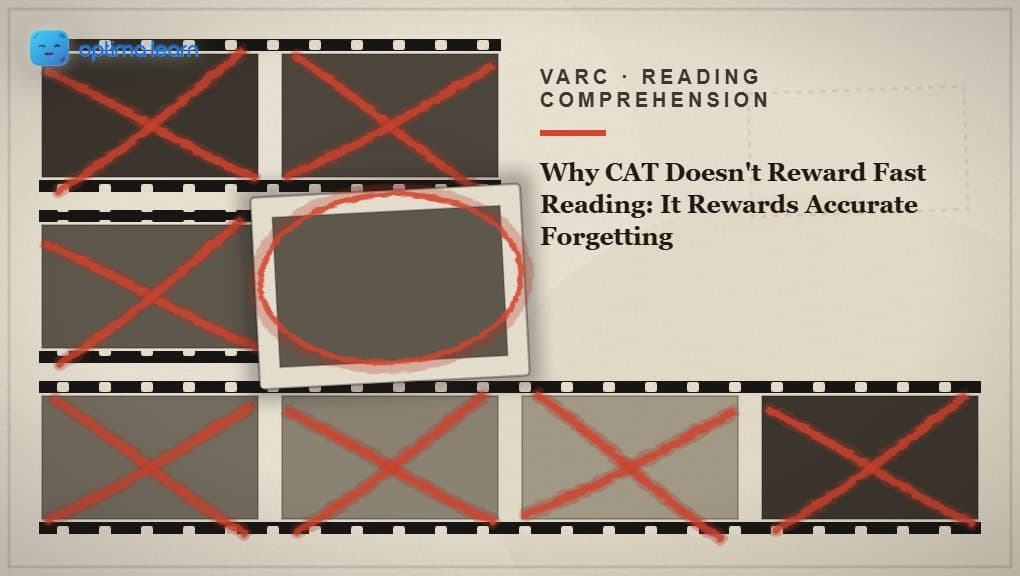
You finish a CAT RC passage certain you understood it, then freeze at the first question because every option sounds like something you just read. That is not a comprehension gap. It is a memory problem: your head kept the wording instead of the argument. Accurate forgetting fixes this by deliberately discarding exact phrasing, sentence order, and example details while protecting the passage's real claim, its structure, and the function each part served. Fast readers finish CAT RC quickly and still lose marks, because speed fills memory with everything, and everything is precisely what makes four similar-sounding options impossible to separate.
- Fast reading does not fix CAT RC accuracy, because it fills memory with everything, and options are built to trap readers who recall wording instead of meaning.
- The Discard Reflex names three things strong readers let go of on purpose: exact wording, sentence order, and example details.
- What survives instead: the passage's real claim, its argument structure, and the function each example was serving.
- Options usually paraphrase the passage rather than quote it, so verbatim memory of sentences works against you, not for you.
- Practicing this is a closed-book habit: after reading, state the claim and the structure in one sentence each, without looking back.
This is for you if you finish CAT RC passages on time, understand what you just read, and still guess between two nearly identical options at the end. Before working through the Discard Reflex itself, it helps to know the specific question types CAT actually asks, since each one draws on a different part of what you chose to keep.
Fast Readers Still Get RC Questions Wrong, and This Is Why
Ask any aspirant stuck at a mediocre RC score whether they understood the passage, and most say yes. They read every line, missed nothing, finished with time to spare. Then four options appear, each restating a piece of the passage in different words, and confidence disappears. The problem was never reading speed. It was what got stored afterward, and how little of it turned out to be useful.
CAT RC options rarely quote the passage directly. They paraphrase it, sometimes accurately, sometimes with one word quietly changed. Holding onto exact sentences means searching for a match that sounds right, then picking whichever option echoes the passage's phrasing most closely. That option is often the trap, built specifically to reward readers who remember words instead of meaning.
Take a passage arguing that a city's transit reforms reduced congestion for a narrow window before rebounding. One option states the reforms failed outright. Another states they worked temporarily, then reversed. Clinging to the phrase reduced congestion makes the first option look right, because it echoes the words. Holding the actual claim instead, temporary success followed by reversal, points straight to the second option as the only accurate one.
The same trap shows up in opinion passages, not just fact-heavy ones. A passage might argue that a particular art form declined in quality after commercialization, hedged with words like largely and mostly. An option quietly drops the hedge and states the decline as absolute. Keeping the passage's actual, qualified claim makes the shift obvious immediately, while keeping only fragments of wording leaves no way to notice that one word changed everything.
Would you be able to state that passage's real claim in one sentence right now, without looking back at it? If not, you were reading for words, not for the argument they were building, and that gap is exactly what CAT's option-writers are counting on.
The Discard Reflex: What Strong Readers Actively Forget
The Discard Reflex still means reading carefully, just once, and then deliberately letting three specific things fade so the part that actually answers the question stays sharp. It has three parts, and each one names both what to release and what to protect in its place.
The Discard Reflex
- Forget the Wording, Keep the Claim. The passage's exact sentences fade within minutes. What should survive is the author's actual position, since options are built to paraphrase rather than quote.
- Forget the Order, Keep the Structure. Which paragraph came third barely matters. What matters is how the argument was built, claim, complication, resolution, and whether you can still trace that shape.
- Forget the Examples, Keep the Function. The specific details of an example rarely matter beyond the job it was doing. Remembering why the author included it beats remembering the example itself.
Consider a passage that opens with a historical claim, complicates it with a counterexample, then resolves the tension in its final paragraph. A question asks how the argument develops. A reader who only remembers "something about history, then an example" cannot answer. A reader who kept the shape, claim, complication, resolution, matches it to the option describing that exact movement, even without recalling which paragraph held which piece.
Function works the same way. A passage might mention a specific policy purely to illustrate a broader trend. A trap option restates the policy's details accurately but misses why it was mentioned at all. Keeping the function, this example proves the trend existed, beats keeping the fact itself, which the question was never really testing.
Next time you finish a passage, ask yourself which of the three you actually held onto, and which one slipped away by accident instead of on purpose. That answer alone tells you which part of the reflex still needs deliberate practice, and which one has already become automatic.
Turn the Discard Reflex Into a Habit
Reading about selective memory is not the same as building it under timed conditions. The fastest way to make it automatic is running it against real passages, not made-up drill text.
Practice CAT VARC Previous Year QuestionsPracticing Selective Memory Instead of Total Recall
Selective memory is a skill, not a personality trait, which means it can be drilled the same way evidence-anchoring or elimination checks can. The method is simple to describe and uncomfortable to do at first, because it means deliberately not looking back at the passage.
After finishing a passage, close it completely. Do not scroll back, do not glance at the last paragraph again. State the author's claim in one sentence. State the argument's structure in one sentence. State what the central example was proving in one sentence. Only then open the questions.
Try this on a passage about a scientific debate. After reading, you might state the claim as researchers disagree on a method's reliability, and the structure as the passage presenting one side, then the other, then the author's own judgment. Neither sentence needs the original wording, and both are usually enough to answer three or four of the four questions correctly.
This closed-book habit also exposes a passage's hidden conversation inside every RC passage, the position the author is quietly arguing against, since that opposing view is usually part of the claim worth keeping, not the wording used to state it.
Common Mistakes That Come From Trying to Remember Everything
Most of the mistakes below do not come from careless reading. They come from careful reading aimed at the wrong target, holding onto detail that felt important in the moment but was never going to answer the question. That distinction matters, because the fix for wrongly aimed attention is different from the fix for actual carelessness.
One aspirant might spend the final thirty seconds before choosing an answer still turning over three different facts from the passage, none of which the question actually needs. That hesitation looks like carefulness but works like static, unprocessed memory competing for attention at exactly the moment a decision needs to be made quickly and cleanly.
| Panic Move | Pro Move |
|---|---|
| Rereading the passage to find the exact phrase an option seems to echo | Checking whether the option matches the claim you already stated, regardless of wording |
| Trying to remember every example the author used, just in case | Remembering only what each example was proving, then letting the detail go |
| Picking the option that repeats the passage's exact words | Treating an exact-word match as a warning sign, not a confirmation |
| Holding four or five details loosely instead of committing to the argument's shape | Committing to the structure early, then testing each option against that shape |
If this pattern feels familiar, the deeper explanation is rarely vocabulary or English fluency. Our companion piece on the real reason RC questions go wrong walks through why strong readers in every other context still stumble specifically on CAT RC.
A Practice Drill for Training the Discard Reflex
Building this reflex does not require new material. It works best on passages you have already solved, reviewed a second time with a different goal, not solving the questions again but grading what your memory kept and what it should have dropped instead.
| Day | Drill | What to Check |
|---|---|---|
| Day 1 | Reread 2 solved passages, state the claim only, closed-book | Did the claim match what you originally answered? |
| Day 2 | Reread 2 solved passages, state the structure only, closed-book | Can you name claim, complication, and resolution in order? |
| Day 3 | Reread 2 solved passages, state each example's function only | Did you name the job, not the detail, of each example? |
| Day 4 | Full closed-book run: claim, structure, and function together | Which of the three still takes longest to produce? |
Grade yourself honestly. It is easy to convince yourself you remembered the structure correctly after the fact, once you already know the right answer. The real test is writing the one-sentence claim and structure down before checking anything, then comparing what you wrote against what the passage actually argued.
Track which of the three parts, claim, structure, or function, keeps lagging behind the others. Most aspirants are strong at one and weak at another, and the weak one is usually where wrong answers cluster on real mocks. Fixing that one weak part often moves accuracy more than adding an entirely new drill.
Which of the three would you guess is your weakest right now, before you have even tested it? Write down your guess before you start, then check it honestly against the table above once you finish all four days of the drill.
The Bottom Line
CAT RC does not reward how much of the passage you remember. It rewards how precisely you know what to let go of, and how confidently you can act on what remains. That is a different skill than fast reading, and it is one you can actually train.
The Discard Reflex, Recapped
- Forget the Wording, Keep the Claim: exact sentences fade, the author's real position should not.
- Forget the Order, Keep the Structure: paragraph sequence fades, claim, complication, resolution should not.
- Forget the Examples, Keep the Function: example detail fades, the job it was doing should not.
The next passage you read will disappear from memory within the hour, regardless of how carefully you read it. The only real choice is which three things you let it take with it, and which three you decide, on purpose, to keep.
Start with one passage today: read it once, close it, and name only the claim. A cluttered memory of a passage rarely means you read poorly. More often, it means you have not yet decided, on purpose, what your memory is actually for.
Ready to Test the Discard Reflex on Real Passages?
Reading about what to forget only helps once you have tried it under a clock, on the kind of passage CAT actually sets.
Practice Real CAT RC PassagesFrequently Asked Questions
How can forgetting help with CAT RC if remembering more usually helps?
Remembering everything equally means nothing is prioritized, and options are built to trap readers who recall wording instead of meaning, deliberately discarding exact phrasing while keeping the passage's actual claim protects you from options that sound familiar but say something different.
What exactly should I let go of while reading an RC passage?
The precise wording of sentences and the specific details of any example the author uses, both fade fast and rarely matter directly, what should survive is the author's actual claim and the shape of the argument that built it.
Isn't this the same as just reading faster?
No, reading faster usually means skimming more and retaining less of everything indiscriminately, the Discard Reflex is about reading at a normal pace while being selective about what gets kept, which is a different skill from speed.
How do I practice discarding the right things instead of the wrong things?
After finishing a passage, close it and try to state the author's claim and the argument's structure in one sentence each without looking back, if you can't, you were likely holding onto details instead of the claim, which is the exact pattern to correct.
Practice VARC, chapter by chapter
CAT VARC practice across reading comprehension, para-summary and para-jumbles, each with a worked solution.
More from VARC
Continue reading

XLRI Admission Process: The Exam Nobody Ever Checks

Why Do Some CAT DILR Sets Feel Totally Unsolvable?
Why School Level Quant Feels Hard in the CAT Paper

Why Do Non Engineers Struggle in CAT VARC As Well?
Put it into practice