
Which DILR Clue Should You Start With
Give ten aspirants the same DILR caselet and watch where they start. Most begin with clue one, because it is first. A few scan all the clues, pick one, and are three deductions ahead within ninety seconds.
The difference is not reading speed. It is that clues are not equal, and the ordering on the page has nothing to do with the order they should be used in. Some clues drive the set. Others cannot do anything until something else has been resolved. Starting with a follower produces the specific frustration of reading a constraint, understanding it perfectly, and being unable to use it.
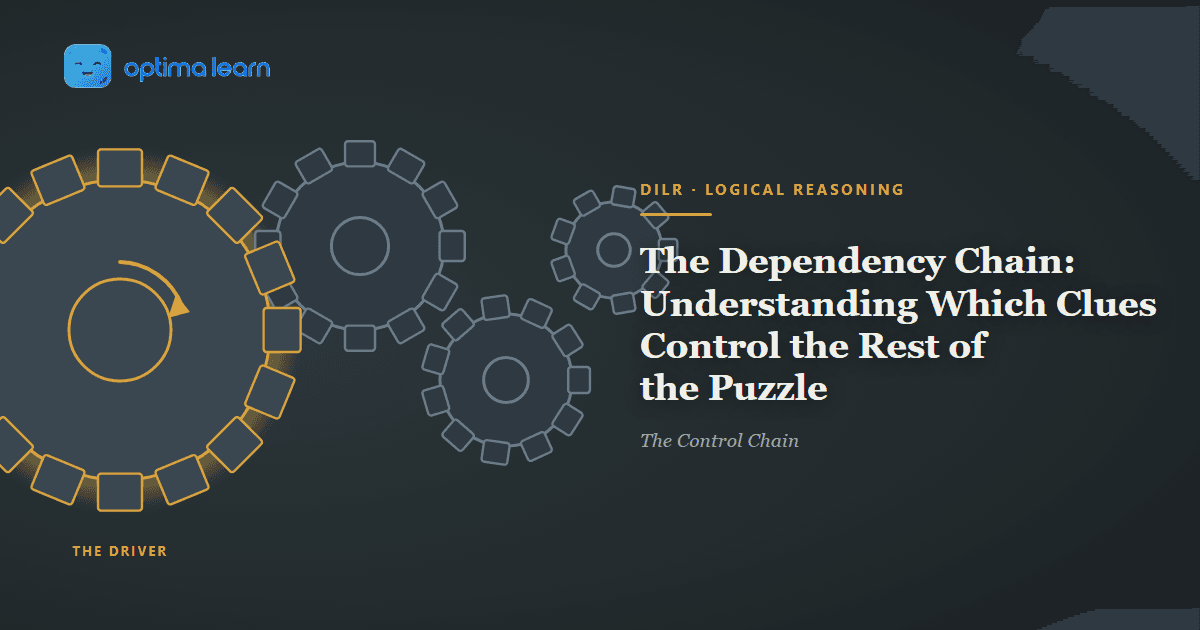
A gear train is the honest picture: one gear is turned, and everything meshed to it follows. Find the driver and the set unwinds in order. Start anywhere else and you are pushing on a gear that is waiting for another one to move.
- Clues in a DILR set form a dependency chain. Some drive the set, most follow, and the printed order tells you nothing about which is which.
- The Control Chain ranks clues on reach, rigidity and dependency, and the ranking takes about forty seconds.
- The best opening clue has high reach, high rigidity, and depends on nothing else being resolved first.
- A clue you cannot use is usually a follower rather than a hard clue, and returning to it after one deduction often makes it trivial.
- Ranking before solving is what converts a caselet from a search into a sequence.
Why Clue Order on the Page Is Not Solving Order
Setters order clues for readability, and sometimes deliberately against solving order. The clue that unlocks a caselet is frequently fourth or fifth, sitting after several that are unusable until it has done its work.
The result of ignoring that is predictable:
- You extract something small from clue one and something small from clue two.
- Neither connects, because the clue that would have linked them has not been used.
- You reach clue five with a grid of scattered marks and no frame to hang them on.
- The set now feels hard, when what actually happened is that you read it in the wrong order.
Nothing was wrong with any individual step. The sequence was wrong, and a wrong sequence is indistinguishable from a hard set while you are inside it.
What distinguishes a driver from a follower is visible before you use either:
- A driver constrains many entities at once, so one application changes a lot of the grid.
- A driver permits few arrangements, so it eliminates rather than merely describing.
- A driver needs nothing resolved first, so it can be applied immediately.
- A follower typically references a quantity or position that has not been established yet.
The Control Chain: Ranking Clues Before You Use Them
The ranking is a single pass over the clue list with three questions, and it happens before anything is written in the grid.
The Control Chain
- Reach. How many entities or slots does this clue touch? A clue mentioning four of six people has more reach than one mentioning two.
- Rigidity. How few arrangements does it permit? "Exactly one" and "adjacent" are rigid; "at least one" and "not last" are loose.
- Dependency. Does it need something else resolved before it can be applied? If yes, it is a follower, whatever its reach.
Reach is the fastest to assess and is a rough count rather than a judgement:
- Count the named entities in the clue. That number is its reach.
- A clue about a total or an ordering of everything has maximum reach and is almost always a driver.
- A clue naming one entity has minimal reach and is nearly always a follower or a finisher.
Rigidity matters more than reach when the two disagree, because a wide but loose clue eliminates almost nothing:
- Exact statements outrank comparative ones: "is third" beats "is above".
- Negative constraints are often more rigid than they look, especially combined with a count.
- Anything containing "only", "exactly" or "must" is rigid and should be ranked up.
Dependency is the test that reorders your list, and it is the one aspirants skip:
- If a clue references a position, quantity or rank not yet established, it is downstream.
- If a clue compares two things whose values are both unknown, it usually waits.
- A clue that depends on nothing is applicable immediately, regardless of how minor it seems.
Put the Control Chain to Work
Ranking clues is a forty-second habit that only pays off against caselets built to reward it. Optima Learn's DILR sets mirror real CAT structures, so the drivers sit where the exam hides them.
Practise CAT DILR SetsHow the Chain Usually Runs
Once you have ranked, the shape of most caselets becomes fairly standard, and knowing the shape lets you predict what comes next rather than searching for it.
| Position in the chain | What the clue looks like | What it does |
|---|---|---|
| Driver | High reach, rigid, no dependency | Establishes the frame: a total, an ordering, a partition |
| Second link | Moderate reach, rigid, depends on the frame | Fixes one or two positions inside the frame |
| Middle links | Narrow reach, rigid | Eliminate options, usually creating two-option slots |
| Finishers | Single entity, often negative | Resolve the last two-option slots |
| Checks | Restates something derivable | Nothing. Verify with it, do not solve with it. |
The last row is worth knowing about. Well-built caselets often include a clue that is redundant given the others. Spotting it early stops you searching it for information it does not contain, and it makes an excellent final check on a completed grid.
What to Do When Two Clues Tie
Ranking often leaves two candidates that look equally good. A few tie-breakers, in order of usefulness:
- Prefer the one that fixes rather than eliminates. A fixed value cascades; an elimination usually does not.
- Prefer the one touching the most constrained entity. Working where the options are already few produces results faster.
- Prefer numerical over relational. "Scored 40" is worth more than "scored more than Rahul".
- Prefer the one that combines with a clue you have already used. Two clues about the same entity are worth more together than apart.
- If still tied, take either. Deliberating past ten seconds costs more than a slightly suboptimal start.
Ranking pairs naturally with the opening scan of a set, which is covered in the sixty seconds that decide whether you will crack a DILR set.
Common Mistakes in Reading the Chain
Related errors that cost time:
- Confusing reach with rigidity. Chasing a clue that mentions everyone but permits almost every arrangement.
- Ignoring dependency. Attacking a high-reach clue that cannot be applied until something else is fixed.
- Forcing an unusable clue. Re-reading a follower repeatedly instead of parking it and returning after one deduction.
- Missing the redundant clue. Searching a verification clue for information it was never going to provide.
- Re-ranking mid-set. The chain does not change; only your position in it does. Rank once.
A Practice Drill for Finding the Driver
The drill isolates ordering from reasoning, which is the only way to tell which one is costing you.
- Take ten DILR sets. Do not solve them.
- For each, rank the clues by reach, rigidity and dependency, and write down which clue you would open with.
- Now read the official solution and note which clue it actually opens with.
- Count the matches. Then solve five fresh sets using your ranking, and compare your time to first fixed value against your usual.
Common findings from this drill:
- Ranking accuracy starts around half and reaches most of the way within about thirty sets.
- The clue you would have opened with is frequently second or third in the official solution rather than wrong.
- Dependency is the criterion aspirants most often ignore, and correcting it produces the largest single gain.
- Time to first fixed value falls well before total solving time does, which is the earliest sign the habit is working.
The Bottom Line
A DILR caselet is not a pile of facts to be absorbed. It is a chain with one end you can pull. Aspirants who find that end solve in sequence; aspirants who start at clue one search, and searching under a clock is what makes a solvable set feel impossible.
The Control Chain, Recap
- Reach: how many entities the clue touches. Count them.
- Rigidity: how few arrangements it permits. Exact beats comparative.
- Dependency: whether it needs something resolved first. If so, park it.
Build the Habit on Timed CAT DILR
Forty seconds of ranking feels unaffordable until it has saved a set, so it has to be practised under a clock. Work through CAT previous year questions in timed blocks, or sit full CAT mock tests and past papers so ranking survives real section pressure. More DILR method sits in the CAT DILR blog archive, and if set selection keeps going wrong it is worth having your strategy reviewed honestly.
Find the Driver Before CAT 2026
The order you use clues in decides whether a caselet unwinds or stalls, and ranking them takes less time than one wasted deduction. Build the habit on real CAT-style sets.
Start Practising CAT DILRFrequently Asked Questions
Which clue should I start with in a DILR set?
The one with the highest reach that is rigid and depends on nothing else being resolved first. Count the entities each clue names, circle any containing "exactly", "only" or "must", and open with the highest circled count. Printed order is chosen for readability and is close to useless as a solving order.
What is a dependency chain in DILR?
It is the order in which clues become usable. Some clues can be applied immediately, while others reference a position or quantity that must be established first. Ranking clues by dependency converts a caselet from a search into a sequence, which is where most of the time saving comes from.
What do I do with a clue I cannot use?
Park it and move down your ranking. An unusable clue is almost always downstream rather than difficult, and a single deduction elsewhere usually makes it immediate. Re-reading a follower repeatedly is one of the most common ways aspirants lose two minutes on an unblocked caselet.
Why do some DILR clues seem to add nothing?
Some genuinely add nothing new. Well-built caselets often include a clue that is redundant given the others, present so the set can be verified. Identifying it early stops you searching it for information it does not contain, and it makes an excellent final check once the grid is complete.
Practice DILR sets, chapter by chapter
CAT DILR practice across LR puzzles and DI sets, each with a worked solution.
More from DILR
Continue reading

Using a Study Journal for CAT Without Overdoing It

How to Stop Comparing Your CAT Prep With Everyone Else

SPJIMR Admission Process: Why the Profile Leads It

How to Solve CAT Quant Faster Without Skipping Steps
Put it into practice