
The Threshold Effect in CAT Quant
Every aspirant knows the feeling. You have been circling a question for two minutes, the page is filling up, and then something shifts. Not gradually. One thought lands and the entire question falls over, and what is left is arithmetic you could do in your sleep.
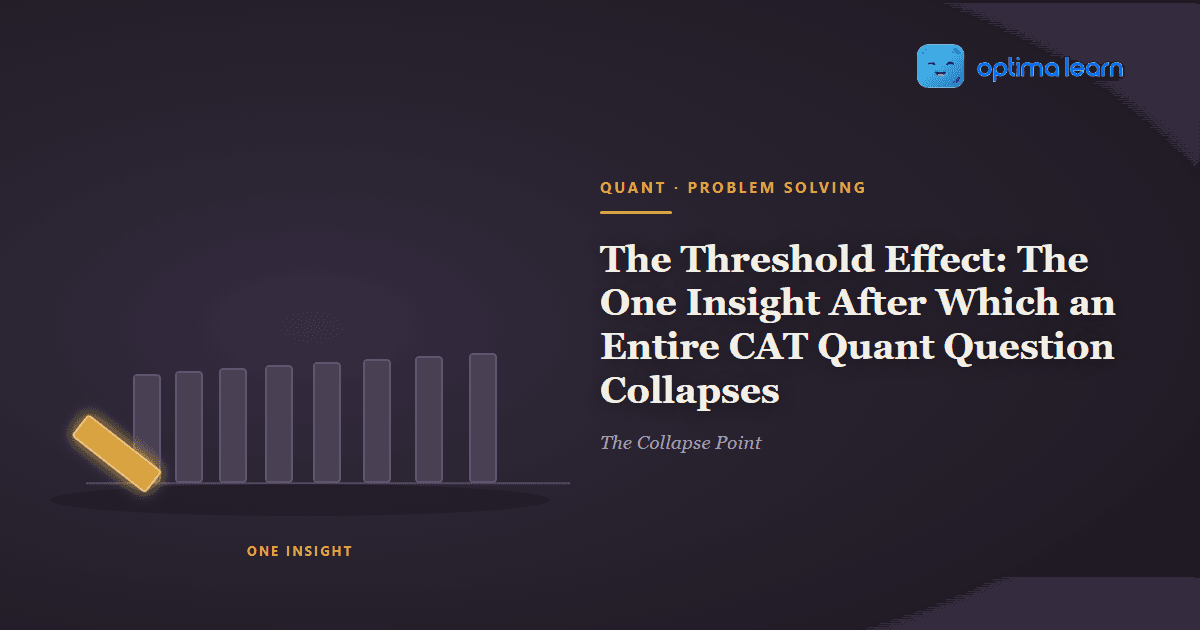
That shift is not luck and it is not a mood. It is a threshold, and it behaves like the first domino in a long row: nothing much happens for a while, and then one small thing tips and the rest go down on their own.
What separates aspirants is rarely whether they can cross that threshold. It is whether they recognise they have crossed it, and whether they keep searching for it long enough to get there.
- Hard CAT Quant questions do not get gradually easier. They stay hard and then collapse, usually on one idea.
- The Collapse Point has three markers: unknowns drop faster than one at a time, the remaining work stops needing decisions, and you could explain the rest in a sentence.
- Recognising the collapse matters as much as reaching it, because aspirants routinely keep searching after the question has already fallen over.
- If none of the three markers appear within about two minutes of searching, you have not found it, and more searching is not the answer.
- The insight almost never gives you the answer. It removes the reason the answer was hard to get.
Why Difficulty in Quant Is Not Gradual
Most aspirants model a hard question as a long one: more steps, more effort, a slow climb to the answer. Under that model, being stuck means you are partway up and should keep climbing.
That model is wrong for most CAT Quant, and believing it is expensive. A well-built question has a single structural obstacle. Before you clear it, effort produces almost nothing. After you clear it, almost no effort is required. There is no middle.
Which means being stuck carries a very different instruction than being slow:
- Being slow means the route is right and you should continue.
- Being stuck means the route is not yet open, and more of the same will not open it.
- Partial progress on a threshold question is usually an illusion; the page fills but the problem does not shrink.
- The correct response to stuck is to change what you are looking at, not to look harder at the same thing.
The Collapse Point: Three Markers You Have Crossed It
These are diagnostic rather than instructional. They tell you where you are, which is what decides whether to keep searching or start finishing.
The Collapse Point
- Unknowns drop in clusters. One idea removes two or three unknowns at once. Ordinary steps remove them one at a time; a threshold removes several.
- The work stops needing decisions. Everything remaining is execution. You are no longer choosing what to do next, only doing it.
- You could explain the rest in one sentence. If the remaining path fits in a sentence, the difficulty is behind you.
Unknowns dropping in clusters is the most objective marker because you can count it on the page:
- Three variables become one substitution, and the other two never need values.
- A case list of eight collapses to two because one property rules the rest out.
- An expression that needed both roots turns out to need only their sum.
Decisions disappearing is the marker that most reliably tells you to stop searching and start finishing:
- You know every remaining step before you write it.
- There is no branch left that you would have to think about.
- If interrupted, you could resume without re-reading anything.
The one-sentence test is the fastest of the three and works even mid-question:
- "Substitute and solve the quadratic" is a sentence. You have crossed it.
- "Try some values and see what happens" is not a plan, it is a hope. You have not.
- If the sentence needs an "and then figure out", the threshold is still ahead.
Put the Collapse Point to Work
Recognising a collapse is a judgement built from seeing many of them. Optima Learn's Quant sets follow real CAT patterns, so the threshold questions behave the way they will on exam day.
Practise CAT Quant QuestionsHow Long to Keep Searching for the Collapse
The threshold model has an uncomfortable implication: if you have not found the insight, the minutes you have spent bought you almost nothing, and the next minutes may buy nothing either. So the search needs a budget.
| Time searching | What it means | What to do |
|---|---|---|
| Under 45 seconds | Normal. Most thresholds sit here. | Keep looking. Do not start computing. |
| 45 to 90 seconds | Slower than typical but not unusual. | Change what you are looking at: re-read the stem, not your page. |
| 90 to 120 seconds | The obvious entrances are exhausted. | Try one structurally different angle, then decide. |
| Over 2 minutes | You are unlikely to find it under exam pressure. | Leave it. The cost of staying is now several other questions. |
The last row is the one that saves sections. A threshold question you have not cracked in two minutes is not nearly solved. It is exactly as unsolved as it was at thirty seconds, which is what makes it so different from a long-but-open question. The wider version of that judgement is in why every CAT Quant question has a point of no return.
Where to Look When Nothing Is Collapsing
If the markers are not appearing, the useful move is to change the object of attention rather than the intensity. In rough order of payoff:
- Re-read the stem, not your working. The insight is nearly always in the question, and your page has been slowly replacing it in your attention.
- Look at what is being asked, not what is given. A target you have not looked at recently frequently rules out most of what you are doing.
- Ask what would make this easy. Name the fact that, if true, would collapse it. Then check whether the question implies it.
- Try the smallest case. Whatever the general question is, do the tiny version. Structure is often visible at n equals 2 and invisible in general.
- Check what you have not used. A given you have not touched is either a decoy or the threshold, and it is usually the threshold.
The last of those is worth doing routinely rather than only when stuck. A well-built question rarely wastes a given, so an unused condition is a strong signal about where the collapse lives. The complementary skill is covered in the hidden architecture of CAT Quant, which is about where entrances hide rather than how to know you have found one.
Common Mistakes Around the Threshold
The threshold model breaks down in a few predictable ways:
- Grinding a closed door. Computing hard on a question whose obstacle is structural, which produces pages and no progress.
- Mistaking comprehension for progress. Understanding the question deeply and treating that as being close.
- Abandoning at ninety seconds. Leaving just before the threshold, which is a real cost in the other direction.
- Searching the page instead of the stem. Re-reading your own working, where the insight has never once been.
- Refusing the small case. Insisting on the general argument when n equals 2 would have shown the structure in ten seconds.
A Practice Drill for Recognising the Collapse
The drill trains recognition rather than insight, which is the part most preparation ignores.
- Take twelve hard questions you have already solved, along with your original working.
- For each, mark the exact line where the last real decision was made. That is your collapse point.
- Split your time on each question into before and after that line. Write both numbers down.
- Now note, for each, which of the three markers appeared first. Over twelve questions a pattern shows up.
What usually comes out of this:
- The pre-collapse share of time is far larger than aspirants expect, typically three quarters or more.
- One marker is reliably your earliest signal, and it is worth knowing which.
- On several questions you kept searching for a while after the collapse had already happened.
- The questions you abandoned cluster tightly around the ninety-second to two-minute band, which is exactly where the budget matters.
The Bottom Line
Hard Quant questions are not steep climbs. They are locked doors with ordinary rooms behind them. Almost all your effort goes into the lock, almost none into the room, and the two most valuable skills are knowing when the lock has opened and knowing when to stop trying.
The Collapse Point, Recap
- Unknowns drop in clusters: two or three at once, not one at a time.
- Decisions disappear: everything left is execution.
- One sentence covers the rest: if it needs an "and then figure out", you are not there.
Build the Habit on Timed CAT Quant
Search budgets only mean anything against a clock, because untimed practice never forces the decision. Work through CAT previous year questions in timed blocks, or sit full CAT mock tests and past papers so the two-minute judgement gets rehearsed under real fatigue. More on question construction sits in the CAT Quant blog archive, and if hard questions keep swallowing whole sections it is worth having your strategy reviewed honestly.
Frequently Asked Questions
What is the threshold effect in CAT Quant?
It is the pattern where a hard question stays hard until one specific insight lands, after which it collapses into routine arithmetic. Difficulty is concentrated at a single structural obstacle rather than spread across the solution, so effort before the threshold produces very little.
How do I know I have found the key insight?
Three markers: several unknowns disappear at once rather than one at a time, the remaining work stops requiring any decisions, and you could describe everything left in a single sentence. If a plan still needs an "and then figure out", the threshold is still ahead of you.
How long should I search before giving up on a hard question?
About two minutes. Most thresholds are crossed inside forty-five seconds, and the odds fall sharply after ninety. Because a threshold question is exactly as unsolved at two minutes as it was at thirty seconds, staying longer usually costs several other questions for nothing.
What should I do when I am stuck but understand the question well?
Change what you are looking at rather than looking harder. Re-read the stem instead of your working, check which givens you have not used, and try the smallest case. Understanding a question thoroughly is normal before a threshold and is not the same as having a route into it.
Find the Collapse Faster in CAT 2026
Knowing whether to keep searching or start finishing is worth more than any single technique. Build the judgement against real CAT-style questions under a clock.
Start Practising CAT QuantPractice these Quant concepts, chapter by chapter
Thousands of CAT Quant practice questions by chapter and difficulty, each with a worked solution.
More from Quant
Continue reading
Using a Study Journal for CAT Without Overdoing It
How to Stop Comparing Your CAT Prep With Everyone Else

SPJIMR Admission Process: Why the Profile Leads It
How to Solve CAT Quant Faster Without Skipping Steps
Put it into practice