
The Forgotten Skill in CAT Preparation: Learning How to Learn
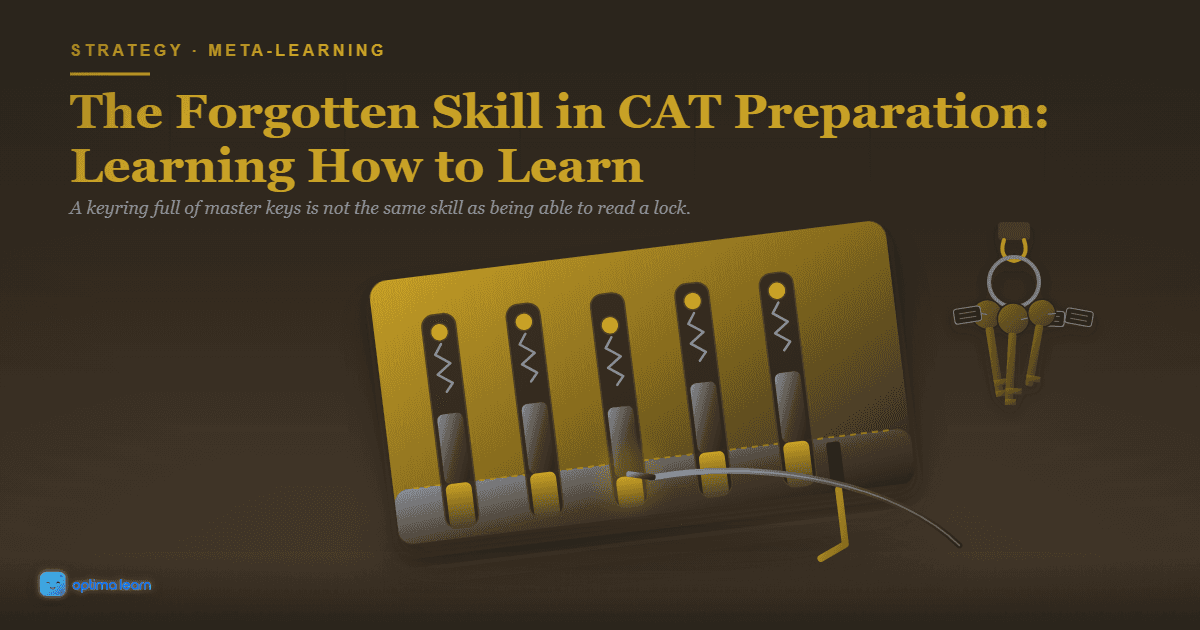
The forgotten skill in CAT preparation is noticing your own pattern of understanding, which concepts genuinely click and which ones you only nod along to, not another shortcut or timetable. Most aspirants collect borrowed techniques instead of reading that pattern, which is why two aspirants working from identical material can improve at completely different rates.
How many saved screenshots of "CAT shortcuts" are sitting on your phone right now, the ones you bookmarked during a late-night scroll and have opened exactly once since? If the honest answer is more than you'd like to admit, you're not doing anything wrong by saving them.
The problem starts later, quietly, when saving becomes a substitute for a different kind of work: the work of noticing what your own attempts, not someone else's, are actually telling you. That work has a name in this piece. We're calling it the Locksmith's Ear, and almost nobody teaches it directly.
- Collecting borrowed techniques, a topper's timetable, a mentor's formula sheet, feels like progress, but it isn't the same skill as reading your own pattern of understanding.
- The Locksmith's Ear names three parts: the Keyring (borrowed techniques), the Pins (your own daily feedback), and Reading by Feel (the transferable skill of adjusting your method).
- Most aspirants generate useful feedback about their own learning every single day and never actually read it.
- A mock plateau is often the moment your own learning pattern becomes impossible to ignore, since whatever worked before has visibly stopped being enough.
- Self-awareness only helps once it changes your actual study plan, not just your understanding of yourself.
This piece is for anyone whose study folder has grown bigger than their confidence, aspirants who've downloaded plenty of advice but couldn't tell you, specifically, what their own last three mistakes had in common. If that sounds familiar, closer attention to material you already have will do more for you here than one more borrowed technique.
Why Do Most CAT Aspirants Collect Techniques Instead of Reading Their Own Pattern?
Most CAT aspirants collect techniques instead of reading their own pattern because a saved shortcut feels like progress the moment you save it, while noticing your own recurring mistake feels like admitting a weakness. Collecting is comfortable and visible. Reading your own pattern is quieter, slower, and far more useful over a full preparation cycle.
Most study folders by month three look remarkably similar: a topper's timetable screenshot, a mentor's formula sheet PDF, three different shortcut videos for the same percentage-change trick. Each one was cut for a specific lock, someone else's schedule, someone else's weak area, and works beautifully there. It rarely works quite as well on yours.
If you want a faster read on where your own gaps actually sit, without months of guessing on your own, a personal CAT mentor who has coached this exact pattern in aspirant after aspirant can shorten that guesswork considerably. But even the best mentor is pointing you toward a skill, not handing you a shortcut around building it.
None of this makes borrowed material useless. A close look at what habits high percentilers actually share is genuinely worth your time, and several of those habits are worth borrowing outright. The keyring metaphor isn't an argument against borrowing keys, just a reminder that a key cut for someone else's lock, however well made, still needs a lock of your own shape to actually turn.
Ask yourself honestly: of the last five tips you saved somewhere, how many have you actually used inside a timed mock since?
What Is the Locksmith's Ear, and What Does Each Part Actually Mean?
The Locksmith's Ear is a way of naming the difference between owning borrowed techniques and developing the skill to read your own preparation: it has three parts, the Keyring, the Pins, and Reading by Feel, and only the third one is genuinely transferable to a topic no borrowed key was ever built for.
The metaphor is simple on purpose. A locksmith who only owns master keys can open every lock someone already cut a key for, and nothing else. A locksmith who can read pins, feel where a lock resists and where it gives, can eventually open a lock nobody's ever seen before. CAT preparation rewards the second skill far more than the first.
The Locksmith's Ear
A keyring full of master keys is not the same skill as being able to read a lock.
- The Keyring: a growing collection of borrowed techniques, someone else's shortcut, a topper's timetable, a mentor's formula sheet, each one useful for the specific lock it was cut for and nowhere else.
- The Pins: the actual feedback your own preparation constantly gives off, which kind of question consistently costs you time, which explanation genuinely clicks versus which one you only nodded along to, information most aspirants generate but never read.
- Reading by Feel: the transferable skill itself, noticing your own pattern of understanding and misunderstanding well enough to adjust your own method, which works on a lock, a topic, a question type, no borrowed key was ever cut for.
Psychologists have a name for this general skill: metacognition, essentially thinking about your own thinking, and unlike raw intelligence, it's something you can deliberately train.
Picture a specific moment: a friend swears by a particular shortcut for percentage-change questions, and it visibly works for them, fast and clean, every single time. You borrow it. It doesn't click the same way, and you can't quite say why. That gap is worth sitting with, because it's the Pins trying to tell you something the Keyring never could.
How Do You Actually Read Your Own Pins?
You read your own pins by tracking two specific signals after every study session: which question type consistently costs you more time than it should, and which explanation you can actually rebuild from memory versus the one you only nodded along to. Most aspirants generate both signals daily and record neither.
Start smaller than you think you need to. After any study session where a concept clicked, or stubbornly refused to, write exactly one sentence explaining why. Not what the concept was, that part's easy to look up again. Why it suddenly made sense, or why it still doesn't, is the actual signal worth keeping.
Do this for two or three weeks and then read the sentences together, in one sitting, back to back. A real pattern tends to show up faster than most aspirants expect: the same kind of explanation keeps genuinely landing, and a different kind keeps quietly getting nodded through without actually sticking.
There's a second signal worth tracking alongside the sentence habit: which question type consistently eats more time than it should, independent of whether you get it right. Time cost and correctness aren't the same signal, and conflating them hides exactly the pattern you're trying to read.
Here's what reading the pins looks like next to the more common reflex, side by side, across four everyday moments.
| Moment | The Keyring Reflex (Panic Move) | Reading the Pins (Pro Move) |
|---|---|---|
| A shortcut doesn't work under time pressure | Search for a different, newer shortcut | Ask which specific step of your own process the shortcut skipped |
| An explanation makes sense while reading it | Mark the topic as done and move on | Try to rebuild the explanation from memory a day later |
| The same question type keeps costing extra time | Assume it's just a weak topic and grind more questions | Isolate what specifically slows you down inside that topic |
| A mentor's method feels harder than your own instinct | Force yourself to use it because it worked for someone else | Test it once, then keep only the part that actually fit |
Why Does a Mock Plateau Reveal Your Learning Pattern Better Than a Rising Score Does?
A mock plateau reveals your learning pattern better than a rising score does because a rising score can hide which specific technique is actually working, while a stuck score forces you to isolate what genuinely changed and what didn't. Improvement can mask a shaky method for months before a plateau finally exposes it.
A close read of what to do when your mock scores stop improving covers the tactical side of breaking a stall: which topics to prioritize, how to restructure a revision week, where to find fresh practice material. The angle here is narrower and comes before all of that: a plateau is also the exact moment your own learning pattern becomes impossible to keep ignoring.
A rising score is generous in a specific, misleading way. It lets a shaky method hide behind good outcomes for months, because the outcome looks fine even when the underlying process isn't repeatable. A plateau removes that cover. Whatever got you this far has visibly, undeniably, stopped being enough on its own.
Have you ever noticed that the advice which fixed a plateau last time doesn't seem to work this time? That usually means the pattern underneath has shifted and needs a fresh read, not the exact same key you reached for last time.
Stop Guessing at Your Own Pattern
A mentor who has already read hundreds of these plateaus can help you see yours faster than another month of solo guessing.
Find Your CAT MentorThe Bottom Line: Are You Collecting Keys, or Learning to Read the Lock?
The bottom line is that borrowed techniques and self-awareness serve different purposes, and only one of them keeps working once your preparation moves past the specific lock it was built for. A keyring helps you open doors other people already opened. Reading by Feel helps you open the ones nobody's cut a key for yet.
The Locksmith's Ear, Recapped
A keyring full of master keys is not the same skill as being able to read a lock.
- The Keyring: borrowed techniques, useful for the lock they were cut for, rarely for yours exactly.
- The Pins: the feedback your own preparation gives off daily, mostly unread.
- Reading by Feel: the transferable skill of noticing your own pattern well enough to adjust your method on anything.
Self-awareness on its own rarely moves a percentile; it has to turn into a changed plan, or it stays an interesting observation about yourself and nothing more. Once you can name your own pattern with real confidence, the next step is folding that into a personalized CAT study plan that adjusts around what you now know, instead of a generic syllabus checklist built for an average aspirant who doesn't actually exist.
The forgotten skill in CAT preparation was never a secret technique waiting somewhere to be discovered. It was the ordinary discipline of paying attention to your own preparation the way you'd pay attention to a lock you were genuinely trying to open, one pin at a time, on purpose, instead of reaching for one more key that was never cut for you in the first place.
Learn to Read Your Own Pattern, With Help
A CAT mentor who has already cracked the exam can help you name your own pattern with a clarity no amount of self-review alone quite reaches.
Get a CAT MentorFrequently Asked Questions
What does 'learning how to learn' actually mean for CAT preparation?
It means paying attention to your own pattern of understanding, not just collecting more study techniques. Most aspirants can list several borrowed methods, a topper's routine, a mentor's shortcut, but far fewer can say specifically which of their own explanations of a concept later turned out to be wrong, which is the actual signal that improves how they learn next.
Isn't collecting more study techniques from toppers still useful?
It is useful the way a labeled master key is useful, for the specific lock it was cut for. A technique that worked for someone else's weak areas may do nothing for yours, since it was built to fit their specific pattern of understanding, not a generic one.
How do I start noticing my own learning pattern if I've never paid attention to it before?
After any session where a concept clicks, or fails to, write one sentence explaining why, not what the concept was, but why it suddenly made sense or why it still doesn't. That single habit, repeated for a few weeks, is usually enough to reveal a pattern in how you personally learn best.
Is this skill more important early in preparation or closer to the exam?
It compounds, so earlier is better, but it is never too late to start. An aspirant who develops this awareness even eight weeks out can redirect the remaining time toward what actually works for them, instead of continuing to follow a borrowed method that was never suited to their specific gaps.
Build your CAT 2026 study plan
Personalised daily plan that adapts to your section-wise mock scores.
More from Strategy
Continue reading

Why Word Problems Feel Harder in CAT Quant Than School

Why High Scorers Skip an Entire CAT RC Passage Fully

Why DILR Sets Take Longer to Understand Than Solve
Do Mocks in a Noisy Environment Help or Hurt CAT Prep?
Put it into practice