
The Compounding Advantage in CAT Prep
Most preparation decisions are worth roughly what they cost. Choosing which topic to study on Tuesday affects Tuesday. Picking one question bank over another affects the questions you solve. Sensible choices, bounded returns.
A small number of decisions are not like that. They change how every subsequent hour behaves, which means their value keeps accruing long after they were made. Deciding in August to review properly does not improve one session; it improves every session between then and 29 November, and the difference compounds.
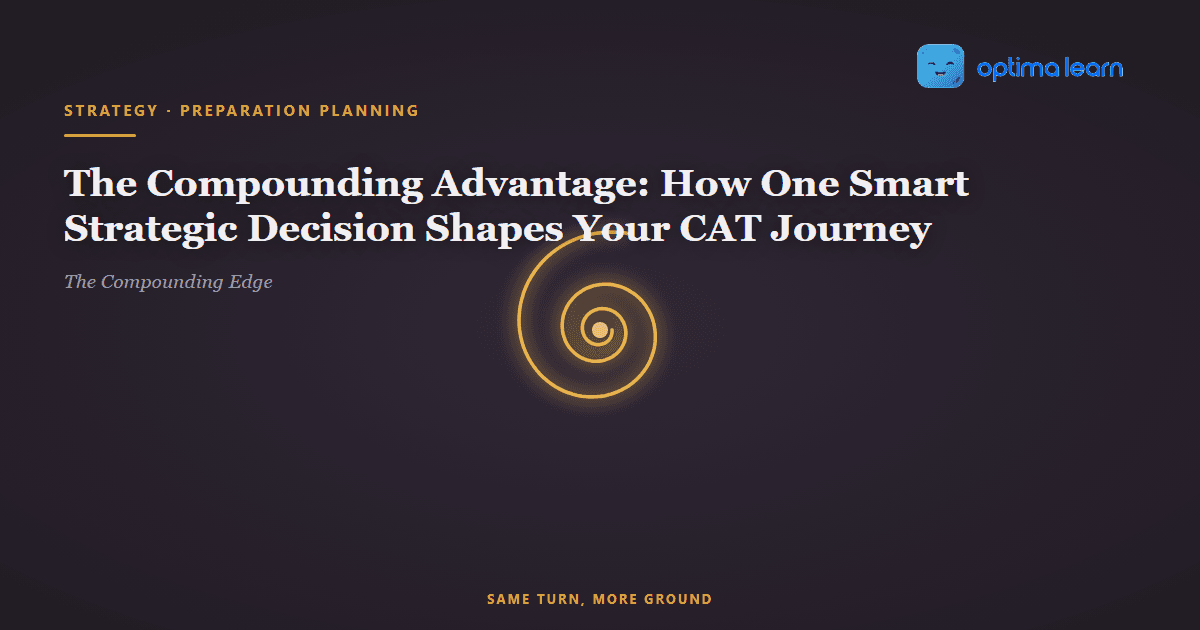
A spiral covers more ground on each turn while the turn itself stays the same. That is the shape worth looking for, and there are only a handful of decisions that have it.
- Most preparation decisions pay once. A few change how every later hour behaves.
- The Compounding Edge identifies three: the review habit, the metric you choose, and keeping decisions reversible.
- Compounding decisions are worth making early, because their value is proportional to the time remaining.
- They are usually undramatic, which is why they get postponed in favour of visible ones.
- Made in August they have four months to work; made in November they are almost worthless.
What Makes a Decision Compound
A compounding decision has one property: it changes the return on every subsequent hour rather than producing a return itself.
Deciding to study probability this week produces some knowledge of probability. Deciding how you will review produces nothing on its own, and it changes what every solved question is worth from that point on. The second is worth far more and looks like far less on the day it is made.
Which is exactly why they get deferred:
- Compounding decisions produce nothing immediately, so they never feel urgent.
- Their value depends on time remaining, so deferring them destroys most of it.
- They are usually about process rather than content, and process feels like overhead.
- Nothing prompts them, because no syllabus contains "decide how you will review".
The Compounding Edge: Three Decisions Worth Making Now
Each of these takes under an hour to settle and continues paying for as long as the preparation lasts.
The Compounding Edge
- The review habit. How you handle a solved question determines what every future question is worth. It is the highest-compounding decision available.
- The metric you choose. Whatever you measure is what improves, so the choice of number quietly sets your ceiling.
- Keeping decisions reversible. Preserving options costs almost nothing now and is worth a great deal when information arrives later.
The review habit compounds harder than anything else because it applies to every question you will ever solve:
- An aspirant who reviews by category learns something transferable from each question; one who checks answers learns one fact.
- The gap widens with volume, so it is largest for the people solving the most.
- Established in August it applies to thousands of questions; established in November it applies to a few hundred.
- It costs no additional hours, only a different use of hours already committed.
The metric you choose is the least obvious of the three and arguably the most powerful:
- Measure questions solved and you will solve more questions, whether or not that helps.
- Measure lines of working per question and your solutions get shorter.
- Measure questions never opened and your selection improves, because the loss becomes visible.
- Whatever goes unmeasured drifts, and the unmeasured thing is usually where the marks are.
Keeping decisions reversible compounds by preserving future value rather than creating present value:
- A plan reviewed monthly can absorb new information; one committed to in August cannot.
- Keeping a second exam on the calendar in September preserves an option that costs little to hold.
- Not abandoning a section early keeps a route open that a later mock might justify.
- Each preserved option is worth most at the moment you would otherwise have closed it.
Put the Compounding Edge to Work
Compounding decisions need volume to compound across. Optima Learn's question sets and mocks give the review habit something to act on.
Practise CAT QuestionsWhy Timing Decides the Value
The same decision is worth wildly different amounts depending on when it is made, which is unusual and worth internalising.
| Decision made in | Hours it affects | Roughly worth |
|---|---|---|
| August | Everything to 29 November | Its full value |
| September | About three quarters | Most of it |
| October | About half | Half |
| Early November | A few weeks | Very little |
| Late November | Days | Effectively nothing |
This is the argument for settling process decisions before content ones. A month spent studying is a month of content that will still be there in October. A month spent without a review habit is a month of questions solved at a permanently lower rate of return, and that month cannot be recovered.
Other Decisions Worth Treating This Way
Three is the core set. A few more belong in the same category and are similarly undramatic:
- The floor session. A defined daily minimum protects the routine, and a protected routine compounds by definition.
- The leaving rule. Applied to every question in every mock and in the exam itself.
- Predicting before scoring. Ten seconds per mock, improving every in-exam judgement thereafter.
- Naming error categories. Once named, every future error is classifiable instead of anonymous.
- The monthly review date. Which keeps every other decision revisable rather than fixed.
All five share the same profile: cheap, undramatic, and applying to everything that comes after them. None of them will feel like the most important thing you do this week, and collectively they will outperform whatever does.
Common Mistakes About Compounding
Related errors:
- Measuring the easy thing. Counting hours or questions because they are countable, and thereby setting a ceiling.
- Reviewing by checking answers. The most common way to solve thousands of questions and learn from a few hundred.
- Closing options early. Dropping an exam or a section in September to simplify, and losing the option cheaply.
- Expecting compounding decisions to feel important. They do not, and that is why they get skipped.
- Making them late. A good decision in November is worth almost none of what it was worth in August.
A Drill for Finding Your Compounding Decisions
Half an hour, and it is one of the few pieces of planning that pays for itself several times over.
- List the ten decisions you have made about your preparation this year, process and content together.
- Beside each, write whether it produced a one-off return or changed the return on every hour after it.
- Count how many are in the second column. For most aspirants the answer is zero or one.
- Pick two from the Compounding Edge and settle them this week, before touching anything about content.
What this usually shows:
- Almost every decision made so far has been the one-off kind.
- The compounding ones were all available in the first month and were never considered.
- None of them require extra hours, only different use of committed ones.
- Settling two of them takes under an hour and affects everything that follows.
The Bottom Line
Preparation is mostly a sequence of decisions that pay once, and a very small number that keep paying. The second kind are cheap, unglamorous, available today and steadily losing value while they wait. Making two of them this week will do more for 29 November than anything else on your list, and it will feel like it did nothing at all.
The Compounding Edge, Recap
- The review habit: changes what every future question is worth.
- The metric you choose: whatever you measure is what improves.
- Keeping decisions reversible: preserves options that later information may justify.
Build the Habit on Timed Practice
Compounding needs volume to compound across, and volume needs a steady cadence. Work through CAT previous year questions with the review habit applied to every one, and sit full CAT mock tests and past papers so the metrics you chose have something to move on. More on planning sits in the CAT strategy blog archive, and if none of your decisions seem to be compounding it is worth having your approach reviewed honestly.
Make the Compounding Decisions Now
Two choices settled this week will shape every hour between now and 29 November. They will not feel important, and they are.
Build Your CAT 2026 PlanFrequently Asked Questions
Which CAT preparation decisions matter most?
The ones that change the return on every subsequent hour rather than producing a return themselves: how you review a solved question, which metric you track, and whether your plan stays revisable. Each takes under an hour to settle and applies to everything that follows.
Why does it matter when I make these decisions?
Because their value is proportional to the time remaining. A review habit established in August applies to thousands of questions before 29 November; the same habit established in early November applies to a few hundred. Deferring a compounding decision destroys most of its value.
What is the single highest-return habit in CAT preparation?
Reviewing by error category rather than checking answers. It costs no extra hours, only a different use of hours already committed, and it changes what every future question is worth. The gap it creates widens with volume, so it matters most for people solving the most.
How does the metric I track affect my preparation?
Whatever you measure is what improves, so the choice quietly sets your ceiling. Counting questions solved produces more questions solved; counting questions never opened improves selection, because the loss becomes visible. Anything unmeasured drifts, and it is usually where the marks are.
Build your CAT 2026 study plan
Personalised daily plan that adapts to your section-wise mock scores.
More from Strategy
Continue reading
XLRI Admission Process: The Exam Nobody Ever Checks
Why Do Some CAT DILR Sets Feel Totally Unsolvable?
Why School Level Quant Feels Hard in the CAT Paper

Why Do Non Engineers Struggle in CAT VARC As Well?
Put it into practice