
Missing Information in CAT Quant
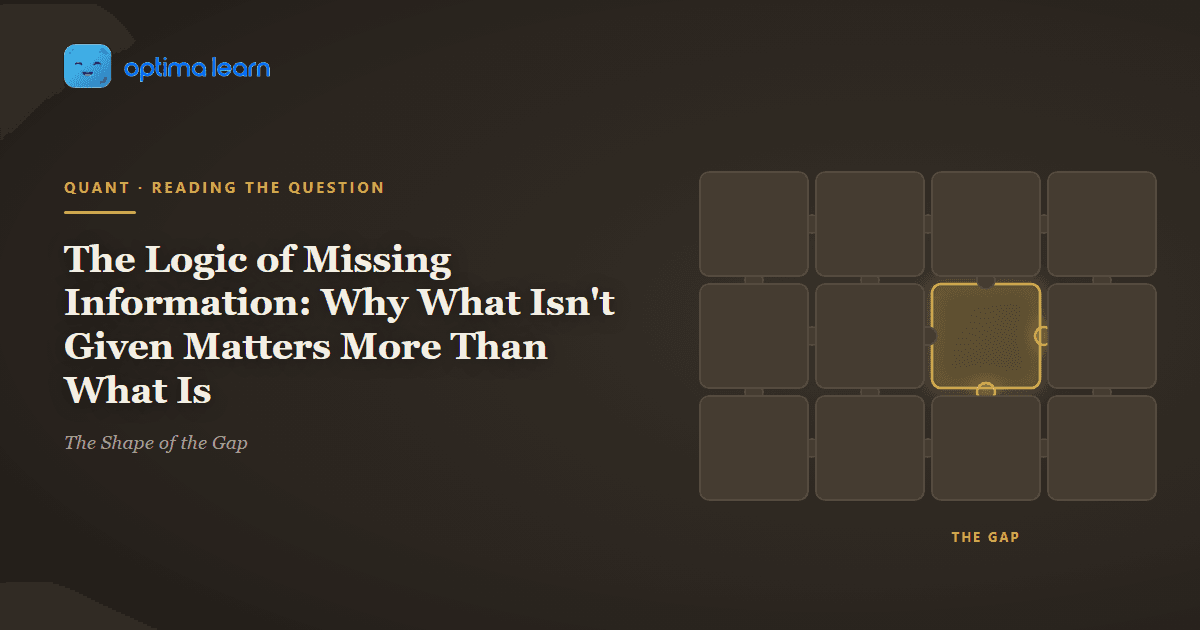
A CAT Quant question gives you four facts and asks for a fifth. Most aspirants read the four facts. Very few read the gap between them, and the gap is often the more informative object.
Consider what it means that a question has a unique answer. Everything needed is present, and everything present is needed. So a quantity the setter deliberately left unfixed is not an omission. It is a statement: whatever this is, the answer does not depend on it. That is a usable piece of information, and it was free.
The missing piece in a jigsaw tells you its own shape. Questions work the same way, and reading the hole is a skill that costs nothing and is almost never taught.
- A CAT question with a unique answer contains exactly what it needs, so what is absent carries information as reliably as what is present.
- The Shape of the Gap reads three absences: what was left free, what was not asked, and what must be inferable.
- A quantity left unfixed usually means the answer does not depend on it, which licenses you to choose a convenient value.
- If the answer is unique but a given seems missing, the gap has to close from structure. That is the question, not a flaw in it.
- Reading absences takes about fifteen seconds and frequently removes the entire need for algebra.
Why Absence Is Information
The logic rests on one assumption that holds for essentially every CAT question: the answer is unique and determinable. Setters do not ship ambiguous questions, and the options confirm it.
Grant that, and absences start speaking. If a quantity is never pinned down and the answer is nonetheless unique, then the answer cannot vary with that quantity. It does not matter what it is. You may therefore pick any convenient value, or ignore it entirely.
That reasoning is available before you write anything, and it routinely does more work than the first two lines of algebra would have:
- A radius never given, in a question whose answer is a ratio: the radius cancels, so set it to 1.
- A starting quantity left unstated in a percentage-change chain: set it to 100.
- An unstated number of workers when only relative rates are asked: pick the convenient count.
- A total left open in a mixture question that asks for a final concentration: concentration is intensive, so the total is irrelevant.
The Shape of the Gap: Three Absences Worth Reading
Each of the three answers a different question about what you are allowed to skip.
The Shape of the Gap
- What was left free. Any quantity the stem never fixes. If the answer is unique, it cannot depend on that quantity, so choose it conveniently.
- What was not asked. The target defines what you may ignore. Anything that does not feed the target is optional work, however tempting.
- What must be inferable. If something seems missing and the answer is still unique, that gap closes from structure, and finding how is the question.
What was left free is the most immediately profitable, and the signals are easy to scan for:
- A dimension mentioned but never measured, in a question asking for a ratio or a proportion.
- A base value in a chain of percentage changes, where only the net change is wanted.
- A unit of time or currency that appears on both sides of every relationship.
What was not asked prevents the most common form of wasted work, which is solving a harder question than the one on the page:
- The question wants a sum, so the individual values are optional.
- The question wants whether something is possible, so the actual value is optional.
- The question wants a remainder, so the quotient is optional and usually enormous.
What must be inferable is the one that turns apparent unfairness into a direction to search in:
- An integer condition doing the work a missing equation would have done.
- A positivity or physical-sense requirement eliminating every case but one.
- A uniqueness claim in the stem, which is itself a constraint you can solve with.
Put the Shape of the Gap to Work
Reading absences is a scanning habit, and habits form against real questions. Optima Learn's Quant sets follow genuine CAT patterns, so the deliberate gaps sit where the exam puts them.
Practise CAT Quant QuestionsWhen a Question Looks Under-Specified
This is the moment the framework earns its place, because the instinct is to conclude the question is broken and the correct conclusion is nearly always the opposite.
| What seems missing | What is usually happening | What to do |
|---|---|---|
| A value you would need to compute | It cancels or is intensive | Set it to 1 or 100 and proceed |
| One equation short | A word-constraint replaces it | Find the integer, positivity or distinctness condition |
| Two unknowns, one relationship | Only a symmetric function is asked | Solve for the sum or product, not the individuals |
| No numbers at all | The answer is a ratio or an always-true claim | Assign convenient values and test |
| Genuinely nothing to work with | You have misread the target | Re-read what is being asked |
The last row matters more than its position suggests. When aspirants declare a CAT question unsolvable, misreading the target accounts for far more cases than an actual gap in the data does.
How to Scan for Absences in Fifteen Seconds
The scan is short because it is a fixed sequence rather than open-ended thinking.
- Name the target first. Everything downstream depends on knowing precisely what is being asked, and it takes three seconds.
- List the quantities mentioned but never fixed. These are your free choices.
- Count relationships against unknowns. If you are short, the shortfall is a word-constraint you have not registered yet.
- Ask what the target does not need. Cross off anything that cannot reach it.
- Choose values for the free quantities before writing a single equation, because doing so often removes the need for equations at all.
That last step is where most of the time saving sits, and it pairs naturally with reading how much a question constrains in the first place, covered in the hidden architecture of CAT Quant.
Common Mistakes When Reading What Is Missing
The habit fails in a few recognisable ways:
- Declaring the question broken. Concluding data is missing, when a word-constraint was doing that job.
- Choosing a value that is not free. Assigning a number to something the stem does constrain, which produces a confidently wrong answer.
- Solving past the target. Finding the individuals when only their sum was wanted, then combining them back.
- Ignoring uniqueness. Failing to use the fact that the answer is unique, which is itself a constraint.
- Picking awkward values. Choosing 7 where 100 or 1 would have made every subsequent step trivial.
A Practice Drill for Reading the Gap
As with the other structural habits, the drill stops short of solving on purpose.
- Take fifteen Quant questions. For each, write the target in your own words in under eight words.
- List every quantity mentioned but never fixed. Beside each, write "free" or "constrained".
- For each free quantity, choose a convenient value. Now predict how much algebra remains.
- Solve, and check your prediction. Note every case where you labelled something constrained that was actually free.
The pattern in the mistakes is usually consistent:
- Aspirants under-identify free quantities, treating far more as constrained than really are.
- Geometry and mixtures carry the most free quantities, and are the topics where the drill pays fastest.
- Where the target was written in fewer than eight words, the question was almost always solved faster.
- Questions previously labelled under-specified turn out, on re-reading, to contain a word-constraint that was skimmed.
The Bottom Line
A CAT question is a closed system with exactly enough in it. That makes every absence deliberate, and deliberate absences are as readable as the givens. Aspirants who read only what is written solve the question the setter wrote down. Aspirants who also read what was left out solve the question the setter actually built.
The Shape of the Gap, Recap
- What was left free: unfixed quantities cannot affect a unique answer, so choose them.
- What was not asked: the target defines what you may skip.
- What must be inferable: an apparent gap closes from structure, and finding how is the question.
Build the Habit on Timed CAT Quant
Reading absences is the first thing that disappears under pressure, because pressure narrows attention to what is written. Work through CAT previous year questions in timed blocks, or sit full CAT mock tests and past papers so the scan survives real fatigue. More on question structure sits in the CAT Quant blog archive, and if questions keep looking under-specified to you it is worth having your preparation reviewed honestly.
Frequently Asked Questions
What does missing information mean in a CAT Quant question?
Usually that a quantity has been deliberately left unfixed. Because CAT questions have unique answers, an unfixed quantity cannot affect the result, so it is a free choice rather than an omission. Genuine gaps in the data are very rare compared with word-constraints that were skimmed.
When can I assume a value in CAT Quant?
Whenever the stem never fixes that quantity and substituting a value breaks none of the given conditions. Test it against every given first: if nothing breaks, the quantity was free and you have removed an unknown for nothing. If something breaks, it was constrained and assuming would be unsafe.
What if a CAT question genuinely seems unsolvable?
Re-read the target before concluding anything. Misreading what is being asked accounts for far more apparent dead ends than missing data does. After that, look for a word-constraint such as integer, distinct or positive, which is usually doing the job of the equation you think is absent.
Which values are best to assume?
Use 100 for anything involving percentages, 1 for a quantity that will cancel, and the lowest common multiple of the denominators in a rates or work question. The aim is to make every subsequent step arithmetic you can do mentally, so awkward choices waste most of the benefit.
Read the Gaps Before CAT 2026
What a question leaves out is free information that most aspirants never collect. Start reading it against real CAT-style questions under a clock.
Start Practising CAT QuantPractice these Quant concepts, chapter by chapter
Thousands of CAT Quant practice questions by chapter and difficulty, each with a worked solution.
More from Quant
Continue reading

Using a Study Journal for CAT Without Overdoing It
How to Stop Comparing Your CAT Prep With Everyone Else

SPJIMR Admission Process: Why the Profile Leads It
How to Solve CAT Quant Faster Without Skipping Steps
Put it into practice