
How CAT DILR Difficulty Has Changed in Recent Years
DILR carries a reputation for being the section that moves most between years, and aspirants ask about its trend more than either other section. The reputation is partly earned and the trend does not exist, and the distinction between those two statements is the useful content here.
What is genuinely true about DILR is that it has higher variance than quant or VARC, and that variance is structural rather than a matter of difficulty drifting upward. Understanding where it comes from explains both the reputation and why no year-on-year comparison survives scrutiny.
Variance is handled by breadth rather than by forecasting. Work across recurring set types in CAT DILR practice chapters.
- DILR's high variance is structural: fewer decisions carry more weight, so outcomes spread wider.
- It is not chapter based, so the mix of set types has genuinely swung between years.
- That variation is not a difficulty trend, and no reliable trend can be drawn.
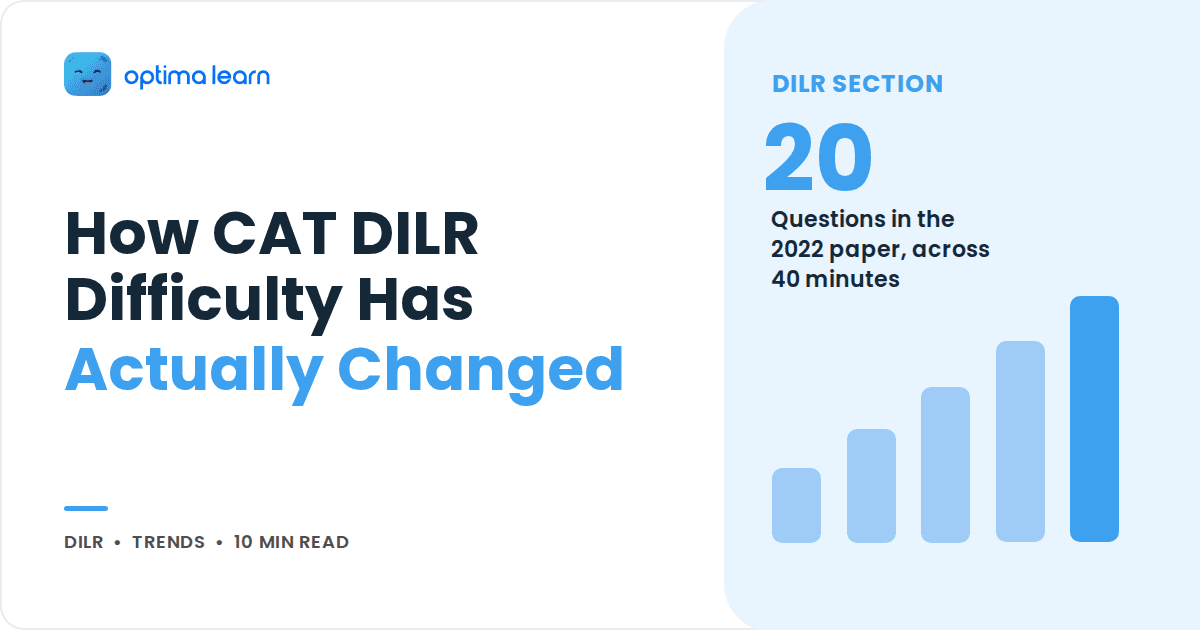
- In the 2022 paper DILR ran 20 questions worth 60 marks with a 40 minute sectional limit.
- Breadth across set types is the only preparation that does not depend on predicting the mix.
Where DILR's Variance Actually Comes From
This is the part that separates a real property of the section from a difficulty claim.
In quant, questions are independent. Across twenty two questions, individual good and bad decisions average out into something reasonably stable, so two candidates of similar ability tend to produce similar sections.
In DILR, questions arrive attached to sets. In the 2022 paper the section carried 20 questions worth 60 marks across a handful of sets, which means two or three commitments decided most of it. Fewer decisions carrying more weight produces a wider distribution of outcomes for the same preparation.
That is variance, not difficulty. The same candidate can score twenty marks apart on the same paper depending on which set they opened first, and neither outcome tells you the paper was hard.
Reading your own swing between DILR mocks as evidence that difficulty is moving between papers. A section decided by three commitments has a wide natural spread, so several mocks apart is the expected pattern rather than a signal about the papers you sat.
The Thing That Has Genuinely Moved
One claim about DILR across years does hold up, and it is about composition rather than severity.
- The set type mix. DILR is not chapter based, and which types appear has swung between years.
- The balance between DI and LR. Both halves have been consistently present and their proportions have moved.
- The paper's overall size. Recent papers have run roughly 66 to 68 questions in total, so sectional composition moved with it.
- What has not moved. The marking rules, the forty minute sectional limit, and the fact that questions arrive in sets.
The Mix Is the Real Instability
Data interpretation spans tables, bar and line charts, pie charts, caselets, Venn diagrams, networks and quant-heavy DI. Logical reasoning spans arrangements, games and tournaments, scheduling, distribution, selection, routes and networks, puzzles and binary logic. Which of those appear, and in what balance, has genuinely varied.
Why That Is Not a Difficulty Trend
A paper leaning toward set types you have practised is easy for you and hard for the candidate who practised the other ones. The mix moving produces different individual experiences without the section becoming harder or easier in any collective sense, which is exactly why aggregated opinion about a year is unreliable.
And Percentile Absorbs the Rest
Percentile is your position relative to everyone who sat the exam, so a genuinely harder section lowers scores across the room together. Normalisation additionally handles slots that did not receive identical papers. Neither mechanism cares about which year anyone thinks was worse.
| Claim about DILR | Status |
|---|---|
| Higher variance than other sections | Structurally true |
| Set type mix has moved between years | True |
| Difficulty has trended upward | Not establishable |
| You can predict next year's mix | No |
| Preparation should respond to the mix | Only by covering breadth |
What Breaks Every Trend Claim
Three problems, and they compound in DILR specifically.
The first is that difficulty is not a property of a paper. It is a relationship between the sets and the candidate, and in a section where set type familiarity matters this much, that dependence is stronger than elsewhere.
The second is that the proxies people chart are contaminated. Cutoffs, average scores and topper counts move with cohort size and preparation quality as well as with the paper.
The third is sample size. A claim built from three or four papers is describing a handful of set mixes, and because the mix genuinely varies, three papers is not enough to distinguish a trend from ordinary variation.
Judge a set by what it gives you rather than by how it looks. A long set handing you six firm constraints usually resolves faster than a three line set with two loose conditions, because constraints do the eliminating. That judgment holds regardless of which set types the paper happens to contain.
What the Variance Should Change About Preparation
The structural facts point at three specific responses, and none of them involves predicting anything.
Cover breadth across set types rather than depth in a few. Because the mix moves, having met many types matters more than mastering a handful. An aspirant who has seen a network set before will handle one under time; one who has only done arrangements very well will not.
Train selection as its own skill, because variance concentrates in the commitment decision. The standard sequence is to learn set types, practise them individually, then sit full sections, which leaves selection to be acquired by accident. Adding a deliberate step changes the section more than additional solving does.
And judge your own progress on inputs rather than on scores, since DILR totals carry more paper luck than either other section. Productive minutes, meaning the share of your forty that produced marks, rises before the score does.
Mentors find that candidates tracking DILR scores across mocks conclude almost anything they like from the data, because the spread is wide enough to support any narrative. The same candidates tracking productive minutes see a clear signal, and it usually shows improvement they had already decided was not happening.
Breadth Is the Answer to a Moving Mix
You cannot forecast which set types arrive. You can make sure none of them is unfamiliar.
Work Through CAT DILR ChaptersUsing Past Papers Properly Here
Since trend claims get built from past papers, it is worth separating their genuine use from that one.
Their real value is exposure. Working across several years puts you in front of more set types than any single year contains, which is precisely the breadth that protects against an unexpected mix.
Their second value is calibration. Sitting an old section under time tells you how your selection and execution behave against real sets rather than curated practice.
What they cannot do is forecast. A candidate who concludes from three papers that arrangements are becoming less common, and reallocates accordingly, has made a bet on a sample of three in a section whose mix is known to swing.
The Comparison Worth Making
Compare yourself across papers rather than comparing papers to each other. If your productive minutes and your ranking accuracy improve across a term of past sections, the preparation is working, and that holds however the papers differed.
The Drill That Handles Any Mix
Five sets, ninety seconds each without solving, ranked by expected solvability, then all five solved and the ranking checked. It trains the judgment that decides sections regardless of which types appear. Working across types including selection based sets keeps the drill varied enough to be informative. Our guide on spotting a solvable set in two minutes covers the signals it teaches.
What High Variance Means for Reading Your Own Mocks
The structural point has a direct consequence for how you should interpret your own results, and most candidates get it wrong in a costly direction.
If a section is decided by three commitments, the spread of possible outcomes for any given preparation level is wide. That means a single DILR score carries very little information, and two scores twenty marks apart can come from identical preparation on identical papers, separated only by which set got opened first.
So never redesign your DILR approach on the evidence of one bad section, and do not treat one excellent section as proof the approach is sound either. If the marks came from a lucky opening choice rather than a deliberate one, the same approach will produce the bad version soon enough.
Five sections is a reasonable window before drawing any conclusion, and even then the thing to read is the pattern in productive minutes rather than in totals. A candidate who abandons a working method after two disappointing mocks usually replaces it with something worse and then abandons that too when the variance catches them again.
The Answer
Has CAT DILR got harder over recent years? No reliable trend can be established, for the same reasons that defeat difficulty claims about any section, and with an additional problem specific to this one: the set type mix genuinely varies, which produces very different individual experiences from papers that are not collectively harder or easier.
What is true, and what the reputation is actually tracking, is that DILR has higher variance than the other sections. Questions arrive in sets, two or three commitments decide most of the forty minutes, and fewer decisions carrying more weight produces a wider spread of outcomes for the same preparation.
That points at breadth across set types, selection trained deliberately as its own skill, and progress judged on productive minutes rather than on totals that are too noisy to read. None of those depends on knowing what next November contains, which is the property that makes them worth building.
- Have you met every recurring set type at least twice?
- Do you track productive minutes rather than only the sectional score?
- Do you practise blocks where several sets compete for the same minutes?
- Have you run a ranking drill in the last fortnight?
If your DILR scores swing without an obvious cause, that spread is usually structural rather than evidence about the papers. A CAT preparation strategy review will separate variance from ability, and a personalised CAT preparation plan can keep breadth and the ranking drill in your week.
Variance Is Not Difficulty
DILR's reputation is tracking a real property of the section, and it is not the one people name.
Build My Weekly PlanFrequently Asked Questions About DILR Difficulty Trends
Has CAT DILR become harder over recent years?
No reliable trend can be drawn. Difficulty depends on the match between the set types and the candidate, the proxies people chart move with cohort size too, and a few papers is not enough to distinguish a trend from ordinary variation.
Why does DILR feel more unpredictable than other sections?
Because questions arrive in sets, so two or three commitments decide most of the forty minutes. Fewer decisions carrying more weight produces a wider spread of outcomes for the same preparation, which is variance rather than difficulty.
What has genuinely changed between years?
The mix of set types, since the section is not chapter based, along with the balance between data interpretation and logical reasoning and the paper's overall size. The marking rules and the sectional limit have not.
How should I prepare for a mix that moves?
Breadth across the recurring set types rather than depth in a few, selection trained deliberately as its own skill, and progress judged on productive minutes rather than on sectional totals that carry heavy paper variance.
Practice DILR sets, chapter by chapter
CAT DILR practice across LR puzzles and DI sets, each with a worked solution.
More from DILR
Continue reading

How to Avoid Overthinking During the Actual CAT Exam
Is CAT VARC Vocabulary Heavy or Comprehension Heavy?

How CAT VARC Difficulty Has Changed in Recent Years
How to Cross-Check Your CAT Quant TITA Answers Fast
Put it into practice