
Finishing the Syllabus Isn't Enough
Why completing the CAT syllabus does not mean you are exam-ready
Finishing the CAT syllabus tells you what you have covered. It does not tell you what you can actually solve under exam pressure. Coverage and readiness are not the same thing, and mixing them up is one of the most common, and costliest, mistakes an aspirant can make in the final stretch.
I get some version of this message every October: "I've finished the entire syllabus, so why isn't my score moving?" The tone is usually confusion, sometimes real panic. The tracker shows every topic ticked off. The mock score tells a different story entirely.
- Finishing the syllabus means you've been exposed to every topic, not that you can solve it cold under pressure.
- The gap is easy to miss because coverage is easy to measure and readiness isn't.
- The real test: can you solve a fresh, unseen question from a "done" topic today, without reviewing it first.
- This is a narrower, more specific slice of the broader motion-versus-progress problem in CAT prep.
What does finishing the syllabus actually mean?
For most aspirants, it means every chapter has been read, every explainer video watched, and a handful of examples solved from each topic at least once. That's real work, and it matters.
But it's a much lower bar than exam-ready. Too often, the two get treated as the same thing.
Most trackers are built around this same measure: chapters covered, videos watched, questions attempted at least once. It's an honest, useful way to track breadth. The trouble starts when you ask that same tracker a question it was never built to answer: am I actually ready?
That gap, between covering a topic and being ready for it, is what this piece is about. It's a narrower question than asking whether you're making progress overall. It's about the one milestone that feels the most final: "I've finished the syllabus."
Why does finishing feel like real progress?
Coverage feels like progress because it's easy to measure: a chapter is either read or it isn't, a video either watched or not. Readiness is harder to measure, since it only shows up when you meet a question you haven't seen before. The easy number quietly replaces the real one.
Psychologists have a name for this pattern: illusory superiority. We tend to rate ourselves highest in exactly the areas we've most recently touched, before we've actually been tested on them. Finishing a topic once gives you that same rush of confidence, right before the confidence gets tested for real.
A related piece on this blog, the Illusion of Progress, covers this same trap at a wider scale: motion getting mistaken for progress across every kind of CAT prep activity, not just syllabus coverage. This post stays narrower on purpose. It's about one specific, very common belief: finishing every topic once means you're ready for it.
The Colored-In Map
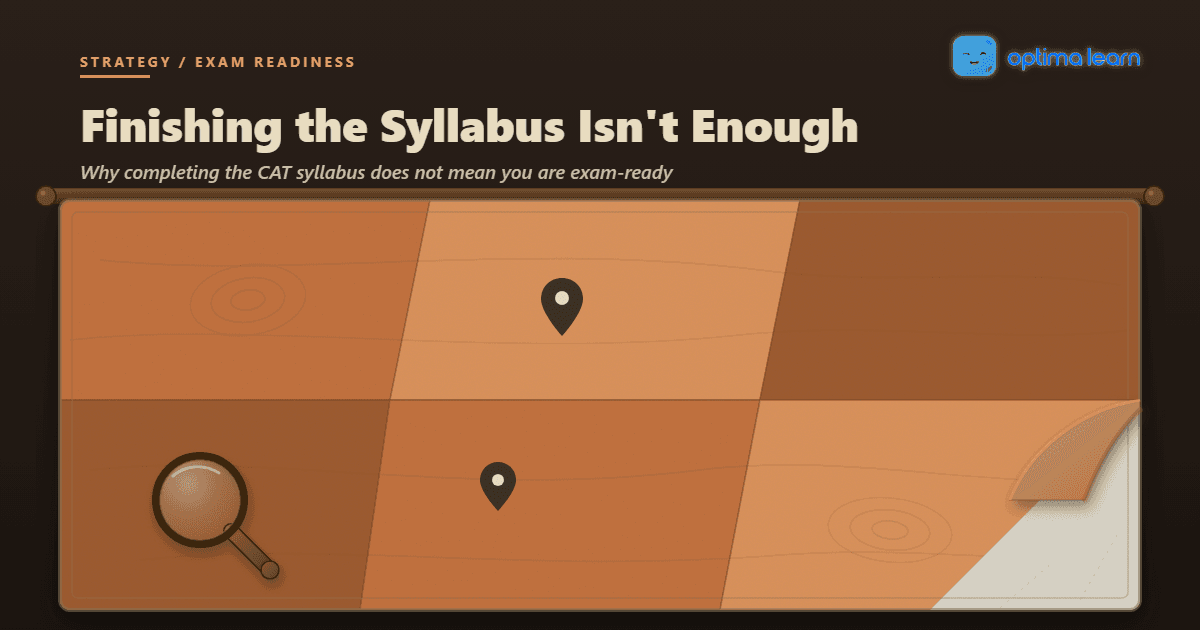
Here's a way to picture that gap. Imagine a large wall map of unfamiliar country. Most of it is filled in with color, each region shaded once it's been marked as surveyed. From a distance, it looks complete.
Then one corner peels back like a sticker, and underneath is blank paper. Nothing was ever actually surveyed there. It was only ever colored.
The Colored-In Map
Coloring the map isn't the same as knowing the terrain.
- The Coloring: marking a topic as done because you read about it, watched an explanation, or solved a few examples once.
- The Terrain: what actually happens when that topic shows up live, disguised, or combined with another topic, under real exam pressure.
- The Gap Between Them: the actual test: can you solve a fresh, unseen question from that topic cold, today, without reviewing it first. If not, the map is colored but the terrain is still unknown.
This is close to an old idea called the map-territory relation: a map is a useful stand-in for a place, but it was never the place itself. Confusing the two gets expensive fast in unfamiliar terrain. A syllabus tracker is a map of your preparation. It was never meant to be the terrain.
How do you know if a topic is actually done?
A topic is genuinely done when you can solve a question from it that you've never seen before, cold, without opening your notes first. Anything short of that is still coloring, no matter how many times you've revised the chapter.
Take a Quant topic like Time, Speed and Distance. Most aspirants can solve the three or four question types they practiced from their notes without trouble. Fewer can solve the same concept once it's buried in a word problem with an unfamiliar twist, or mixed with a percentage change they never practiced. That specific stumble, staring at a topic you were sure you had closed, is exactly what a set of unseen CAT Quant previous year questions exposes fast.
| Looks like readiness (the coloring) | Actually is readiness (the terrain) |
|---|---|
| You recognize the topic name instantly | You can solve it without seeing the topic name first |
| You followed the worked example easily | You can solve a differently worded version alone |
| You've revised the chapter two or three times | You can solve it after two weeks with no revision |
| You solved it correctly once | You solve it correctly most times, under time pressure |
The fix is simple to state, even if it takes discipline to actually do. Before marking any topic closed, pull a small batch of fresh, unseen questions on it and attempt them without reviewing anything first. A topic that survives this is genuinely done. One that doesn't, just got recolored.
Want a real answer, not a guess?
A free study-plan review can show you exactly which "finished" topics still need real testing before CAT day.
Get a Free Study-Plan ReviewBottom line
Finishing the syllabus isn't wasted effort. It's the coloring, and the coloring has to happen before anything else can. The mistake is stopping there and calling it done. The actual exam only ever tests the terrain. It never tests the map.
The Colored-In Map, in short
- The Coloring: covering a topic once.
- The Terrain: what it looks like live, under pressure.
- The Gap Between Them: a fresh, unseen question, solved cold, today.
Get an honest read on your coverage
A free study-plan review can tell you which "finished" topics are still just map, and which ones are genuinely terrain.
Get Your CAT Plan Reviewed FreeFrequently Asked Questions
Does finishing the CAT syllabus count for nothing then?
It counts as coloring the map, a real and necessary first step, not nothing. The mistake is treating coloring as the finish line instead of the starting point for the actual test: solving fresh questions from that topic cold.
How do I test whether a 'finished' topic is actually terrain I know?
Pick a handful of fresh, previously unseen questions from that topic and attempt them without reviewing notes first. A topic that's genuinely known survives this. A topic that's only been colored in usually doesn't.
Why does the syllabus trap feel so convincing while it's happening?
Because coverage is easy to measure, chapters read, videos watched, while actual readiness is not. The easy-to-measure signal quietly substitutes for the real one you actually care about.
Is this the same as the Illusion of Progress covered elsewhere on this blog?
It's a specific case of that broader idea. The Illusion of Progress covers motion versus progress across all prep activities; this post is about one particular, very common version of it: mistaking syllabus completion for exam readiness.
Build your CAT 2026 study plan
Personalised daily plan that adapts to your section-wise mock scores.
More from Strategy
Continue reading

Why Aspirants Misjudge Which DILR Sets Are Really Doable

Should You Reattempt CAT After a Disappointing Score?

How to Stop Second Guessing on Para Summary Questions

SCMHRD Pune and the Deadline That Actually Binds You
Put it into practice