
CAT 2026 Preparation Roadmap After Registration: What High Percentilers Will Do Differently From This Week Onwards
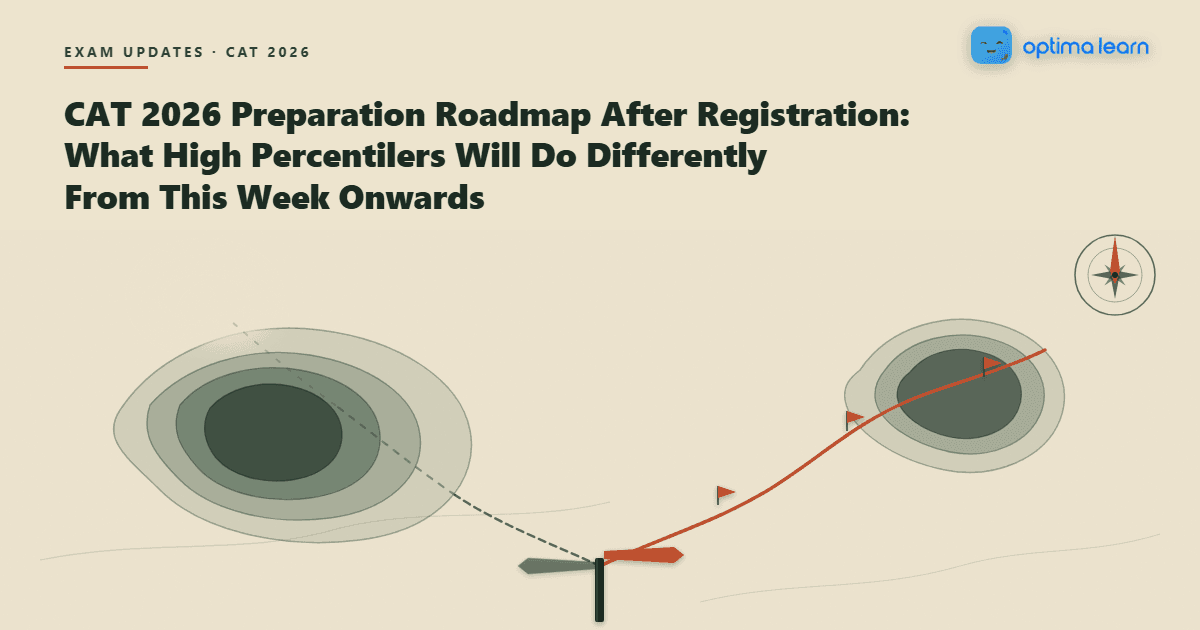
High percentilers do not spend the week after CAT 2026 registration studying harder than everyone else. They spend it doing one specific thing within 48 hours: a diagnostic mock, a weak-area audit, or a real study-plan draft, before the relief of registering quietly turns into a pause most aspirants never notice happening.
You submitted the CAT 2026 application. You paid the fee, uploaded the documents, double-checked the city and category preferences, and clicked submit. Then, in the ten minutes after, something strange happened: the task felt finished.
It wasn't. Registration is the easiest part of this entire process, the part that asks the least of your actual reasoning ability. But it doesn't feel that way in the moment. It feels like a milestone, and milestones come with a built-in permission to rest.
That permission is where this article actually begins. The registration mechanics themselves, dates, documents, fees, the deadlines to watch, already have their own detailed guide elsewhere on this blog. What follows here starts a week later, at a fork almost nobody notices they're standing at.
- The gap between high and low percentilers doesn't start with mock scores, it starts with what happens in the 48 hours after registration closes on relief.
- The Default Path treats registering as a finish line and waits for motivation to return on its own, usually two to three weeks later.
- The Compounding Path pairs the same relief with one concrete action within 48 hours: a diagnostic mock, a weak-area audit, or a real study-plan draft.
- A cold diagnostic mock taken in week one is uncomfortable by design, it gives you a real baseline before months of prep blur your starting point.
- Momentum needs a trigger to restart once it stalls; the Compounding Path builds that trigger in before the stall has a chance to happen.
Consider this the second half of that story: written for anyone who registered for CAT 2026 in the last few days and already felt that same rest instinct kick in. If you want the full week-by-week schedule instead, a companion piece lays out a complete 35-day game plan for the registration window. What follows here is narrower and more behavioral: not what to study, but which of two paths you're already walking.
What Actually Happens in the Week After You Register for CAT 2026?
Nothing structural happens in the week after registration for most CAT 2026 aspirants, and that's precisely the problem. Registering is an administrative act, not a preparation act, yet it produces the same emotional relief as finishing a hard task, which is exactly what makes the following week so easy to lose.
Registration for CAT 2026 opened on August 3. If you registered in the days right around then, you're likely reading this in the exact window this article is about, the first week, when the form is done and the actual preparation hasn't visibly started yet. None of that is coincidental; it's the exact moment this piece is built for.
Think about what registration actually required of you. Filling a form, verifying documents, choosing test cities, paying a fee. None of it tested your quant speed, your reading stamina, or how you handle a DILR set that refuses to open up. And yet the relief you feel afterward doesn't know the difference.
If you're still working through the registration mechanics themselves, dates, documents, the fee structure, the deadlines to watch, a companion guide on this blog covers the full CAT 2026 registration process in detail. Assume that part is already handled here; the real question is different: now that it's done, what happens next inside your head?
Here's a question worth sitting with for a moment: if nobody reminded you to open a book today, would you have? For most aspirants in week one, the honest answer is no, not out of laziness, but because nothing yet feels urgent enough to override the relief.
The Percentile Split: Two Paths From the Same Registration Screen
The Percentile Split is a simple way to name what separates high scorers from everyone else in week one: not talent, not luck, but whether relief gets paired with one concrete action inside 48 hours. Two aspirants can register on the identical day and still be on completely different paths by day three.
Registration day looks identical for everyone, the same form, the same fee, the same confirmation email. The week after it doesn't. The framework below names exactly that split, and it's worth sitting with before you decide which path you're already walking.
The Percentile Split
Registration day looks identical for everyone. The week after it doesn't.
- The Default Path: relief after registering, a mental pause, "I'll start properly next week," which quietly becomes two or three weeks, since no specific trigger ever arrives to restart urgency.
- The Compounding Path: the same relief, but paired with one specific action taken within 48 hours, a diagnostic mock, a weak-area audit, or a first real study-plan draft, so momentum never has a gap to fall into.
Notice what the framework does not say. It doesn't say the Default Path aspirant is lazy, or that the Compounding Path aspirant is somehow more disciplined by nature. It says one group's relief has a trigger attached to it, and the other group's doesn't yet. It's a fixable gap, not a fixed trait.
Why Does the Default Path Feel Like the Responsible Choice?
The Default Path feels reasonable because rest genuinely is part of good preparation, and that truth gets misapplied here. One evening of rest after registering is healthy. The problem is that without a specific trigger, that one evening quietly stretches into ten, and nobody ever consciously decided it should.
There's also a quieter reason the Default Path feels safe: it postpones a genuinely uncomfortable moment, the first honest look at where you actually stand. A diagnostic mock in week one will almost certainly return a percentile far below your target. Waiting a few weeks to take it feels like giving yourself more time to prepare for the number. It's actually giving the number more time to stay unknown.
There's a third reason worth naming too: the Default Path doesn't announce itself as a mistake while it's happening. Nobody wakes up on day ten and decides to procrastinate. Each individual day feels like a reasonable one-day delay, and it's only in hindsight, usually at the next mock, that the ten small delays look like a single large one.
The pattern isn't unique to the week after registration either. A closer look at what habits separate 99.99 percentilers from everyone else turns up the same pattern again and again: the willingness to confront an uncomfortable truth early, before comfort has a chance to calcify into avoidance.
Inside the Compounding Path's First 48 Hours
The Compounding Path asks for exactly one concrete action inside 48 hours of registering: a cold diagnostic mock, a focused weak-area audit, or a first draft of a real study plan. Any one of the three works: the specific action matters less than the fact that a trigger exists at all.
A cold diagnostic mock is the most uncomfortable of the three, and often the most useful. Taking one in week one is not about the score; it's about anchoring a real baseline before months of preparation blur your memory of where you actually started. Aspirants who wait until month two to take their first mock often can't remember their honest starting point at all.
A weak-area audit doesn't need to be elaborate to count. Pull up 15 to 20 questions from the topic you already suspect is weakest, solve them without notes, and tag each miss by cause. A single honest session like that tells you more about week one's real priority than a week of unfocused revision would.
If a full mock feels like too much this week, the weak-area audit or the plan draft both work just as well as a trigger. A personalized CAT study plan built from whatever you already know about your strengths gives you a version-one draft to revise later, which beats waiting for a perfect plan that never gets written.
| Moment | Default Path Move | Compounding Path Move |
|---|---|---|
| Right after clicking submit | Feel relief, close the tab, plan to start "Monday" | Feel the same relief, then open one tab: a mock or the planner |
| Within 48 hours | No specific action scheduled; "next week" stays vague | One concrete action completed: a mock taken, an audit done, or a plan drafted |
| One week later | Still waiting for motivation to return on its own | Already has one data point to build the next week's plan around |
| Three weeks later | Realizes the "week off" quietly became three | Already three weeks into a plan shaped by week one's real data |
Turn Week One Into Your First Data Point
Stop guessing what to study next. Build a plan around your actual strengths and gaps, not a generic syllabus checklist.
Build Your CAT PlanThe Bottom Line: Which Path Have You Already Chosen?
The path you're on right now isn't fixed by anything except whether a specific action happens before day three. If it hasn't happened yet, it still can, the 48-hour window is a guideline for urgency, not a hard deadline that's already closed for anyone reading this in week one.
The Percentile Split, Recapped
Registration day looks identical for everyone. The week after it doesn't.
- The Default Path: relief, a pause, and a "next week" that keeps sliding without a trigger to restart it.
- The Compounding Path: the same relief, paired with one concrete action inside 48 hours, so momentum has nothing to fall into.
Registering for CAT 2026 was never the hard part, and it was never supposed to be. What happens in the days right after it is where the actual split begins, quietly, without an announcement, without anyone telling you which path you just stepped onto. You get to choose that consciously, or let the choice happen by default. Only one of those leads somewhere on purpose.
Start the Compounding Path Today
Take the one action that turns relief into real momentum, before the default gap has a chance to open up.
Build Your CAT PlanFrequently Asked Questions
I just registered for CAT 2026, what should I actually do this week?
Take one diagnostic action within 48 hours rather than treating registration as a natural pause: a cold diagnostic mock if you have not taken one recently, or a 30-minute audit of your weakest topic area. The specific action matters less than doing something concrete before the relief of registering turns into a multi-week gap.
Is it too early to start mocks right after registering?
No. A cold diagnostic mock this early is not about the score, it is about establishing a real baseline before months of preparation make it hard to remember what your actual starting point was. High percentilers tend to take this mock in week one specifically because it is uncomfortable, not despite that.
Do high percentilers really behave differently in week one, or is that just motivation talk?
The behavioral difference is specific and checkable: it is whether a concrete first action happens within 48 hours of registering, or whether the first concrete action happens whenever momentum eventually returns, which for most aspirants is two to three weeks later without a specific trigger.
How is the Percentile Split different from a generic CAT study plan?
A study plan tells you what to do across months. The Percentile Split is specifically about the first 48 hours after registration, the narrow window where most aspirants' momentum quietly stalls before any study plan even begins.
Track CAT 2026: never miss a date
Slot booking, admit cards, results, and IIM cutoffs, one timeline.
More from Exam Updates
Continue reading
XLRI Admission Process: The Exam Nobody Ever Checks

Why Do Some CAT DILR Sets Feel Totally Unsolvable?
Why School Level Quant Feels Hard in the CAT Paper

Why Do Non Engineers Struggle in CAT VARC As Well?
Put it into practice