
Building an Error Database: The Preparation Habit That Most Aspirants Never Develop
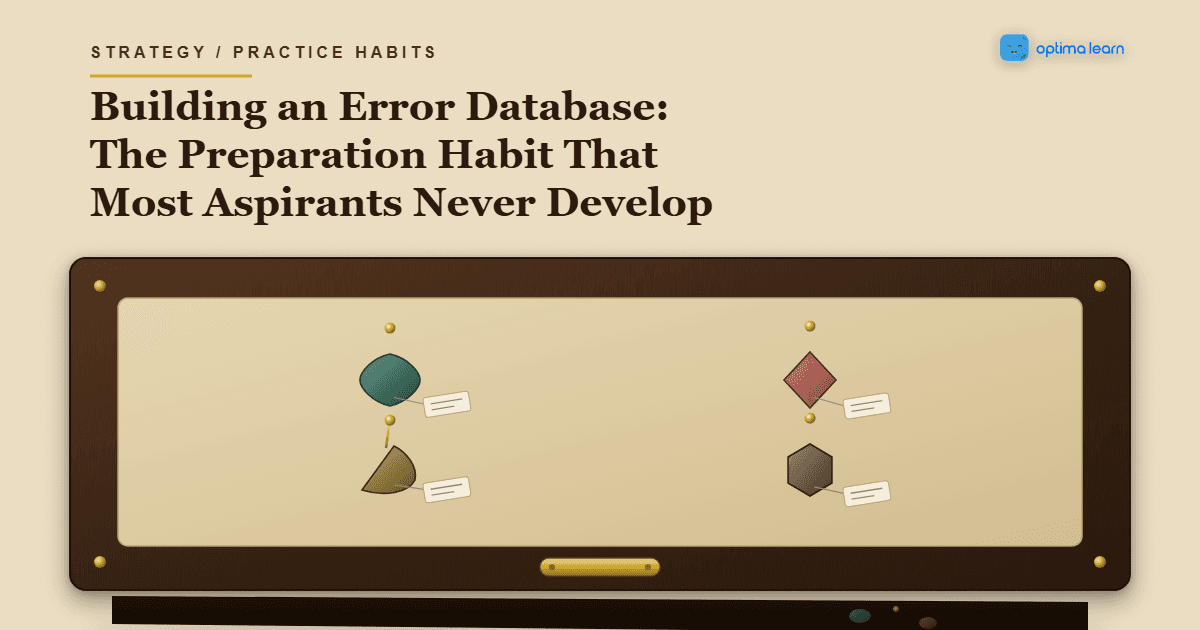
Most CAT aspirants who start an error log quit within three or four weeks, not because the format is wrong, but because logging a mistake without a system forces you to reprocess the same silent embarrassment every single time. The Specimen Method fixes this by replacing that reprocessing with classification.
Think back to the last error log you actually kept. Maybe it started strong: a fresh notebook page, a neat column for topic, a neat column for reason. By day nine, the columns blurred into one word, repeated over and over. Careless. Careless. Careless. By day twenty, the page stopped opening. Not because you forgot it existed. Because some part of you did not want to see it again.
That reaction makes sense once you see the design flaw underneath it. Nobody quits a habit that feels neutral. People quit habits that feel like a running tally of everything wrong with them, and a generic error log, the kind that just asks "what happened," is exactly that tally in disguise.
- Error logs usually die from the emotional friction of repeated self-judgment, not from a lack of time or discipline.
- The Specimen Method sorts every mistake into four species: Conceptual, Careless, Time-Pressure, and Interpretation.
- Naming the species turns logging into classification instead of confession, which removes much of the ego cost that kills most logs.
- A 15 to 20 minute weekly review beats a daily deep-dive, especially when logging itself happens briefly in real time.
- Skipping this habit means repeating the same error species for months without ever noticing the pattern.
This piece is for anyone who has already tried an error log and let it go. It skips template mechanics on purpose, since two thorough walkthroughs of that already exist on this site, and we will point you to both further down. This is about what happens before any template can help: why the habit stops.
Why Do Most CAT Error Logs Quietly Die Within a Month?
Most error logs do not die from a lack of discipline. They die because the aspirant is asked to write down proof of their own repeated weakness, in their own handwriting, week after week, and eventually the discomfort of that outweighs the vague sense that logging is "supposed to help."
The pattern is remarkably consistent. Week one runs on motivation from a bad mock, and every mistake gets written down in detail. Week two slows; a few entries get skipped "because it was obvious." Week three becomes "I'll catch up this weekend." By week four, the notebook sits closed on the desk, and the aspirant privately decides error logs "don't work for them," when the format simply asked for more emotional labor than it ever returned in clarity.
Common Mistake: Logging the Verdict, Not the Species
Most error log templates include one open field: "what went wrong." That field invites a story about your own weakness rather than a category you can act on. Two aspirants can write completely different things for the identical mistake: one blames themselves, the other describes the mechanics, and only the second version stays useful a week later.
Have you noticed that your own error log is the one study material you dread opening, even though it is arguably the most useful thing you own? That dread is not a character flaw. It is a design flaw in how most logs ask you to record a mistake.
Discipline will not fix this, and neither will a better reminder app. What helps is removing the part of logging that feels like confession in the first place, which means changing what you are actually asked to write down when something goes wrong.
What Makes Logging Your Own Mistakes Feel So Uncomfortable?
Logging a mistake doubles as a small act of self-assessment, repeated dozens of times a week, not neutral data entry. Psychologists have a name for the discomfort of holding two conflicting self-images at once, capable aspirant and repeat-error-maker: cognitive dissonance, and closing the notebook is often the fastest way to resolve it.
Mentor Insight: Treat the Log Like a Lab Notebook
The aspirants who keep logging the longest rarely describe it as tracking their weaknesses. They describe it as running an experiment on their own solving process, where a wrong answer is a data point, not a verdict. That single reframe, from diary to lab notebook, does more to keep the habit alive than any reminder or streak counter ever does.
There is a second, quieter reason the habit dies: an ungrouped log grows unreadable fast. After forty entries of unsorted narrative, finding a pattern means rereading forty small confessions, which is exhausting enough that most aspirants simply stop looking. A log that cannot be scanned in under a minute stops getting opened, no matter how disciplined the aspirant otherwise is.
The real problem was never your willpower. It was that nobody ever handed you a neutral enough word to write down instead of "I did it again." That is precisely the gap the Specimen Method is built to close.
Naming a mistake by species instead of by story is a small linguistic shift, and it does most of the work. You are no longer confessing something about yourself. You are sorting something that already happened into a known category.
How Does the Specimen Method Turn Confession Into Classification?
The Specimen Method sorts every wrong answer into one of four species: Conceptual, Careless, Time-Pressure, or Interpretation. Instead of describing what happened in your own words, you are pinning a specimen to a known category, the same neutral act a naturalist performs on a beetle, which removes the self-judgment a free-text log invites.
The Specimen Method
An error log fails when it just marks wrong answers. It works when it pins the species.
- Conceptual - the underlying model was wrong, you would have gotten it wrong no matter how much time you had.
- Careless - the model was right, execution slipped, a sign flip, a copied number, a skipped step.
- Time-Pressure - the model was right, but you rushed a step you would normally get right untimed, a panic error rather than a knowledge gap.
- Interpretation - you answered a different question than the one actually asked, the model was never even tested.
Take a simple pricing question: a shopkeeper marks an item 40 percent above cost price and then offers a 25 percent discount on the marked price. What is the overall profit percentage? Set cost price at 100. The marked price becomes 140. A 25 percent discount on 140 is 35, so the selling price is 105. Profit is 5 on a cost of 100, which makes the answer 5 percent.
Four different aspirants can miss this exact question in four different ways. One takes the discount off the cost price instead of the marked price, a Conceptual error, since that model is wrong regardless of time or pressure. Another sets up 140 times 0.75 correctly but multiplies it out to 115 instead of 105, a Careless error, since the model was right and only the arithmetic slipped.
A third knows the correct setup but, under mock-test pressure, rounds 140 times 0.75 down to a quick 100 instead of working the exact multiplication, a Time-Pressure error. A fourth solves the whole thing correctly and reports the selling price, 105, when the question actually asked for profit percentage, an Interpretation error, since a fully correct model still answered the wrong question.
All four aspirants get the same red mark on the same question. A generic log would record all four identically: wrong. The Specimen Method records four completely different diagnoses, and each one points to a different fix, which is the entire point of building the database in the first place.
Knowing why the habit dies is only half the job. The other half is a system worth keeping, and two already exist on this site. If you want the categories laid out as a ready-to-use template with a weekly ritual, the CAT error log template with categories and a weekly ritual covers that step by step, and a complete walkthrough on building a CAT error log that actually improves your percentile covers execution end to end.
Give the habit somewhere to live
Classifying a mistake only helps if the weekly review actually happens. A personalized CAT study plan builds that 15-to-20-minute review into your week instead of leaving it to memory alone.
Build Your CAT PlanWhat Happens If You Never Build This Habit at All?
Skipping an error database costs more than a few percentile points. It means repeating the same species of mistake for months without ever noticing the repetition, since nothing forces the pattern into view. A single wrong answer looks random. Twelve Time-Pressure errors across three mocks look like a fixable habit, but only once someone has actually counted them.
Without classification, every mock review becomes the same shallow ritual: look at the score, feel briefly bad or briefly relieved, move on to the next mock. Nothing gets isolated for targeted practice, because nothing was ever sorted into a group large enough to justify it. The aspirant ends up preparing in general, which is a far slower way to raise a percentile than preparing against a named, counted pattern.
Exam Tip: Log the Rough Work While It's Fresh
Right after a mock, while the memory is still sharp, jot a one-word species guess next to any question you are unsure about, before you even check the official solution. That first instinct is often more accurate than a calmer classification made a week later, once both the panic and the pattern have faded.
| Panic Move | Pro Move |
|---|---|
| Write "silly mistake" and move on | Ask which of the four species it actually was |
| Only log the questions you got wrong | Log slow-but-correct questions too, since Time-Pressure errors often hide inside a right answer |
| Reread the whole log once a month | Sort new entries by species weekly, before memory of the mistake fades |
| Treat every wrong answer the same way | Fix Conceptual errors by relearning, Careless by timed drilling, Interpretation by slower reading |
The right column takes the same four minutes as the left one; it simply aims those minutes at something specific instead of something vague, and that is the entire difference between a review that changes your next mock and one that only records it.
This is also where the ego cost resurfaces. Counting a dozen mistakes from the same species across three mocks is more confronting than one vague sense of "I sometimes rush." The Specimen Method does not erase that discomfort; it only sharpens it into something you can actually act on.
The Bottom Line: Building an Error Database That Actually Survives
An error database survives when logging feels like sorting, not confessing, and when the weekly review is small enough to actually happen. 15 to 20 minutes a week, spent sorting fresh entries into Conceptual, Careless, Time-Pressure, or Interpretation, does more for your percentile than months of unsorted, abandoned notebooks ever could.
None of this pays off in a single week, which is exactly why it gets abandoned before it compounds. A small daily logging habit works the same way that small daily decisions decide your final percentile elsewhere on this site: unremarkable on any single day, and the actual difference between aspirants by the time results arrive.
Build the weekly review into whatever routine already governs your week, not a separate willpower project sitting on top of it. A personalized CAT study plan can hold that 15-to-20-minute slot the same way it holds a mock or a topic drill, so the review survives on the calendar instead of quietly disappearing by week four.
The Specimen Method, in short
- Conceptual - the model was wrong.
- Careless - the model was right, execution slipped.
- Time-Pressure - the model was right, but you rushed.
- Interpretation - you answered a different question than the one asked.
Turn this into a habit that survives past week four
A personalized CAT study plan holds your weekly error review the same way it holds a mock or a topic drill, so it never depends on memory or motivation alone.
Build Your CAT PlanFrequently Asked Questions
Isn't an error log just the same as marking wrong answers?
Marking a wrong answer tells you that you missed a mark. An error database, built with the Specimen Method, tells you which of the four species caused it, which is the difference between reviewing a scoresheet and actually fixing a pattern.
How much time should the weekly error review actually take?
15 to 20 minutes is enough if the logging happened in real time during practice. Most aspirants who say it takes too long are actually trying to log and analyze in the same sitting, which is slower than logging briefly each day and analyzing once a week.
Why do most aspirants quit their error log after a few weeks?
Because logging a mistake feels like admitting a pattern about yourself, not just marking a wrong answer, and that small ego cost is enough friction to make the habit quietly die once motivation dips. Naming the four species in advance removes some of that friction, since you are sorting into a known category, not confessing something new each time.
Should silly mistakes go in the same log as conceptual gaps?
Yes, but in a separate species. A Careless error and a Conceptual error need completely different fixes, more practice under time pressure for one, relearning the model for the other, so logging them identically hides which fix you actually need.
Build your CAT 2026 study plan
Personalised daily plan that adapts to your section-wise mock scores.
More from Strategy
Continue reading

XLRI Admission Process: The Exam Nobody Ever Checks

Why Do Some CAT DILR Sets Feel Totally Unsolvable?

Why School Level Quant Feels Hard in the CAT Paper

Why Do Non Engineers Struggle in CAT VARC As Well?
Put it into practice