
What Is a Good CAT Quant Score? A Realistic Answer
The question arrives in almost every mentoring conversation, usually in the same shape. How many marks do I need in quant for a 95, or a 98, or a 99. It sounds like a question with an answer, the way "how many runs is a good score" sounds like it should resolve to a number.
It does not, and the reason is not evasion. A raw quant score is a count of marks you earned. A percentile is your position relative to everyone else who sat the paper, which means the same marks convert differently depending on how hard that paper was and how everyone else handled it. Ask what score equals 95 and you are asking what position a fixed number of marks will occupy in a distribution that has not been drawn yet.
What you can measure is whether your marks are coming from questions you actually control. Work a block of CAT quant practice chapters and record how many you got right without guessing.
- There is no fixed score to percentile mapping in CAT, so no honest article can tell you the marks that equal 95 or 99.
- Raw score is marks earned. Percentile is position relative to everyone else, and it moves with paper difficulty and normalisation.
- A quant score is built from three things you do control: how many questions you select well, your accuracy on them, and how many wrong MCQs you buy.
- Sectional qualifying cutoffs are a floor to be considered, not the score that earns an interview call.
- The useful target is a personal accuracy and selection benchmark, not a borrowed number from someone else's year.
Why the Question Has No Fixed Answer
Start with what a percentile is, because most of the confusion lives here.
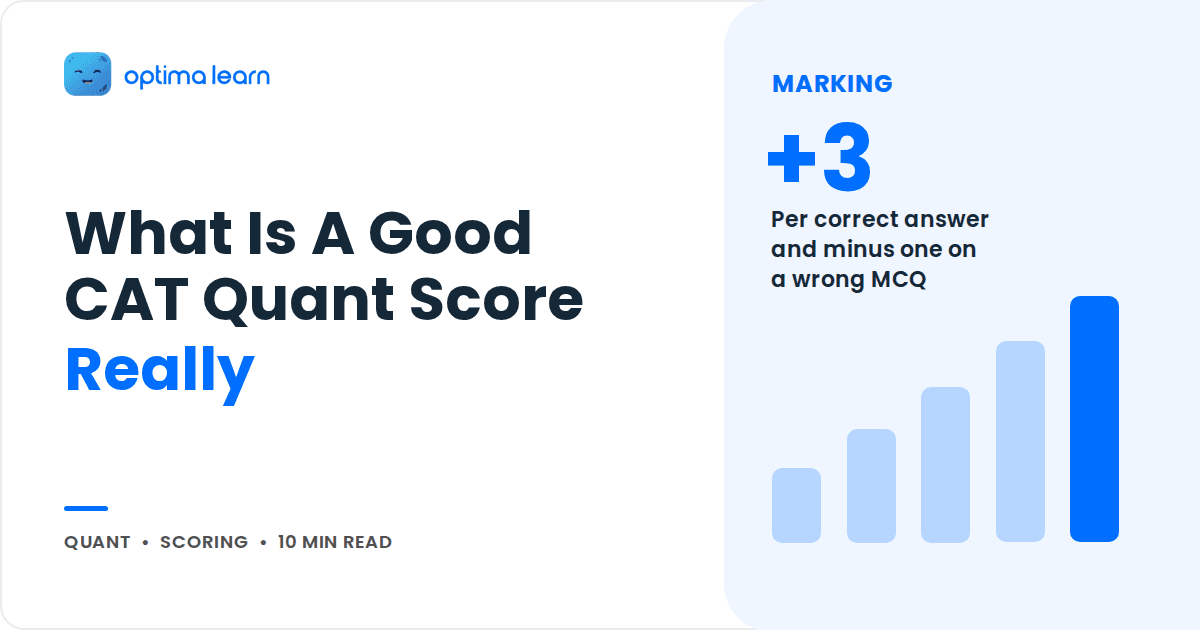
Your raw score comes out of your own paper. Correct answers add three marks, wrong MCQs take one away, and TITA questions, the ones where you type the answer instead of choosing it, carry no negative marking at all. That arithmetic is fixed and knowable.
Your percentile comes out of everyone else's papers. It says what share of test takers you finished above. If a quant section is brutal and most candidates score poorly, a modest raw score sits high in the distribution. If the section is gentle, the same raw score sits lower. Nothing about your performance changed; the distribution around you did.
Normalisation adds a second layer. CAT runs across multiple slots on the same day, and those slots do not get identical papers. The normalisation process exists to make scores comparable across them, which is another reason a raw number cannot carry a fixed percentile label.
Taking a score to percentile table from a past year and treating it as a target for this year. Those tables are accurate records of what happened in that specific paper with that specific cohort. Used as a forecast, they quietly convert a variable relationship into a constant, which is the commonest error in CAT content.
What a Quant Score Is Actually Made Of
If the output cannot be pinned down, the inputs can, and they are more useful anyway.
Three things produce a sectional score, and only three. The number of questions you engage with, your accuracy on the ones you engage with, and the damage done by wrong MCQ attempts. Every strategy conversation about quant is really a conversation about the balance between those three.
The third one is the part aspirants underweight, because negative marking makes a wrong attempt cost more than a blank. A blank is worth zero. A wrong MCQ is worth minus one. The gap between those two is the entire reason attempting more questions can lower your score.
| Input | What it is | What moves it |
|---|---|---|
| Engagement | Questions you commit time to | Selection skill, reading the whole section first |
| Accuracy | Share of committed questions you get right | Technique depth, error review, familiarity |
| Negative drag | Marks lost to wrong MCQs | Willingness to leave a question blank |
| TITA handling | Type-in answers, no penalty for wrong | Attempting every TITA you have a reasoned answer for |
The Three Benchmarks Worth Setting Instead
Since the percentile target is not controllable, replace it with three that are. These are the numbers a mentor would actually ask you for.
- Accuracy on committed questions. Of the questions you decided to solve, what share did you get right? This is the single most informative number in your section, and most aspirants have never calculated it.
- Cost of your wrong attempts. Multiply your wrong MCQs by one. That is the marks you handed back. Compare it against your gross marks from correct answers.
- Selection quality. Of the questions you skipped, how many could you have solved? Of the ones you committed to, how many were never going to resolve in time?
Accuracy Tells You Whether to Attempt More
High accuracy with few attempts means you are being too cautious and leaving marks on the table. Low accuracy with many attempts means the opposite, and the fix is not more practice but more restraint. The number tells you which conversation you are in, and no percentile target can do that.
The Cost of Wrong Attempts Is Usually a Shock
Run the arithmetic on a real mock. Take a paper of 66 questions worth 198 marks. Suppose you attempt 63 of them at 41 percent accuracy, so roughly 26 correct. Those 26 correct answers are worth 78 marks gross. The 37 wrong attempts pull the net down to 54. Attempting almost everything cost 24 marks against simply leaving the unknown questions blank.
That is not an argument for a specific attempt count, because the right count depends on you and on the paper. It is an argument for the principle underneath: an attempt is only worth making when your odds on that question are good, and a blank is free while a wrong MCQ is not.
Selection Quality Is the One Nobody Measures
After a mock, go back through the questions you skipped and mark the ones you could have solved comfortably. Then look at the ones that ate five minutes and yielded nothing. Both lists are selection errors, in opposite directions, and both are fixable inside a fortnight.
Attempt every TITA question where you have a reasoned answer, even a partly reasoned one. There is no negative marking on them, so a considered attempt is strictly free. Aspirants routinely apply MCQ caution to TITA questions and give away marks that cost nothing to chase.
Where Sectional Cutoffs Fit, and Where They Do Not
Schools do publish sectional percentile requirements, and those are real. They are also widely misread.
A qualifying sectional cutoff is the floor below which your application is not considered. Clearing it does not put you in contention; it stops you being filtered out. The score that actually earns an interview call is usually well above that published minimum, and it is not published.
The second misreading is treating every school's requirement as the same. Shortlisting formulas differ sharply. One school may weight CAT at 75 percent with academics and work experience carrying the rest, another may weight CAT at 90 percent with small allocations for work experience and diversity. The same sectional performance produces different outcomes across that spread.
The aspirants who handle this well stop asking what score is good in the abstract and start asking what their specific shortlist requires. That turns an unanswerable question into a research task with a finite answer, and it usually reveals that their academic profile or work experience matters more than the extra two marks they were chasing.
Set the Target You Can Actually Move
Accuracy and selection are yours. Percentile is the market's. Work on the first and the second follows.
Work Through CAT Quant ChaptersHow to Build a Personal Quant Benchmark
This takes one mock and about twenty minutes of honest review.
Write down four numbers from your last quant section: questions committed, correct, wrong MCQs, and TITA attempts. Then compute your accuracy on committed questions and the marks lost to wrong MCQs. Those two figures are your baseline.
Now set the next target as a movement in one of them, not both. If accuracy is under half, the target is accuracy and the method is fewer, better chosen attempts. If accuracy is high and your attempt count is low, the target is engagement and the method is being braver on questions from chapters you are strong in.
Running that loop across four mocks gives you a trajectory, which is far more predictive than any single score. Our guide on mock test analysis through five lenses covers how to extract the rest of what a mock is telling you.
Why a Trajectory Beats a Target
A target tells you whether today was good or bad. A trajectory tells you whether the method is working, which is the only question that matters with months to go. Two aspirants at the same score are in completely different positions if one is climbing and the other has been flat for six weeks.
The Chapters That Carry the Weight
Historically, arithmetic and algebra recur most heavily in quant, with geometry and number system behind them and modern mathematics contributing a smaller share. That is a record of what the exam has kept asking, not a prediction and not a licence to skip the tail. It does mean that accuracy built in percentage based questions and the rest of arithmetic tends to pay back faster than the same hours spent elsewhere.
What a Good Score Actually Means
Strip away the number and a useful definition survives.
A good quant score is one where the marks you earned reflect the questions you were genuinely capable of, and where you did not hand a meaningful share of them back through attempts you should not have made. By that definition you can grade your own section the day you sit it, without waiting for a percentile.
It also travels. That standard holds in an easy paper and a brutal one, in your slot and the other two, in a mock and in the real thing. A borrowed marks target holds in exactly one paper, the one it came from.
If you want a number to aim at, aim at your own accuracy figure from last month and try to beat it with the same or fewer attempts. That is a real target, it is measurable this week, and unlike the percentile it is entirely in your hands.
- Do you know your accuracy on committed questions from your last mock?
- Have you calculated the marks your wrong MCQs cost you?
- Did you attempt every TITA question you had a reasoned answer for?
- Do you know the actual shortlisting weightage of your top three schools?
If your sectional scores swing without an obvious cause, the pattern usually lives in selection rather than knowledge. A CAT preparation strategy review will show which of the two your results point at, and a personalised CAT preparation plan can hold the weekly accuracy target in place.
Stop Chasing a Number That Moves
Percentile is an outcome. Accuracy and selection are inputs. Only one of those pair is available to work on today.
Build My Weekly PlanFrequently Asked Questions About CAT Quant Scores
What quant score gives a 99 percentile in CAT?
No fixed figure exists. Percentile is your position relative to everyone who sat the paper, so the marks behind any percentile shift with paper difficulty and with normalisation across slots. Past year tables record what happened once; they do not forecast the next paper.
Is clearing the sectional cutoff enough for a call?
No. A qualifying sectional cutoff is the floor below which you are not considered. The score that actually earns an interview call is usually well above it and is not published. Schools also weight CAT differently against academics and work experience.
Should I attempt more quant questions to raise my score?
Only if your accuracy on committed questions is already high. Wrong MCQs cost a mark each while blanks cost nothing, so raising attempts at low accuracy can lower the net score. Check your accuracy figure before changing your attempt behaviour.
Which quant topics carry the most marks?
Historically arithmetic and algebra recur most, with geometry and number system next and modern mathematics smaller. That is recurring pattern rather than a published weightage, and it argues for sequencing your preparation by return, not for skipping the lower-frequency areas.
Practice these Quant concepts, chapter by chapter
Thousands of CAT Quant practice questions by chapter and difficulty, each with a worked solution.
More from Quant
Continue reading

Will CAT 2026 Have More Test Takers Than CAT 2025?

Why Do Toppers Deliberately Skip Entire DILR Sets?
Why Do Engineers Struggle More With CAT VARC Than Quant?

Which CAT Quant Topics Have the Most Questions Now?
Put it into practice