
TITA Questions in CAT: 4 Myths About the Zero Penalty
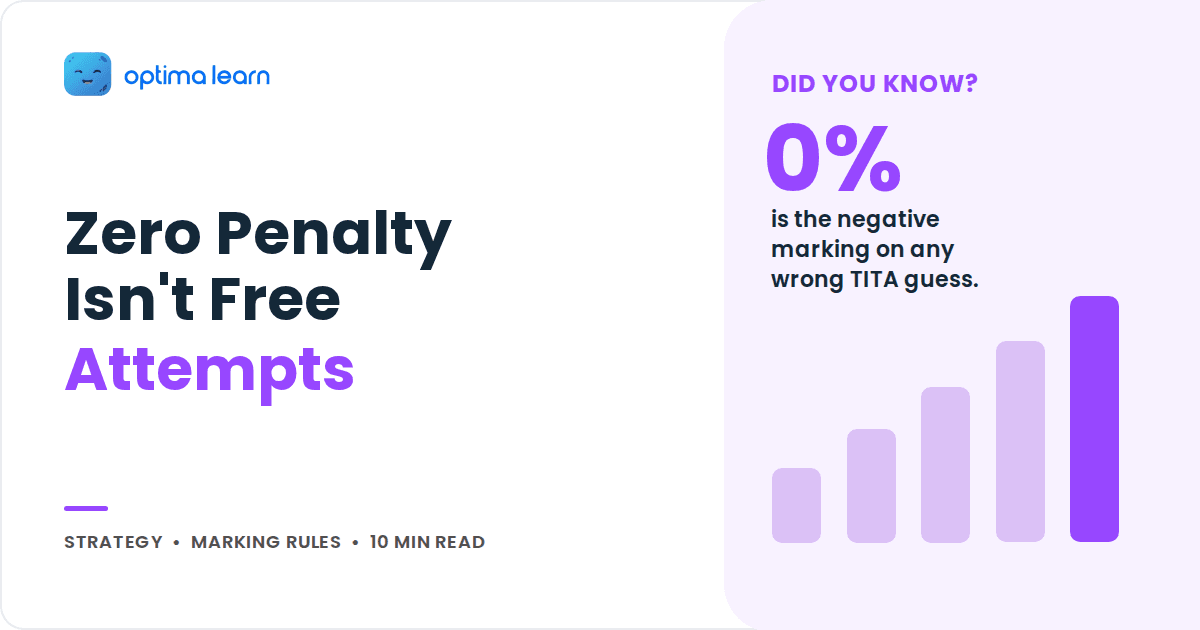
There is a myth going around CAT prep groups about TITA questions in CAT: since there is no negative marking, every attempt is basically free. Type in a number, the logic goes, and if it is wrong you lose nothing. So why would you ever leave one blank?
The marking rule inside that myth is true. What gets left out is the rest of the sentence. A wrong TITA guess costs you nothing on the scoreboard, but it can still cost you the sixty to ninety seconds you needed for a question you actually knew how to solve. Confusing no penalty with no cost is the exact mistake this guide is built to fix.
Before you change how you handle TITA questions, see where your attempts are actually landing you. Work through a set of CAT preparation practice sets and compare your TITA accuracy against your MCQ accuracy, section by section.
- TITA questions score +3 if correct and 0 if wrong or left blank, so there genuinely is no negative marking on TITA the way there is on MCQs.
- On the scoring dimension alone, a TITA guess with any real chance of being right is never worse than leaving it blank, because wrong and blank both return zero.
- The real constraint on TITA is time, not accuracy. A blind guess costs the same sixty to ninety seconds a solvable question needed, with no options to eliminate toward an answer.
- Unlike MCQs, TITA gives no partial credit shortcut through elimination, so a genuine blind guess is usually a poor trade even though it carries zero scoring risk.
- The real question before attempting a TITA question is not will I lose marks but do I actually have a partial method, not just a guess.
How TITA Questions Are Actually Scored
Every question on the CAT paper takes one of two formats. Multiple Choice Questions give you four options, and picking the wrong one costs marks. TITA questions, short for Type In The Answer, give you no options at all. You solve the problem and type the answer directly into a box.
There is no partial credit for a close answer either. A TITA response is either the exact right value or it is treated as wrong, so an estimate that is nearly correct scores the same zero as one that is nowhere close.
The scoring difference between the two formats is real and exact. A correct answer earns three marks whether it is an MCQ or a TITA question. An incorrect MCQ costs one mark. An incorrect TITA answer costs nothing, and an unattempted one costs nothing either. The table below makes it explicit.
| Question Type | Correct | Incorrect | Left Blank |
|---|---|---|---|
| MCQ | +3 | -1 | 0 |
| TITA | +3 | 0 | 0 |
That bottom row is the entire myth compressed into one line. A wrong TITA answer and a blank one score exactly the same: zero. That is why so many aspirants conclude that attempting every TITA question, known or not, must be a strictly better strategy.
Where TITA Questions Show Up in CAT
TITA questions are also not spread evenly across the paper. Quant and DILR both carry a real share of them, since both deal in numbers with one defensible answer. VARC carries none, because a passage's main idea rarely reduces to a single typed value.
The exact TITA count shifts year to year, and CAT has not announced any change to that pattern for the 2026 exam. What stays fixed across every attempt is the marking rule itself, so everything in this guide applies wherever a TITA question happens to land.
The TITA Attempt Audit: 4 Myth vs Reality Checks for CAT TITA Questions
Run your own TITA habits through this attempt audit. Each check starts from a claim that sounds airtight on the marking scheme alone, and each one breaks the moment you bring the clock into the picture instead of just the scoreboard.
Myth 1: TITA Questions Are Free Attempts
On the scoreboard, this is technically true. Wrong and blank both score zero, so nothing is deducted for trying. But free only describes the marks. It says nothing about the sixty to ninety seconds a genuine attempt takes, time that came from somewhere else on the paper.
Myth 2: If There is No Penalty, Attempt Every TITA Question
Attempting every TITA question, including ones you have no real handle on, spends your scarcest resource, exam time, on questions with close to zero odds of a hit. CAT hands out no extra minutes for TITA over MCQ, so every second guessing blind is a second not spent on a question you could actually solve.
Myth 3: A TITA Guess Carries the Same Risk as an MCQ Guess
An MCQ guess is scoring risky but time cheap. Pick an option in five seconds and you either gain three marks or lose one, and you can often narrow four options to two first. A TITA guess is scoring safe but offers no such shortcut, since there is nothing to eliminate.
Myth 4: Wrong or Blank, It Does Not Matter Which You Pick
It matters, just not for your score. Choosing to attempt costs you time that a blank answer does not. The decision that actually protects your score is not about the mark you might lose. It is about whether that attempt was worth the minute you spent reaching it.
Why Removing the Accuracy Risk Does Not Remove the Real Cost
CAT's marking scheme genuinely removes one kind of risk from TITA questions: the risk of your score going down because you were wrong. That is worth taking seriously, and it is the one part of the myth that holds up under scrutiny.
What it does not remove is the clock. A CAT section runs roughly forty minutes, and every question inside it draws from the same pool of time. A TITA question you cannot solve and guess on anyway still takes the better part of a minute to read, attempt, and abandon.
Mentors who review CAT score sheets for a living see the same pattern every season. The aspirant who attempted every TITA question rarely scores higher than one who attempted two thirds, because the extra attempts came at the cost of a solvable question elsewhere.
None of this means TITA questions deserve less attention than MCQs. It means the decision to attempt one needs a different question attached: not will I lose marks here, but is this specific attempt worth the time it will take.
Blind Guess vs Educated Estimate on a TITA Question
Not every TITA attempt made without full certainty is the same. There is a real difference between typing in a number pulled out of nowhere and one you arrived at through partial working or a bounded range. The table below draws that line.
| Basis | Blind Guess | Educated Estimate |
|---|---|---|
| How you got the number | No working, a number picked at random | Partial method: bounded the range, solved part of the problem, or estimated from known values |
| Odds of a correct hit | Close to zero on an open numeric field | Meaningfully higher, often good enough to be worth the time |
| Time already spent | Usually already spent reading and attempting before giving up | Time spent, but spent building toward an actual answer |
| Worth attempting | Rarely, unless time is genuinely spare | Usually yes, the partial work already paid for itself |
The gap between these two rows is where a smart TITA strategy actually lives, not in attempting more or fewer questions on principle. It is about noticing, honestly, which side of that table you are standing on before you commit to typing an answer in.
A Decision Rule for Every TITA Question You Face
Turn the myth vs reality checks above into something you can actually apply in real time, under a running clock and real exam pressure. Ask yourself three questions, in order, in the seconds before you commit to any TITA attempt.
Step 1: Can You Set Up the Equation or the Relationship
If you can write down what the question is actually asking, even without solving it fully, you already have more than a guess to work from. Half a method genuinely beats none, since it gives your attempt a real, defensible basis.
Step 2: Can You Bound the Answer, Even Roughly
Knowing the answer must fall between two values, or must be even, or must end in a specific digit, turns an open guess into a narrowed one with real odds attached. That is an educated estimate, not a blind guess pulled from nowhere.
Step 3: Would a Guess Here Cost You a Solvable Question Elsewhere
If you are ahead on time and every other question on the section is done or marked for review, a low odds attempt costs almost nothing. If you are behind on time, that same attempt is borrowed directly from a question you could have solved.
- Can you name one concrete step of a method for this question, or is it truly a shot in the dark?
- Do you know roughly what range the answer should fall in?
- Have you already marked every question on this section that you can solve outright?
- Is there a solvable question still sitting unattempted while you consider this guess?
- Read the question once, fully, before deciding whether to attempt or skip.
- If you can set up the relationship, attempt it now, in the same pass, not on a second look.
- If you can only bound the range, note your estimate and move on. Return only if time allows.
- If it is a true blind guess, save it for the very last minute of the section, never before.
- Review every TITA miss afterward and label it: method gap, time pressure, or blind guess.
The Mistake That Undoes the Time You Saved
Aspirants who genuinely understand the no negative marking rule on TITA often overcorrect in a specific, avoidable way. The pattern shows up almost every mock season, and it has nothing to do with knowing the marking scheme wrong. It comes from treating the rule as permission instead of one input into a fixed time budget.
In the last two minutes of a section, they rapid fire blind guesses into every remaining TITA question, because it cannot hurt. Meanwhile, a half solved MCQ sits marked for review, already narrowed to two options before time ran out. The guessing spree costs seconds that marked question actually needed.
The fix here is not to stop guessing altogether. It is to guess last, only after every question with real partial credit potential has already been revisited and locked in. Order of operations matters more here than the guess itself does.
This shows up just as often in a mock as on the real exam, and a mock is exactly where the habit should get caught. A single combined TITA accuracy number cannot tell a wasted blind guess from a strong estimate that happened to miss.
Split your review into the three buckets from the decision rule above: had a real method, had a bound, or had nothing at all. The third bucket is where your extra minute actually went, and it is the only one worth cutting.
Building Real TITA Skill Before Exam Day
The best way to stop needing the TITA attempt audit mid section is to reduce how often you land on a true blind guess. That comes from practice, not a rule recited in the exam hall. Solve TITA questions against a clock, since a method that works but takes four minutes is not exam ready.
Then log whether each miss was a genuine gap, a slow solve, or a blind guess, a distinction that tells you more than a combined accuracy number ever will. For Number System questions, where a solid share of CAT's TITA load tends to sit, you can practice CAT Number System questions under real time pressure and start noticing which ones you can bound quickly.
Turn This Into a Repeatable TITA Routine
Stop deciding TITA attempts on instinct and run your own attempt audit before every mock. Get a personalised CAT 2026 study plan that builds estimation and bounding practice into your weekly Quant and DILR sessions.
Build My CAT 2026 Study PlanIt also helps to know how the rest of the paper is built around this same logic. Our breakdown of the CAT exam pattern from the 2025 paper covers how MCQ and TITA questions are distributed across sections, and why the split shifts every year.
Keep a set of quick reference formula sheets on hand to shrink the time a method takes, and once you have logged a few weeks of attempts, our previous year CAT question archive lets you isolate TITA questions by section.
If your current strategy still treats every TITA question the same, method or not, it may be worth a second opinion. Get your full CAT exam strategy reviewed and find out exactly where your attempt decisions are costing you time instead of marks.
Get a Second Opinion on Your Attempt Strategy
A strategy review looks at exactly how you are spending time on TITA questions, not just how many you are getting right.
Get My Attempt Strategy ReviewedFrequently Asked Questions About TITA Questions in CAT
Is there really no negative marking on TITA questions in CAT?
Yes. A correct TITA answer earns three marks, and both an incorrect answer and a blank one score zero. That differs from MCQs, where an incorrect answer costs one mark. The absence of a penalty is real, it just does not make an attempt free of cost.
Should I attempt every TITA question since there is no penalty?
Not automatically. Attempting a question you have no method for still costs the sixty to ninety seconds a solvable question needed, with no elimination shortcut to shorten it. Attempt the ones with a partial method or a bounded estimate first, and treat blind guesses as a last resort.
What is the difference between guessing an MCQ and guessing a TITA question?
An MCQ guess is scoring risky but fast, since you can often eliminate a couple of options and pick from what remains. A TITA guess is scoring safe but slow, since there is nothing to eliminate and your odds on an open field are close to zero.
How many TITA questions appear in CAT?
The exact split between MCQ and TITA questions changes from year to year and section to section, so treat any fixed number you read online with caution. What stays constant is the marking rule: TITA scores zero for both wrong and blank answers, every year, in every section.
Build your CAT 2026 study plan
Personalised daily plan that adapts to your section-wise mock scores.
More from Strategy
Continue reading
Why CAT RC Answer Options Often Feel Equally Correct

How To Study For CAT When You Are Mentally Exhausted

How To Stop Procrastinating On Your Weakest Section
How To Recover From A Wrong Start On A DILR Set Explained
Put it into practice