
The Opportunity Cost of Every CAT Question
Every question you attempt in CAT is also a decision not to attempt several others. That second half never appears in your mock analysis, because the questions you did not reach leave no trace: no working, no wrong answer, no entry in the report.
So aspirants analyse what they got wrong and almost never analyse what they never saw. The result is a preparation loop that optimises accuracy on attempted questions while the larger loss sits outside the frame entirely.
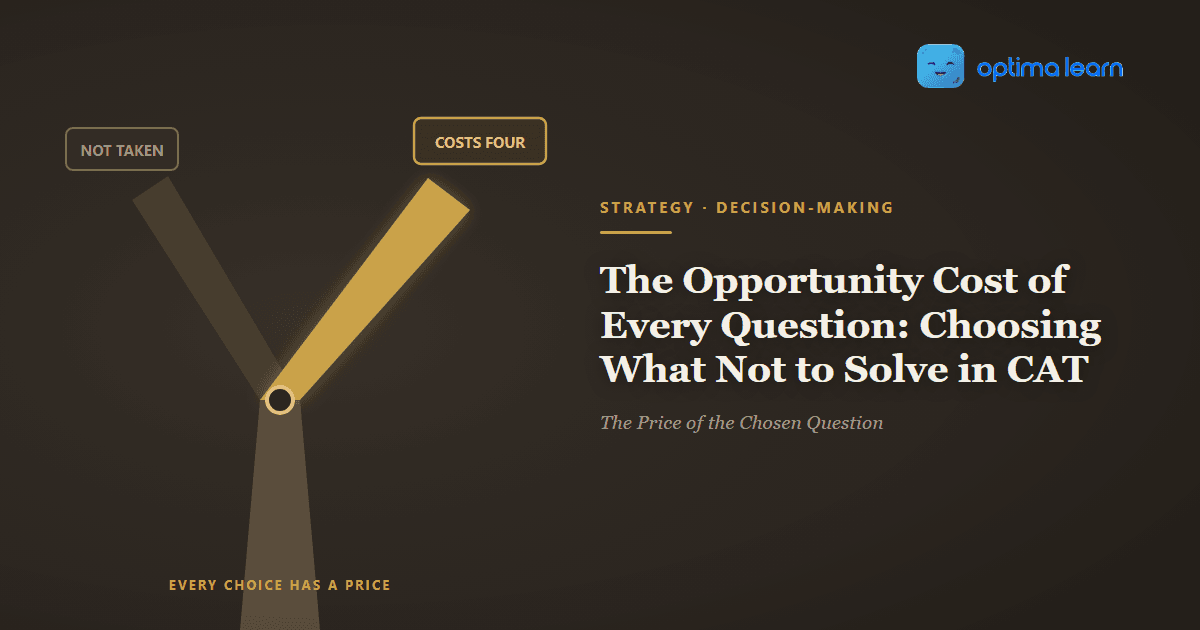
A fork in a path makes the trade visible in a way a question paper does not. One branch is taken, the other is not, and the cost of the branch you chose is the branch you gave up. That cost is real whether or not anyone writes it down.
- Attempting a question is also a decision not to attempt others, and the second half is invisible in mock reports.
- The Price of the Chosen Question has three components: clock, attention and order.
- The attention price is the least understood: a hard question degrades performance on the next two, not just the current one.
- Solving in the printed order is itself a choice, and usually an expensive one.
- The right metric is marks per minute across the section, not accuracy on what you attempted.
Why the Cost of a Question Is Invisible
Mock reports record attempts, accuracy and time per attempted question. Every one of those is about questions you engaged with. Nothing in a standard report describes the questions you never opened, because there is nothing to describe.
That creates a systematic blind spot. An aspirant with 88 percent accuracy on eighteen attempts looks like they are doing well, and they may be leaving four solvable questions unread at the end of every section.
The invisible losses have a consistent shape:
- They sit at the end of the section, so they are the ones you never reached.
- They are a random sample of difficulty, which means some of them were easy.
- They produce no error to analyse, so they never enter your review.
- They are caused by decisions made much earlier, usually in the first ten minutes.
The Price of the Chosen Question: Three Components
The full cost of attempting a question is larger than the minutes it takes, and the parts that are not minutes are the ones nobody counts.
The Price of the Chosen Question
- The clock price. The minutes spent, which displace other questions at roughly the section's average rate.
- The attention price. A hard question degrades the two that follow it. Frustration and fatigue do not reset at the next question number.
- The order price. Solving in the printed order forfeits selection entirely, and the printed order is not sorted by difficulty.
The clock price is the only one most aspirants count, and even this is usually under-counted:
- A six-minute question in a forty-minute section costs roughly three average attempts.
- The displaced questions come from the end of the section, where you had no information about them.
- Getting the long question right does not settle the trade; it has to be worth the three you gave up.
The attention price is the one that surprises people, and it is measurable in your own mocks:
- Accuracy on the two questions after a long struggle is reliably below your baseline.
- Working memory does not clear instantly, so the failed approach keeps intruding.
- The cost is largest when you abandoned the hard question, because there is no resolution to close it out.
The order price is the cheapest to fix and the most commonly paid:
- Question papers are not ordered by difficulty, so sequential solving is effectively random selection.
- A first pass that picks the tractable questions costs about ninety seconds and changes what you reach.
- Without a pass, the questions you never see are determined by paper order rather than by you.
Put the Price of the Chosen Question to Work
Selection is a skill that only exists under a clock and a full paper. Optima Learn's practice sets mirror real CAT structures, so the choices you make are the ones the exam will ask for.
Practise CAT QuestionsWhat a Question Has to Be Worth
Once the full price is counted, the bar for attempting a long question is higher than it feels.
| Time on the question | Attempts displaced | Attention cost | Worth it if |
|---|---|---|---|
| Under 2 minutes | About 1 | Negligible | Almost always |
| 2 to 3 minutes | About 1.5 | Small | You are confident of getting it |
| 3 to 5 minutes | 2 to 3 | Noticeable | Rarely, and only early in the section |
| Over 5 minutes | 3 or more | Large | Almost never |
| Over 5 and abandoned | 3 or more | Largest | Never |
The last row is the outcome to design against. A long question you abandon costs the clock price, the attention price, and produces nothing, which makes it the single worst result available in a section and the one most sections contain.
How to Choose What Not to Solve
Selection is a positive skill rather than an absence of effort, and it has a procedure:
- Take a first pass. Ninety seconds scanning the whole section before solving anything. This is the highest-return time in the paper.
- Mark three categories. Attempt now, attempt if time remains, do not attempt. Three marks, no deliberation.
- Solve the first category in your own order, not the paper's.
- Never revisit the third category. If it was a leave at minute one, it is still a leave at minute thirty with less time.
- Leave early when you leave. A question abandoned at thirty seconds costs almost nothing; the same question abandoned at five minutes costs the section.
The related judgement about when a question you have already started should be dropped is covered in why every CAT Quant question has a point of no return.
Common Mistakes in Question Selection
Related errors:
- Solving in printed order. Handing selection to the paper, which does not sort by difficulty.
- Reviewing only errors. Analysing what you got wrong and never what you did not reach.
- Optimising accuracy. Improving a metric that only counts attempted questions.
- Ignoring the attention cost. Treating each question as independent of the one before it.
- Revisiting leaves. Returning to a question you correctly rejected, now with less time and more fatigue.
A Practice Drill for Selection
The drill separates choosing from solving, which is the only way to improve choosing.
- Take a full section paper. Do not solve anything. Spend ninety seconds marking every question attempt, maybe or leave.
- Now solve only the attempts, timing each one.
- Afterwards, solve the leaves untimed and check how many were genuinely beyond you.
- Count how many leaves turned out to be tractable. That number is your selection error rate.
What aspirants usually find:
- Selection error runs high at first, with several tractable questions marked as leaves on appearance.
- Length is the most common reason for a wrong leave, and it correlates poorly with difficulty.
- Marks per minute rises before accuracy does, which is the intended direction.
- The ninety-second pass pays for itself within two or three sections.
The Bottom Line
Every attempt is a purchase, and the currency is the questions you will not reach. Aspirants who improve fastest are not the ones who solve hard questions well. They are the ones who noticed that choosing is itself the skill, and that it is being tested in every section whether or not they are practising it.
The Price of the Chosen Question, Recap
- Clock price: minutes spent displace attempts at the section's average rate.
- Attention price: a hard question degrades the two that follow it.
- Order price: solving in printed order hands selection to the paper.
Build the Habit on Timed Practice
Selection only exists when there is more paper than time, so it has to be practised on full sections. Work through CAT previous year questions in timed blocks, or sit full CAT mock tests and past papers so the ninety-second pass becomes automatic. More on exam decision-making sits in the CAT strategy blog archive, and if your score has stalled despite good accuracy it is worth building a plan around what you actually reach.
Choose Better in CAT 2026
The questions you never reach cost more than the ones you get wrong. Start measuring both on real CAT-style papers.
Get Your Strategy ReviewedFrequently Asked Questions
What is opportunity cost in the CAT exam?
It is the value of the questions you give up by attempting the one in front of you. A six-minute question in a forty-minute section displaces roughly three average attempts, and those displaced questions sit at the end of the section where you never got to see them.
How do I decide which questions to skip?
Take a ninety-second first pass over the whole section before solving anything, marking each question attempt, maybe or leave. Then solve in your own order rather than the paper's. Without a pass, selection is effectively handed to the paper, which is not sorted by difficulty.
Why is accuracy a misleading metric in CAT?
Because it only counts questions you attempted. Attempting fewer and safer questions raises accuracy while the score stalls, and nothing in a standard mock report describes the questions you never opened. Marks per minute across the whole section is the figure that actually moves percentiles.
Does a hard question really affect the questions after it?
Yes, and it is measurable in your own mocks. Accuracy on the two questions following a long struggle is reliably below baseline, because working memory does not clear instantly and the failed approach keeps intruding. The effect is largest when the hard question was abandoned rather than solved.
Build your CAT 2026 study plan
Personalised daily plan that adapts to your section-wise mock scores.
More from Strategy
Continue reading
XLRI Admission Process: The Exam Nobody Ever Checks
Why Do Some CAT DILR Sets Feel Totally Unsolvable?
Why School Level Quant Feels Hard in the CAT Paper
Why Do Non Engineers Struggle in CAT VARC As Well?
Put it into practice