
The Decision Latency Trap in CAT DILR
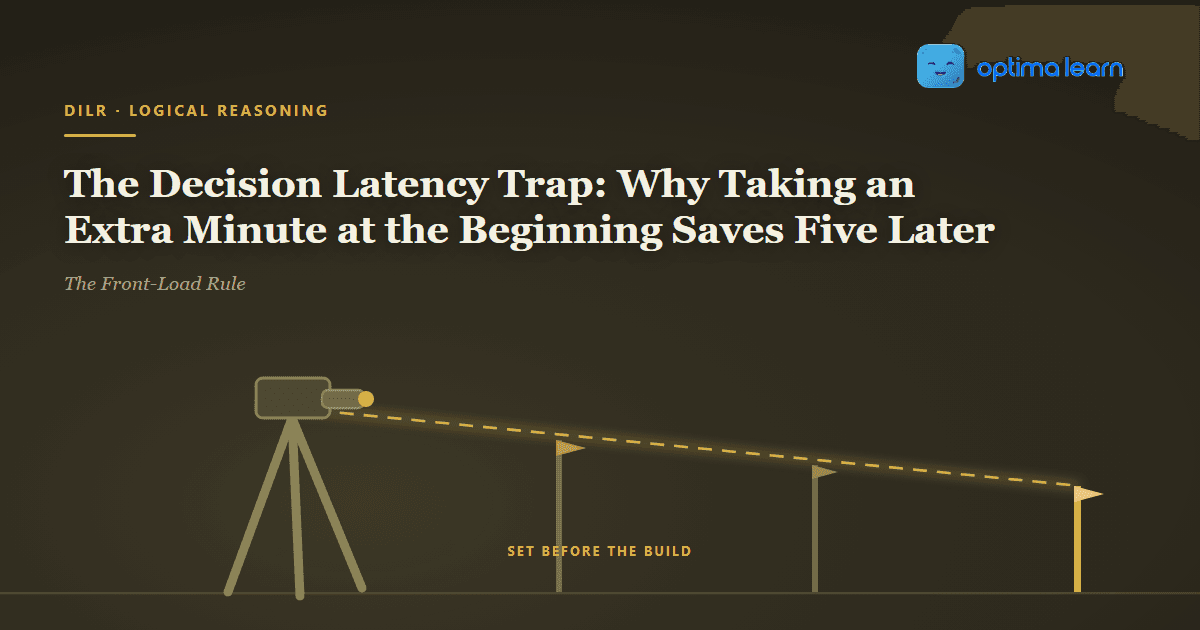
A minute spent at the start of a DILR set and a minute spent at minute eight are the same minute on the clock. They are worth completely different amounts.
The early one buys structure: an invariant, a clue ranking, the right frame. Everything you do afterwards is cheaper because of it. The late one buys a single entry in a grid, and only that entry. Same cost, wildly different return, and almost nobody prices them differently. That mispricing is the decision latency trap.
A surveyor sets the instrument before anyone digs. Not because setting up is enjoyable, but because every measurement afterwards depends on it, and an error introduced at the tripod propagates through the entire site. DILR has the same shape.
- Time spent before the first deduction is worth roughly three times as much as time spent after it.
- The Front-Load Rule is an exchange rate, not a checklist: early minutes buy structure, late minutes buy entries.
- Aspirants under-invest at the start because early time produces nothing visible, which feels like falling behind.
- How much to front-load varies: more on unfamiliar set types, less on ones you have solved many times.
- The rate is measurable on your own mocks, and measuring it is what makes the discipline stick.
Why Early Decisions Are Worth More Than Late Ones
The return on a minute depends on how much of the remaining work it improves. A minute at second thirty affects every subsequent decision in the set. A minute at minute eight affects whatever is left, which by then is not much.
That alone would make early time more valuable. What makes the gap large rather than marginal is that structural work is multiplicative: a correct clue ranking does not add a deduction, it makes every later deduction easier to find.
Concretely, here is what each kind of minute actually buys:
- Second 0 to 60: the frame, the invariants, and which clue is the driver. Affects everything.
- Minute 1 to 3: the first deductions, which cascade. Affects most of what remains.
- Minute 4 to 7: filling in a structure that already exists. Affects the cells it touches.
- Minute 8 onward: individual entries, and increasingly, repair work. Affects almost nothing else.
The Front-Load Rule: Pricing Your Minutes
This is not a list of things to do at the start. It is a way of deciding how much of the set to spend before writing anything.
The Front-Load Rule
- Early minutes buy structure; late minutes buy entries. Structure compounds. Entries do not.
- The exchange rate is roughly one to three. A minute at the start typically saves three later. Measure yours rather than trusting the number.
- Front-load more when the set is unfamiliar. Familiarity has already done the structural work for you, so it needs buying only when it is absent.
Structure versus entries is the distinction that makes the rest usable, and it is easy to check on your own sheet:
- Structure is anything that makes the next deduction easier to find: a frame, a total, a ranking.
- An entry is a value in a cell. Useful, but it improves nothing except itself and its immediate neighbours.
- If your first two minutes produced only entries, you did late-minute work early, which is the trap.
The exchange rate matters because it converts an abstract principle into a decision you can actually make under a clock:
- At one to three, ninety seconds of setup is worth spending if it saves four and a half minutes, which it routinely does.
- The rate falls as the set progresses. By minute six, structural work is worth roughly what entry work is.
- Past minute eight the rate inverts: setup no longer pays, and you should simply be answering.
Varying the investment is what stops this becoming a rigid ritual applied to sets that do not need it:
- A set type you have solved thirty times needs almost no front-loading. You already own the structure.
- An unfamiliar format deserves two minutes before a single mark, because you are buying something you do not have.
- A set with heavy data and light constraints needs frame work; one with light data and heavy constraints needs clue ranking.
Put the Front-Load Rule to Work
An exchange rate only means something once you have measured your own. Optima Learn's DILR sets mirror real CAT caselets, so the setup time you buy is being tested against genuine structures.
Practise CAT DILR SetsWhy Nobody Front-Loads Naturally
The rule is not hard to understand. It is hard to follow, and the reasons are worth naming because they are situational rather than about discipline.
| What you feel at second 40 | What is actually true |
|---|---|
| Nothing is on the page, so nothing is happening | The most valuable work in the set is happening |
| Others are already writing | They are buying entries at three times the price |
| The clock is moving and I have no marks | Marks are not the output of this phase |
| I can set up as I go | Structure derived mid-set arrives after it would have helped |
| This set looks simple | Possibly true, and then front-loading costs you thirty seconds |
The final row is the honest counterweight. Front-loading is not free, and on a genuinely familiar set it is a small waste. The asymmetry is that the waste is thirty seconds and the saving, when it lands, is several minutes.
How to Spend the First Ninety Seconds
The rule says how much to invest. This is what to buy with it, in order of return:
- Read everything before writing anything. Partial reading is what produces the wrong frame, and the wrong frame costs more than every other error combined.
- Choose the frame. Table, line, grid or network. Getting this right is the single highest-return decision in the set.
- Derive the invariants. Totals, counts and parity, all of which hold regardless of how the set resolves.
- Rank the clues. Find the one with the widest reach that depends on nothing else.
- Only then write. The first mark should be a deduction, not a transcription.
The first sixty seconds of a set has its own dedicated treatment in the sixty seconds that decide whether you will crack a DILR set, which covers what to do; this piece is about why it is worth the minute in the first place.
Common Mistakes in Pricing Your Time
Related errors:
- Reading half the clues before starting. The frame gets chosen on incomplete information, which is the most expensive mistake available.
- Front-loading a familiar set. Spending two minutes on structure you already own.
- Setting up mid-set. Deriving totals at minute six, after they would have eliminated two cases.
- Treating setup as ritual. Running a fixed routine regardless of what this particular set needs.
- Never measuring. Believing the exchange rate rather than checking it on your own mocks, so the habit never sticks.
A Practice Drill for Measuring the Rate
This drill produces your own number, which is the only version of this that changes behaviour.
- Take twelve DILR sets. Solve six with your usual approach, recording total time and time to first written deduction.
- Solve the other six with a forced ninety-second setup: read fully, choose the frame, derive invariants, rank clues, write nothing.
- Compare average total times across the two groups.
- Divide the time saved by the extra setup time. That ratio is your personal exchange rate.
What most aspirants find:
- The measured rate lands between two and four to one, and is highest on unfamiliar formats.
- Completion rate improves before average time does.
- The forced-setup group has far fewer abandoned sets, which is where most of the marks are.
- Sets where the rate was lowest are the ones you already knew well, which tells you where not to front-load.
The Bottom Line
DILR is not won by working faster once you are underway. It is won by deciding how much of the set to spend before you are underway at all. The minute that feels most wasteful is usually the one carrying the highest return, and the only way to believe that is to have measured it yourself.
The Front-Load Rule, Recap
- Early buys structure, late buys entries: structure compounds, entries do not.
- The rate is about one to three: a minute at the start saves roughly three later.
- Vary by familiarity: front-load unfamiliar formats, skip it on ones you own.
Build the Habit on Timed CAT DILR
An empty sheet at second forty only feels survivable under a real clock, which is where it has to be practised. Work through CAT previous year questions in timed blocks, or sit full CAT mock tests and past papers so the discipline holds under pressure. More DILR method sits in the CAT DILR blog archive, and if your section timing keeps collapsing it is worth having your strategy reviewed honestly.
Buy the Early Minutes Before CAT 2026
The minute that produces nothing visible is usually the one carrying the set. Measure your own exchange rate on real CAT-style caselets.
Start Practising CAT DILRFrequently Asked Questions
What is the decision latency trap in DILR?
It is treating every minute of a set as equally valuable. Time spent before the first deduction buys structure that makes all later work cheaper, while time spent late buys single entries. Pricing them the same leads to under-investing at exactly the point where investment pays most.
How long should I spend before writing anything in a DILR set?
Around ninety seconds on an unfamiliar format, and considerably less on a set type you have solved many times, because familiarity has already done the structural work. Spend it reading fully, choosing the frame, deriving invariants and ranking clues, in that order.
Is a minute of setup really worth it when the clock is running?
Measured on real mocks the exchange rate usually lands between two and four to one, so ninety seconds of structure typically saves three to six minutes. The asymmetry matters more than the average: when front-loading is unnecessary it costs thirty seconds, and when it lands it saves several minutes.
Why does front-loading feel so uncomfortable?
Because an empty sheet at second forty reads as falling behind, and that feeling arrives before any reasoning about value can. The reliable fix is to measure your own exchange rate on your mocks, since a number you produced yourself carries more weight under pressure than a principle does.
Practice VARC, chapter by chapter
CAT VARC practice across reading comprehension, para-summary and para-jumbles, each with a worked solution.
More from VARC
Continue reading

Using a Study Journal for CAT Without Overdoing It

How to Stop Comparing Your CAT Prep With Everyone Else

SPJIMR Admission Process: Why the Profile Leads It
How to Solve CAT Quant Faster Without Skipping Steps
Put it into practice