
TAPMI Admissions and the Three Things Called a Cutoff
Every December, a version of the same conversation happens thousands of times. Someone has a percentile, they have found a cutoff on a forum, the percentile is above the cutoff, and they have concluded they will get a call. Quite often they do not, and they experience it as unfair rather than as a misreading.
It was a misreading, and a specific one. The word cutoff is used for at least three different things in this process, and only one of them is a number any school publishes in advance. This piece explains what each kind of cutoff is, why the one you want does not exist before the cycle runs, and how to read a school's published criteria so that you are planning on something real.
A target has to be set on your own trend, not on a forum figure. The CAT target percentile tool is where that number comes from.
- Qualifying cutoff, call cutoff and last year's closing figure are three different things.
- Only the qualifying minimum is published in advance, and it is a floor for consideration.
- A call cutoff cannot be published early because it depends on who applies that year.
- Percentile and score are different quantities, and forums mix them constantly.
- A published weighting is more useful than any cutoff, because it shows how the decision is built.
Three Different Things Called a Cutoff
Separating these is most of the work, because once they are separate the confusion cannot recur.
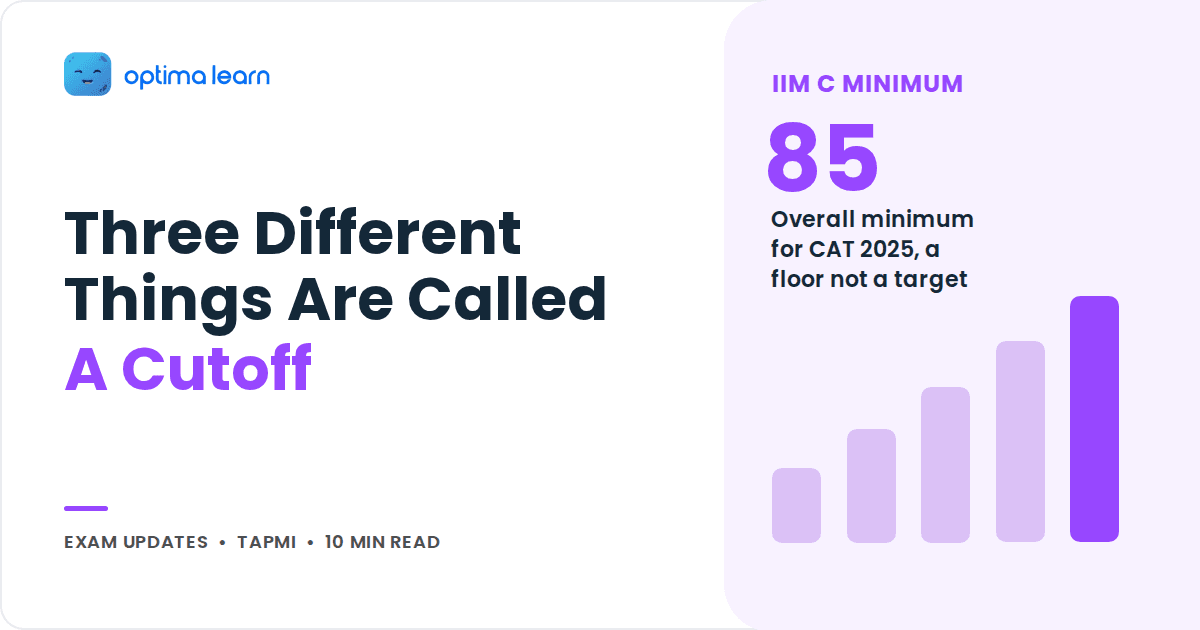
The qualifying cutoff is a minimum the institute publishes in advance, often sectional and overall. Meeting it means your application will be considered. It says nothing about whether it will succeed. IIM Calcutta, for example, stated qualifying CAT 2025 minimums of 80 sectional and 85 overall, and the word qualifying in that sentence is doing real work.
The call cutoff is the level at which calls actually went out. It is not a policy and it is not published in advance, because it is an outcome of who applied that year and how the paper went.
The closing figure from last year is a historical observation, sometimes reported, frequently misremembered, and never a commitment about this year.
Reading a qualifying minimum as a call threshold. It is the single most common source of misplaced confidence in December, and it produces candidates who cleared every published minimum on their list and still received few calls, with no idea why.
Why the Number You Want Cannot Exist in Advance
This is worth understanding rather than merely accepting, because it removes the search.
A call cutoff emerges from a process. A school receives applications, ranks them by its own formula, and issues calls down that ranking until it has the number it wants. Where that stops depends on how many people applied, what their profiles looked like, and how the exam went that year.
None of those are known before the cycle runs, so the figure does not exist to be published. A school cannot tell you in October where its calls will stop in January, any more than you can know the closing price of something before the market opens.
That is also why the practice of quoting "the cutoff" as though it were a fixed property of a school is so misleading. It describes one year's outcome and presents it as a rule.
The question "what percentile do I need for this school" feels like it should have an answer, and the absence of one is not evasion. A raw score comes from your correct and incorrect responses, a percentile is your position relative to everyone else who sat the exam, and where calls stop depends on the field. Three variable quantities, none of them settled in advance.
Percentile and Score Are Not the Same Quantity
A second confusion compounds the first, and it appears constantly in forum discussion.
Your raw score comes from your correct and incorrect answers under the marking scheme: plus three for a correct answer, minus one for an incorrect MCQ, zero for an unattempted question, and no negative marking on Type In The Answer questions. Your percentile is your position relative to everyone else who sat the exam, and it shifts with paper difficulty and with normalisation across the three slots.
There is no fixed mapping between them. Any statement of the form "this many marks equals this percentile" is presenting a variable relationship as a constant, and any cutoff discussion that slides between marks and percentile without noticing is unreliable on its face.
What to Read Instead of a Cutoff
The useful document is the school's published criteria, and specifically any stated weighting.
- Which entrance exams are accepted. The first fact about any school and the one most often assumed.
- The application window. Published independently of the result date, and several fall before results are out.
- Any published qualifying minimum. Recorded as a floor, and labelled as such in your own notes.
- The shortlisting inputs and any published weighting. How the decision is constructed, which is the genuinely useful part.
- The selection stages. Interview, written component, group stage, or some combination.
- What the stage itself weighs. Since a call is not an admission and the stage reorders the field.
What a Weighting Tells You That a Cutoff Cannot
A formula tells you where your marginal effort pays and whether your profile fits how that school reads candidates, which is actionable in a way a threshold never is.
IIFT's 2026 to 2028 shortlist weighted the entrance score at 90 percent, work experience at 5 and gender diversity at 5, which describes a process dominated almost entirely by the exam. IIT Bombay's SJMSOM used 75 percent entrance score, 20 percent academics and 5 percent work experience for the same batch, where an academic record carries real weight. A candidate with a strong exam score and a weak academic record is positioned very differently at those two schools, and no cutoff would have told them that. Both need re-verifying per cycle, and both are quoted here as illustrations rather than as anything applying to TAPMI.
| Kind of figure | Published in advance | What it actually means |
|---|---|---|
| Qualifying minimum | Yes, by the institute | A floor to be considered, nothing more |
| Call cutoff | No, it cannot be | Where calls stopped, known only afterwards |
| Last year's closing figure | Sometimes reported | A historical observation, not a commitment |
| Published weighting | Yes, by some schools | How the decision is constructed |
| Forum percentile talk | No | Frequently mixes marks and percentile |
Why This Piece Gives You No TAPMI Figures
Consistent with all of the above, we are not providing cutoff numbers, and the reason is the argument of the piece rather than an omission.
Cutoffs and weightings are published per admission cycle by each institute and are revised between years. A figure carried over from a previous batch and presented as current is misinformation with a decimal point attached, and repeating one here would undercut everything written above it.
The institute's own admission policy for your cycle is the document that binds. The six notes are what to take to it, and reading it properly takes one evening.
When you record a figure in your own notes, write next to it whether it is a qualifying minimum, a reported past outcome, or a published weighting. Three months later you will not remember which, and an unlabelled number in your own file behaves exactly like a forum rumour.
What the Decision Actually Reads
Depending on the institute, a profile can include tenth, twelfth and graduation marks, consistency across the three, sectional scores, work experience, gender diversity, academic diversity, category, professional qualifications, extracurriculars, achievements, positions of responsibility, certifications, internships and gap years, plus performance at the selection stage.
No school uses all of them and the weightings differ sharply, which is the mechanical reason two candidates with identical percentiles receive different call lists. Nothing mysterious is happening: the same inputs ranked by different formulas produce different shortlists.
What to Do With a Percentile You Already Have
In December the question becomes practical rather than conceptual, so it is worth saying what a sensible response to a result looks like.
Apply to everything you would accept and clear the published minimum for, rather than filtering the list by forum estimates of where calls will land. The published minimum is the only threshold that genuinely gates consideration, and self-rejecting above it on the basis of a rumoured figure removes schools that nobody actually removed you from.
Then build the list in bands rather than around a single expectation: some schools where your result sits comfortably inside their usual range, some near the boundary, and a couple that would need things to fall your way. The common failures are symmetrical, applying only to reaches and being left with nothing, or applying only to safe options and wasting a strong result.
And accept that some of it is not knowable. Where calls stop is decided by a field you cannot see, so the honest posture is to apply widely within what you would accept and put the energy into the stage you can actually control, which is the one that follows a call.
A Call Is Not an Admission
One more distinction belongs in the same family as the three cutoffs, because it catches candidates later in the cycle.
Getting a call means you have reached the selection stage, and that stage genuinely reorders the field. Shortlists arrive across January to March with rounds through that window, and final offers and waitlist movement run to roughly March to May. Candidates who treat a call as the finish line prepare accordingly and are surprised twice.
The preparation for that stage does not require a result to begin, since the material is your own profile and your own reasons. Our guide on building a realistic preparation plan covers fitting it into the cycle.
The Summary
The word cutoff covers three different things, and only one of them is published in advance. A qualifying minimum is a floor to be considered. A call cutoff is where calls actually stopped and cannot be known before the cycle runs. Last year's closing figure is a historical observation that was never a promise.
Compounding that, percentile and raw score are different quantities with no fixed mapping between them, so any discussion sliding between marks and percentile is unreliable before you even check the number.
Read published weightings instead. They tell you how a school builds its decision, which is what lets you judge where your profile sits and where marginal effort pays. Label every figure in your own notes with what kind it is, take the six notes to the institute's own material for your cycle, and remember that a call is the start of the selection stage rather than the end of the process.
- For every figure in your notes, do you know which of the three kinds it is?
- Are you comparing percentiles with percentiles, rather than sliding into marks?
- Have you found a published weighting for any school on your list?
- Have you started preparing for the stage that comes after a call?
If your list is built on figures you cannot classify, that is worth an evening to fix before December arrives. A CAT preparation strategy review will pressure test the list itself, and a personalised CAT preparation plan keeps the exam work moving while you do the reading.
Label Every Number You Write Down
An unlabelled figure in your own notes behaves exactly like a rumour three months later.
Build My Weekly PlanFrequently Asked Questions About B-School Cutoffs
What is the TAPMI cutoff?
Cutoffs are published per admission cycle and revised between years, so second hand figures are unreliable. Read the current policy at source, and note that any published minimum is a qualifying floor rather than the level at which calls are issued.
What is the difference between a qualifying cutoff and a call cutoff?
A qualifying minimum is published in advance and means your application will be considered. A call cutoff is where calls actually stopped in a given year, which depends on who applied and cannot be known before the cycle runs.
What percentile do I need for a particular school?
There is no fixed answer. Raw score comes from your responses, percentile is your position relative to the field and moves with difficulty and normalisation, and where calls stop depends on that year's applicants. Read published weightings instead.
If I clear the published cutoff, will I get a call?
No. Clearing a qualifying minimum means you will be considered. Calls are issued down a ranking built from the school's own formula, so profile factors and the size of the applicant pool decide where they stop.
Track CAT 2026: never miss a date
Slot booking, admit cards, results, and IIM cutoffs, one timeline.
More from Exam Updates
Continue reading
XIMB Admissions and the Deadline That Actually Binds

Are CAT VARC Passages Deliberately Written to Confuse?

What High Scorers Actually Do in Their Final CAT Week
When You Cannot Understand a CAT RC Passage Opening
Put it into practice