
Reading CAT Quant Equations Like Stories
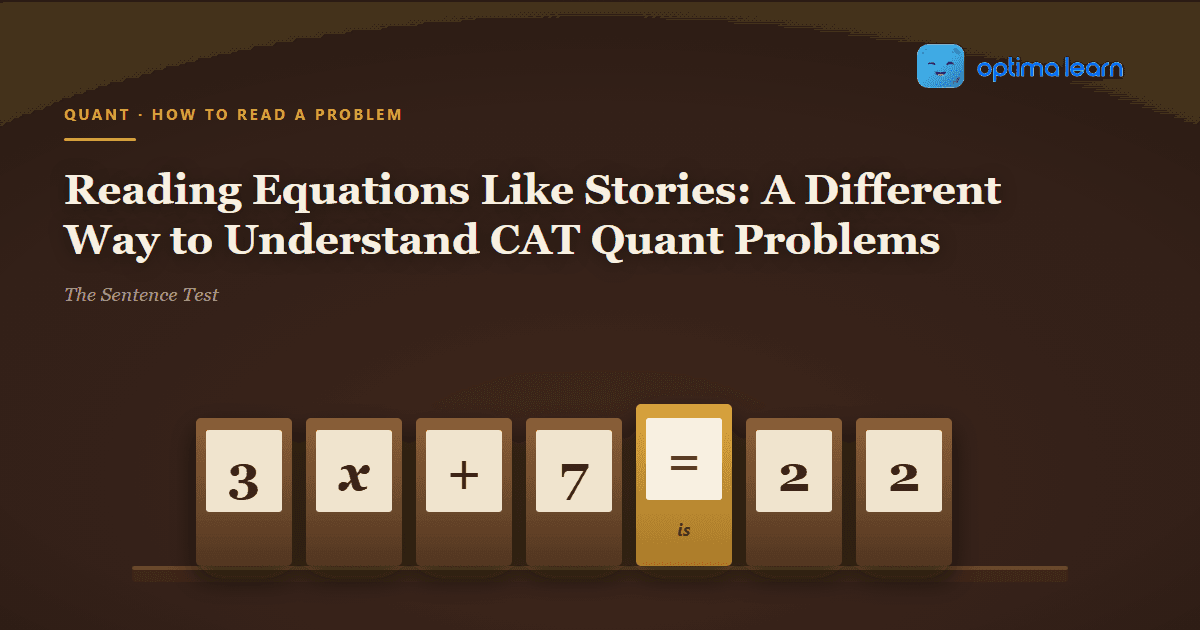
Reading equations is a skill nobody teaches, because everyone assumes it happens automatically. An aspirant writes 3x + 7 = 22 and immediately starts moving the 7. Nothing about that is wrong. But something has been skipped, and what gets skipped is the reason a certain class of CAT Quant error keeps recurring no matter how much algebra practice goes in.
The equation is a sentence. It has a subject, a verb, and a claim. Read as a sentence, 3x + 7 = 22 says: seven more than three times the number is twenty-two. Read as a procedure, it says: subtract seven. The second reading is faster and it is the one almost everyone uses. It is also the reading that loses track of what x was in the first place.
- Most CAT Quant setup errors are reading errors, not algebra errors, and no amount of algebra practice fixes a reading error.
- Every equation is a sentence with a subject, a verb and a claim. Reading it as a procedure skips all three.
- The Sentence Test takes about ten seconds: name the subject, read the verb, state the claim.
- Said aloud in words, a wrong setup usually sounds obviously false against the story, while written in symbols it looks perfectly reasonable.
- The test catches sign errors, swapped variables and misread inequalities before you spend three minutes solving the wrong equation correctly.
The Error That Algebra Practice Does Not Fix
Look through a mock analysis and separate the Quant mistakes into two piles. One pile is genuine algebra: a sign dropped, a term mis-expanded, an arithmetic slip. The other pile is setup: the equation you solved was not the equation the question described.
The second pile is almost always bigger, and it behaves differently. Algebra errors get rarer with practice. Setup errors do not, because practice drills the manipulation and never touches the translation. You can get faster at solving the wrong equation indefinitely.
The two piles behave differently under practice, which is why the distinction is worth making:
- Algebra errors fall steadily as you solve more. Setup errors do not move at all.
- Algebra errors are caught by re-checking your working. Setup errors survive every re-check.
- Algebra errors produce answers that look wrong. Setup errors produce answers that look entirely reasonable.
- Algebra errors cost you a mark. Setup errors cost you a mark plus the minutes you spent earning it.
What makes setup errors so persistent is that they are invisible from inside. Once the equation is written, it looks like a fact. Every subsequent step is checked against the equation rather than against the question, so the original mistranslation never comes up for review again.
The Sentence Test: Reading an Equation Before Solving It
The fix is not to be more careful, which is advice nobody can act on. It is to add one short, mechanical step between writing an equation and manipulating it.
The Sentence Test
- Name the subject. Say what the variable actually is, in words, with its unit. Not "x" but "the number of chairs".
- Read the verb. Every operator is a verb. The equals sign means is, not do something. A "less than or equal to" means at most.
- State the claim. Say the whole equation as one English sentence and check it against the story. If it sounds wrong, it is wrong.
Naming the subject sounds trivial and is where most of the value sits. An unlabelled variable drifts. It starts as "the speed of the first train" and quietly becomes "the speed" and then "the answer". Fixes:
- Write the unit next to the variable the moment you define it, every time.
- If two quantities are similar, name them by what distinguishes them, not by order of appearance.
- When the question asks for something you did not define, define it explicitly rather than assuming it equals your variable.
Reading the verb catches the errors that cost whole questions. Operators carry meaning that symbol-pushing discards:
- "Is 5 more than" is addition to the other side, and it reverses more often than any other phrase.
- "Twice as many A as B" means A = 2B, and the ordering trips up an enormous number of otherwise capable solvers.
- "At least" and "at most" flip the inequality direction, and the flip is silent once written.
- "Decreased by 20 percent" is multiplication by 0.8, not subtraction of 20.
Stating the claim is the check that closes the loop. Say the equation as a sentence, then hold it against the story. This works because human ears are far better at detecting a false statement in English than eyes are at detecting a wrong equation in symbols.
Put the Sentence Test to Work
Ten seconds of translation is only affordable once it has saved you a question or two. Optima Learn's Quant sets use real CAT phrasing, so the language that causes mistranslation shows up exactly where the exam puts it.
Practise CAT Quant QuestionsThe Phrases That Cause the Most Mistranslation
Setters do not need to invent difficult language. Ordinary English carries enough ambiguity on its own, and a handful of constructions account for a large share of setup errors.
| Phrase in the stem | What it means | What gets written instead |
|---|---|---|
| A is 5 more than B | A = B + 5 | A + 5 = B |
| Twice as many A as B | A = 2B | 2A = B |
| A exceeds B by 20% | A = 1.2B | B = 1.2A |
| Reduced to 80% | New = 0.8 × old | New = old − 0.8 |
| At least 12 | Quantity ≥ 12 | Quantity > 12 |
Every row in that table is a sentence that sounds obviously wrong when spoken and looks entirely plausible when written. That asymmetry is the whole argument for the test.
What Changes When You Read Equations as Sentences
The obvious benefit is catching errors. The less obvious ones matter more over a full section:
- You stop solving for the wrong thing. Naming the subject means the target stays in view, so you finish with the quantity that was asked for rather than the one that was convenient.
- Estimation becomes possible. A sentence has a rough size. "Roughly three times something near seven" tells you the answer is near twenty, which kills two options before you compute.
- Checking gets fast. Substituting your answer back into a sentence takes seconds; substituting it into an equation takes a line of algebra.
- Wordy questions stop being intimidating. A long stem is a long sentence, and sentences are something you already read fluently.
This pairs closely with reading a question for how much it actually constrains, which is covered in why every CAT Quant question has a point of no return and in the wider CAT Quant blog archive.
Reading the Stem as a Paragraph, Not a Puzzle
The Sentence Test works on individual equations. The same instinct applied to the whole stem changes how a wordy question feels before you write anything.
- Read it once without a pen. Reaching for notation on the first pass fragments the story into symbols before you know what the story is.
- Find the question sentence first. It is usually last, and reading it first tells you which quantities matter.
- Say what happened, in order. Most arithmetic stems describe a sequence of events, and getting the order right is most of the setup.
- Notice the tense. "Was" and "will be" separate a before-state from an after-state, and conflating them is a classic percentage-change error.
- Only then define variables, naming each for the thing it stands for rather than the order it appeared in.
Common Mistakes That Come From Symbol Pushing
The habit produces a few recognisable failures:
- The unlabelled variable. Defining x without a unit, then losing track of whether it was the price, the quantity or the total.
- The reversed comparison. Writing "more than" the wrong way round, which survives every subsequent check.
- The answered sub-question. Solving correctly for x when the question wanted x + 3, or wanted the other train.
- The silent inequality flip. Reading "at most" as a strict inequality and losing the boundary case, which is frequently the answer.
- The percentage subtraction. Treating a percentage change as an additive one, which produces an answer close enough to look plausible.
A Practice Drill for Translation
This drill deliberately stops before the solving, which is what makes it work.
- Take fifteen word problems. Set up the equation for each one and then stop. Do not solve.
- Underneath each equation, write it out as a full English sentence with units.
- Read your sentence against the stem. Mark every mismatch, however small.
- Only now solve the ones whose sentences matched. Count how many you would have solved perfectly and still got wrong.
The mismatches cluster in predictable places:
- Comparative phrases reversed, which is by far the most common single fault.
- A variable defined for one quantity and used for another halfway down.
- A percentage treated additively rather than multiplicatively.
- The equation correct, but built for a quantity the question did not ask about.
- An inequality written strictly when the stem said "at least" or "at most".
Fifteen setups take about twelve minutes and typically expose one or two recurring phrases that you personally mistranslate. That list is short, specific and fixable, which is not true of "be more careful".
The Bottom Line
An equation is a claim about the world, not an instruction to move symbols. Aspirants who read it as a claim catch their setup errors in ten seconds. Aspirants who read it as an instruction catch them in the mock analysis, three days later, and call them silly mistakes.
The Sentence Test, Recap
- Name the subject: say what the variable is, in words, with its unit.
- Read the verb: equals means is; every operator carries meaning.
- State the claim: say it as one sentence and hold it against the story.
Build the Habit on Timed CAT Quant
Translation is the step that gets dropped first under pressure, so it has to be rehearsed under pressure. Work through CAT previous year questions in timed blocks, or sit full CAT mock tests and past papers so the habit survives real section fatigue. If setup errors keep appearing in your analysis, it is worth having your preparation reviewed honestly rather than adding more solving hours.
Frequently Asked Questions
What does it mean to read an equation like a sentence?
It means treating the equation as a claim in English rather than a set of symbols to manipulate. You name what the variable stands for, read each operator as a word, and say the whole thing as one sentence, then check that sentence against the question before doing any algebra.
Why do I keep making silly mistakes in CAT Quant?
Most so-called silly mistakes are setup errors rather than algebra errors. The equation written down did not match the question described, and every later step was checked against that equation rather than the stem, so the mistranslation was never caught. More algebra practice does not reduce them because it never touches the translation step.
Does the Sentence Test cost too much time in the exam?
It takes roughly ten seconds per question, and it replaces time you would otherwise spend re-checking algebra that is already correct. Given that a single setup error costs a whole question plus the minutes spent solving it, the trade is heavily in favour of the ten seconds.
Which phrases cause the most translation errors?
Comparative constructions cause the most trouble: "five more than", "twice as many A as B", and "exceeds by 20 percent" are all frequently reversed. Boundary language such as "at least" and "at most" is next, because the inequality direction becomes invisible once written in symbols.
Fix the Reading Before CAT 2026
Translation errors are the cheapest marks on the table because the fix is a ten-second habit rather than new knowledge. Start building it against real CAT phrasing.
Start Practising CAT QuantPractice VARC, chapter by chapter
CAT VARC practice across reading comprehension, para-summary and para-jumbles, each with a worked solution.
More from VARC
Continue reading

Using a Study Journal for CAT Without Overdoing It

How to Stop Comparing Your CAT Prep With Everyone Else

SPJIMR Admission Process: Why the Profile Leads It
How to Solve CAT Quant Faster Without Skipping Steps
Put it into practice