
Is CAT VARC Vocabulary Heavy or Comprehension Heavy?
The question shapes a great deal of wasted preparation. An aspirant who decides VARC is vocabulary-heavy buys a word list and works through it for months. One who decides it is comprehension-heavy reads more. Only one of those is close to right, and the framing itself is doing damage before either decision gets made.
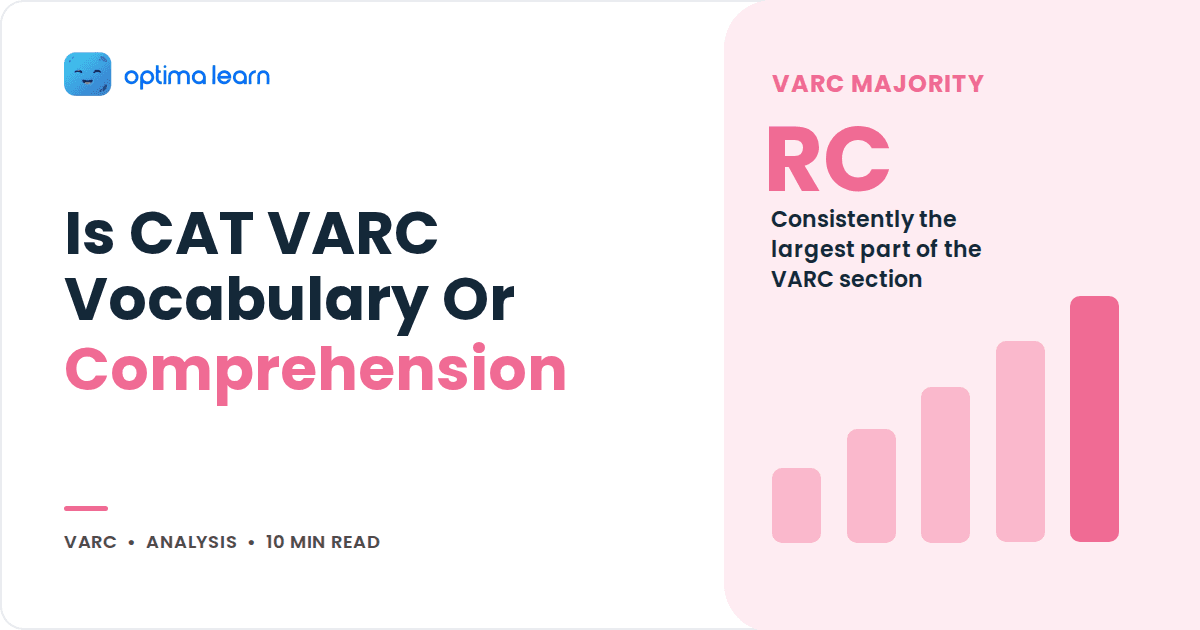
There is no published question-type weightage for CAT, so nobody has data of the kind the question implies. What has held up across papers is clear enough: reading comprehension consistently carries the majority of the section, which settles the practical question. The more useful answer is that vocabulary and comprehension are not two competing halves at all.
If RC carries the section, RC accuracy is the section score. Build it in timed sets of CAT reading comprehension practice.
- CAT publishes no type-wise weightage, so there is no data of the kind the question assumes.
- Reading comprehension has consistently carried the majority of VARC, with verbal ability the remainder.
- There is no standalone vocabulary question type in the modern section, so the framing is outdated.
- Vocabulary matters as an input to comprehension rather than as a thing tested directly.
- Word lists underperform because words met in isolation rarely surface under time pressure.
What the Section Actually Contains
The composition settles most of this before any argument is needed.
VARC splits into reading comprehension and verbal ability. RC covers main idea, inference, tone, author's purpose, specific detail, and strengthen or weaken questions, attached to passages. Verbal ability covers para summary, para jumbles and odd sentence out.
Notice what is not in that list. There is no synonym question, no antonym question, no fill in the blank, no standalone vocabulary item. The section does not contain a place where knowing a word is the thing being marked.
In the 2022 paper VARC ran 24 questions worth 72 marks with a 40 minute sectional limit, though recent papers have run roughly 66 to 68 questions overall and the composition has moved with them. What has not moved is RC carrying the majority.
Preparing for a section shape that no longer exists. The vocabulary-heavy framing comes from older verbal test formats where words were tested directly. Buying a word list for CAT is preparing for questions the paper does not ask.
Where Vocabulary Actually Matters
Dismissing vocabulary entirely would be wrong, and being precise about its role is what makes the advice usable.
- As reading speed. Every unfamiliar word costs a fraction of a second and a small break in flow, and those accumulate across four dense passages.
- In the options. Answer choices use precise language, and a shade of meaning between two options can decide which is supported.
- As tone. Judging whether an author is sceptical, approving or ambivalent depends on registering the connotation of the words they chose.
- Not as a question. At no point are you asked what a word means in isolation.
The Options Are Where It Bites
This is the underrated one. Passages are usually navigable even with a few unknown words, because context fills gaps. Options are short, precise and deliberately close to each other, and a candidate who does not register the difference between a word implying cause and one implying correlation is choosing between them on something other than meaning.
Tone Questions Depend on Connotation
Tone is among the harder question types and it rests on whether you noticed that the author called something a scheme rather than a plan. That is vocabulary in the sense of sensitivity to shade, which is exactly what a word list does not build.
Why Word Lists Underperform
Words learned in isolation, with a definition attached, rarely surface under time pressure, and they carry no sense of how the word is actually used. Words met repeatedly inside sentences do surface, because they arrive with context attached. That is the whole argument for reading over memorising.
| Question type | What it tests | Role of vocabulary |
|---|---|---|
| Main idea | Holding the author's central claim | Indirect, via reading speed |
| Inference | What the text supports without stating | In the options, precision matters |
| Tone | The author's stance | Direct, through connotation |
| Para jumbles | Logical sequence and reference | Minimal |
| Para summary | Identifying the central claim | In the options |
So What Is the Section Heavy In
Neither of the two options in the question, which is why the framing misleads.
The dominant competence is argument tracking: following a claim through its support to a conclusion, separating what an author asserts from what they report, and judging the scope of a statement precisely. Almost every wrong RC answer comes from a failure in one of those three rather than from a word.
The second competence is decision making under a penalty. A correct answer adds three marks, a wrong multiple choice answer deducts one, and a blank costs nothing, which means knowing when to leave a question is worth as much as understanding the passage.
So the honest answer to vocabulary against comprehension is that the section is heavy in judgment, and both of the offered categories are inputs to it rather than descriptions of it.
After reading a passage and before looking at the options, state the author's position in one sentence in your own words. If you can do that, your comprehension is adequate regardless of how many words you did not know, and the remaining errors are in option selection rather than in reading.
What This Changes About Preparation
Three adjustments follow, and the first is the one that frees the most time.
Stop working through word lists as a primary activity. The hours produce recognition of words in isolation, which is not the form the section requires, and they come out of the reading time that would build the same vocabulary with context attached.
Read prose that argues rather than prose that describes. Long form essays, serious criticism, social science and history that takes a position. That builds argument tracking and vocabulary simultaneously, which a word list cannot do.
Attach an audit to it. After anything you read seriously, write one sentence stating what the author was arguing and one naming what they would disagree with. Ordinary reading is never checked, and unchecked reading builds capacity without building the judgment the section grades.
Mentors reviewing VARC error logs almost never find a wrong answer caused by an unknown word. They find options that were reasonable but unsupported, and scope errors where a narrow claim was promoted into a general one. Candidates arrive convinced their vocabulary is the problem because it is the most visible thing they lack.
The Section Is Heavy in Judgment
Vocabulary and comprehension are inputs. Argument tracking and the leave decision are what is graded.
Work Through CAT VARC ChaptersThe Vocabulary Work That Is Worth Doing
Some of it does pay, and it looks different from a list.
Keep a short record of words you met in your reading and could not gloss from context. Not every unknown word, only the ones where context failed you, since those are the ones that actually cost you something. That list will be short and it will be relevant.
Pay attention to the language of options rather than of passages. Words that set scope, such as always, most, generally and in some cases, and words that signal a relationship, such as because, despite and although, do more work in option selection than any amount of general vocabulary.
And notice connotation deliberately when you read. Asking why the author chose this word rather than a neutral one is a tone question rehearsed in advance, and it takes seconds.
Reading Still Does Most of the Work
Vocabulary built by reading arrives with usage attached, which is why it surfaces under pressure when list vocabulary does not. Thirty focused minutes a day on argued prose does more for both halves than any memorisation schedule.
Where the Faster Gains Actually Are
If the exam is close, neither vocabulary nor comprehension moves fast enough to matter, and the available gains are in decisions: which passage to open first, whether to leave a question you cannot resolve to a single option, and whether the verbal ability block is getting real minutes. Our guide on the signals that decide your RC attempt order covers the first of those.
Why Candidates Reach for the Vocabulary Explanation
Given how rarely an unknown word actually causes a wrong answer, it is worth asking why so many aspirants are convinced it is their problem.
The reason is that vocabulary is the only deficit that is visible while you read. You notice a word you do not know, the noticing is uncomfortable, and it leaves a memory. Failing to track a scope qualifier leaves no memory at all, because nothing about it felt like a gap at the time. So the experience of reading a hard passage gets attributed to the one difficulty that announced itself.
It is also the most fixable-looking problem. A word list is finite, progress through it is measurable, and finishing one feels like an achievement. Argument tracking has no list, no completion point and no visible progress until accuracy moves, which makes it much less appealing as a project even though it is where the marks are.
The correction is to let the error log decide rather than the reading experience. Classify wrong answers by cause and see how many were genuinely caused by a word. For most candidates the answer is close to none, and that finding redirects a great deal of effort.
The Answer
Is CAT VARC vocabulary-heavy or comprehension-heavy? No published type-wise weightage exists, so there is no data in the sense the question assumes, and the framing itself belongs to an older test format.
What can be said is that reading comprehension consistently carries the majority of the section, and that no question in it asks what a word means in isolation. Vocabulary matters as an input, mostly in reading speed, in distinguishing between precisely worded options, and in judging tone.
The competence the section actually rewards is tracking an argument and deciding what the text supports, under a clock, with a penalty for being wrong. Both halves of the original question are inputs to that, and preparing for either one as though it were the test itself is how months of reading or memorising produce a score that has not moved.
- Have any of your wrong answers actually come from an unknown word?
- Do you read the scope words in every option deliberately?
- Is your reading argued prose, or mostly description?
- Can you state a passage's position before looking at the options?
If you have been building vocabulary and the score has not moved, the effort was probably aimed at the wrong component. A CAT preparation strategy review will classify where your errors actually come from, and a personalised CAT preparation plan can redirect the weekly reading block.
No Question Asks What a Word Means
That fact alone should reshape how a VARC month is spent.
Build My Weekly PlanFrequently Asked Questions About VARC Vocabulary
Is CAT VARC vocabulary-heavy or comprehension-heavy?
Neither framing fits. No published type-wise weightage exists, RC has consistently carried the majority of the section, and no question asks what a word means in isolation. Vocabulary enters as an input rather than as a tested item.
Should I work through word lists for CAT?
Not as a primary activity. Words learned in isolation rarely surface under time pressure and carry no sense of usage, while words met repeatedly in reading arrive with context attached and do surface.
Where does vocabulary matter then?
In reading speed, in distinguishing between precisely worded answer options, and in judging tone, which rests on connotation. The options are where it bites most, since they are short and deliberately close to each other.
What is the section actually testing?
Argument tracking and decision making. Following a claim through its support, separating assertion from report, judging scope precisely, and knowing when to leave a question given that a wrong multiple choice answer deducts a mark.
Practice VARC, chapter by chapter
CAT VARC practice across reading comprehension, para-summary and para-jumbles, each with a worked solution.
More from VARC
Continue reading
Why Word Problems Feel Harder in CAT Quant Than School

Why High Scorers Skip an Entire CAT RC Passage Fully

Why DILR Sets Take Longer to Understand Than Solve

Do Mocks in a Noisy Environment Help or Hurt CAT Prep?
Put it into practice