
IIM Visakhapatnam Admission 2026: Selection Rounds
Admission is usually described as one decision with a score attached. It is not. It is a sequence of separate filters, each removing a different group of people for a different reason, and a candidate who is strong against one filter can be removed by the next without anything going wrong.
Seeing the sequence as a sequence explains most of the outcomes that look arbitrary from outside: the high percentile with few calls, the call that did not convert, the offer that went to someone who scored lower. This piece uses IIM Visakhapatnam as the case and walks the stages in order.
Each stage rewards something different. The CAT target percentile tool settles the one stage you control entirely.
- Admission is a sequence of filters, not one scored decision.
- Eligibility, qualifying minimum, shortlist, assessment and final merit are five distinct stages.
- Each stage removes people for a different reason.
- Your exam score matters most early and progressively less later.
- The weights are published per cycle, so read them per school.
The Five Stages, In Order
Naming them separately is most of the work, because the confusion comes from collapsing them into one.
| Stage | What it does | Who it removes |
|---|---|---|
| Eligibility | Checks degree and minimum marks | Anyone outside the stated requirement |
| Qualifying minimum | Sets a floor on the entrance score | Applications below the published floor |
| Shortlist | Ranks applicants by the school's formula | Everyone below where calls stopped |
| Assessment | Runs WAT, GD or PI as the school chooses | Nobody directly, it produces scores |
| Final merit | Combines inputs into one ranked list | Everyone below the intake |
Read that way, several familiar puzzles dissolve. A candidate who cleared every published minimum and got few calls was removed at stage three by a ranking, not at stage two by a threshold. A candidate who had calls and no offers was assessed at stage four and ranked at stage five.
Treating the qualifying minimum as the stage that decides calls. It is a floor for consideration, and the ranking that follows is a separate operation on everyone who cleared it. Conflating the two produces most of the surprise in December.
Stage One Is Not About Competition
Worth a minute because it is the only stage with no ranking in it at all.
Eligibility for CAT is a bachelor's degree with 50 percent, or 45 percent for SC, ST and PwD candidates, with no age limit. Individual institutes state their own requirements alongside that, and final-year students are generally accommodated with conditions on completion.
Nobody is competing here. You either meet the stated requirement or you do not, and the only failure mode is an administrative one: a document that does not arrive, a percentage computed differently from how the institute computes it, a deadline missed. Those losses are entirely preventable and they still happen every year.
Stage Two Is a Floor, Not a Target
The distinction the whole cycle turns on, and it is a matter of one word in the source document.
A qualifying minimum is published in advance and often stated sectionally as well as overall. IIM Calcutta, for instance, stated qualifying CAT 2025 minimums of 80 sectional and 85 overall. Clearing it means your application enters the ranking; it does not mean you are near a call.
So a published minimum is useful for exactly one decision, which is whether to apply. Using it to predict a call is using a floor as a forecast, and the two numbers can sit far apart.
The sectional part of a qualifying minimum quietly does a lot of damage. A strong overall percentile carried by two sections can miss a sectional floor and be removed at stage two entirely, which is why a weak section is an application risk and not only a score risk.
Stage Three Is Where Profile Enters
This is the stage most candidates never actually read about, and it is the one that produces the outcome they find hardest to explain.
The shortlist is built by applying the institute's own formula to everyone above the floor. That formula can include the entrance score, academic marks across school and graduation, work experience, gender diversity and academic diversity, weighted however the school chooses and published per cycle.
Which is why the same percentile produces different results for different people. Two candidates with identical scores and different academic records are different applications at this stage, and neither of them did anything wrong.
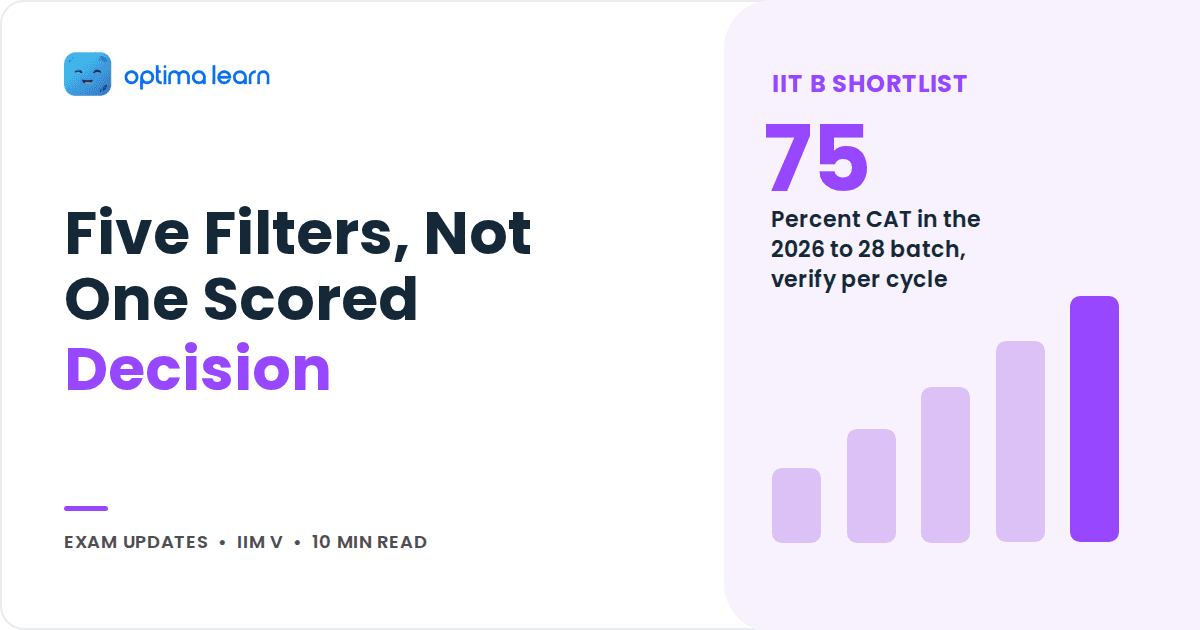
Two published examples, both to be re-verified per cycle and neither applying to IIM Visakhapatnam: IIFT's 2026 to 2028 shortlist weighted the entrance score at 90 percent, work experience at 5 and gender diversity at 5. IIT Bombay's SJMSOM used 75 percent entrance score, 20 percent academics and 5 percent work experience for the same batch. The gap between those two formulas is the entire reason a generic strategy does not exist.
Reading a Weighting Is a Twenty Minute Job
And it is the highest value reading available in the whole application period.
Open the institute's admission policy for your cycle, go to the shortlisting section rather than the eligibility pages, and answer four questions: which inputs are listed, whether percentage weights are attached, whether any stated number is called minimum or qualifying or required, and which stages follow.
Those answers tell you where your own marginal effort is worth anything. A candidate whose academic record is fixed and whose shortlist formula is 90 percent exam score now knows exactly what to do, which is to stop worrying about the record.
Do this reading before you submit the form, not after results. Some inputs are things you report rather than things you have, and a work experience figure computed the way the institute computes it can differ from the one you assumed.
Stages Four and Five Rebalance Everything
The exam score dominates early and thins out later, and that shift is the design rather than a side effect.
Stage four is the assessment round, which can include written ability, group discussion, personal interview or some combination, chosen and weighted by the institute. It produces a new set of scores about qualities the entrance exam cannot observe.
Stage five combines everything into one ranked list under the school's published final weighting, which is a separate published object from the shortlist weighting and frequently has a different shape. Offers go down that list until the intake is filled, which is why a call is not an outcome and why candidates ahead at stage three can finish behind.
What the Sequence Changes About Planning
Three practical consequences, and they are not obvious until the stages are separated.
- Apply everywhere you would accept and clear the published minimum for, rather than filtering your list on rumoured call levels, since the published floor is the only threshold that actually gates consideration.
- Treat a weak section as an application risk and not only a score risk, because a sectional floor removes you before any ranking happens.
- Treat the weeks after a call as the most valuable preparation window in the cycle, because it is the last stage where effort still moves a decision that is open.
Diagnosing Which Stage Removed You
Useful whether you are reattempting or just want the year to have taught you something.
If you did not meet a stated requirement or a document did not arrive, stage one removed you, and that is administrative rather than competitive. If you missed a published sectional or overall minimum, stage two did, and the fix is a specific section rather than a general improvement. If you cleared every published minimum on a list and received few calls, stage three did, which means the formulas ranked you below where calls stopped and the lever is either the score or the school list rather than anything else.
If calls came and offers did not, stage four or five did, and that is the assessment round or the final weighting rather than your exam performance. Candidates in that position frequently conclude they need a higher percentile next year, which may be true but is not what the evidence shows.
The diagnosis matters because the four causes have four different responses, and the default assumption that a disappointing cycle means the score was too low is right roughly a quarter of the time.
Why This Piece Gives You No Visakhapatnam Figures
Because the numbers are published per cycle by the institute and revised between years, so a figure lifted from an earlier cycle and stated as current is wrong with a decimal point attached.
The institute's own admission policy for your cycle is the binding document, and it is short. Read it per school too, since CAT is accepted by all 22 IIMs, IIM Guwahati being the newest, and by more than a thousand other institutions, and that shared entrance is the only thing they share. Everything downstream of it is set independently.
Your School List Is a Stage Three Decision
Barely discussed, and it acts on exactly the stage most people find opaque.
Since each school ranks applicants by its own formula, the composition of your list decides which formulas you are ranked by. A candidate with a strong academic record and a moderate exam score is ranked differently at a school weighting academics at 20 percent than at one weighting the exam at 90, and that difference is available to read before applying rather than discoverable afterwards.
Which means building the list by reputation alone leaves information on the table. Reading four or five shortlist weightings and noticing which ones favour the shape of your own application is a genuine advantage, and it costs an evening.
None of which argues for applying only where you fit best. It argues for knowing, when a list is otherwise a matter of preference, that some entries on it read your application more favourably than others.
The Summary
Admission is five stages, not one decision. Eligibility checks a requirement with no competition in it. A qualifying minimum is a floor that admits you to the ranking. The shortlist applies the school's own formula, which is where profile factors enter and where identical percentiles stop producing identical results.
The assessment round then measures what the exam cannot, and the final merit list combines everything under a published weighting that is a different object from the shortlist weighting. Your exam score matters most early and progressively less later.
So read the shortlisting section of each school's policy for your cycle, apply everywhere you clear the published minimum for, treat a weak section as an application risk, and put real work into the stage after the call. That is the whole sequence, and knowing which stage removed you is the difference between learning something and guessing.
- Can you name which of the five stages you are currently preparing for?
- Do you know the sectional minimums for every school on your list?
- Have you read a published shortlist weighting this cycle?
- Do you know whether your target schools run WAT, GD, PI or a combination?
Stage two and three are decided by work you do now, months before any of the rest applies. A personalised CAT preparation plan keeps that work sequenced, and a CAT preparation strategy review will tell you whether a weak section is quietly becoming an application problem.
Know Which Filter You Are Facing
Five stages, five different reasons to be removed. Preparing for the wrong one is the common error.
Build My Weekly PlanFrequently Asked Questions About Selection Rounds
What is the IIM Visakhapatnam selection process?
Each institute publishes its selection criteria per admission cycle, including which stages it runs and how the final merit list is weighted. Read the current policy at source, since these details are revised between years.
Why did I clear the cutoff and still not get a call?
A published minimum is a floor that admits your application to a ranking. The ranking is a separate stage applied to everyone above the floor, and calls stop wherever the institute has enough candidates.
Do sectional minimums really matter?
Yes, and they remove people quietly. A strong overall percentile carried by two sections can miss a sectional floor and be filtered out before any ranking happens, which makes a weak section an application risk as well as a score risk.
Does my CAT score still matter after the shortlist?
Usually yes, but less. Most schools publish a final weighting that combines the entrance score with assessment round performance and other inputs, and that weighting is a separate published object from the shortlist weighting.
Track CAT 2026: never miss a date
Slot booking, admit cards, results, and IIM cutoffs, one timeline.
More from Exam Updates
Continue reading

Why CAT RC Answer Options Often Feel Equally Correct

How To Study For CAT When You Are Mentally Exhausted

How To Stop Procrastinating On Your Weakest Section

How To Recover From A Wrong Start On A DILR Set Explained
Put it into practice