
IIM Rohtak Admissions: One Exam, Twenty Two Policies
There is a habit that costs candidates schools every cycle, and it is not laziness. It is treating the IIM system as one institution with a shared admission policy, so that having read one IIM's criteria feels like having read them all.
They are not one policy. Each IIM publishes its own criteria for its own cycle, weights academics and work experience and profile factors on its own terms, and runs its own selection stages. That is the mechanical reason two candidates with identical percentiles receive different call lists, and it is why the school-by-school reading is the work rather than an optional extra. This piece covers what that means in practice, using IIM Rohtak as the case, and is explicit about what has to be verified at source.
One exam opens all of them, which makes the list work cheap. The CAT target percentile tool sets the number to build it around.
- The 22 IIMs share an entrance exam, not an admission policy.
- Each publishes its own criteria per cycle, which is why identical percentiles get different calls.
- A published minimum is a floor for consideration, never the score that earns a call.
- Widening your list inside the CAT route costs an application, not another exam.
- Read formulas rather than collecting cutoffs, because formulas tell you where effort pays.
One Exam, Many Policies
Start with the structure, because everything else follows from it.
CAT scores are accepted by all 22 IIMs, IIM Guwahati being the newest, and by more than a thousand other business schools. That shared entrance is what makes the system feel unified, and it is the only thing that is unified.
Beyond the exam, each institute decides for itself. Which profile factors it reads, how it weights them, what minimums it sets, which selection stages it runs. Those decisions are published per cycle by the institute, they are revised between years, and they differ enough that the same application lands very differently across the system.
Reading one IIM's criteria and assuming the rest are similar. The shared exam creates an impression of a shared process that does not exist, and a candidate who reads one policy has read one policy.
Why Identical Percentiles Produce Different Calls
Nothing mysterious is happening and the mechanism is worth stating plainly.
Each school constructs its shortlist from its own formula, so the same inputs weighted differently produce different rankings and therefore different shortlists. A candidate with a strong exam score and an ordinary academic record is positioned very differently at a school that weights the exam heavily than at one that weights academics substantially.
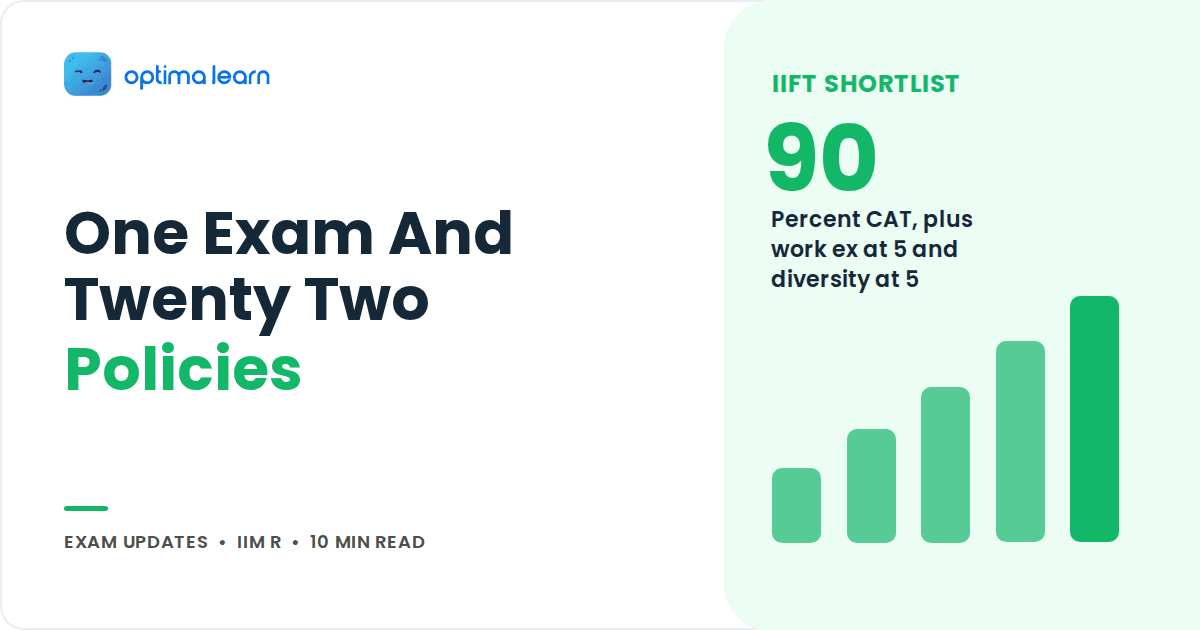
Three published examples show what a stated formula looks like. IIFT's 2026 to 2028 shortlist weighted the entrance score at 90 percent, work experience at 5 and gender diversity at 5, which is a process dominated almost entirely by the exam. IIT Bombay's SJMSOM used 75 percent entrance score, 20 percent academics and 5 percent work experience for the same batch. IIM Calcutta stated qualifying CAT 2025 minimums of 80 sectional and 85 overall, and the word qualifying is doing real work there. All three need re-verifying per cycle and none of them applies to IIM Rohtak.
A qualifying cutoff and a call cutoff are different objects, and conflating them causes more misplaced confidence in December than anything else. The published minimum is the floor to be considered. Where calls actually stop depends on who applied that year, and no institute publishes it in advance because it does not exist in advance.
Six Notes Per School
- The institute's own criteria for your cycle. Read at source, not inferred from another IIM.
- Any published qualifying minimum. Recorded as a floor, and labelled as such in your notes.
- Any published weighting. How the decision is constructed, which is the genuinely actionable part.
- Which profile factors it reads. No school reads all of them, and the set differs.
- The application window. Published independently of the result date.
- The selection stages. Interview alone, or with a written component or group stage.
Widening Inside the CAT Route Costs Almost Nothing
This is the practical payoff of the shared exam and candidates underuse it badly.
Each additional IIM is an application form and a set of criteria to read. It is not another registration window, another fee for an exam, or another paper whose marking rules you have to learn. Compared with adding a second entrance exam, it is close to free.
Yet candidates routinely under-apply within the CAT system while agonising over whether to add another exam elsewhere, which is close to backwards. The cheapest place to widen a list is inside the exam you are already sitting.
Before considering an additional entrance exam, check you have applied to every school on your current route that you would actually accept. Most candidates find two or three they had simply not got round to.
What the Decision Actually Reads
A profile is not percentile plus marks. Depending on the institute it can include tenth, twelfth and graduation marks, consistency across the three, sectional scores, work experience, gender diversity, academic diversity, category, professional qualifications, extracurriculars, achievements, positions of responsibility, certifications, internships and gap years, plus performance at the selection stage itself.
No school uses all of them and the weightings differ sharply. Two terms are worth defining because they get misread. Academic diversity means extra consideration for backgrounds underrepresented in MBA cohorts, covering humanities, commerce, medicine, law and other non-engineering routes. Work experience generally means full time work after graduation, though what counts varies by institute in months, type of organisation, role and relevance.
| School | Exam | What the published record shows |
|---|---|---|
| IIM Rohtak | CAT | Read the institute's own policy for your cycle |
| IIFT | CAT | 2026 to 2028: exam 90, work ex 5, gender diversity 5 |
| IIT Bombay SJMSOM | CAT | 2026 to 2028: exam 75, academics 20, work ex 5 |
| IIM Calcutta | CAT | Qualifying CAT 2025 minimums: 80 sectional, 85 overall |
| XLRI Jamshedpur | XAT | Components stated, no published percentage split |
Why This Piece Gives You No Rohtak Figures
You will find pages listing an IIM Rohtak cutoff confidently. Treat them carefully, and treat this piece the same way, because we are deliberately not supplying figures.
Cutoffs and weightings are published per admission cycle by each institute and revised between years. A number carried over from a previous batch and presented as current is misinformation with a decimal point attached, and it is worse than no number because it supports confident planning around something untrue.
The institute's own admission policy for your cycle is the document that binds, and reading it properly takes one evening. The six notes above are what to take to it.
The Question Underneath This One
Candidates asking about a particular IIM are frequently asking something else: whether the newer institutes in the system are worth applying to.
That is a judgement rather than a fact, and it should be made on things you can check rather than on reputation rankings of uncertain provenance. Read the programme structure, the published placement information the institute itself puts out, the faculty, the location and what the two years would actually involve. Those are institutional facts available to you.
What should not decide it is a hierarchy absorbed from discussion forums. The system has expanded considerably and a list built on an inherited ranking of which IIMs count is working from a picture that may be several years out of date.
How to Read a Policy in Twenty Minutes
Since the argument is that you should read many of these, it is worth saying how to read one quickly, because candidates either skip the documents or lose an evening in each.
Go straight to the shortlisting section and ignore everything before it. The opening pages of an admission policy are usually eligibility and process description, which is largely common across the system and not where the school differentiates itself. What you want is the part specifying how the shortlist is built.
There, answer four questions and write the answers down. Which inputs are listed. Whether any percentage weights are attached to them. Whether the numbers given are described as minimum, qualifying, or required, since those words are doing different work. And what stages follow the shortlist.
Four answers per school, twenty minutes each. A list of ten schools is therefore an afternoon rather than a project, and at the end of it you have something no forum thread can give you: a comparison built from primary documents for the cycle you are actually applying in.
The Stage That Actually Decides It
The full process runs CAT, then application, then shortlisting, then the selection stage, then final selection, then admission, and every school modifies the middle.
Two consequences follow. A call is not an admission, and the selection stage genuinely reorders the field. And that stage is almost always the least prepared for, because it arrives after the exam is over and the energy has gone. Shortlists arrive across January to March with rounds through that window, and final offers and waitlist movement run to roughly March to May. Our guide on building a realistic preparation plan covers fitting that work into the cycle.
The Summary
The 22 IIMs share an entrance exam and not an admission policy. Each publishes its own criteria per cycle, weights profile factors on its own terms, and runs its own stages, which is the mechanical reason identical percentiles produce different call lists.
That makes the school-by-school reading the actual work. Take six notes per institute: its own criteria for your cycle, any qualifying minimum labelled as a floor, any published weighting, which profile factors it reads, the application window, and the selection stages.
Use the shared exam properly by widening the list inside it, since each additional IIM costs an application rather than another registration window and fee. Read formulas instead of collecting cutoffs. And remember that a call is the start of the selection stage rather than the end of the process, which is the part almost nobody prepares for until January.
- Have you read more than one IIM's criteria directly, for this cycle?
- Have you applied to every school on the CAT route you would genuinely accept?
- Is any figure in your notes labelled as a qualifying minimum or a past outcome?
- Have you started preparing for the stage that follows a call?
If your list was built on a ranking you absorbed rather than on criteria you read, that is the cheapest gap to close this month. A CAT preparation strategy review can pressure test the list, and a personalised CAT preparation plan keeps the exam work moving while you do the reading.
One Exam, Twenty Two Policies
Having read one IIM's criteria means you have read one IIM's criteria.
Build My Weekly PlanFrequently Asked Questions About IIM Rohtak Admissions
What is the IIM Rohtak cutoff?
Cutoffs are published per admission cycle by the institute and revised between years, so second hand figures are unreliable. Read the current policy at source and treat any published minimum as a qualifying floor rather than a call-earning score.
Do all IIMs use the same admission criteria?
No. They share CAT as the entrance exam and nothing else. Each publishes its own criteria per cycle, weights profile factors on its own terms and runs its own selection stages, which is why the same percentile produces different call lists.
How many IIMs should I apply to?
Every one you would genuinely accept. Each additional application inside the CAT route costs a form and some reading rather than another registration window and fee, so it is the cheapest possible way to widen a list.
Are the newer IIMs worth applying to?
Judge on things you can check: programme structure, the institute's own published placement information, faculty, location and what the two years involve. A list built on an inherited ranking may be working from a picture several years out of date.
Track CAT 2026: never miss a date
Slot booking, admit cards, results, and IIM cutoffs, one timeline.
More from Exam Updates
Continue reading
XIMB Admissions and the Deadline That Actually Binds

Are CAT VARC Passages Deliberately Written to Confuse?

What High Scorers Actually Do in Their Final CAT Week
When You Cannot Understand a CAT RC Passage Opening
Put it into practice