
IIM Bodh Gaya Admission 2026: Reading The Cutoffs Guide
A candidate reads that a school's cutoff is a certain figure and plans around it. In December they clear it comfortably and receive no call. Nothing unfair happened, and the mistake was made months earlier when a number was recorded without anyone asking what kind of number it was.
The word cutoff covers several different objects, only one of which is published in advance, and the differences decide whether a figure is something to plan against or something to ignore. This piece takes IIM Bodh Gaya as the case and sets out how to read any published figure correctly, and what to write next to it in your own notes.
Plan against a target you derived, not a figure you found. The CAT target percentile tool sets that number.
- A qualifying minimum, a call level and a past closing figure are three different things.
- Only the qualifying minimum is published in advance, and it is a floor for consideration.
- A call level cannot be published early because it depends on who applies that year.
- Percentile and raw score are different quantities with no fixed mapping.
- Label every figure you record, or it becomes a rumour in your own notes.
Three Different Numbers, One Word
Separating these is most of the work, and once separated the confusion cannot recur.
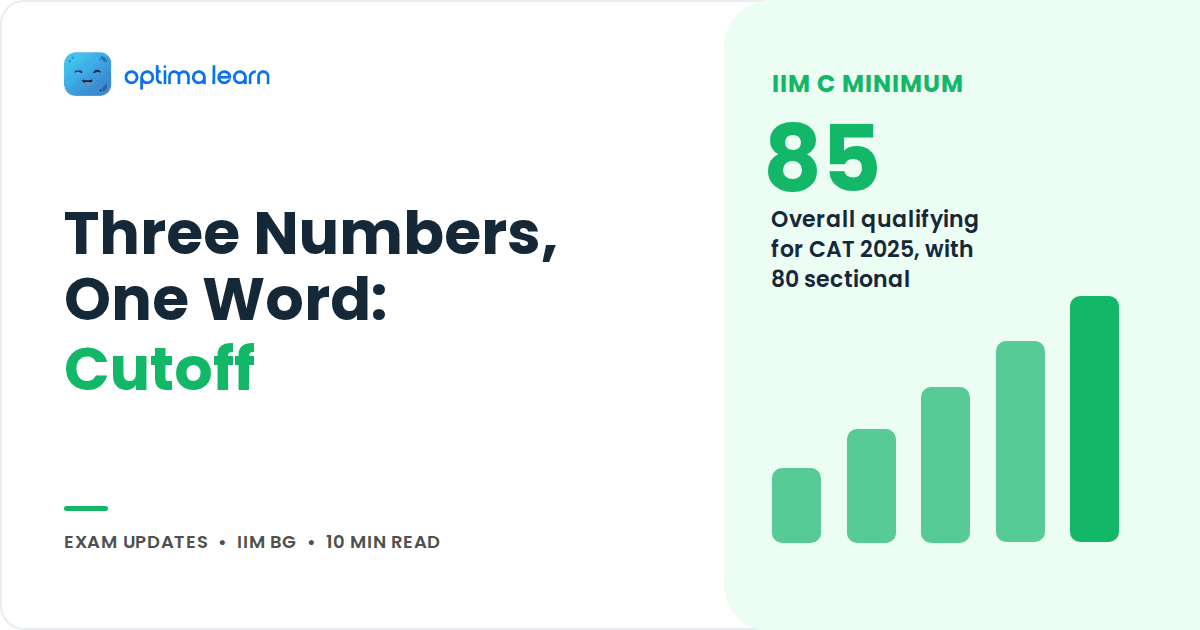
The qualifying minimum is published in advance by the institute, often sectional and overall. Meeting it means your application will be considered, and it says nothing about whether it will succeed. IIM Calcutta, for example, stated qualifying CAT 2025 minimums of 80 sectional and 85 overall, and the word qualifying there is doing real work.
The call level is where calls actually went out. It is an outcome rather than a policy, and it is not published in advance because it does not exist in advance.
The past closing figure is a historical observation, sometimes reported, frequently misremembered, and never a commitment about this year.
Reading a qualifying minimum as a call threshold. It is the single most common source of misplaced confidence in December, and it produces candidates who cleared every published minimum on their list and received few calls with no idea why.
Why the Number You Want Cannot Exist Yet
Worth understanding rather than just accepting, because it removes the search.
A call level emerges from a process. The institute receives applications, ranks them by its own formula, and issues calls down that ranking until it has the number it wants. Where that stops depends on how many people applied, what their profiles looked like, and how the exam went that year.
None of those is known before the cycle runs, so the figure does not exist to be published. A school cannot tell you in October where its calls will stop in January.
That is also why quoting a cutoff as a fixed property of a school is misleading. It describes one year's outcome and presents it as a rule.
The question of what percentile you need feels like it should have an answer, and the absence of one is not evasion. Raw score comes from your responses, percentile is your position relative to the field, and where calls stop depends on that year's applicants. Three variable quantities, none settled in advance.
Score and Percentile Are Different Quantities
A second confusion compounds the first and appears constantly in discussion.
Your raw score comes from your correct and incorrect answers under the marking scheme: plus three for correct, minus one for an incorrect MCQ, zero for unattempted, and no negative marking on Type In The Answer questions. Your percentile is your position relative to everyone who sat the exam, and it shifts with paper difficulty and normalisation across the three slots.
There is no fixed mapping between them, so any statement that a certain number of marks equals a certain percentile presents a variable relationship as a constant. Any cutoff discussion sliding between marks and percentile without noticing is unreliable before you even check the figure.
Read the Formula, Not the Threshold
The genuinely useful document is the institute's published criteria, and specifically any stated weighting.
| Kind of figure | Published in advance | What it means |
|---|---|---|
| Qualifying minimum | Yes, by the institute | A floor to be considered, nothing more |
| Call level | No, it cannot be | Where calls stopped, known afterwards |
| Past closing figure | Sometimes reported | A historical observation, not a commitment |
| Published weighting | Yes, by some schools | How the decision is constructed |
| Forum percentile talk | No | Frequently mixes marks and percentile |
A weighting tells you where marginal effort pays and whether your profile fits how that school reads candidates, which is actionable in a way a threshold never is. IIFT's 2026 to 2028 shortlist weighted the entrance score at 90 percent, work experience at 5 and gender diversity at 5, describing a process almost entirely decided by the exam. IIT Bombay's SJMSOM used 75 percent entrance score, 20 percent academics and 5 percent work experience for the same batch, where an academic record carries real weight. Both need re-verifying per cycle and neither applies to IIM Bodh Gaya.
Label Every Figure You Record
This is the habit that prevents the whole problem, and it costs a few words.
Next to every number in your notes, write which kind it is: a qualifying minimum, a published weighting, or a reported past outcome. Add the cycle it refers to and where you got it.
Three months later you will not remember, and an unlabelled figure in your own file behaves exactly like something you read on a forum. Candidates who skip this end up planning against numbers whose provenance they cannot reconstruct.
When a source does not say which kind of figure it is quoting, treat that as a reason to distrust the figure rather than a detail to fill in yourself. Reliable sources are explicit about it, because the distinction is the first thing anyone writing carefully would clarify.
Why This Piece Gives You No Bodh Gaya Figures
Consistent with all of that, we are not supplying numbers, and the reason is the argument rather than an omission.
Cutoffs and weightings are published per admission cycle by each institute and revised between years. A figure carried over and presented as current is misinformation with a decimal point attached, and repeating one here would undercut everything above it.
The institute's own admission policy for your cycle is the document that binds. Go straight to the shortlisting section, ignore the eligibility pages before it, and answer four questions:
- Which inputs are actually listed as counting toward the shortlist.
- Whether percentage weights are attached to those inputs or only named.
- Whether any stated number is described as minimum, qualifying or required.
- What stages follow the shortlist, and whether they carry their own weight.
The IIMs Share an Exam, Not a Policy
Worth restating in this context, because it explains why this reading is per school.
CAT scores are accepted by all 22 IIMs, IIM Guwahati being the newest, and by more than a thousand other institutions. That shared entrance is the only thing shared. Each institute publishes its own criteria per cycle and weights profile factors on its own terms.
So a figure from one IIM tells you nothing about another, and reading one policy means you have read one policy. That is four answers per school and twenty minutes each, which makes a list of ten an afternoon rather than a project.
What to Do When You Have a Result
The practical version, since the abstraction becomes concrete quickly.
Apply everywhere you would accept and clear the published minimum for, rather than filtering the list by forum estimates of where calls will land. The published minimum is the only threshold that genuinely gates consideration, and self-rejecting above it on a rumoured figure removes schools nobody actually removed you from.
Then accept that part of it is not knowable. Where calls stop is decided by a field you cannot see, so the honest posture is to apply widely within what you would accept and put your energy into the stage you can control, which is the one after a call.
How a Figure Drifts Between Sources
Worth tracing once, because the path is always the same and recognising it saves you checking.
An institute publishes a qualifying minimum in its admission policy. An aggregator page summarises it and drops the word qualifying. A forum thread quotes the aggregator and adds an estimate of where calls went. A comment converts that estimate into marks. By the fourth step the figure is a raw score attached to a school that never published one, and every step looked reasonable to the person taking it.
Nothing malicious happened, and no single step was a large error. The distortion comes from compression: each retelling drops a qualifier because qualifiers read as hedging, and after three retellings the hedge that carried the meaning is gone.
The defence is simply to end the chain early. If a figure matters enough to plan against, open the institute's own policy document for your cycle and read the sentence it sits in. That sentence contains the word that tells you what kind of figure it is, and every version downstream has lost it.
The Summary
The word cutoff covers three different objects. A qualifying minimum is published in advance and means your application will be considered. A call level is where calls actually stopped and cannot be known before the cycle runs. A past closing figure is an observation that was never a promise.
Compounding that, raw score and percentile are different quantities with no fixed mapping, so any discussion sliding between them is unreliable before you check the number.
Read published weightings instead, because they tell you how a school builds its decision. Label every figure in your notes with its kind, its cycle and its source. Read each institute's own policy, since the IIMs share an exam and nothing else. And in December, apply everywhere you would accept and clear the published minimum for, rather than filtering on figures nobody can actually know yet.
- For every figure in your notes, do you know which of the three kinds it is?
- Are you comparing percentiles with percentiles rather than sliding into marks?
- Have you found a published weighting for any school on your list?
- Have you read the shortlisting section for more than one IIM this cycle?
If your list is built on figures you cannot classify, that is an evening to fix before December arrives. A CAT preparation strategy review will pressure test the list, and a personalised CAT preparation plan keeps the exam work moving while you do the reading.
Label the Number or Lose Its Meaning
An unlabelled figure in your own notes behaves exactly like a rumour three months later.
Build My Weekly PlanFrequently Asked Questions About Reading Cutoffs
What is the IIM Bodh Gaya cutoff?
Cutoffs are published per admission cycle by the institute and revised between years, so second hand figures are unreliable. Read the current policy at source, and note that a published minimum is a qualifying floor rather than the level at which calls are issued.
What is the difference between a qualifying cutoff and a call cutoff?
A qualifying minimum is published in advance and means your application will be considered. A call level is where calls actually stopped in a given year, which depends on who applied and cannot be known before the cycle runs.
Can I convert marks into a percentile?
No. Raw score comes from your responses under the marking scheme, while percentile is your position relative to everyone who sat the exam and shifts with paper difficulty and normalisation across slots. There is no fixed mapping.
Should I skip applying if I think my score is below the usual level?
No. The published minimum is the only threshold that genuinely gates consideration, so self-rejecting above it on a rumoured figure removes schools that nobody actually removed you from.
Track CAT 2026: never miss a date
Slot booking, admit cards, results, and IIM cutoffs, one timeline.
More from Exam Updates
Continue reading

Why CAT RC Answer Options Often Feel Equally Correct

How To Study For CAT When You Are Mentally Exhausted

How To Stop Procrastinating On Your Weakest Section

How To Recover From A Wrong Start On A DILR Set Explained
Put it into practice