
Great Lakes Chennai Admissions: Accepted Is Not Equal
Great Lakes Chennai sits in a category that causes avoidable losses every cycle: a school that accepts more than one entrance exam. That sounds like good news, and it quietly creates a research problem, because a school with several accepted routes usually has different criteria attached to each one.
Candidates handle this by assuming their own exam is covered and moving on, which is how a school ends up on a list without anyone having read its actual policy. This piece covers what multi-exam acceptance really means for your application, the framework for reading any school's criteria properly, and an explicit statement of what has to be verified at source rather than taken from any summary including this one.
List research starts with which exam opens which door. The CAT target percentile tool handles the CAT side of that list.
- A school accepting several exams usually applies different criteria to each route.
- Accepted does not mean equivalent, and that assumption costs applications.
- Cutoffs and weightings are published per cycle and must be read from the institute.
- A published minimum is a floor for consideration, never the score that earns a call.
- Application windows are published independently of any result date.
Multi-Exam Acceptance Is Not the Simplification It Looks Like
Start here, because it is the fact that makes this school worth a separate piece rather than a line on a list.
When a school accepts several entrance exams, a candidate hears one thing: my exam qualifies, so I can apply. What they usually do not check is whether the routes are treated identically, and frequently they are not. Different accepted exams can carry different qualifying levels, different seat allocations, or different handling inside the shortlisting process.
Accepted and equivalent are separate claims. Treating them as the same is the specific error this situation produces, and the correction costs one evening reading the institute's own material for your cycle.
Assuming that because a school accepts your exam, your score means the same thing there as another exam's score would. Two exams have different scales, different difficulty and different candidate pools, so a school has to make a decision about how to treat each one. That decision is published, and it is the thing to read.
Six Notes Per School
This framework applies to every school on your list, whichever exam they take, and it is what to carry into the institute's own material.
- Which entrance exams are accepted. All of them, not just yours, because the comparison tells you how your route is positioned.
- Whether the routes are treated identically. The question almost nobody asks, and the one that multi-exam schools make necessary.
- The application window. Published independently of any result date, and several across the cycle fall before results are out.
- The shortlisting inputs and any published weighting. How the decision is constructed, which matters more than any threshold.
- Whether a stated figure is a qualifying minimum. A floor for consideration is not a call-earning score.
- The selection stages. Interview, written component, group stage, or some combination, since these differ by institute.
A Published Weighting Beats Any Cutoff
Candidates collect cutoffs because they are concrete. A weighting is more useful and is collected far less often.
A cutoff tells you one number from one cycle, frequently a qualifying minimum being read as a call threshold. A published weighting tells you how the decision is constructed, which lets you work out where marginal effort actually pays and whether your profile fits the way that school reads candidates.
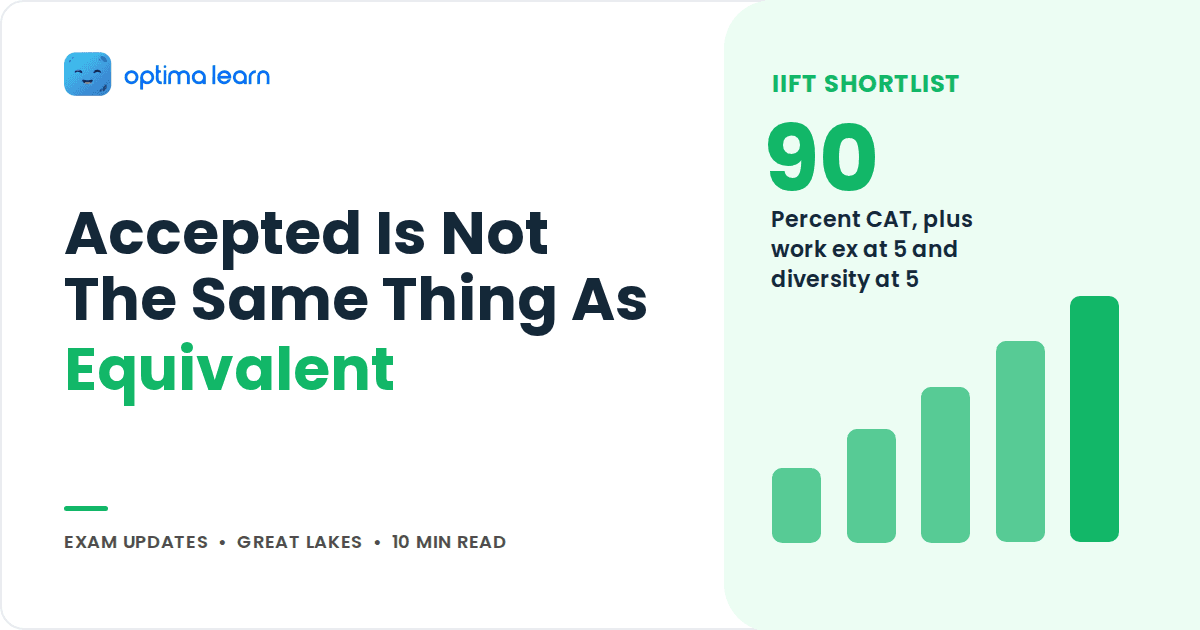
Three real examples show what a stated formula looks like. IIFT's 2026 to 2028 shortlist weighted the entrance score at 90 percent, work experience at 5 and gender diversity at 5, which is a process dominated almost entirely by the exam. IIT Bombay's SJMSOM used 75 percent entrance score, 20 percent academics and 5 percent work experience for the same batch, where an academic record carries real weight. IIM Calcutta stated qualifying CAT 2025 minimums of 80 sectional and 85 overall, and the word qualifying is doing genuine work there. All three need re-verifying per cycle, and all three are quoted as illustrations rather than as anything applying to Great Lakes.
A qualifying cutoff and a call cutoff are different objects, and conflating them produces more misplaced confidence than anything else in this process. The published minimum is the floor to be considered. The score that earns a call is set by who applied that year, and it is not published in advance because it does not exist in advance.
Why This Piece Deliberately Gives You No Numbers
You will find pages confidently listing a Great Lakes cutoff. Treat them carefully, and treat this piece the same way, because we are not giving you figures and the reason matters.
Cutoffs, weightings and stage details are published per admission cycle by each institute and are revised between years. A figure carried over from a previous batch and presented as current is misinformation with a decimal point attached, and it is worse than no figure because it produces confident planning around a number that is not true.
What we can give you honestly is the structure of the decision and the questions to take to the source. The institute's own admission policy for your cycle is the document that binds, and reading it properly takes one evening.
| School | Route | What the published record shows |
|---|---|---|
| Great Lakes Chennai | Accepts more than one entrance exam | Read the institute's own policy for your cycle |
| IIFT | CAT | 2026 to 2028: exam 90, work ex 5, gender diversity 5 |
| IIT Bombay SJMSOM | CAT | 2026 to 2028: exam 75, academics 20, work ex 5 |
| IIM Calcutta | CAT | Qualifying CAT 2025 minimums: 80 sectional, 85 overall |
| XLRI Jamshedpur | XAT | Components stated, no published percentage split |
Deciding Whether a Second Exam Is Worth It
For a school accepting several exams, a specific question arises: if your exam qualifies, is there any reason to sit another one.
Usually not for this school alone, and the honest test is a single question applied across your whole list. If a school made you an offer, would you take it? Where the answer is yes and the school is only reachable through an exam you have not registered for, that exam earns its place in your calendar. Where the answer is that you would probably decline, you are buying an option you will not exercise.
Candidates get into trouble by answering that question with reputation rather than intention, collecting three or four routes and preparing properly for none. Each additional exam costs a registration fee, a date, and a set of structural differences that need real study sessions rather than assumed absorption.
What Transfers and What Does Not
Most of the substance transfers. Arithmetic is arithmetic, reading comprehension is reading comprehension, and reasoning practice sharpens reasoning generally.
What does not transfer is the structure: question counts, sections, time limits and marking rules, and therefore the entire attempt strategy. CAT applies plus three for a correct answer, minus one for an incorrect MCQ, zero for unattempted, and no negative marking on Type In The Answer questions, with hard 40 minute sectional limits across three sections. Another exam may differ on every one of those, and attempt behaviour tuned to one marking scheme is actively wrong under another.
How Many Routes Is Too Many
There is a number at which adding exams stops helping, and it arrives earlier than most candidates expect.
Each additional exam takes preparation attention that is not free. The overlapping content transfers, but the structural differences do not, and absorbing those properly takes scheduled sessions rather than a skim of the pattern the week before. A candidate carrying four routes is dividing a fixed amount of preparation time across four sets of structural rules, and usually arrives at all four slightly underprepared rather than at one well prepared.
The practical ceiling for most candidates is CAT plus at most one more, chosen because it opens schools they would genuinely accept. Beyond that, the marginal exam is usually bought with quality on the primary one, and since CAT scores are accepted by all 22 IIMs and more than a thousand other schools, the primary route already covers a great deal of ground.
What a Profile Actually Contains
Whichever route you come through, the selection stage reads more than a score. Depending on the institute that can include tenth, twelfth and graduation marks, consistency across the three, sectional scores, work experience, gender diversity, academic diversity, category, professional qualifications, extracurriculars, achievements, positions of responsibility, certifications, internships and gap years, plus how you perform at the stage itself.
No school uses all of them and the weightings differ sharply, which is exactly why the same score produces different outcomes for different candidates. Two terms are worth defining because they get misread: academic diversity means extra consideration for backgrounds underrepresented in MBA cohorts, covering humanities, commerce, medicine, law and other non-engineering routes, and work experience generally means full time work after graduation, computed differently by every school.
The Stage Almost Nobody Prepares For
Shortlists arrive across January to March with rounds through that window, and final rounds, offers and waitlist movement run to roughly March to May. Starting interview preparation in February is tight, and the material is your own profile and your own reasons rather than anything requiring a result. Our guide on building a realistic preparation plan covers fitting that work into the cycle without stealing from exam preparation.
The Summary
Great Lakes Chennai accepts more than one entrance exam, and the thing to take from that is not reassurance but a research task: accepted and equivalent are different claims, and which one applies is published per cycle by the institute.
Take the six notes to the institute's own material. Which exams are accepted, whether the routes are treated identically, the application window, the shortlisting inputs and any published weighting, whether a stated figure is a qualifying minimum, and the selection stages.
This piece deliberately hands you no figures, because a carried-over number is worse than no number. Read formulas rather than collecting thresholds, treat every published minimum as a floor, and remember that the stage which finally decides the outcome is the one almost nobody prepares for until January.
- Do you know every entrance exam each school on your list accepts?
- Have you checked whether a multi-exam school treats the routes identically?
- Is any figure you are planning around a qualifying minimum or a call threshold?
- Have you read at least one institute's admission policy directly this cycle?
If your school list was built on reputation without checking exams and criteria, that is the cheapest gap you can close this month. A CAT preparation strategy review can pressure test the list, and a personalised CAT preparation plan keeps the exam work on track alongside it.
Six Notes and an Evening
Current, specific to your cycle, and from the only source whose statement actually binds.
Build My Weekly PlanFrequently Asked Questions About Great Lakes Chennai Admissions
Does Great Lakes Chennai accept CAT?
It accepts more than one entrance exam. The important follow-up is whether the accepted routes are treated identically in shortlisting, which is published per cycle by the institute and should be read there rather than assumed.
What is the Great Lakes cutoff?
Cutoffs are published per admission cycle and revised between years, so second hand figures are unreliable. Read the current policy at source and treat any published minimum as a qualifying floor rather than a call-earning score.
If a school accepts my exam, is my score treated the same as another exam's?
Not necessarily. Two exams have different scales, difficulty and candidate pools, so a school has to decide how to treat each one. Accepted and equivalent are separate claims and the institute publishes which applies.
Should I sit a second entrance exam alongside CAT?
Ask whether you would accept an offer from the school it opens, since not sitting the exam removes it entirely. Most preparation transfers, while the structural differences in marking, sections and timing need scheduled sessions rather than assumed absorption.
Track CAT 2026: never miss a date
Slot booking, admit cards, results, and IIM cutoffs, one timeline.
More from Exam Updates
Continue reading
XIMB Admissions and the Deadline That Actually Binds

Are CAT VARC Passages Deliberately Written to Confuse?

What High Scorers Actually Do in Their Final CAT Week
When You Cannot Understand a CAT RC Passage Opening
Put it into practice