
CAT Attempt Strategy: Build Your Own Target in 4 Steps
What is your real attempt ceiling? The honest answer: nobody else can calculate it for you, not a topper's forum post, not a mentor's blanket rule, not a forwarded message with a magic number circled in red. Every one of those numbers came from someone else's accuracy, on someone else's paper.
That gap is exactly where marks leak. Aspirants walk into a mock with a borrowed target, force the paper to match it, and either freeze under a ceiling too cautious for them or bleed marks chasing one that was never theirs. The fix is a method to build your own, from your own mocks and CAT's marking math.
Before you build anything, see what your last few attempts actually looked like. Work through a set of CAT preparation practice questions and notice where you knew the answer and where you were guessing.
- A universal attempt number ignores your actual accuracy, so it is wrong for you by construction, no matter who hands it out.
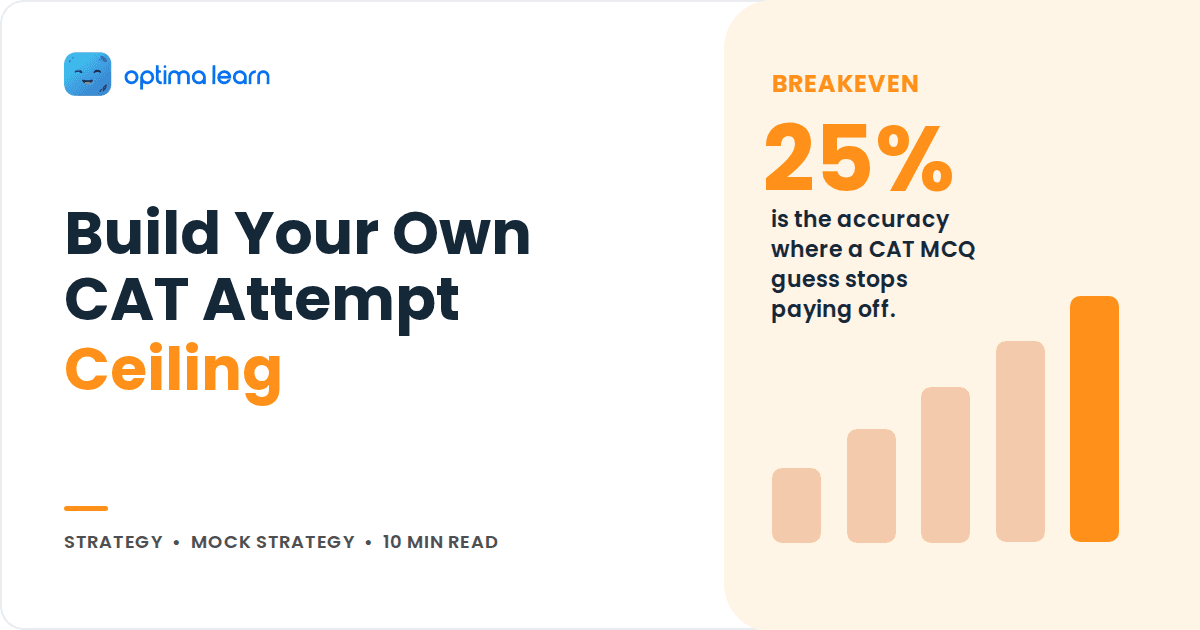
- CAT's marking math sets a hard breakeven: an MCQ guess only pays off, on average, above 25% accuracy on that question type.
- TITA questions carry no negative marking, so the same guess never punishes you the way an MCQ guess does.
- The 4-Step Attempt Ceiling Method turns your last three mocks into a personal number, confidence tier by tier.
- Your ceiling is not fixed. Recalculate it after every mock as your accuracy moves, instead of setting it once.
Why a Universal Attempt Number Cannot Work for You
Walk into any CAT prep group and someone will hand out a number within the first ten messages. Attempt this many in Quant, this many in VARC, leave this many blank in DILR. The number sounds authoritative because it is stated so confidently, and it spreads fast because it feels like a shortcut past months of trial and error.
The trouble is what the number is built on. It came from one person's accuracy on one paper, and accuracy swings by section, topic, and how tired that person was that morning. Borrow the number without the accuracy behind it, and you copy the output while skipping the calculation.
Common sources of a borrowed number, none of which know anything about your paper:
- A senior's number from a year with a different paper and different personal accuracy.
- A coaching institute's round figure, pitched to a whole batch instead of to you.
- A topper's public number, repeated without the years of accuracy that made it safe.
There is also no fixed score-to-percentile mapping that would make a shared number reliable even with identical accuracy. Your CAT percentile depends on your position relative to everyone who sat that slot, and it moves with paper difficulty and normalization.
Skip the borrowed number entirely. Run your own CAT preparation gap analysis instead, so the ceiling you build is based on where your accuracy actually breaks down, not on where someone else's did.
Mentors who review scripts season after season see the same thing repeat: two aspirants can attempt the exact same 54 questions on the same mock and land different net scores, because their accuracy on those questions was never the same to begin with.
The Marking Math Behind Every Attempt Decision
Before you build a personal ceiling, you need the rule it is built on. CAT's marking is not a mystery: a correct MCQ earns +3, a wrong MCQ costs -1, an unattempted question earns 0. TITA also earns +3 correct, but there is no penalty for a wrong TITA answer, only 0.
- MCQ: +3 for correct, -1 for wrong, 0 for skipped.
- TITA: +3 for correct, 0 for wrong, 0 for skipped.
That asymmetry is why attempt strategy is a skill separate from knowledge, and why two aspirants with identical syllabus knowledge can still post very different net scores.
Guess on 20 similar MCQs at exactly 25% accuracy: 5 land correct, 15 land wrong. The correct ones earn 15 marks, the wrong ones cost 15, and the two cancel to zero. Push accuracy above a quarter and the guesses start paying you. Drop below it and every extra attempt drains marks you already had.
TITA has no such breakeven, because there is nothing to lose beyond the time it cost. That one constant changes how every tier should be treated:
- A tier where you are right more than a quarter of the time is worth attempting, even if it does not feel strong.
- A tier where you are right about half the time is comfortably worth attempting, and probably deserves more practice reps.
- A tier where you are right one in ten times is working against you, no matter how many questions you get through.
Treat 25% as a marking constant, not a target to hit. It is the accuracy level where an MCQ guess stops costing you marks on average. Your next job is finding out, tier by tier, where your accuracy sits against that line.
The 4-Step Attempt Ceiling Method
This is the process that replaces a borrowed number with one that is actually yours. It uses only two inputs you already have: your last few response sheets, and the marking math above.
The 4-Step Attempt Ceiling Method, in order:
Step 1: Split Your Last Three Mocks by Confidence Tier
Open your response sheets, not your memory, for at least three recent mocks. Sort every attempted question into three tiers: Sure, meaning you knew the method before finishing the question; Educated Guess, meaning you narrowed it to two options; and Guess, meaning you had no real basis for the answer. Three mocks smooths out one unusually good or bad day.
Not sure how many mocks to sit before trusting this data. Our breakdown of sectional tests versus full length mocks covers how to build a cadence that gives you enough response sheets to work with.
Step 2: Run the Marking Math on Each Tier
Inside each tier, calculate your actual accuracy: correct answers divided by attempts, for that question type. An MCQ tier above 25% accuracy is adding marks on average across your mocks. An MCQ tier below 25% is costing you marks, however confident it felt in the moment. TITA tiers are close to always worth attempting, since a wrong answer costs nothing but time.
Step 3: Set Your Personal Attempt Ceiling
Your ceiling is the sum of three groups, nothing outside them:
- Every Sure question, since this tier already clears the marking math comfortably.
- Every Educated Guess question from a tier whose measured accuracy clears 25%.
- Every TITA you have time left for, since there is no penalty to weigh against it.
Questions in a Guess tier below 25% get left blank unless there is genuine spare time. This number will differ from your batchmate's, differ by section, and probably differ from whatever number you had in your head before you ran this.
Step 4: Revisit the Number After Every Mock
A ceiling calculated once and never touched again stops describing you within a few weeks. Accuracy moves as weak areas get patched, and a static ceiling either holds you back once improved, or overstates accuracy on a topic not actually fixed. Rerun Steps 1 to 3 after every mock.
How to Calculate Your Personal Breakeven Point
The steps above sound clean in theory. Seeing them run on real numbers is what makes the method click.
A Worked Example, Anonymized
Take a recent mock's Quant section, 22 questions. After sorting every attempted question by confidence tier, using the response sheet rather than memory, the breakdown looked like this:
| Tier | Attempted | Correct | Accuracy | Marks From This Tier |
|---|---|---|---|---|
| Sure | 8 | 7 | 87.5% | +20 (7×3 minus 1×1) |
| Educated Guess | 6 | 2 | 33% | +2 (2×3 minus 4×1) |
| Guess | 5 | 1 | 20% | -1 (1×3 minus 4×1) |
Reading What the Table Actually Says
- The Sure tier does the heavy lifting, exactly as it should: high accuracy, high net marks.
- The Educated Guess tier sits just above the 25% breakeven, so it still adds marks, but barely. Worth attempting, not worth relying on.
- The Guess tier sits below breakeven and actively costs marks. Leaving those 5 questions blank would have added 1 mark back, not lost anything.
Notice the ceiling for this paper: 14 questions, the Sure and Educated Guess tiers combined, not the Guess tier's 5 extra attempts that felt like effort but were a net drain. That number came entirely from this reader's own accuracy. It is not a rule anyone else should copy, only the method that produced it.
The tier that wrecks this method is Sure, not Guess. Aspirants routinely rate a question as certain in the moment and discover, once they check the response sheet, that their real accuracy on that tier is closer to 70%.
Sort by what the response sheet says after the mock, never by how confident the question felt while answering it. Do the sorting against the answer key, not while solving under the clock.
Why Your Ceiling Changes, and How to Hold It on Exam Day
A ceiling built from one mock is a snapshot, not a target. The number should move as your prep moves, and knowing which direction it is moving tells you almost as much as the number itself.
What Moves the Ceiling Up or Down
Upward, most often: a Guess-tier topic crossing into Educated Guess as concept clarity improves, calmer solving under the clock reaching questions that used to run out of time, and review narrowing the gap between how a question feels and how it resolves.
Downward, most often: a stretch of mocks skipped, letting speed and pattern recognition go soft, a harder set type your Sure tier has never faced, or exam-day nerves pulling accuracy below where practice data says it should sit.
Neither direction is a verdict on your preparation. It is information, so your next mock's attempt decisions are built on where you actually are, not where you were three weeks ago.
None of this helps if the ceiling only exists on a spreadsheet, since there is no time to run the math mid-section on exam day. The discipline has to be practiced until it is automatic, the same way a solving method is.
- Before each mock, write down your current ceiling per section, from your last recalculation.
- During the mock, flag a question the instant it feels like a Guess tier item, and move on.
- Return to flagged questions only after every Sure and Educated Guess question is done.
- Stop attempting once Guess-tier flags exceed what your ceiling allows for that section.
- After the mock, re-sort against the response sheet and update the ceiling before the next attempt.
If your confidence tiering keeps drifting on a specific topic, that usually means the topic needs more repetitions, not that the method is broken. It is worth checking whether more study hours are converting into accuracy before assuming the fix is another mock.
Build a Ceiling That Updates Itself
Running the 4-Step Attempt Ceiling Method by hand after every mock works, but it takes discipline to keep current. A weekly plan that tracks your accuracy by topic does the recalculation for you.
Plan My Weekly CAT PrepIf you are not sure whether your current approach has a real ceiling behind it, or a gut number dressed up as strategy, a second opinion helps more than another mock. Get your full CAT exam strategy reviewed and see whether your attempt decisions match your accuracy data.
Verify Your Ceiling With a CAT Score Calculator and Your Response Sheet
The method above works on mocks, where your response sheet comes back within minutes. On the real CAT, the same verification matters even more, since no mentor is standing over your shoulder to tell you whether your attempt decisions paid off.
Once your response sheet is out, do not wait for the official percentile release to know whether your ceiling held. Enter your answers into a CAT score calculator built for this, tier your attempts the way you practiced, and see your raw score before the wait for percentile begins.
Percentile itself is never something a calculator can promise, since it depends on how the whole cohort performed, but your raw score from your response sheet is not a guess. It gives you everything the method needs:
- The exact question and option marked for every attempt, MCQ and TITA both.
- Enough detail to re-sort the paper into the same Sure, Educated Guess and Guess tiers you practiced with.
- A real accuracy figure per tier, not a memory of how confident you felt.
- Have you sorted at least three recent mocks by confidence tier, using the response sheet, not memory?
- Do you know your actual accuracy, as a percentage, in each tier for each section?
- Is your attempt ceiling written down anywhere, or only a vague number in your head?
- Have you recalculated it since your last mock?
Check Your Real Score, Not a Guess
Stop waiting on percentile day to find out if your ceiling worked. Run your actual response sheet through a calculator built on CAT's real marking rules.
Use the CAT Score CalculatorFrequently Asked Questions About CAT Attempt Strategy
What is a good number of questions to attempt in CAT?
There is no single good number, and any source that gives you one is skipping the part that matters: your accuracy. Two aspirants attempting the same 50 questions can land different net scores, because the marking math treats a correct guess and a wrong guess very differently. Use the 4-Step Attempt Ceiling Method on your own mocks instead.
How does negative marking actually affect my attempt decisions?
Only MCQs carry negative marking, -1 per wrong answer against +3 for a correct one. TITA earns +3 correct and 0 wrong. So the breakeven accuracy for an MCQ guess sits around 25%, while a TITA guess almost always makes sense if you have the time, since there is nothing to lose beyond that time.
Should I attempt every TITA question since there is no negative marking?
Mostly yes, with one real constraint: time. A wrong TITA answer costs nothing in marks, but the minutes spent on it are gone regardless of outcome. If attempting a shaky TITA means running out of time for a Sure question elsewhere, the cost was never the negative marking, it was the clock.
How often should I recalculate my attempt ceiling?
After every mock, not once at the start of prep. Accuracy shifts as weak topics get fixed and new set types show up, so a ceiling calculated in month one is almost never right by exam day. Treat Step 4 as ongoing, not a one time setup task.
Build your CAT 2026 study plan
Personalised daily plan that adapts to your section-wise mock scores.
More from Strategy
Continue reading

Why CAT RC Answer Options Often Feel Equally Correct

How To Study For CAT When You Are Mentally Exhausted

How To Stop Procrastinating On Your Weakest Section

How To Recover From A Wrong Start On A DILR Set Explained
Put it into practice