
Why CAT RC Passages Get Easier
Most aspirants decide how hard CAT RC passages are going to be somewhere in the middle of the first paragraph. Dense vocabulary, an unfamiliar field, a long opening sentence, and the verdict arrives: this is a hard one.
That verdict is made on the least informative part of the passage. First paragraphs are frequently the hardest to read and the least useful to have read, because they are setting something up rather than saying anything. The passage does not become comprehensible until the thing being set up gets used, and that almost always happens in paragraph two.
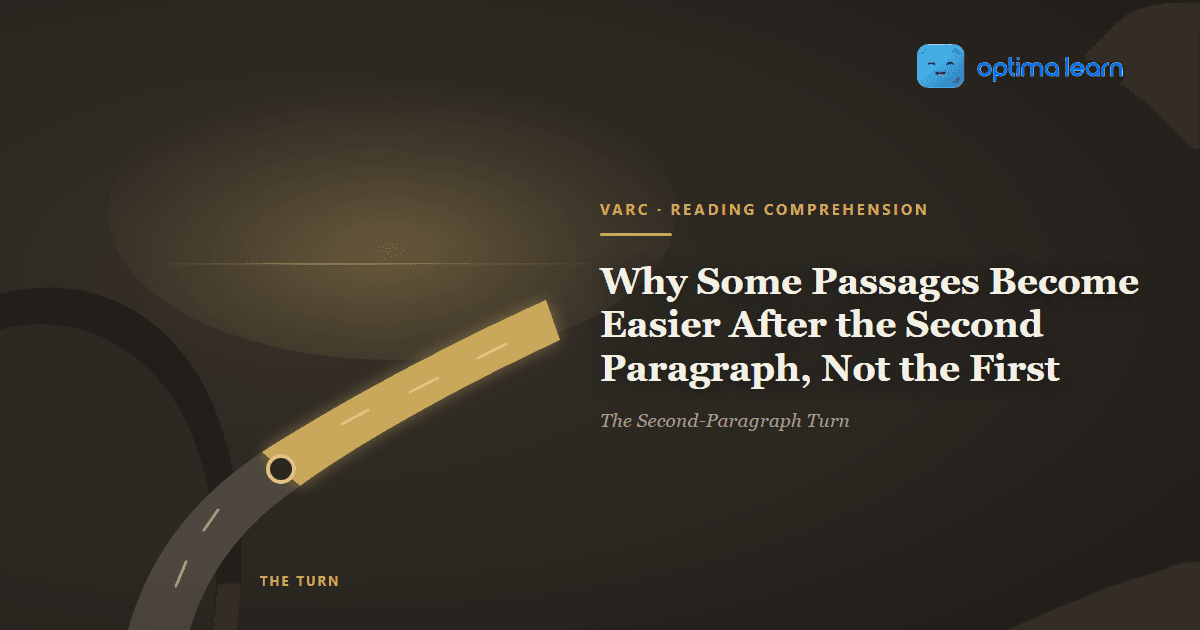
It is the same as driving a bend. The road ahead is hidden, the corner feels tight, and then you are round it and can see for a mile. Judging the whole drive from inside the corner is a mistake, and it is exactly what most RC readers do.
- First paragraphs set something up; second paragraphs use it, which is why comprehension usually arrives late.
- Judging passage difficulty during paragraph one is judging on the least informative part of the text.
- The Second-Paragraph Turn does three things: it names the tension, reveals whose position paragraph one was, and fixes the shape of the rest.
- Paragraph one should be read lightly and quickly, because most of it will be re-explained by the turn.
- Aspirants who wait for the turn read the whole passage faster, not slower.
Why RC Passages Open at Their Hardest and Least Useful
An opening paragraph has an awkward job. It has to introduce a subject you know nothing about, in a register you did not choose, without yet being able to tell you why any of it matters. So it front-loads context, and context without purpose is genuinely hard to hold.
What makes this expensive is that difficulty at this stage carries almost no information about the passage. It reflects unfamiliarity with the topic, not the complexity of the argument, and those two things are close to unrelated in CAT RC.
The symptoms of over-reading paragraph one are recognisable:
- Re-reading the opening sentence three times before continuing.
- Trying to memorise names and dates that will turn out not to matter.
- Deciding to skip the passage before reaching the point where it explains itself.
- Arriving at paragraph two with no attention left, which is where the attention was needed.
The Second-Paragraph Turn: What Actually Changes
Paragraph two is where a passage stops describing and starts arguing. Three things usually happen at once, and any of them is enough to make the rest readable.
The Second-Paragraph Turn
- It names the tension. Paragraph one gave a position or a situation. Paragraph two introduces what complicates it, and the complication is what the passage is about.
- It reveals whose voice paragraph one was. Very often that opening position belongs to someone the author is about to disagree with.
- It fixes the shape. Once you know the tension and the author's side, the remaining paragraphs become predictable rather than surprising.
Naming the tension is the most common function, and it is usually signalled rather than stated:
- A contrast word opening the paragraph: but, yet, however, and their quieter cousins.
- A shift from description to evaluation, where the text begins judging rather than reporting.
- The appearance of a second party who sees things differently.
Revealing the voice is the one that changes answers, because attributing a position to the wrong party is the most costly reading error available:
- Watch for reporting verbs applied retroactively: "this account assumes", "on this view".
- A hedge appearing around paragraph one's claim signals it was never the author's.
- If paragraph two argues against something, check whether the something was paragraph one.
Fixing the shape is what converts reading into prediction, which is where the speed comes from:
- Tension named plus author's side taken usually means paragraphs three and four are evidence.
- Tension named without a side taken often means the passage will hold both positions to the end.
- A tension that gets resolved early usually means the rest is implication rather than argument.
Put the Second-Paragraph Turn to Work
Holding your judgement for one more paragraph is a habit, and habits need real passages under a real clock. Optima Learn's VARC sets follow genuine CAT structures, so the turn arrives where the exam puts it.
Practise CAT VARC QuestionsHow to Read Paragraph One Differently
The practical change is not to read paragraph one more carefully. It is to read it less carefully, on purpose, and to spend the saved attention on the turn.
| In paragraph one | Standard approach | Better approach |
|---|---|---|
| An unfamiliar term | Stop and work it out | Note it and move on; it usually gets explained |
| Names and dates | Try to retain them | Note their existence, not their values |
| A stated position | Accept it as the author's | Hold it as unattributed until paragraph two |
| A long sentence | Re-read until it resolves | Take the main clause and continue |
| Feeling lost | Consider skipping the passage | Expected at this stage. Reach the turn first. |
The last row is the one that changes attempt counts. A passage abandoned in paragraph one is abandoned before it has said anything, which means the decision was made on unfamiliarity rather than on difficulty.
When the Turn Comes Later, or Not at All
Paragraph two is the usual location, not a rule. A few variations worth recognising, because each one changes how you should read:
- The turn in paragraph three. Common in longer passages with two paragraphs of setup. If paragraph two is still describing, keep reading lightly.
- The turn in the first sentence. Some passages open on the tension directly. You will know because the contrast arrives immediately, and the rest is elaboration.
- Two turns. The author complicates a position, then complicates the complication. The second turn is usually the author's real view.
- No turn. Purely expository passages exist, mostly in science and history. They are usually easier and the questions are more literal.
- A false turn. A contrast word that introduces a minor qualification rather than the central tension. If the passage returns to its original direction, that was not the turn.
Distinguishing a real turn from a minor qualification is a related skill in its own right, and it is what separates readers who track the argument from readers who track the sentences. The live piece on the difference between understanding and selecting covers what happens after that, at the answer options.
Common Mistakes Around the First Paragraph
Related habits worth dropping:
- Judging difficulty too early. Deciding to skip based on the first four lines, which reflect topic familiarity rather than argument complexity.
- Exhausting attention on setup. Reading paragraph one hardest, so the turn is read tired.
- Memorising detail. Retaining names and figures that the questions will let you look up.
- Treating every contrast word as the turn. Reacting to a minor qualification as though it reversed the passage.
- Re-reading paragraph one after finishing. Usually unnecessary; the turn has already re-explained what mattered.
A Practice Drill for Finding the Turn
The drill trains you to locate the turn rather than to read faster, which is the part that transfers.
- Take fifteen RC passages. Do not answer any questions.
- For each, mark the exact sentence where the passage stops describing and starts arguing.
- Beside it, write the tension in one sentence and note whose position paragraph one was.
- Now read the questions. Check how many of them turn on the tension you identified.
What the drill usually shows:
- The turn sits in paragraph two roughly two-thirds of the time, and in paragraph three most of the rest.
- A large share of questions turn directly on the tension, which is why locating it pays.
- Passages that felt hardest often had the latest turn, not the hardest argument.
- Misattributing paragraph one is the most common single error, and it is usually visible immediately once you look for it.
The Bottom Line
RC passages are not uniformly difficult from start to finish. They are hardest where they are least informative and easiest where they matter most, which is an unusual shape and one worth reading around deliberately. The first paragraph asks for patience. The second one repays it.
The Second-Paragraph Turn, Recap
- It names the tension: the complication that the passage is actually about.
- It reveals the voice: paragraph one is often not the author speaking.
- It fixes the shape: after the turn, the rest becomes predictable.
Build the Habit on Timed CAT VARC
Holding a verdict for one more paragraph is hardest under a clock, so it has to be practised there. Work through CAT previous year questions in timed blocks, or sit full CAT mock tests and past papers so passage selection is tested with real fatigue. More reading method sits in the CAT VARC blog archive, and if passage selection keeps going wrong it is worth having your strategy reviewed honestly.
Wait for the Turn in CAT 2026
The paragraph that makes a passage readable is almost never the first one. Build the habit of reading to the turn on real CAT-style passages.
Start Practising CAT VARCFrequently Asked Questions
Why do RC passages get easier after the first paragraph?
Because first paragraphs set something up while second paragraphs use it. An opening has to introduce unfamiliar context before it can say why any of it matters, which is intrinsically hard to hold. Comprehension arrives when the setup gets used, usually at the start of paragraph two.
Should I decide whether to skip a passage from the first paragraph?
No. Difficulty felt during paragraph one mostly reflects unfamiliarity with the topic rather than complexity of the argument, and the two are close to unrelated. Reading to the end of paragraph two costs about twenty seconds and gives you a far better basis for the decision.
How do I know whose view the first paragraph represents?
Wait for the turn. If paragraph two argues against a position, check whether that position was stated in paragraph one. Retroactive reporting phrases such as "this account assumes" or "on this view" are the clearest signal that the opening was not the author speaking.
What if the turn does not come in paragraph two?
Longer passages sometimes use two paragraphs of setup, in which case the turn arrives in paragraph three and you should keep reading lightly until it does. Some expository passages, mostly in science and history, have no turn at all; these are usually easier and their questions more literal.
Practice VARC, chapter by chapter
CAT VARC practice across reading comprehension, para-summary and para-jumbles, each with a worked solution.
More from VARC
Continue reading
XLRI Admission Process: The Exam Nobody Ever Checks
Why Do Some CAT DILR Sets Feel Totally Unsolvable?
Why School Level Quant Feels Hard in the CAT Paper
Why Do Non Engineers Struggle in CAT VARC As Well?
Put it into practice