
The Information Density Rule: Why Some CAT Questions Contain More Signal Than Others
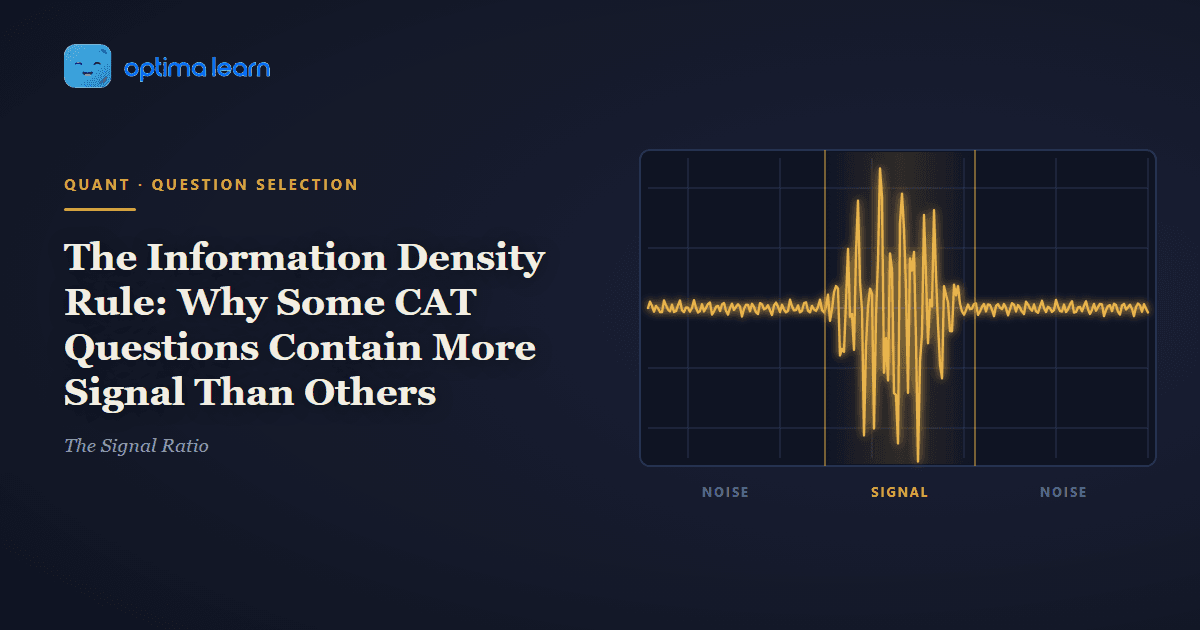
Two questions in the same Quant section. Both are four lines long. Both mention three quantities. One of them is done in fifty seconds; the other eats four minutes and still does not resolve.
Most aspirants explain this with difficulty. The second question was harder. But sit with the two stems side by side after the mock and something else shows up: the first question told you four things about three quantities, and the second told you two. The first was over-determined and practically solved itself. The second needed you to supply the missing structure, and supplying structure is what takes four minutes.
Length told you nothing. Density told you everything, and it was measurable before you started.
- Questions of equal length carry wildly unequal amounts of usable information, and the difference is visible in the stem before you commit to solving.
- The Signal Ratio is constraints divided by unknowns. At or above one, the question is determined and short. Below one, it needs a structural insight you have to find.
- Constraints are not equal. One that pins a value is worth several that merely bound a range.
- Sentences carrying no constraint are framing. Their proportion tells you how heavily the question is disguised, not how hard it is.
- Counting takes about twenty seconds and changes which questions you attempt, which is worth more marks than solving faster.
Why Two Questions of the Same Length Are Not the Same Question
Every Quant question is a small system. It names some quantities you do not know, and it gives you some statements that restrict them. Those statements are constraints, and how many you get relative to how many unknowns you carry is the single best predictor of how long the question will take.
Three unknowns and three independent constraints is a determined system. The algebra may be tedious but the path is never in doubt. Three unknowns and two constraints is not solvable by grinding, no matter how much time you spend, because the missing information has to come from structure: an integer condition, a positivity requirement, a symmetry, a bound that quietly eliminates all but one case.
That is the real difficulty axis in CAT Quant, and it has almost nothing to do with the topic. Put two stems side by side and the difference is countable:
- Two unknowns with two clean equations is determined. Expect ninety seconds.
- The same two unknowns with one equation plus an integer condition is also determined, but only if you notice the condition.
- Three unknowns with two equations and no word-constraint is genuinely under-determined. No amount of algebra closes it.
- Four unknowns with five constraints is over-determined, which usually means one constraint exists to be used as a check rather than a step.
The Signal Ratio: Reading a Question by What It Constrains
The count is quick enough to do inside the exam, and it answers a question worth more than "is this hard?" It answers "what kind of work is this going to be?"
The Signal Ratio
- Count the unknowns. Every distinct quantity the question has not given you a number for. Include the one being asked about.
- Count the constraints. Every statement that restricts those quantities, including the ones hidden in words like "integer", "positive", "distinct" or "at most".
- Read the ratio. At or above one, solve directly and expect it to be short. Below one, stop and hunt for the structural condition before you write anything.
Counting unknowns is easier than it sounds because most aspirants over-count. Two quantities that always move together are one unknown, not two. Things to fold together:
- A quantity and any fixed multiple of it.
- Ratios where only the ratio ever appears, never the individual parts.
- A rate and a time when only their product enters the question.
Counting constraints is where the marks are, because the ones that decide questions are rarely written as equations. Watch for:
- Word constraints. "Natural number", "distinct", "no two are equal", "at least one". Each of these is a real restriction that eliminates cases.
- Physical constraints. Lengths are positive. People are whole numbers. A discount cannot exceed the price.
- Boundary constraints. "Between 10 and 40", "not more than 5". These look soft and are often decisive once combined with an integer condition.
An aspirant who counts only the equations will read a determined question as under-determined and reach for a long method that was never necessary.
Put the Signal Ratio to Work
Counting is a twenty-second habit that only forms under a clock. Optima Learn's Quant sets follow real CAT patterns, so the hidden word-constraints appear exactly where the exam puts them.
Practise CAT Quant QuestionsWeighting the Constraints: Not All Givens Are Worth the Same
A raw count is a good first pass, but two questions can both show a ratio of one and behave completely differently. What separates them is the quality of the constraints.
| Constraint type | What it does | Rough value |
|---|---|---|
| Fixes a value | Pins one unknown outright | Highest. Removes an unknown completely. |
| Relates two quantities | Ties them together | High. Removes one degree of freedom. |
| Integer or counting condition | Discretises a range | High when combined with a bound. Often decisive. |
| Bounds a range | Restricts without fixing | Low alone, high alongside an integer condition. |
| Positivity or non-zero | Kills sign cases | Low, but frequently the reason an answer is unique. |
The row that decides the most CAT questions is the third. An integer condition on its own does little. An integer condition sitting next to a range does an enormous amount, because together they turn an infinite set into a handful of candidates you can simply check.
Dead Words and Where Setters Put Them
Not every sentence in a stem carries information. Some exist to set a scene, and it helps to be blunt about which is which.
- Framing sentences establish context. "A shopkeeper sells two varieties of rice." No constraint, though it defines the unknowns.
- Restating sentences say the same thing twice in different words. Common in wordy arithmetic questions.
- Decoy detail looks like a constraint but never enters the answer, such as a quantity mentioned once and never used again.
- Live constraints genuinely restrict. These are the only sentences you need to carry forward.
Marking them as you read costs nothing and changes what you carry forward:
- Underline only the clauses that restrict. Leave everything else unmarked.
- If a quantity appears once and is never referred to again, treat it as decoy until proven otherwise.
- If two sentences say the same thing, use the more precise one and drop the other.
- Count your underlines at the end. That number, not the stem length, is what you are actually working with.
Marking dead words is not about skimming. It is about knowing what you are still holding in working memory at minute two, which is when overload starts producing errors. A question can be 90 percent framing and still be trivial, and that is exactly the question most aspirants skip because it looks long.
What Density Changes About Question Selection
The practical payoff is not solving faster. It is choosing better, and the choice happens in the first thirty seconds.
- A high-ratio question with clean constraints is an attempt, almost regardless of topic.
- A low-ratio question in a strong topic is worth thirty seconds hunting for the structural condition, then a decision.
- A low-ratio question in a weak topic is a leave, and leaving it early costs nothing.
- A long question that is mostly framing is frequently the easiest mark on the page, and it is systematically under-attempted because length reads as difficulty.
- Two questions of equal ratio should be separated by which one has the higher-quality constraints, not by which looks shorter.
This sits directly alongside knowing when to walk away from something you have already started, which is covered in why every CAT Quant question has a point of no return. Density decides what you pick up; the point of no return decides when you put it down.
Common Mistakes That Come From Reading Length Instead of Density
The same misreading shows up in several ways:
- Skipping on sight. Passing over a long stem without reading it, and never discovering it was over-determined.
- Counting equations only. Missing the integer or positivity condition, then concluding the question is unsolvable.
- Carrying dead detail. Holding framing information in working memory through the whole solution, which crowds out the target.
- Grinding an under-determined system. Manipulating two equations in three unknowns for minutes, hoping something cancels.
- Trusting the topic label. Assuming a familiar topic means a short question when the ratio says otherwise.
A Practice Drill for Measuring Signal
Like most reading skills, this is trained by deliberately not solving.
- Take fifteen Quant questions. Do not solve them.
- For each, write two numbers in the margin: unknowns and constraints. Force yourself to include word-constraints in the second number.
- Predict, in one word, whether the question is short or long. Commit before checking.
- Now solve them and compare. Your prediction accuracy after about sixty questions is a better indicator of section readiness than your accuracy rate.
Run across sixty questions, the drill tends to surface the same findings:
- You under-count constraints far more often than you over-count them.
- Integer and positivity conditions are the ones you miss, almost every time.
- Your short-or-long prediction is sharper on topics you have drilled, which is a cleaner readiness signal than accuracy.
- The questions you skipped on sight were disproportionately the over-determined ones.
Aspirants running this drill usually find one specific leak: they systematically miss integer conditions. That is a single, fixable habit rather than a knowledge gap, and it moves attempt counts within a fortnight.
The Bottom Line
The exam is not testing how quickly you can process a long stem. It is testing whether you can tell how much of that stem is actually load-bearing. Most of the time-loss in a Quant section happens before any calculation, in the gap between reading a question and knowing what kind of question it is.
The Signal Ratio, Recap
- Count unknowns, folding together anything that always moves as one.
- Count constraints, including the ones written as words rather than symbols.
- Read the ratio: at or above one, solve; below one, find the structure first.
Build the Habit on Timed CAT Quant
Twenty seconds of counting only feels affordable once it has paid off a few times under real pressure. Work through CAT previous year questions in timed blocks, or sit full CAT mock tests and past papers so selection gets practised alongside fatigue. More structural approaches sit in the CAT Quant blog archive, and if selection keeps going wrong across whole sections it may be worth having your strategy reviewed honestly.
Frequently Asked Questions
What is information density in a CAT Quant question?
It is how much genuine constraint a question carries relative to how many unknowns it introduces. A dense question restricts its quantities heavily and resolves quickly; a sparse one leaves them loose and requires you to find a structural condition before any calculation will help.
How do I count constraints during the exam?
Read the stem once and tick every sentence that restricts something, then count separately the condition words such as integer, distinct, positive, at most and exactly. The word-constraints are the ones most aspirants miss, and they are frequently the ones that make the answer unique.
Does a longer question mean a harder question?
No, and assuming so is one of the most expensive habits in a Quant section. Length usually reflects framing rather than constraint. A long stem often carries more givens, which makes the system more determined and the question faster, which is why long questions are systematically under-attempted.
What should I do when the Signal Ratio is below one?
Stop and look for a hidden condition rather than starting to manipulate what you have. Under-determined systems do not resolve through algebra, so grinding cannot work. Give it about twenty to thirty seconds; if no structural condition appears, the question is a leave and leaving it early is nearly free.
Read Density Before CAT 2026
Question selection is decided in the first thirty seconds, and it moves more marks than solving speed ever will. Start counting constraints on real CAT-style questions.
Start Practising CAT QuantPractice these Quant concepts, chapter by chapter
Thousands of CAT Quant practice questions by chapter and difficulty, each with a worked solution.
More from Quant
Continue reading

Using a Study Journal for CAT Without Overdoing It

How to Stop Comparing Your CAT Prep With Everyone Else

SPJIMR Admission Process: Why the Profile Leads It
How to Solve CAT Quant Faster Without Skipping Steps
Put it into practice