
The Inference Threshold in CAT RC
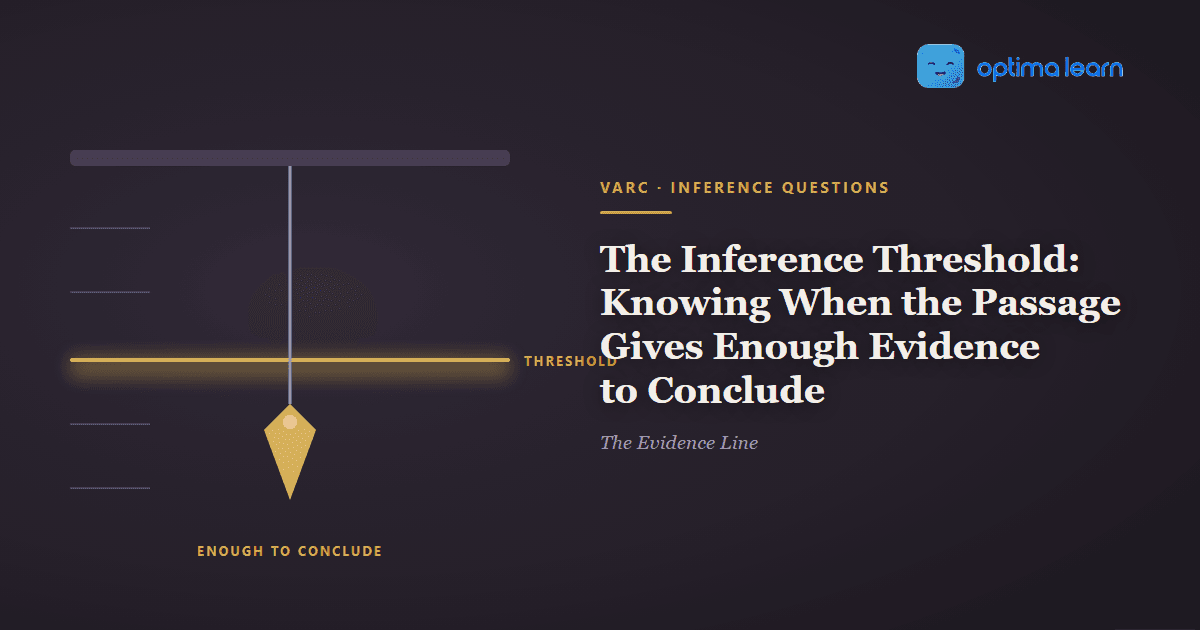
The hardest thing about an inference question is not working out what follows from the passage. It is knowing when you have crossed from following to guessing, because both feel identical from the inside.
An option seems reasonable. It fits what the passage said. It is the sort of thing the author would probably accept. You choose it, and it is wrong, because "would probably accept" and "follows from the text" are different standards and only one of them is being tested.
A plumb line settles this kind of question in a way that judgement cannot. There is a threshold marked, and the bob is either past it or it is not. The reading does not depend on how confident anyone feels.
- Inference questions test what the passage forces, not what it makes plausible.
- The Evidence Line applies three tests: can you point at the sentences, did you supply a step, and does it follow rather than merely fit.
- Most wrong inferences involve one small step the reader added without noticing.
- A true statement about the world is wrong here unless the passage established it.
- The threshold is lower than most aspirants think for supported options and higher than they think for reasonable ones.
Why "Reasonable" Is Not the Standard
An inference question asks what must be true given the passage. Not what is likely, not what fits, not what a sensible person would conclude. That gap is narrow in wording and wide in practice.
Distractors are built precisely in it. They take something the passage supports and extend it slightly: a shade more general, one causal step further, a degree more certain. Each extension is individually reasonable, which is exactly why it gets chosen.
The distinction is worth stating plainly:
- Supported: the passage's sentences force it. Correct.
- Consistent: the passage does not contradict it. Not sufficient.
- Plausible: it fits what we know generally. Not sufficient, and usually a trap.
- Contradicted: the passage rules it out. Easy to eliminate and rarely the difficulty.
The Evidence Line: Three Tests for Enough
Each test is a check on the option rather than a judgement about the world, which is what makes them usable under time pressure.
The Evidence Line
- Can you point at the sentences? Name the one or two sentences that force it. If you cannot point, you are not inferring.
- Did you supply a step? If the chain runs passage, then something you know, then option, the middle link is yours and the option fails.
- Does it follow, or merely fit? Ask whether the passage could be entirely true and the option false. If it could, the option is not supported.
Pointing at the sentences is the fastest of the three and eliminates most wrong options:
- Locate the specific lines, not the general area. "Somewhere in paragraph three" is not pointing.
- If two sentences from different paragraphs combine to force it, that is a legitimate inference and often the intended one.
- If you find yourself pointing at the whole passage, the option is probably describing tone rather than following from content.
Checking for a supplied step catches the errors that feel most like careful reasoning:
- Background knowledge is the most common uninvited step, especially on economics and science passages.
- Any assumption about what is normal or typical is a step you added.
- Watch for causal steps: the passage says two things co-occur, and you concluded one produced the other.
The follows-versus-fits test is the strongest and the one to use when two options survive:
- Try to construct a world where the passage is true and the option is false. If you can, eliminate it.
- Options with universals fail this quickly, because one counterexample is enough.
- Options restricted to what the passage discussed usually survive, which is why cautious options do well here too.
Put the Evidence Line to Work
The threshold only becomes calibrated against real options and real keys. Optima Learn's VARC sets follow genuine CAT patterns, so the distractors sit at the distances the exam uses.
Practise CAT VARC QuestionsHow Far Past the Text Is Too Far
Some distance is expected. An inference that merely restates a sentence is usually wrong for a different reason. The question is how much distance.
| Distance from the text | Example of the move | Verdict |
|---|---|---|
| Restatement | Says a sentence in other words | Usually wrong; too close |
| Combination | Joins two stated facts | Usually correct |
| Narrow implication | What one fact requires in this context | Usually correct |
| Generalisation | Extends beyond the discussed cases | Usually wrong |
| Causal leap | Turns co-occurrence into cause | Wrong |
The middle two rows are where correct answers live. Combining two facts from different paragraphs is the single most common shape of a correct inference, and it is under-considered because it requires holding two places in the passage at once.
How to Build the Check Into Reading
The threshold works best applied while choosing rather than afterwards:
- Read all five before deciding. Inference options are compared against each other for distance, not judged individually.
- Point before you pick. Say the sentence numbers to yourself. Silence means you are guessing.
- Prefer combinations. When an option joins two stated facts, it is usually the intended answer.
- Distrust your own expertise. On a topic you know well, over-inference is more likely, not less.
- Check universals last. Options with "all" or "never" fail the follows test quickly and can be cleared fast.
The second point is the one that changes accuracy fastest, because it converts a feeling of support into a specific claim you either can or cannot make.
Common Mistakes on Inference Questions
Related errors:
- Supplying a step. Adding background knowledge so smoothly you do not notice it entered.
- Accepting consistency. Treating "the passage does not contradict this" as support.
- Choosing a restatement. Picking the option closest to a sentence, which is usually too close to be the answer.
- Generalising the sample. Extending a claim about the discussed cases to all cases.
- Skipping options after finding a good one. Inference questions are comparative, and the best option is often the fourth.
A Practice Drill for Calibrating the Threshold
The drill makes the supplied step visible, which is the whole difficulty.
- Take twenty inference questions you have already answered, with keys.
- For each option you chose, write the chain: sentence, sentence, conclusion.
- Mark any link in the chain that did not come from the passage.
- Sort your errors into three buckets: supplied step, generalisation, and restatement. The distribution is usually lopsided.
What aspirants typically find:
- Supplied steps account for most errors, and they cluster on familiar topics.
- Correct answers are combinations of two stated facts far more often than single-sentence implications.
- Restatement errors are rarer but concentrated on easier questions, where the closest option looks safest.
- Accuracy improves within a fortnight, because the fix is a check rather than new knowledge.
The Bottom Line
Inference questions are not asking you to think well about a topic. They are asking you to think within a text, which is a narrower and less natural operation. The threshold is where your reasoning stops being the passage's and starts being yours, and the only reliable way to find it is to point at sentences.
The Evidence Line, Recap
- Point at the sentences: name the specific lines, or you are not inferring.
- Check for a supplied step: any link from your own knowledge fails the option.
- Follows, not fits: if the passage could be true and the option false, eliminate it.
Build the Habit on Timed CAT VARC
Under pressure, plausibility starts to feel like support, so the check has to be trained on the clock. Work through CAT previous year questions in timed blocks, or sit full CAT mock tests and past papers so the discipline holds under fatigue. More reading method sits in the CAT VARC blog archive, and if inference accuracy has plateaued it is worth having your preparation reviewed honestly.
Find the Line in CAT 2026
Knowing when the passage has given you enough is a separate skill from reading it well. Calibrate it on real CAT-style questions.
Start Practising CAT VARCFrequently Asked Questions
What counts as a valid inference in CAT RC?
Something the passage forces rather than something it makes plausible. If you can construct a situation where every sentence in the passage is true and the option is false, the option is not supported however reasonable it sounds.
How do I stop over-inferring on RC questions?
Point at the specific sentences that force the option before selecting it. If you can only gesture at a paragraph rather than name one or two lines, treat it as unsupported. Most over-inference involves one small step supplied from your own knowledge without being noticed.
Can a statement be true and still be the wrong answer?
Yes, and it is one of the most common traps. Inference questions test what this text establishes, not what is true generally. A widely accepted fact that the passage never supports is wrong here, which is why agreement is a poor basis for choosing.
What shape do correct inferences usually take?
Most often a combination of two stated facts, frequently from different paragraphs. Pure restatements are usually too close to be the answer, and generalisations beyond the cases discussed are usually too far. The correct option typically sits between those two distances.
Practice VARC, chapter by chapter
CAT VARC practice across reading comprehension, para-summary and para-jumbles, each with a worked solution.
More from VARC
Continue reading
XLRI Admission Process: The Exam Nobody Ever Checks

Why Do Some CAT DILR Sets Feel Totally Unsolvable?
Why School Level Quant Feels Hard in the CAT Paper
Why Do Non Engineers Struggle in CAT VARC As Well?
Put it into practice