
The Hierarchy of Ideas in CAT RC
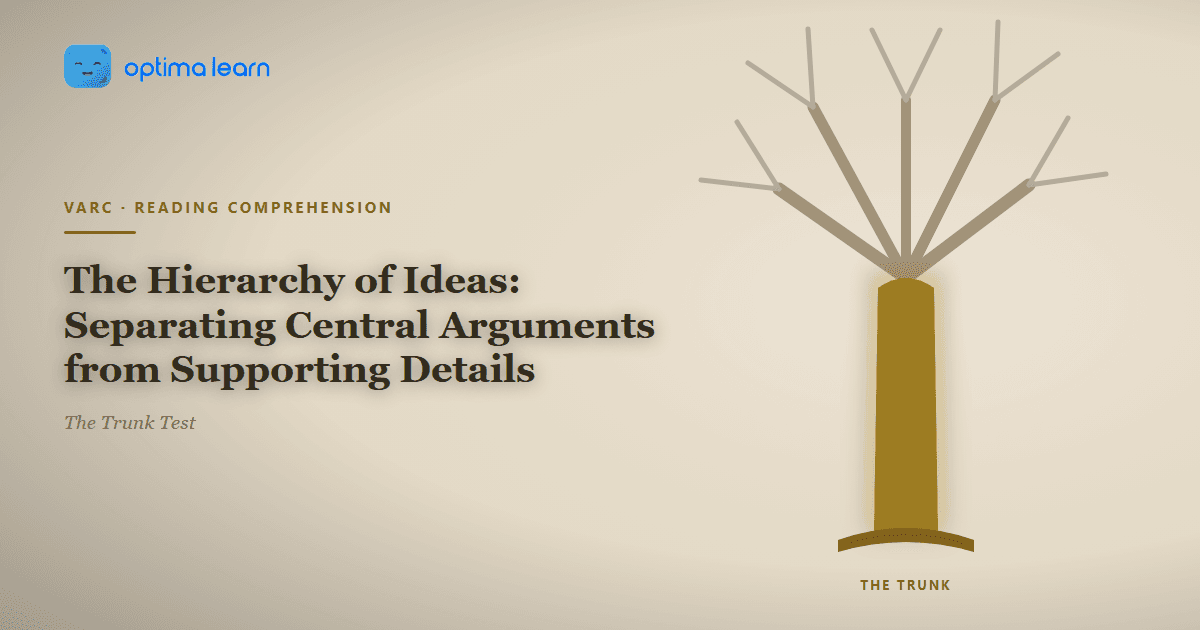
Every CAT RC passage has a hierarchy. It contains perhaps forty distinct claims, and one of them is what the passage is about. The other thirty-nine exist to support it, qualify it, illustrate it or push against it.
Ask most aspirants for the main idea and you get one of the thirty-nine. Usually a good one: something the passage genuinely said, stated accurately, that happens to be a branch rather than the trunk. And on a main-idea question, a well-stated branch is wrong in exactly the same way as a misreading.
A tree makes the distinction obvious in a way that prose does not. The branches are more numerous, more interesting and more visible. Cut one and the tree carries on. Cut the trunk and there is nothing left.
- A passage has one central claim and many supporting ones, and both feel equally true while reading.
- The Trunk Test separates them with three questions: does the argument survive without it, does it explain or get explained, and could it be the title.
- Main-idea questions are usually lost to a well-stated supporting claim rather than to a misreading.
- Supporting ideas are more memorable than central ones, because they are more concrete, which is precisely the trap.
- The trunk is often stated only once, and rarely in the opening paragraph.
Why Supporting Ideas Feel More Important Than They Are
The central claim of a passage is usually abstract. It has to be, because it has to cover everything else the passage says. The supporting material is concrete: a case, a figure, a vivid comparison.
Concrete things are easier to remember, easier to restate and more satisfying to have understood. So when you finish a passage, what is available to recall is systematically the wrong layer, and it feels like the right one because it is the part you understood most confidently.
The imbalance shows up predictably:
- The example you remember best is almost never the main idea.
- The most quotable sentence is usually a supporting flourish.
- The most technical paragraph feels central and is usually evidence.
- The trunk often appears once, in plain language, and reads as unremarkable.
The Trunk Test: Three Questions That Separate the Layers
Each question is a different angle on the same distinction, and any one of them usually settles it.
The Trunk Test
- Remove it. Does the argument survive? If the passage still makes sense without this claim, it is a branch.
- Does it explain, or is it explained? Whatever the passage spends its time justifying is the trunk. Whatever does the justifying is a branch.
- Could it be the title? Only the central claim can head the whole piece. A branch as a title would misdescribe the passage.
The removal test is the fastest and works even when you are unsure what the passage was arguing:
- Delete the claim mentally and ask whether the rest still hangs together. If yes, branch.
- Delete the trunk and the passage becomes a list of unconnected observations.
- If deleting something removes two other claims with it, you have found a major limb rather than the trunk.
Explains or is explained is the most reliable when several claims look central:
- Follow the "because" relationships. Arrows point from branches toward the trunk.
- The claim with the most support directed at it is the one the passage is defending.
- Evidence paragraphs are branches by definition, however substantial they are.
The title test is the best final check because it catches over-narrow answers:
- A title that covers only paragraphs three and four describes a branch.
- A title that covers everything but sounds vague is often correct; central claims are abstract.
- If two candidates both work as titles, the trunk is the one that includes the other.
Put the Trunk Test to Work
Telling trunk from branch is a judgement built on many passages. Optima Learn's VARC sets follow genuine CAT sources, so the central claims sit where the exam hides them.
Practise CAT VARC QuestionsWhere the Trunk Usually Sits
Position is not decisive, but it narrows the search considerably.
| Location | How likely to be the trunk | Why |
|---|---|---|
| Last sentence of paragraph two | High | Just after the turn, where the passage states its real subject |
| Final paragraph | High | Passages often restate the central claim once at the close |
| First paragraph | Low | Usually setup, and often someone else's position |
| Most technical paragraph | Low | Almost always evidence, however impressive |
| The vivid example | Very low | Memorable by design, supporting by function |
The bottom two rows are where confident wrong answers come from. Technical density and vividness both create a strong impression of importance, and neither has any relationship to whether a claim is central.
How the Hierarchy Changes the Answer Options
Once you can rank claims, several option types become eliminable without re-reading:
- True but narrow. Accurately describes one paragraph. Wrong on a main-idea question, and the most common trap.
- True but supporting. States a branch correctly. Fails the removal test.
- Broader than the passage. Covers ground the passage never entered.
- Correct scope, flat tone. Frequently the right answer, and often rejected for sounding unexciting.
- The vivid restatement. Echoes the passage's most memorable sentence, which is nearly always a branch.
That fourth bullet is worth internalising, because it means the correct main-idea option often reads as the least impressive one. The related trap at the answer stage is covered in the difference between understanding and selecting.
Common Mistakes in Ranking Ideas
Related errors:
- Naming the topic instead of the claim. "Urban planning" is a subject, not an argument.
- Promoting the technical paragraph. Mistaking density for centrality.
- Taking paragraph one's claim. Often a position the author goes on to reject.
- Rejecting the bland option. Discarding the correct answer for sounding unremarkable.
- Never testing by removal. Accepting the first plausible candidate without checking whether the passage needs it.
A Practice Drill for Finding the Trunk
The drill forces the ranking to happen before the options can influence it.
- Take fifteen RC passages. Cover the questions.
- For each, write the central claim in twelve words or fewer, then list two supporting claims beneath it.
- Run the removal test on your central claim. If the passage survives without it, rewrite.
- Now uncover the main-idea question and check which option matches your sentence.
What aspirants usually find:
- First attempts are frequently branches, and the removal test catches most of them.
- Written answers get blander and more accurate over about twenty passages.
- The trunk sits after the turn far more often than in the opening paragraph.
- Accuracy on main-idea questions moves before accuracy on inference does.
The Bottom Line
Understanding a passage and ranking it are different achievements. You can follow every sentence, retain the best examples, and still name a branch when asked what the piece was about. The hierarchy is not in the text; it is something you build while reading, and questions are written by someone who built it.
The Trunk Test, Recap
- Remove it: if the argument survives, it is a branch.
- Explains or explained: whatever is being justified is the trunk.
- Could it be the title? Only the central claim can head the whole piece.
Build the Habit on Timed CAT VARC
Ranking claims is the first thing that collapses under time pressure, so it needs practising there. Work through CAT previous year questions in timed blocks, or sit full CAT mock tests and past papers so the habit holds under fatigue. More reading method sits in the CAT VARC blog archive, and if main-idea questions keep costing you marks it is worth having your preparation reviewed honestly.
Find the Trunk in CAT 2026
Main-idea marks are lost to accurate answers about the wrong layer. Build the ranking habit on real CAT-style passages.
Start Practising CAT VARCFrequently Asked Questions
How do I find the main idea of a CAT RC passage?
Test candidates by removal. If the passage still makes sense without a claim, that claim is supporting rather than central. Then check direction: whatever the passage spends its words defending is the trunk, and whatever does the defending is a branch.
Why do I keep picking wrong answers on main-idea questions?
Usually because you are choosing a true statement about the wrong layer. Supporting claims are concrete and memorable while central claims are abstract, so what you recall most confidently after reading is systematically the material that supports the argument rather than the argument itself.
Where in the passage is the main idea usually stated?
Most often just after the turn, at the end of the second paragraph, or restated in the final paragraph. It is rarely in the opening, which is typically setup and frequently states a position the author will go on to reject.
Should the correct main-idea option sound interesting?
Usually not. Central claims are abstract because they have to cover everything the passage says, so the correct option often reads as flat next to options echoing the passage's most vivid sentence. Blandness is a signal in its favour rather than against it.
Practice VARC, chapter by chapter
CAT VARC practice across reading comprehension, para-summary and para-jumbles, each with a worked solution.
More from VARC
Continue reading
XLRI Admission Process: The Exam Nobody Ever Checks

Why Do Some CAT DILR Sets Feel Totally Unsolvable?
Why School Level Quant Feels Hard in the CAT Paper
Why Do Non Engineers Struggle in CAT VARC As Well?
Put it into practice