
The Hidden Geometry of CAT Arithmetic
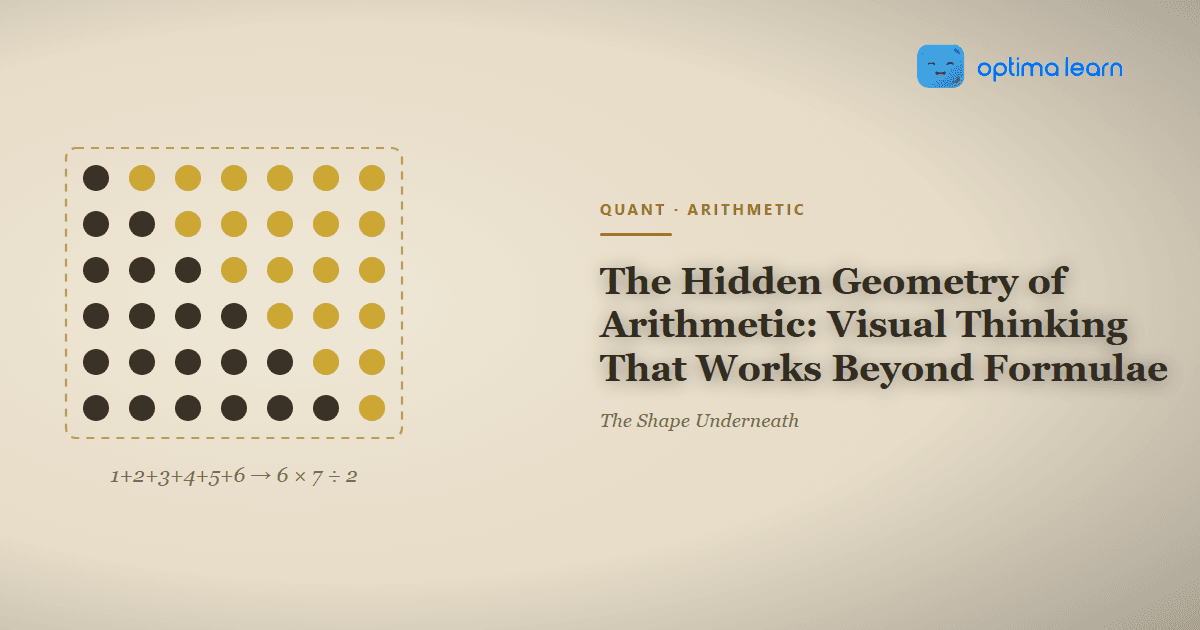
Add the numbers 1 to 100. Most aspirants reach for the formula, and the formula is correct. But there is a reason it is correct, and the reason is a picture: stack the numbers as rows of dots and you get a staircase. Put a second, upside-down staircase beside it and the two lock together into a perfect rectangle, 100 wide and 101 tall. Half of that rectangle is your answer.
That is the hidden geometry of arithmetic. A large number of CAT Quant results that get memorised as formulae are shapes underneath, and the shape is not decoration. It is faster, it survives pressure better than a half-remembered formula, and it keeps working on the variants where the formula does not quite fit.
- Many arithmetic results are geometric facts in disguise, and the picture is usually easier to hold than the formula.
- The Shape Underneath translates three families: sums become areas, ratios become slopes, and averages become centres of balance.
- A drawn relationship survives exam pressure. A memorised formula is one misremembered term away from a wrong answer with no way to check it.
- Pictures generalise. When a question varies the standard setup, the shape adapts and the formula usually does not.
- You are not replacing calculation. You are deciding what to calculate, which is where the time actually goes.
Why a Formula Is a Compressed Picture
Formulae are storage. Someone worked out a relationship, found it kept recurring, and compressed it into symbols so it could be carried around. The compression is genuinely useful and it has one cost: the reason is thrown away.
That cost is invisible until the moment it matters. Under time pressure, a formula you cannot reconstruct is either remembered correctly or it is not, and you have no way to tell which. A picture degrades gracefully. Even a rough mental image of the staircase tells you the answer to 1 through 100 is somewhere near five thousand, which is enough to eliminate three options.
What a picture gives you that a formula does not:
- A size, immediately, which is often enough to eliminate options without computing.
- A check, because a wrong answer usually looks wrong against the shape.
- A route into variants, where the standard formula no longer applies.
The pictures worth carrying are few. Three families cover most of what CAT asks.
The Shape Underneath: Three Translations Worth Carrying
The Shape Underneath
- Sums become areas. Any evenly spaced sum is a staircase, and two staircases make a rectangle. Series questions turn into length times width.
- Ratios become slopes. Speed, rate, concentration and price per unit are all gradients. Comparing two ratios becomes comparing two steepnesses.
- Averages become centres of balance. A mean is the point where deviations cancel. Weighted averages are a see-saw with the fulcrum off centre.
Sums as areas is the most immediately useful, because arithmetic progressions are everywhere in CAT and the staircase handles them all:
- Consecutive integers from 1 to n: a staircase, doubled into an n by (n+1) rectangle, halved.
- Any arithmetic progression: a trapezium, so the sum is the average of the ends times how many terms there are.
- Sums of odd numbers: a growing square, which is why 1+3+5+7 is 16 and not a coincidence.
Ratios as slopes converts a comparison problem into something you can see rather than compute:
- Two vehicles at different speeds are two lines from the same origin, and the steeper one is faster. Where they meet is when.
- A better price per unit is a shallower line, and you can rank three offers by steepness without dividing anything.
- Average speed over two equal distances is not the average of the speeds, and the picture shows why immediately: you spend longer on the slow leg, so it weighs more.
Averages as balance is the one that saves the most arithmetic in practice:
- The mean of an evenly spaced list is its middle term. No addition required.
- In a weighted average, distance from the mean is inversely proportional to weight, which turns most alligation questions into a one-line ratio.
- Adding a value above the mean pulls the mean up by an amount you can estimate from how far out it sits.
Put the Shape Underneath to Work
Seeing the shape instead of recalling the formula is a habit built on repetition. Optima Learn's Quant sets follow real CAT patterns, so the arithmetic that rewards a picture shows up the way it will in the exam.
Practise CAT Quant QuestionsWhere the Picture Beats the Formula
Not always, and it is worth being honest about when. For a standard application of a formula you remember confidently, the formula wins. The picture earns its place in four situations.
| Situation | Why the picture wins |
|---|---|
| The setup is varied | The shape adapts; a memorised formula usually does not fit the variant |
| You need an estimate | A rough shape gives a size instantly and kills options |
| You half-remember the formula | The picture reconstructs it, and tells you which version is right |
| The question asks why | Comparative and reasoning questions are about structure, not values |
The second row is the one aspirants under-use. A great many CAT questions can be answered by knowing roughly how big the answer is, because the options are far apart. An estimate from a shape takes seconds and needs no accuracy at all.
How to Build the Picture Fast
A sketch that takes thirty seconds has failed. These are meant to take five, and the constraints are what make them quick.
- Draw relationships, not values. Nothing needs to be to scale. You want which is bigger and by roughly how much.
- Use one axis for the thing that varies and let everything else be lengths on it.
- Mark the centre first in anything involving an average. Deviations from it are what you will actually use.
- Keep it small. A sketch two centimetres wide is enough, and a large one invites the temptation to make it accurate.
- Do not redraw. If the first sketch is wrong, annotate it. Redrawing is where the thirty seconds goes.
Arithmetic Results Worth Rebuilding as Pictures
You do not need many. These five carry most of what CAT arithmetic asks, and each takes seconds to redraw.
- Sum of 1 to n. A staircase doubled into an n by (n+1) rectangle. Halve it.
- Sum of an arithmetic progression. A trapezium: average the two ends, multiply by the number of terms.
- Sum of the first n odd numbers. A square growing one L-shaped layer at a time, so the total is n squared.
- Weighted average. A see-saw. Distance from the fulcrum is inversely proportional to weight.
- Average speed over equal distances. Two slopes, with more time spent on the shallow one, which is why the slow leg dominates.
Common Mistakes That Come From Formula-First Thinking
Related failures, all of them expensive:
- Applying a formula to a variant. The question changed one condition, the formula no longer holds, and there is no internal check to catch it.
- Adding an evenly spaced list. Summing twelve terms that were balanced around a centre you could have read off.
- Solving alligation with equations. Two lines of algebra where the balance ratio is one line.
- Ignoring the options. Computing exactly when an estimate from a sketch would have left one option standing.
- Distrusting a rough answer. Discarding a good estimate because it is not exact, when exactness was never required.
A Practice Drill for Seeing the Shape
This one rebuilds the reasons behind results you already use, which feels like going backwards and is not.
- List the ten arithmetic formulae you use most in CAT preparation.
- For each, draw the picture it compresses. If you cannot, look up the derivation once and draw it then.
- Cover the formulae. Reconstruct each one from its picture alone, out loud.
- For the next two weeks, on any arithmetic question, sketch before you compute, even when you are certain of the formula.
Two things usually surface in the first pass:
- At least two formulae you use confidently and cannot derive, which are the ones most likely to fail you under pressure.
- One formula you have been applying outside the conditions it assumes, most often average speed.
- A topic where you compute routinely and the picture would have removed the computation entirely.
The point is not to stop using formulae. It is to make every formula recoverable, so that a blank moment in the exam costs you five seconds of drawing rather than a question.
The Bottom Line
Arithmetic is geometry that has been written down. Aspirants who carry only the writing are fine until the question varies or memory wobbles. Aspirants who carry the shape can rebuild the writing whenever they need it, and can usually skip it.
The Shape Underneath, Recap
- Sums become areas: staircases, rectangles and trapezia.
- Ratios become slopes: steeper is faster, shallower is cheaper.
- Averages become balance: distance from the centre is inversely proportional to weight.
Build the Habit on Timed CAT Quant
Sketching is the first habit to disappear when a clock starts, so it has to be built against one. Work through CAT previous year questions in timed blocks, or sit full CAT mock tests and past papers so drawing survives real section fatigue. There is more on how these questions are constructed in the CAT Quant blog archive, and if arithmetic keeps eating your section time it is worth having your preparation reviewed honestly.
Frequently Asked Questions
What is visual thinking in CAT Quant?
It is reading arithmetic relationships as shapes rather than as formulae: sums as areas, ratios as slopes, averages as points of balance. The shape is what the formula compresses, and carrying it means you can rebuild the formula under pressure and often skip it entirely.
Does drawing cost too much time in the exam?
Only if the drawing is accurate. These sketches take about five seconds because nothing is to scale and nothing is measured; you are recording which quantity is larger and roughly by how much. That is enough to estimate an answer and eliminate options.
Which CAT topics benefit most from visual thinking?
Averages, alligation and mixtures benefit most, because the balance picture replaces two lines of algebra with a ratio. Arithmetic progressions come next through the staircase, followed by time-speed-distance, where slopes make comparison and meeting-point questions immediate.
Should I stop memorising formulae?
No. Formulae are faster when the question matches their assumptions and you remember them confidently. The picture is insurance and extension: it reconstructs a formula you have half-forgotten, and it keeps working on the variants where the standard formula quietly stops applying.
See the Shape Before CAT 2026
A formula you can rebuild is worth more than one you can only recall. Start drawing the relationships behind the arithmetic you already use.
Start Practising CAT QuantPractice these Quant concepts, chapter by chapter
Thousands of CAT Quant practice questions by chapter and difficulty, each with a worked solution.
More from Quant
Continue reading

Using a Study Journal for CAT Without Overdoing It

How to Stop Comparing Your CAT Prep With Everyone Else

SPJIMR Admission Process: Why the Profile Leads It
How to Solve CAT Quant Faster Without Skipping Steps
Put it into practice